For years, complaints against prosecutor Terra Morehead go unanswered in Kansas
Complaints against Terra Morehead, an assistant U.S. attorney in Kansas City, Kansas, have been on record with state authorities for years, accusing her of threatening witnesses and concealing evidence.
But Kansas officials responsible for handling those complaints at the Office of the Disciplinary Administrator have continued to allow her to practice even as federal judges conclude she has repeatedly committed misconduct.
The allegations, dating as far back as 2016, accuse Morehead of engaging in unethical actions including accessing phone calls between defense attorneys and inmates at the private prison in Leavenworth. In a 2017 case, Morehead threatened a witness who was going to testify for the defense.
Morehead’s problems go back to the 1990s, when she was an assistant district attorney in Wyandotte County. There, she prosecuted Lamonte McIntyre, who was wrongfully convicted of a double murder and spent 23 years in prison. She also had a relationship with a judge that was not disclosed until several years later.
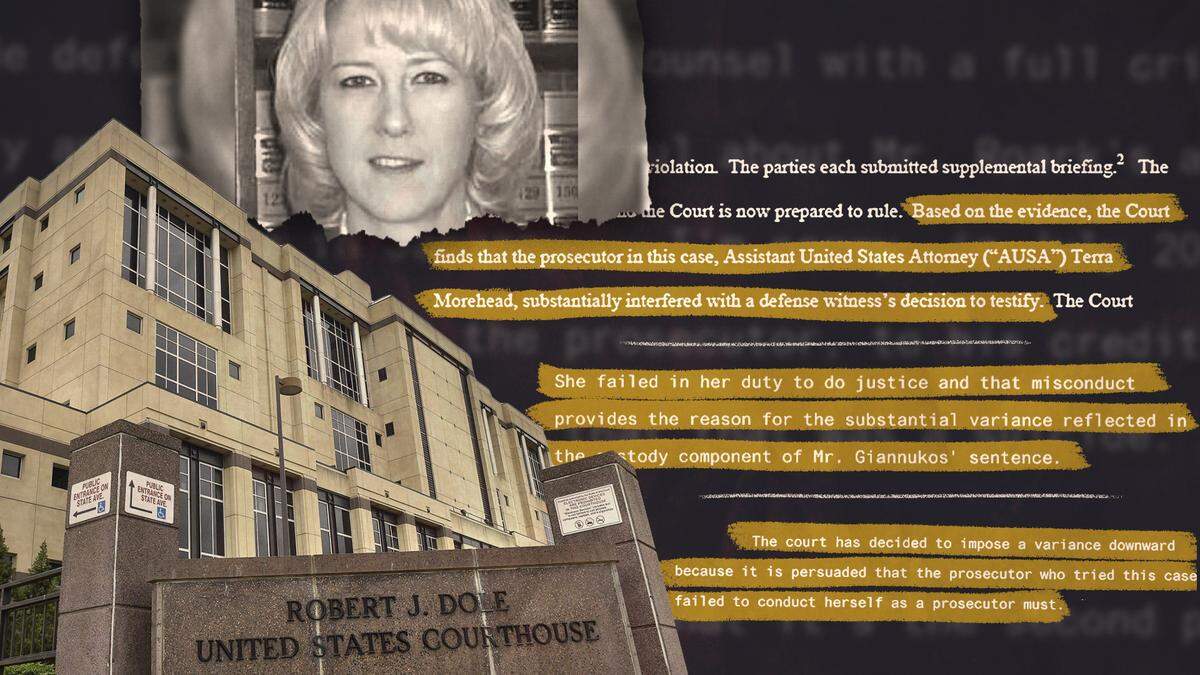
As a federal prosecutor, judges have said in court rulings that Morehead “acted in bad faith” and “failed in her duty to do justice.”
Most recently, a federal judge earlier this month said Morehead committed misconduct by concealing information about a witness’s credibility in a drug case.
Earlier this year, Morehead was moved from criminal to civil cases. She did not respond to a request for comment for this story.
Disciplinary Administrator Stan Hazlett said he could not confirm or deny the existence of a complaint against a particular lawyer.
But he said If probable cause of wrongdoing is found, that information would become public. No probable cause has been found regarding Morehead.
Some who have submitted complaints to the agency about Morehead question its effectiveness, particularly when it comes to checks on prosecutors.
Peter Joy, a law professor at Washington University in St. Louis, said prosecutors often do not face discipline for their conduct.
“There seems to be a reluctance on a lot of disciplinary councils to take complaints against prosecutors with the same degree of seriousness that they may against other lawyers,” Joy said.
Hazlett said his office does not go easier on prosecutors.
“To say that we’re more lenient with them, I don’t agree with that at all,” he said.
Complaints against prosecutors
In August 2016, the federal public defender’s office in Kansas alerted the disciplinary administrator that prosecutors, including Morehead, had routinely accessed calls between defense counsel and clients. That would be a violation of their legal rights.
The scandal spawned more than 100 cases for relief and resulted in a $1.6 million payout to detainees and a $3.7 million settlement to attorneys.
In a scathing order that resulted from an investigation of the prosecutors’ actions, Morehead was named 13 times, saying she failed to exclude phone numbers of attorneys on her requests for recordings of inmate calls, failed to respond to an email acknowledging documents related to the investigation should be preserved and failed to produce paper documents related to the calls.
A federal judge held the U.S. Attorney’s Office in Kansas City, Kansas, in contempt.
Federal Public Defender Melody Brannon said she believes the disciplinary administrator’s investigation into her allegations is still open and ongoing.
“I have not been notified otherwise,” she said.
In December 2017, Brannon submitted a complaint against Morehead after a federal judge said the prosecutor threatened a witness who was going to testify for the defense.
The threat violated the defendant’s right to a fair trial, Judge Julie Robinson wrote in an order. Minutes before the trial was supposed to start, Morehead handed over new evidence to the defense. She said the late disclosure was inadvertent, and she did not inform the court that the evidence was potentially exculpatory.
There has not been a resolution on that complaint either, Brannon said.
“It’s incredibly frustrating that there is such a slow pace in investigating allegations against prosecutors,” she said. “One of the problems is that while these allegations are pending, the prosecutors have continued in their jobs with the Department of Justice. They’ve continued to prosecute people. The result is that people have been convicted and gone to prison based on the word and credibility of these prosecutors.”
Hazlett said complaints that take several years are “highly unusual,” but that some cases “are tremendously complicated, involve a lot of interviewing of witnesses, a lot of reading of transcripts, a lot of documents that have to be reviewed.”
The pandemic, he added, has slowed the process.
Lawyers who violate the rules of professional conduct face a range of consequences, from an informal admonishment to suspension or disbarment.
Hazlett has discretion in how cases are investigated. For example, in his office complaints against prosecutors may be reviewed by a panel of prosecutors.
“It would be a jaded view in my opinion if somebody reached the conclusion that a prosecutor investigating another prosecutor would somehow try to protect them,” he said.
Defense attorney Angela Williams said she plans to make a complaint against Morehead for concealing evidence about the credibility of a government witness in the recent drug case in which a judge said the prosecutor committed misconduct.
She will do so, she said,even though she thinks the disciplinary office is ineffectual.
Complaints made by citizens
In contrast to complaints made by attorneys, which in some cases have taken years, some citizens said their complaints were open and shut too quickly.
Keith McDaniel, 47, is serving time in prison after being convicted in 2009 in a drug conspiracy case prosecuted by Morehead.
He sent the disciplinary administrator three complaints alleging Morehead engaged in misconduct throughout the course of the investigation.
The case involved two dozen defendants including Clinton Holman, who told The Star earlier this year that Morehead pressured him into lying on the stand.
Holman said his testimony helped send an innocent woman to prison for eight years. Several other co-defendants said they were pressured to inflate the amount of drugs they trafficked, increasing the penalties, and two men said Morehead used their family situations to gain leverage over them.
Less than a month after the office of the disciplinary administrator received McDaniels’ three complaints, it cleared Morehead.
McDaniel’s wife, Allicia McDaniel, questioned the thoroughness of the office’s review and said it did not seem like they took it seriously.
“Somebody has to be held accountable,” she said.
Joy, the law professor, said complaints from defendants or their families get filed regularly, but that they aren’t always given the same weight.
“A lot of disciplinary councils’ offices take an attitude of ‘Well it’s just somebody who’s unhappy with the outcome,” Joy said.
“The problem with that is that among those complaints, some of them likely have some merit. But I think the volume of that type of complaint is such that a lot of disciplinary councils’ offices rarely do anything more than a very perfunctory investigation.”
Joy said an audit of citizen complaints would give a clearer picture of whether they are being handled properly.
He also suggested appointing a commission to look at disciplinary offices to see if investigations are being conducted fairly and decisions are being made effectively.
“That’s the promise of equal justice,” he said.