
‘Pure evil’: Why so many people were so angry that Robert Courtney was leaving prison
Robert Courtney had a game plan for coming home.
He detailed it when he requested, on July 9, that his 30-year prison sentence be reduced.
One of his daughters had invited him to live on property she owned outside Trimble, Missouri, north of Smithville. That would put him close to five of his grandchildren.
He figured he could look for a job as a maintenance man at one of the many small churches in the area, or maybe find part-time work “at a hobbycraft shop that does pottery.”
He has a fully funded retirement account, three fully funded life insurance policies and IRA accounts.
He wants out because of his age — he’s 67 now — and in bad health.
This past week, he almost got his wish.
Courtney was awaiting a decision on that request when the Federal Bureau of Prisons tagged him for home confinement because of COVID-19 in prisons.
When news got out that the notorious Kansas City pharmacist — who watered down cancer drugs for thousands of patients — was coming home, phone calls rolled into Michael Ketchmark’s law offices in Kansas City like the first thunder of a summer storm.
The callers were angry, frustrated, shocked. One 87-year-old man who lost his wife to cancer cried on the phone.
Ketchmark and his clients were not the only angry ones.
Kansas City Mayor Quinton Lucas, Missouri Gov. Mike Parson, U.S. Sens. Josh Hawley and Roy Blunt, and U.S. Reps. Emanuel Cleaver II and Sam Graves condemned the move, too.
Then Hawley announced Thursday on Twitter that the U.S. Department of Justice had informed him: Courtney is staying put.
“It’s an amazing feeling to know that he’s going to remain in prison,” Ketchmark said minutes after seeing the news. “It’s where he belongs.”
Courtney’s attorneys did not respond to requests for comment.
In 2002, Courtney was sentenced to 30 years in prison for what The Star described as the “most notorious drug adulteration scheme in the annals of modern medicine.”
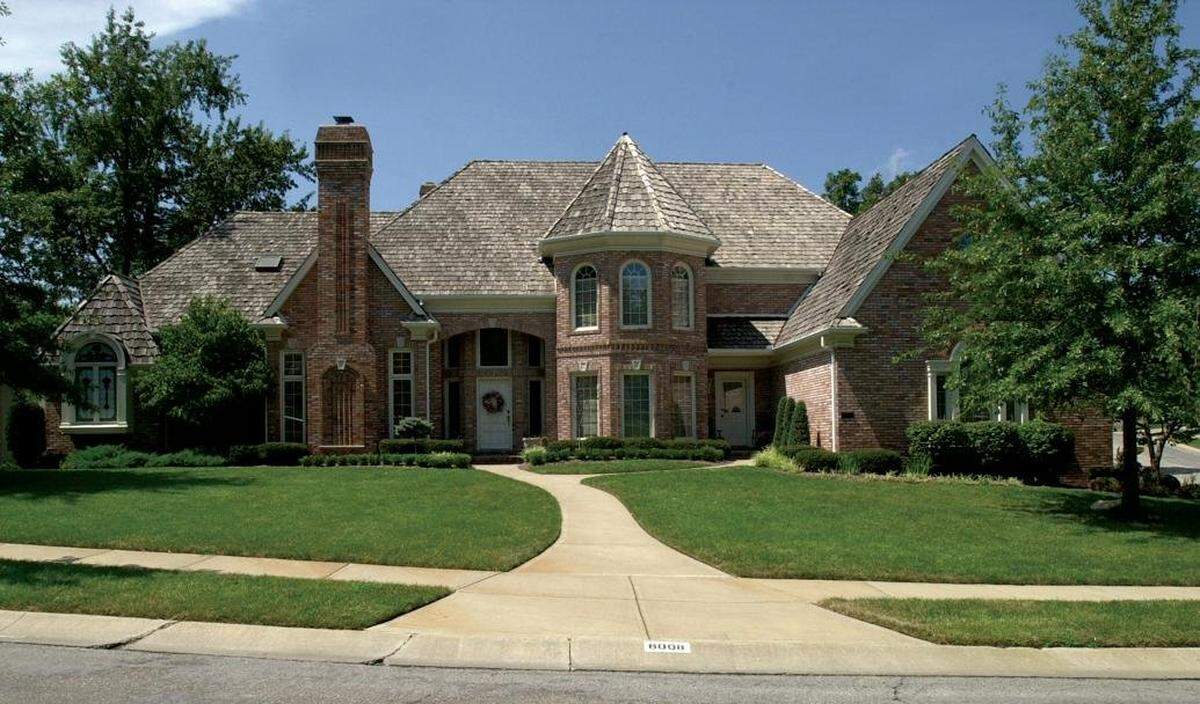
Over nearly a decade, the greedy son of a minister, living in a $700,000 Northland home, profited by diluting 98,000 prescriptions — 72 different medications — given to nearly 4,200 patients.
His victims had no idea they weren’t getting full doses. Some died.
During the trial process, one attorney compared Courtney to Charles Manson.
In court, cancer patient Mary Ann Rhoads recalled noticing once that her syringes were only half full after picking them up from Courtney’s pharmacy.
When she went back for new ones, Courtney met her at the counter.
He smiled, touched her arm and said, “We’ll take care of you.”
That Courtney could look people in the eye, hand them watered-down medications and smile, haunts Ketchmark.
His office was involved in more than 275 wrongful death lawsuits against Courtney and over the last 19 years he has gotten to know generations of victims and their families.
He said he never saw remorse, never saw sorrow, never saw anguish from Courtney.
“This man is a sociopath. He does not belong out on the streets,” said Ketchmark. “It is the closest that I have ever been in the presence of pure evil when I was around that man.
‘Diluted Trust’
At its peak in 2001, more than 100 federal agents and staff members worked on the Courtney case. Their most time-consuming job? Interviewing more than 3,000 potential victims who for months called a special hotline set up by the feds.
“When you walk into a pharmacy and get that prescription, the last thing you should have to worry about is the authenticity of that drug,” Assistant U.S. Attorney Phillip Eugene Porter said at the time.
“That worry now permeates the public here in Kansas City. They don’t have the same confidence and trust in their prescription drugs that they had a year ago.”
The case drew national attention. “60 Minutes” was prepping a story. Investigating this pharmacist in Kansas City became the FBI’s top priority.
Then planes slammed into the twin towers of the World Trade Center in New York City on Sept. 11, 2001.
The Star reported that local FBI agents were in Washington, D.C., that morning, briefing the new FBI director, Robert Mueller, about the Courtney case when an aide entered the room with news of the attack.
“Then Courtney became the second-most important case in the bureau,” Judith K. Lewis, the supervisory special agent who oversaw the Courtney investigation, told The Star.
The FBI conducted an undercover sting operation that confirmed he was tampering with the drugs.
The investigation had a code name: Diluted Trust.
.JPG "DILUTED DRUGS(3).JPG")
Sunday school teacher
Things moved quickly — seven months from the time the FBI was tipped off in July 2001 to Courtney’s guilty plea in February 2002.
Courtney was 49, the father of five children ages 7 to 22 living in Tremont Manor, an upscale subdivision near Interstate 29 and Missouri 45 in Kansas City, North. He had a net worth of between $8 million and $12 million.
He belonged to Northland Cathedral, where he taught Sunday school, sang in the choir and served as a deacon and on the finance committee.
He had pledged $1 million to the church’s building fund, and court records revealed he was worried about meeting that obligation. He owed $300,000 in 2001; a $600,000 tax bill loomed, too.
Fellow pharmacists around Kansas City knew Courtney as a respected figure in their circles. They described him to The Star as serious and quiet.
The daughter of one victim said she didn’t know she was “supposed to protect my mom from Robert Courtney, a real-life monster in a white coat who smiles and pretends to help you.”
His downfall began at the hands of a Kansas City oncologist named Verda Hunter who tipped off federal investigators. A salesman from Eli Lilly and Co. told her that Courtney was dispensing more Gemzar, a chemotherapy medication, than he was buying.

He owned two pharmacies at the time: Research Medical Tower Pharmacy at 6420 Prospect Ave. and Courtney’s Pharmacy at 8901 W. 74th St. in Merriam.
Investigators said he “misbranded and adulterated” the drugs at only the Prospect Avenue location.
A door connected the pharmacy to a doctor’s office on the other side, where cancer patients received intravenous chemotherapy.
At sentencing in December 2002, Jerome S. Tilzer remembered sitting with his wife during a treatment session and watching Courtney casually walk through the infusion room delivering medications. Rita Tilzer later died at age 54.
“I hope the silence of a solitary prison cell will never let him forget the pain, agony and suffering of the people he murdered and the lives he cut short,” Tilzer said in court.
Courtney told federal investigators he didn’t dilute medications that went to friends, family and acquaintances. He had more empathy for “certain people,” he told them.
“One of the things I found most horrific about it was we saw in prosecuting these cases that there was a pattern where he was really targeting certain types of drugs and a lot of them were primarily being used by women who were fighting ovarian cancer, cervical cancer and breast cancer,” Ketchmark said.
“And just such a huge portion of his clients were — customers that ended up dying — were the mothers and grandmothers and wives of people in our community.”
After Courtney was convicted, Northland Cathedral put the $600,000 he had donated into a fund for his victims.
“I remember when it happened. I personally spoke with that minister,” said Ketchmark. “And he prayed with me for the victims. And it was a remarkable thing, it was something they didn’t have to do. But I think the people in their church felt very victimized by him as well.”
‘Why?’
During one week in August 2001, federal agents seized records at Research Medical Tower Pharmacy on Monday, charged Courtney on Tuesday and extracted a confession by Friday.
He said his motive was greed.
It was all about the money.
There was lots to be made in watering down expensive cancer drugs.
Here’s one example of the math, cited by The Star at the time: Courtney could charge $1,021 for one prescription of Gemzar. Diluted, it was only worth $242, making him a profit of about $779.
During one interview, federal agents asked Courtney if he could explain why some samples from his pharmacy tested anywhere from 39% to less than 1% of the dosage prescribed.
“No sir, I can’t,” he told them, according to one court filing. “I don’t understand it.”
Neither did his victims.
News of what he’d done sent shock waves through families whose loved ones had received chemotherapy medications from him.
Brenda Sue Fee’s mother, Margaret Fee, cried, often, after hearing she was one of them.
Why, she asked her family. Why does he want to hurt me?
“We would hold her and cry with her and the answer was, ‘We don’t know.,’” said Fee.
Her mother later died.
The investigation continued for months after Courtney’s arrest as patients and physicians handed over more samples of medications from his pharmacy for testing.
The list of drugs he had tampered with grew longer to eventually include 72 different medications.
Most were used to treat cancer, but others could have been used to treat patients with AIDS, arthritis, multiple sclerosis and other diseases.
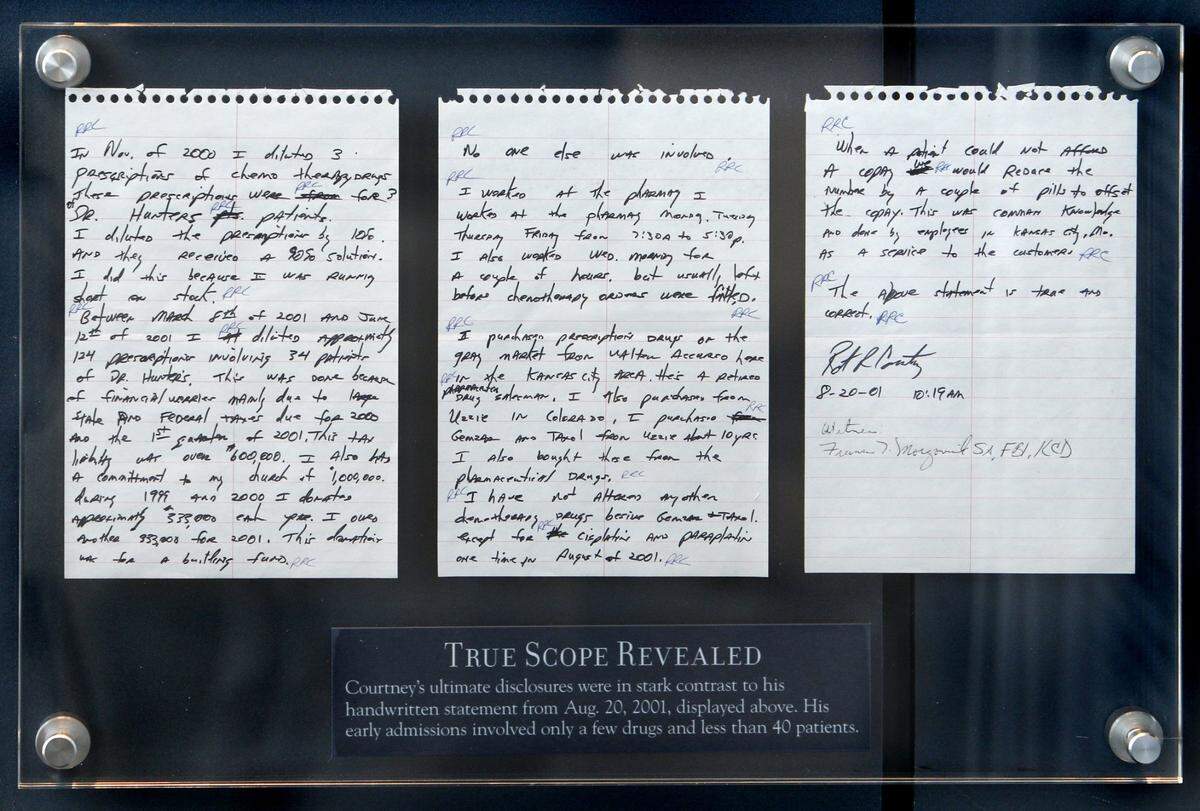
In a statement to the court when he pleaded guilty in February 2002, Courtney said: “I’ve had a long period of time while confined in isolation to reflect on my conduct, asking myself, ‘Why?’
“Why did I commit these inordinate crimes, so profoundly inconsistent with my faith, with my beliefs and my relationship with my Lord and Savior? I’ve uncovered in my daily devotions … no rational explanation for this conduct.”
When he was sentenced to prison for 30 years without parole after pleading guilty to 20 felony criminal charges, Courtney was also ordered to pay restitution of $10,452,109.67 to his victims, plus a fine of $25,000.
‘Prison is a treacherous place’
The families of victims tracking Courtney’s time in prison through the federal Victim Notification Program were told a few days ago that he was getting out.
He was coming home because U.S. Attorney General William Barr ordered the Federal Bureau of Prisons to review inmates at risk for COVID-19 to send them away for home confinement.
Since the order came down on March 26, the prisons bureau has placed nearly 7,000 inmates on home confinement, according to its website, an increase of more than 40%
The bureau is vetting prisoners according to COVID-19 risk factors outlined by the Centers for Disease Control and Prevention, as well as how likely they are to commit another crime.
In his July 9 request, Courtney cited his age and deteriorating physical health as “extraordinary and compelling reasons.”
He wrote that he had a stroke in 2007, and that internal bleeding has caused incidents of “passing out” and that he’s needed blood transfusions. He had two heart attacks within a month of each other in 2018, he wrote.
He detailed how a cardiologist attempting to install stents found damage and scarring suggesting that Courtney had actually had three heart attacks. “The cardiologist told me I had 10 years of life remaining,” Courtney wrote.
In 2013, he was diagnosed with prostate cancer.
In his plea for release he described what it’s been like in prison.
“Prison is a treacherous place, violent and difficult,” he wrote. “I have witnessed stabbings, beatings, bloodshed. However, years in solitary is more, it’s torturous.”
He referenced spending close to four years in segregation and solitary confinement, suggesting it was because he helped officials catch other prisoners doing bad things.
In one case, he turned in a fellow inmate plotting an escape, he wrote.
“The heaviness in my heart will always be present, not the fact that I failed and lost success, but I lost being present with my children, my Dad, grandchildren, lost my wife, career, trust and education,” Courtney wrote.
“It is like I lost my very being. Release from prison does not mean the cost of my crime is paid, nor that punishment is over.”
For now, Robert Ray Courtney remains in the custody of the Federal Bureau of Prisons in Englewood, Colorado, with a projected release date of May 2, 2027.
This story was originally published July 17, 2020 at 3:56 PM.
CORRECTION: An earlier version of this story said Robert Courtney was a benefactor to the University of Missouri-Kansas City School of Pharmacy. There are no records of such a contribution.
.jpg)