In rare case, judge says KC attorney should go to jail for ‘deceptive conduct’
A judge has recommended a Kansas City-area attorney who is the subject of numerous complaints be found guilty of criminal contempt for continuing to work after his law license was suspended for misappropriating client funds.
Jackson County Judge Mary Weir also suggested the attorney, Allan H. Bell of North Kansas City, be sentenced to 30 days in the Jackson County Detention Center.
The judge’s proposal — which also recommends Bell be ordered to pay a $21,000 fine — would be the most severe action taken against Bell after Missouri courts have given him seven official warnings since 1994. Weir’s report of her findings and conclusions of the law, which was filed in December, will land in the Missouri Supreme Court for its consideration.
An attorney since 1967, Bell was suspended on an interim basis in April after he was accused of taking tens of thousands of dollars from dozens of clients. An audit examining his bank account for three years showed settlement funds for 40 clients were deposited into his personal account because he did not use a registered trust account to keep client money separate, a state requirement.
But Bell continued to take new clients even after his law license was suspended, according to the Office of Chief Disciplinary Counsel, the agency charged with investigating attorney misconduct.
The head of that office, Chief Disciplinary Counsel Alan Pratzel, said Tuesday he could not comment on the pending case. In a previous interview, Pratzel called his office’s filing for criminal contempt an “extraordinary process that we normally do not have to engage in.”
Bell’s lawyer, David Bandré, said the move was the first time Missouri had filed a criminal contempt motion against an attorney for the unauthorized practice of law following a suspension.
“This has never happened before,” he said.
Specializing in immigration, employment and labor law, Bell was disbarred from practicing law after he voluntarily surrendered his license and admitted to violating the rules of preserving client funds.
Since mid-2017, at least seven clients have filed complaints against Bell. He has been accused of faking an expert report and ripping off vulnerable clients who did not speak English. Other attorneys have wondered how he had remained licensed.
After a trial in October, Weir’s report found Bell continued to work while he was suspended and engaged in “deceptive conduct” that including backdating his receipt book to make it appear he received funds before his suspension, not after.
Weir mentioned she was mindful of Bell’s age — Bandré believed he was now in his early 80s — in her filing. But she said Bell did not show remorse, causing her “grave concern as to future deterrence.”
Bell maintained his actions were not deliberate.
“That assertion is not credible,” according to the judge’s report, which added that Bell “went to great lengths to cover or hide his continued practice of law.”
Bell’s Jefferson City attorney said Bell believed he had the right to continue dealing with his clients.
Bandré plans to file objections to the judge’s findings, saying he believed there were errors as to what was entered as evidence. Bandré noted Weir made recommendations about Bell’s sentencing and said he would like to instead argue that in court.
Once Bandré files his objections, the judge has the option to amend her findings, he said. The case will then go to Missouri’s highest court, Bandré said.
$7,000 in checks
After repeated incidents of misappropriation of client funds, the Office of Chief Disciplinary Counsel believed Bell was an imminent threat to the public. His suspension became effective April 1.
Bell’s former office assistant testified she printed out the suspension order and gave it to Bell. He told her they had “14 days to do things and get the office in order,” according to the judge’s findings.
But the disciplinary office began receiving multiple reports of Bell continuing to meet with clients.
The assistant did not see any indication that Bell was winding down his practice. Instead, he changed the message on his office’s answering machine from “the Allan Bell Law Office” to “the Bell Law Office,” according to the filing.
Weeks after his suspension, Bell allegedly entered into new fee agreements with two men in immigration matters, but backdated them to March 29, something he instructed his assistant to do on some records, Weir found.
Bell’s receipt book showed at least 21 client payments totaling more than $10,000 that were all dated March 29, according to the judge’s filing. It also revealed he allegedly collected more than $11,000 from May to June from another 21 payments.
The judge’s findings noted Bell offered no evidence that the funds were for work he did before he was suspended. His attorney said the burden of proof was not on Bell, a criminal defendant. Bandré plans to argue it is improper to make any inference of Bell’s guilt because he did not testify at trial.
The findings also detailed funds Bell allegedly asked clients to pay him after his suspension. In May, for example, Bell tried to enter into a $10,000 fee to represent a couple who were trying to obtain visas for their four children, according to testimony.
One former client pursuing a U-Visa testified Bell had him deposit $1,000 into Bell’s personal bank account in April. During a meeting, Bell did not tell the man he was suspended, according to the allegations.
Within months, Bell told the client he was retiring and would give his file to another lawyer. But he did not pass on the file, according to the judge’s findings.
In another case, a former client testified he hired Bell in August 2018 to apply for a skilled worker visa and agreed to pay $9,000, a third of which he already had. More than a week after Bell’s suspension, the man got a letter stating Bell planned to close his practice because of health problems. He immediately called Bell, who allegedly said he would keep representing him through his visa application process. Bell asked the man send him more money in late May, the judge found.
In total, Bell deposited about $7,000 in checks from clients into his personal bank account after he was suspended from practicing law, according to the judge’s filing.
Bell also allegedly continued to hold himself out as the attorney for a man who was going through a divorce. When the opposing attorney asked Bell to enter his appearance on the file, Bell said his client would actually be representing himself, according to testimony. The other attorney said he only learned of Bell’s suspension when he was contacted by the disciplinary office in June.
Bell sent several versions of retirement letters to clients, according to the evidence presented at trial. One said he was leaving the business because of health and “bar-related” issues. One of his previous clients said had he gotten that notification, he would not have taken it to have meant Bell was suspended.
Meanwhile, Bell apparently continued to file documents with the U.S. Citizenship and Immigration Services, the judge found.
‘Meeting with a client’
In June, a fraud examiner made an unannounced stop by Bell’s office in the 2000 block of Swift Street.
When she arrived, accompanied by an investigator with the Missouri Division of Workers’ Compensation, the examiner realized Bell’s office was open, full of files and boxes. He was there, sporting a coat and tie.
Bell’s wife told the examiner Bell was “meeting with a client,” according to the judge’s findings.
At the office, the examiner learned, that client allegedly gave Bell $1,000 in cash. The examiner told Bell to give her money back, which he did reluctantly after allegedly arguing with her. He told the client and a relative he would help them later, according to testimony.
Bell’s record indicated he received payments from that family totaling $3,000 in June, according to the allegations. One fee agreement appeared to show the work was done with the help of another attorney, who Bell identified as an immigration lawyer in Kansas City, according to the evidence presented at trial. But that attorney testified he made no such agreement.
When the fraud examiner asked to see Bell’s receipt book, he denied having one, according to the judge’s filing. But she later discovered it and found, in the nine days prior to her visit, Bell’s planner allegedly showed entries suggesting he had appointments and calls with dozens of clients.
More than a week after the investigators’ visit, the planner showed few entries.
In June, attorneys were appointed as trustees to distribute Bell’s clients’ files.
During a meeting, Bell apparently told the trustees all of his files were at the office. One of the trustees worried when the records they found were mostly from before 2017. And after Bell assured the trustees he did not have a storage unit for his files, one of the attorneys found a contract for one in Kansas City, according to testimony.
Bell then allegedly acknowledged he had a storage unit and later said he also had a second one that contained as many as 50 boxes of files. When they met Bell at the unit, the trustees found just three to five boxes of “files and junk,” the judge found. Bell told the trustees he meant to tell them there were only that many when they initially spoke.
Bandré disagreed with the contention that Bell was attempting to hide the files.
As of late last year, Bell had not turned over active client files to the trustees, according to the judge’s findings.
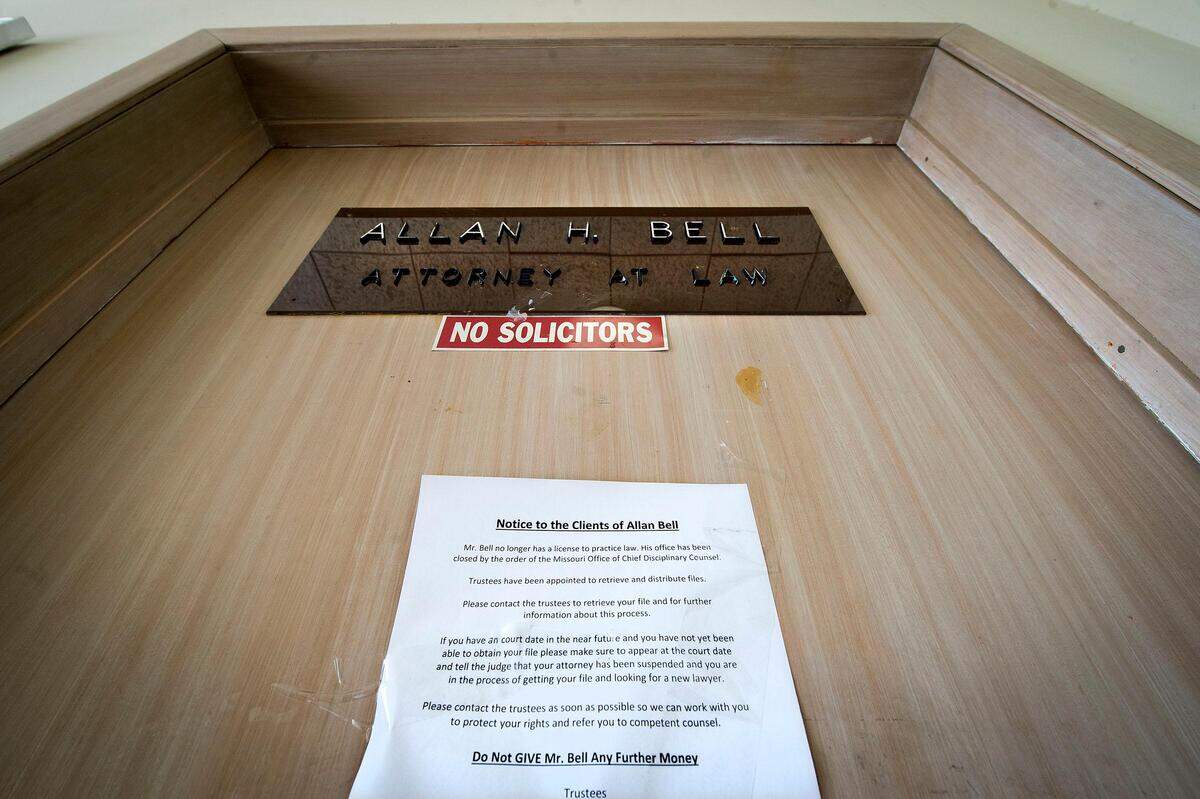
The trustees took control of Bell’s office, changing the lock and forwarding his mail and calls. They taped notices to the doors and windows outside his office, warning former clients, in English and Spanish: “Do not give Mr. Bell any further money.”
In a previous interview with The Star, Bell said he could not comment on the accusations against him because he suffers from memory loss. His attorney said some doctors have found he has the onset of Alzheimer’s disease and dementia.
As part of her fact finding, the judge wrote that Bell’s described actions were not the ones of a “confused lawyer,” but rather of “one acting in a knowing, intelligent and deceptive manner.”
One neuropsychologist said Bell had a mild slowing of his mental processing and that it might interfere with his law practice, according to the judge’s report. But the neuropsychologist opined it was unlikely Bell’s “mental status would have prevented him from comprehending or remembering” he was suspended from practicing law, according to the filing.
If Bandré gets to argue Bell’s sentencing before the Missouri Supreme Court, he said, he would note Bell was licensed as an attorney for more than 50 years and had no criminal history, among other things.
A lawsuit filed against Bell by a former client is pending in Clay County Circuit Court. It claims Bell deposited a woman’s $25,000 check from an insurance payment into his account and has declined to pay her.
This story was originally published January 14, 2020 at 12:37 PM.