
KC man shot woman after judge forbade him from having guns. State law prevents charges.

A judge had banned David Love from possessing weapons. But last August, he grabbed a gun and killed his ex-girlfriend.
Now, nearly a year later, a “failure of the system” has kept him from facing any legal repercussions.
To blame are a series of obstacles, according to Jackson County Prosecutor Jean Peters Baker — from Missouri law that can favor abusers over victims to an overcrowded county jail that refused to incarcerate Love, effectively shielding him from a possible seven-year prison sentence.
What Peters Baker calls a pro-gun stance by the Missouri General Assembly “flies in the face of the protections that should be afforded to domestic violence victims” and ties the hands of prosecutors who would otherwise file charges in this case.
Love admitted to killing his ex-girlfriend, Jessika Peppers, inside his home on Aug. 25, 2017, in what was later ruled self-defense. He told authorities she’d broken in and was holding a hammer. He claimed he didn’t recognize the person he was shooting before pulling the trigger.

Jessika’s mother, Carol Peppers of Independence, said her daughter was simply trying to retrieve her phone and other belongings after Love refused to return them.
About a month earlier, Love’s mother had petitioned a judge for a protection order against him. She accused Love of threatening her life, once knocking her to the floor and brandishing a knife, according to court records.
She wrote in her request that Love said to her: “I’m gonna take you out … I will torture and kill everyone you love … I’m going to chain you to the basement wall.”
A judge granted a full order of protection against Love. The order explicitly banned him from possessing weapons.
“If he didn’t have a gun that day, my daughter would still be alive,” Carol Peppers said.
The self-defense ruling in the shooting case kept Love out of prison.
And Missouri law kept prosecutors from charging him for violating the order of protection.
‘It makes no sense’
For some abusers, a protection order is the first time they’re ever told, “You don’t get to communicate with this woman however you feel like it,” Peters Baker said.
Such orders can contain various prohibitions — don’t possess a weapon, don’t come within so many feet of a victim, don’t contact a victim, for example.
When victims successfully file an order, “It can be one of those power shifting moments,” Peters Baker said. “When that piece of paper doesn’t work and there is a violation, it’s awful. Victims feel like the system let them down.”
Missouri prosecutors disagree about the requirements they need to charge abusers who violate protection orders.
Peters Baker said abusers must be served with formal notice of a protection order before prosecutors can charge them for any violations. Abusers are typically served in court.
In Love’s case, he had been served with a temporary protection order — known as an ex parte — weeks before the shooting. But he did not appear in court when a full order was issued against him by Judge Gregory Gillis.
Gillis banned Love from having guns as a condition of the full order.
Gillis’ office did not respond to multiple requests for comment.
Because Love had not been served with a full order before fatally shooting Jessika Peppers and because Missouri protection order law doesn’t mention weapons, the Jackson County Prosecutor’s Office couldn’t file charges against him even though he possessed a gun against Gillis’ mandate, said Peters Baker and Luke Alsobrook, the prosecutor handling Love’s case.
But others say charges can be filed even if an order has not been served. Ambiguities in Missouri law may explain the discrepancy.
Missouri juries are instructed that to find a defendant guilty of violating a protection order, the defendant must either have been served with the order or “knew” or “was aware” of it, according to the law.
It’s more challenging to prosecute when an order isn’t served, but it’s possible, said Amy Fite, president of the Missouri Association of Prosecuting Attorneys.
Fite, who is also the Christian County prosecutor, said her office has historically pursued prosecutions when orders weren’t served, “as long as we can show they’re aware.” Awareness could come when a victim tells an abuser directly about the existence of an order or if an abuser is served an earlier, temporary order, Fite said.
Platte County Prosecutor Eric Zahnd said the law is open to questions regarding “issues of service and when a person has notice of an order.”
“It would certainly be helpful for lawmakers to clarify the law,” he said. “The orders would provide an even greater level of safety to the community if the Missouri legislature clarified precisely what conduct constitutes a violation of an order of protection and when those cases can be prosecuted.”
Presiding Judge William Collins of Missouri’s 17th Judicial Circuit, which covers Cass and Johnson counties, echoed Zahnd.
“This is something that needs to be addressed by the legislature,” Collins said. “It’s a very important issue that needs to be addressed in the next session.”
Collins said he learned of the issue after an inquiry by The Star. Since then, he’s spoken with senior judges in three counties with pending cases involving issues related to the service of protection orders. Those judges didn’t want their counties named because the cases aren’t resolved, Collins said.
Every year, the problem of serving notice to alleged abusers and getting them to court crops up in hundreds of cases in Jackson County.
In the past 10 years, nearly half of all alleged abusers didn’t show up to court when a full protection order was issued, according to data provided by the Jackson County Circuit Court.
From 2008 through the first six months of this year, that amounted to nearly 8,000 cases.
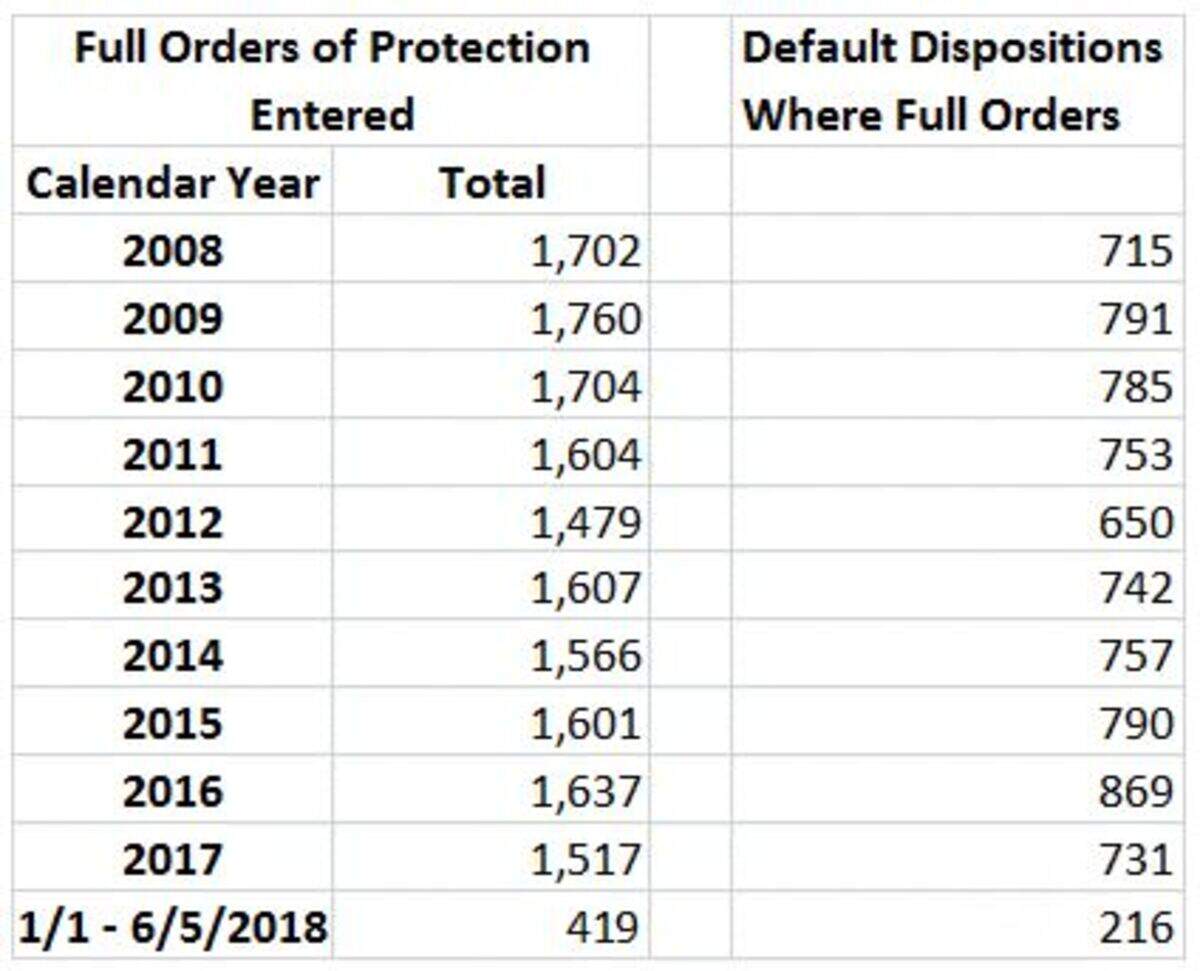
Abusers can easily skip court, resulting in a safety risk for victims “as their full order is effectively unenforceable,” concluded the 2018 Kansas City Domestic Violence Community Safety Assessment, created with input from Kansas City police, Jackson County prosecutors and other organizations.
The report also identified other consequences, such as a decrease in “accountability of batterers” and lost trust in the criminal justice system.
“Victims have reported that they are ‘not going to ask for help again’ because of the lack of enforcement of orders,” the report said.
As a result, people like Love benefit from “a failure of the system,” said Annie Struby, a community safety assessment coordinator with Rose Brooks Center, the Kansas City domestic violence shelter that helped publish the safety assessment report.
“It’s really easy to avoid getting served,” Struby said. “Advocates try to arrange for service. Victims call police and wait to have (abusers) served” — legal paperwork in hand.
“There’s always a chance the abuser sees them,” she said. “That is something that has put people in danger.”
Fite, the Christian County prosecutor, said abuse is often motivated by “power and control.”
“By evading service, that’s another manner in which they can exert power and control over their victim,” she said.
Love, when reached on social media, wrote that he thinks protection orders should be “abolished.”
“All it is is a tool for people to ruin other people’s lives,” he wrote.
Peters Baker said the law should be rewritten to address ambiguities surrounding protection orders.
But that’s just one of the problems in Love’s case.
In addition, unlike federal law, Missouri law does not make it a crime to possess a weapon while under an order of protection, even when judges bar abusers from having guns, Peters Baker and Zahnd said.
“From a domestic violence perspective, we know there’s a power differential,” Peters Baker said. “The abuser is the one with the power, so any way you can level that playing field for the victim is a win.”
As for Carol Peppers, she is maddened that her daughter’s killer was ordered to not possess weapons but hasn’t been held to account for it.
“It makes no sense … It’s all right there in black and white,” she said. “They’re telling me they can’t charge him with that?”
‘They’re never going to quit’
David Love should have faced a judge before now, according to prosecutors Peters Baker and Alsobrook.
When Love killed Jessika Peppers, he was also on probation in a separate case, for felony receiving stolen property. A condition of his probation forbade him from possessing weapons, Alsobrook said.
Love allegedly violated his probation, Alsobrook said, and faces up to seven years in prison.
But the Jackson County jail has refused to admit Love, even when Kansas City police arrested him and transported him there for booking, according to Peters Baker and Alsobrook.
Jail officials cited an unhealed wound Love suffered while chopping wood as grounds for not booking him, Peters Baker said.
“It is also a space issue,” she added. “We are over capacity by over 100 human beings every day, so the jail is saying they won’t take certain people.”
Due to typical court procedure requiring a booking before a judge sets a court date, the case has remained stalled. The delay may work against the prosecution when Love finally does stand before a judge, Peters Baker said.
Carol Peppers said she doesn’t understand how this can be allowed to go on.
“You have all these people getting killed in the city,” she said. “If they know they’re going to get away with it, they’re never going to quit.”
This story was originally published August 17, 2018 at 10:43 AM.