
Effort begins to make Kansas City’s Prospect Avenue corridor safer
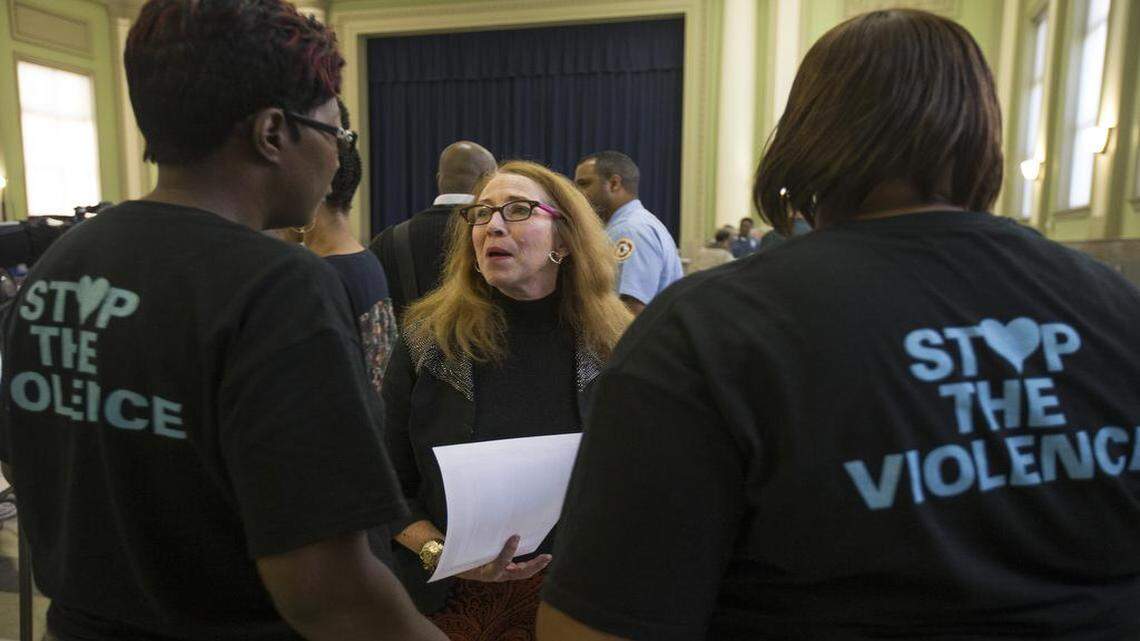
Having bought a home near 39th Street and Flora Avenue just a year ago, Aimee Henderson hustled her family out of bed Saturday to learn how her neighborhood might be made safer.
Greeting her and three sons, ages 11 to 19, at the Robert Mohart Multipurpose Focus Center was a roomful of public officials, social service booths, victim advocacy groups and neighborhood leaders. They came to celebrate the launch of a two-year, multipronged effort to improve safety in Kansas City’s Prospect Avenue corridor.
“My neighbors are awesome. I love them,” Henderson said. “But you do hear the sirens every night. You hear the gunshots.
“I immediately start praying that nobody is hurt … and that the violence never touches my sons.”
The Kansas City No Violence Alliance, or KC NoVa, seeks the same thing.
An initiative funded by a $1 million grant from the U.S. Justice Department will blend the resources of law enforcement, the University of Missouri-Kansas City and the nonprofit Center for Conflict Resolution to target 3 square miles of homes and businesses.
Four additional police detectives and a sergeant have been assigned to the Prospect corridor — between 25th and 39th streets, the Paseo and Indiana Avenue — to assist in the KC NoVa experiment. The initiative aims to bring criminal offenders together with their victims, conflict mediators and community services to resolve problems.
Tried in other U.S. cities with mixed success, federal Edward Byrne grant programs need grass-roots involvement to be effective, said Ryan Samuelson, the Byrne safety coordinator for the Prospect project.
“Sure, we can get big institutions together,” he said. “But if you’re doing this in a top-down, patriarchal way without the community buying into it? The grant goes away, we leave and all momentum dies.”
Kansas City Police Sgt. Garrik Haynes will direct a team of detectives moving through the corridor’s seven neighborhoods to connect with people most likely to cause trouble. The officers hope to direct them to services, jobs or educational opportunities as needed.
“We’re committed to delivering a message,” Haynes said. “We’ll get to know family members, the groups that (potential offenders) hang in. We get that in-depth.”
The Center for Conflict Resolution is seeking about 50 community members to serve on a neighborhood accountability board that “will bring a victim, the offender and community together to help repair the harm,” said the center’s Gregory Winship. “It gives the offender a chance at a clean record.”
UMKC researchers will analyze the corridor’s trends in crime, vacant properties and economic development over the next two years. Officials backing the effort said it could be extended or duplicated, if successful, in other areas of the city.
“We’re not in a crisis here,” Jackson County Prosecutor Jean Peters Baker told the rally. “We’re actually on the cutting edge of doing something wonderful in this community.”
Henderson was almost as hopeful.
“I appreciate their effort,” she said. “At least they’re trying. That’s all you can do.”
To reach Rick Montgomery, call 816-234-4410 or send email to rmontgomery@kcstar.com.
This story was originally published April 25, 2015 at 2:11 PM with the headline "Effort begins to make Kansas City’s Prospect Avenue corridor safer."