
F. Glenn Miller Jr.’s capital murder trial set for August
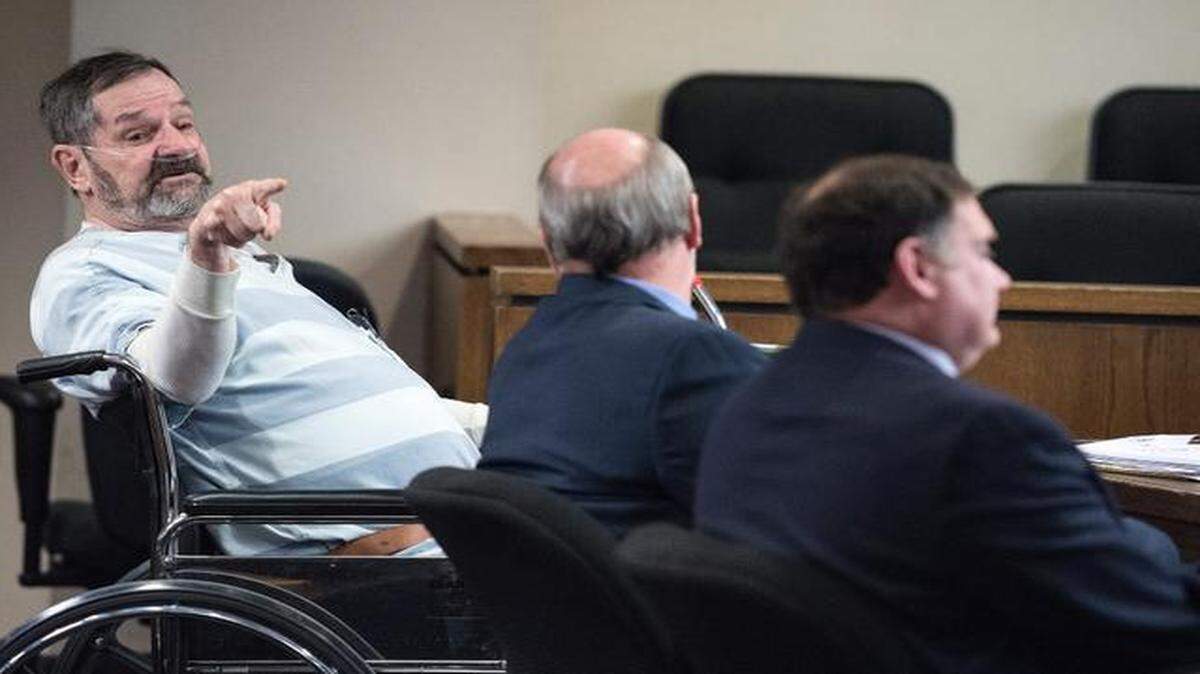
Despite strenuous objections from his defense team, an anti-Semite accused of killing three Christians outside Jewish facilities in Overland Park insisted Friday that he receive a speedy trial.
A judge obliged, setting Aug. 17 as the start date.
If no delays happen, this will be the fastest a Kansas death penalty case ever proceeded to trial after the arraignment, lawyers said.
F. Glenn Miller Jr.’s attorneys wanted to wait until next March, arguing that they would be “unprepared, ineffective and incompetent” without additional time to prepare his defense.
But when Johnson County District Judge Kelly Ryan asked Miller if he wanted to waive his right to being tried within 150 days of his arraignment, as Kansas law mandates, Miller blurted out: “Hell no.”
Miller, 74, said if he were allowed to represent himself, he would go to trial in 30 days.
“I want to have my day in court,” said Miller, whose attorneys entered not guilty pleas on his behalf Friday as he was arraigned on charges of first-degree murder and capital murder in the deaths of William Corporon, Reat Underwood and Terri LaManno.
Miller, who is also called Frazier Glenn Cross Jr., has said publicly that he was targeting Jews when he opened fire on people outside the Jewish Community Center and Village Shalom care center last April.
Corporon, 69, and Reat, his 14-year-old grandson, were at the community center for Reat to compete in a talent competition. They were sitting in a parked vehicle when shotgun blasts hit them.
LaManno, 53, had gone to Village Shalom to visit her mother. A shotgun blast killed her, too.
The gunman also fired at several other people and into the community center.
Defense attorney Mark Manna spent considerable time Friday explaining that attorneys in a capital case must complete extensive and time-consuming tasks beyond those required in other criminal cases. Those include not only preparing for the trial’s guilt phase, but preparing studies of a defendant’s complete physical, mental and social history to present to the jury that must decide if he lives or dies.
District Attorney Steve Howe said that while he sympathized with the defense’s predicament, the court was obligated by law to grant Miller’s request.
Ignoring the speedy trial request could result in the charges being dismissed, Howe said.
“If the defendant wants to create this self-inflicted wound, he’s going to have to live with it,” Howe said.
Attorneys estimate that the trial could take six to eight weeks. The judge set the next hearing for April 3 to begin planning for hearings on anticipated pretrial motions.
Although he won his speedy trial request, Miller lost his demand to be granted Internet access in jail.
In requesting the access, Miller’s attorneys said that Miller needed to contact “like-minded individuals” who shared his political beliefs.
Those witnesses could potentially provide testimony about Miller’s state of mind at the time of the shootings, which could be part of his defense, Manna said.
An attorney for the Johnson County Sheriff’s Office argued that Miller had access to the phone and mail service to make contact with whomever he wanted.
In denying the request, Ryan said the defense had not provided adequate reasons for Internet access.
“There has not been a showing of need other than the defendant’s wishing to have the same access he had before being placed in custody,” Ryan said.
To reach Tony Rizzo, call 816-234-4435 or send email to trizzo@kcstar.com.
This story was originally published March 27, 2015 at 3:58 PM.