
Kim Case, once a victim herself, is changing the way we care for Missouri victims
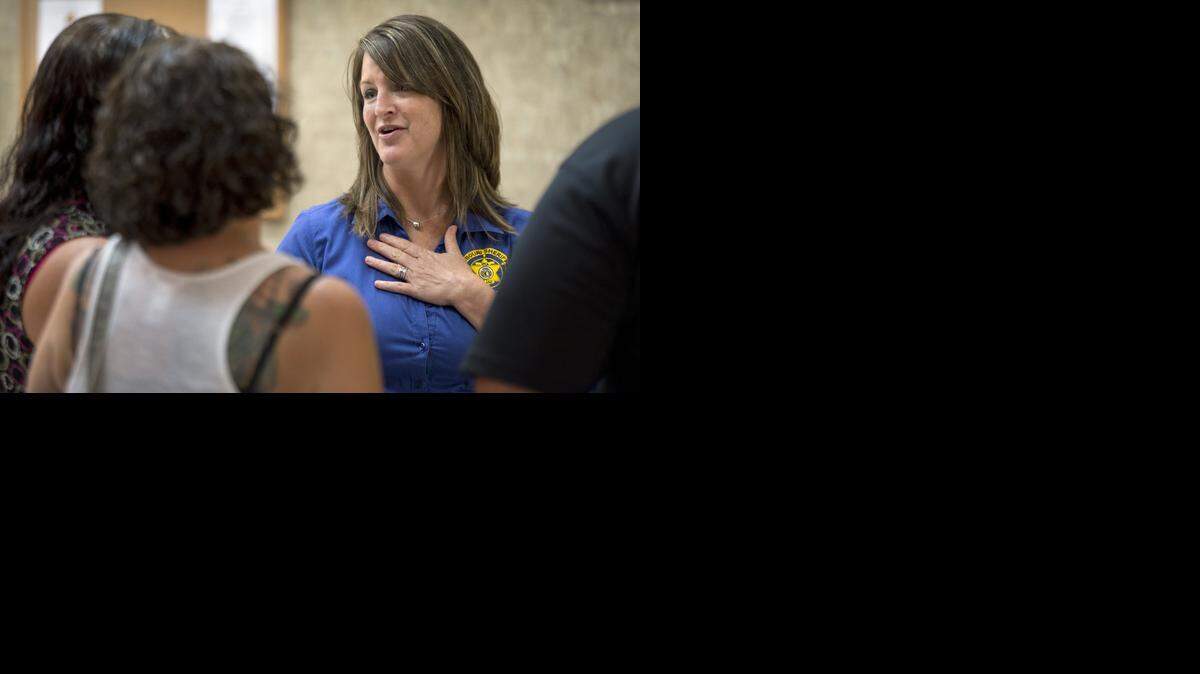
As Kim Case drives the blacktop to this Holt County seat in northern Missouri, a beaded necklace on the dash peeks back through the steering wheel.
It’s so close and brightly colored, Case can almost hear the little girl’s voice.
“Kim, best friends forever,” the necklace says.
The girl was 12 when she made it. Her name is not being used in this story because her father allegedly pimped her out to a truck driver friend who raped her in the sleeper of his Kenworth rig at various stops between the girl’s Holt County hometown and Salt Lake City.
The man, 54, didn’t wait long. Court documents say he assaulted her at a car wash on the way out of town.
Case, a victim advocate case manager for the Missouri Sheriffs’ Association, drove to Oregon because the father and truck driver were both set to appear in Holt County Circuit Court. She drives a lot of blacktops these days, past grazing cows and cornfields. Not exactly the glamour she had in mind when she was young and wanted to be a flight attendant and travel the world.
But then came the night 24 years ago when four men abducted and gang-raped her for 12 hours and threatened to kill her before she escaped from the hayloft of an old barn.
As she watched the last man shuffle out of a courtroom and off to prison, the cruel thought struck her that he gets to sit in a cell and watch TV.
“Well, I can’t take the time like they can,” she said back then. “I have to deal with it now. I have to put a smile on my face and go out there. I have to live my life.”
That world she wanted to see has turned out to be mostly rural Missouri. The roads are long, but they never take her far.
June 6, 1990
Little things bring it back, and there are lots of little things in the life Case has chosen for herself. A judge’s gavel. The smell of hay.
Not long ago, she drove to a Missouri prison to attend a parole hearing for one of her assailants. She couldn’t see him because of a partition, but she could hear him.
“When I heard that voice, it was like I was right back in that car,” she said.
On June 6, 1990, she was Kim Jackson. After her waitress shift at Applebee’s, she had met a friend at another restaurant. When the two women left, they heard hoots and hollers. They ignored the men and kept walking to their cars. They split up, Case driving to her home just blocks away in North Kansas City.
A car stopped behind her. She thought maybe her friend had forgotten to tell her something. Or maybe it was her boyfriend.
A man walked toward her, his silhouette captured in the headlights. She stepped back, too late. He grabbed her. She bit his hand and fought, but he wrestled her into the car, a 1975 Ford Maverick.
She landed between two men in the back seat. It was about 3:30 a.m. At first, the four — they were the men from the restaurant — were quiet. She could smell that they’d been drinking. The car roared down a highway. The windows were down, and night air rushed past.
A man in the back handcuffed her to himself.
“What’s your name?” he said.
The assaults began almost immediately, taking place in Clay, Jackson and Cass counties as the car went south. Case slipped her Applebee’s name tag down in the seat, thinking it could serve as evidence if she were killed.
Toward dawn, the car stopped at a bridge on a country road north of Archie in Cass County. She was forced to a riverbank. A police timeline would show nine incidents of sodomy and six rapes in the next hour.
It began to rain. They all walked along the riverbank to the abandoned barn.
By 3:30 p.m., 12 hours after her abduction, three of the men had left and the other slept. Case made her escape, running barefoot across fields to a farmhouse.
All four men were arrested, charged and convicted. Their sentences ranged from 55 to 152 years.
They remain in prison.
Standing with victims
That young Applebee’s waitress is now 44 years old. She’s married and the mother of two daughters. More than 20 years have passed since all those hearings, trials and sentencings in her case — four defendants, three counties, a gazillion tears.
Why would she want the job she has? Every day is a reminder of her own horror. The clank of shackles on a courtroom floor still awakens her demons.
Because, she will say, she could have used somebody like herself back then, and that person wasn’t always there. She remembers sitting in small rooms at police stations and a hospital, alone and scared and not knowing what was going on.
She was 20. What must that be like for a 12-year-old?
According to court documents in the case involving the girl from Holt County, after the trip to Utah, the father ordered her to have sex with the truck driver in the family’s home. The young victim told authorities that her father’s live-in girlfriend knew of the abuse. Case has pushed the prosecutor to charge the woman with a crime.
During the recent court proceeding, Case sat with the girl’s uncle and two aunts, who now share custody of the youngster. Case had been to the home in Cass County where the girl now lives.
“Amazing,” one of the aunts said of how quickly Case bonded with the girl, who had become withdrawn and suffered nightmares. Case got her to smile, even giggle. That was the day the girl made the necklace for her new friend.
“I looked into her eyes and told her I would be with her every step through this,” Case said.
She phoned on the girl’s birthday.
“She called!” the girl shouted after. “She called!”
Fixing flaw in system
Things have changed since Case’s attack 24 years ago. Victim advocacy is a higher priority now. Still, more than half of Missouri counties do not have the service, and even in some that do, it doesn’t kick in until charges are filed. That can be days or weeks after an assault.
Case, who earned a degree in criminal justice after her abduction, helped write the grant and set up the program for the Missouri Sheriffs’ Association.
Her husband, Greg Hassler, said the phone rings at all hours at their Warrensburg home. Day and night.
“She goes,” he said. “That’s what she does.”
Case and others in her office work with law enforcement, women’s shelters, hospitals, community agencies and prosecutors. She helps answer a hotline.
“Kim probably sees 50 victims a month,” said Kevin Merritt, a grant coordinator for the Missouri Sheriffs’ Association. “She will get a call, get in her car and drive several counties away, even to the Bootheel, and then go to court with them.”
The system was broken, Merritt said. The emphasis had always been on solving crimes, with too little attention paid to victims.
Over the past two decades, beginning when she was in college, Case has worked to help change that. She has talked to college classes, including one taught by the prosecutor who handled her case. She has lobbied the Missouri General Assembly.
She worked for the Johnson County, Mo., Sheriff’s Office and the Missouri Victim Assistance Network. She joined the Missouri Sheriffs’ Association in 2011, helping to set up the state’s only statewide victim advocacy program.
“She knows what she didn’t get when it happened to her, and she doesn’t want anybody else to go through that,” Merritt said. “She is true testament that when something bad happens to you, it doesn’t have to destroy your life.
“I don’t think it’s about a paycheck with her. Kim is right where she wants to be.”
Her husband agrees.
“No question that what happened to her drives her,” Hassler said. “And part of it is her faith. I think she feels she was spared that night so she can do what she is doing now.”
Case merely says, “If I can help them, it’s an honor to be part of that.”
‘I forgave them’
As for her attackers, she will see them regularly in years to come as their parole hearings become more frequent. At an early one, she listened to the man talk of his remorse, how he had become a Christian and how if he could take back that night, he certainly would because he had missed out on so much.
“That made me so sad,” she said recently. “I cried on the way home.”
But at a later hearing, that same man told the panel that “she” wanted to be with them and everything that happened that night was her fault. When a panel member asked what he had thought would happen to her after he left the barn that day, he said, “I didn’t care then, and I don’t care now.”
She cried harder on that trip home. “After all these years …”
Still, she said, she had to let her anger go.
“Oh, I forgave them a long time ago,” she said during a recent interview at a restaurant near Warrensburg. “Anger consumes. We all make mistakes. I wish theirs hadn’t been so serious.
“I wish they would have different lives up to that point. Did they have someone to teach them right from wrong? Were they loved?”
Case doesn’t share her past with every victim she sees. But she did with the family of the little girl from Holt County.
The girl’s uncle remembered Case’s abduction and escape. That old barn was right outside his town of Archie.
“That was a long time ago,” he said.
Yes, and she was a girl who wanted to see the world.
To reach Donald Bradley, call 816-234-4182 or send email to dbradley@kcstar.com.
This story was originally published August 30, 2014 at 3:39 PM.