
Like Ferguson, area police departments lack racial diversity
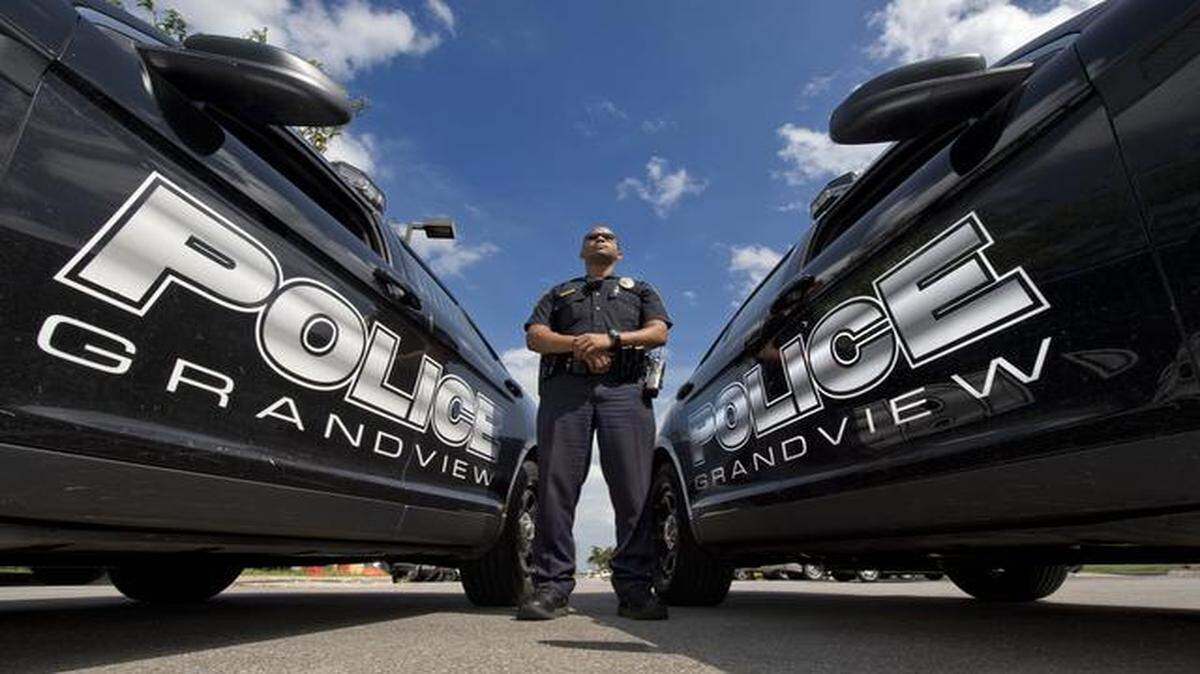
The sight of two police officers walking toward his Grandview home recently caused a wayward 12-year-old boy to start sobbing.
Hoping to teach and soothe, Officer Aaron Carter pulled the boy aside and quietly counseled him about the virtues of obeying his mother.
In suburban communities like racially mixed Grandview, Carter represents what many police officials consider a hot commodity: an African-American in law enforcement.
Yet as the only African-American among his city’s 53 officers, he also represents an ongoing challenge within many police departments: how to attract more like him into the profession — and keep them there.
A lack of African-American police officers has been a key complaint during civil unrest in the St. Louis suburb of Ferguson, Mo., since a white police officer killed an unarmed black teenager Aug. 9. Two-thirds of Ferguson’s residents are African-American. All but three of the department’s 53 officers are white.
Ferguson is not alone.
None of the metro area’s most racially diverse cities — Grandview, Raytown and the two Kansas Cities — has enough minority officers on its force to mirror its community’s racial makeup, a target Attorney General Eric Holder has espoused in recent days, including in a op-ed column published Thursday in The Star.
Area police chiefs say the lack of minority and female officers concerns them and they are trying to diversify.
Part of the problem is that most African-Americans don’t consider law enforcement an attractive career choice. Many grew up with a negative perception of police, who long have exhibited an adversarial relationship with minorities. Those tensions simmered for years in Ferguson before exploding after the shooting of Michael Brown, residents have said.
“That pool (of applicants) is very finite when it comes to minorities, whether they are Asian, Hispanic, African-American and even female,” said Grandview Police Chief Charles Iseman. “Diversity is good, not just by the color of one’s skin, but to have officers from different cultural and socioeconomic backgrounds.”
African-Americans, who make up 13 percent of the U.S. population, accounted for about 12 percent of the full-time officers working for police departments nationally in 2007, according to the latest figures available from the U.S. Department of Justice.
But most of them work in the nation’s largest cities, Justice Department statistics show.
The smaller a community, the whiter its force looks.
Improving those numbers anytime soon could remain a challenge, one expert said.
“It is likely that the events in Ferguson will make it extremely difficult to hire African-Americans, at least in the near future,” said Ronald Weitzer, a professor of sociology at George Washington University who has written extensively about police relations with ethnic minorities.
Yet police departments need diversity, he said.
“A department that is representative of the population has major symbolic advantages over departments that are lopsided and poorly reflect the local population,” he said.
No Kansas City suburb matches Ferguson’s high percentage of African-American residents.
Grandview, in southern Jackson County, comes the closest, with African-Americans accounting for 40.8 percent of the city’s population in 2010, according to the census.
However, Grandview’s police force looks similar to Ferguson’s.
Carter is one of four minority officers. Two are Hispanic and one is of Asian descent. The 49 other officers are white.
In Raytown, African-Americans make up 25 percent of the population. Of the police department’s 55 officers, three are African-American, two are Hispanic and one is multiracial.
Raytown Police Chief Jim Lynch did not respond to calls from a reporter asking to discuss the issue.
The racial disparity isn’t as severe in Kansas City and Kansas City, Kan. But it still exists.
Kansas City’s population is nearly 30 percent black and 10 percent Hispanic. Across the river, the other Kansas City is 27 percent black and nearly 28 percent Hispanic.
Yet more than 70 percent of each police force is white.
In Kansas City, Kan., interim police chief Ellen Hanson, the first woman to head the department, said she recognizes that the department needs to do better and is taking steps to improve the hiring and retention of minority officers.
“There is a definite momentum to be more inclusive,” Hanson said. “Being able to relate to the community more effectively is best served by a diverse police force.”
Kansas City, Kan., has a police cadet program geared toward finding young men and women in the community interested in a police career. Four cadets are getting ready to join the department, she said. One is black, one is Hispanic and two are white.
The department also has a new recruit class of 14 prospective officers that she called a “very, very diverse class.”
Darryl Forté, Kansas City’s first African-American police chief, has challenged every member of his department to think of themselves as recruiters.
“It is important to show the citizens that we are inclusive,” Forté said. “Some people like police officers who look like them; they want people who can relate to them.
“Different ethnicities and different races bring different things to the table. So having a diverse workforce will enable us to have a successful outcome on what we are trying to accomplish.”
After becoming chief, Forté implemented a coordinated recruitment plan to identify minority candidates. His employment staff expanded recruiting practices to include visits to community events and military bases. Recruiters also simplified the application process and removed intimidation factors.
For example, candidates previously had to take the entrance exam at police headquarters downtown, but they didn’t like being seen there by friends who might harass them later. So now the exams are given at the police academy in the Northland, said Sgt. Joe Bediako, a recruiting supervisor.
The department also battles retention issues. Many minority officers leave after only a few years, in part because they don’t feel comfortable within the department, Forté said. Other officers may not understand how to work with someone from another race or culture, he said.
“I think people were very insensitive to the minority culture when I first came on,” Forté said, adding that he has appointed a diversity officer and provided bias awareness classes and other training for his command staff and civilian managers.
He encourages new recruits who experience trouble in the department or community to seek help.
“There is a stigma of being a (black) police officer,” Forté said. “We take a lot of abuse from people, being called traitors and an Uncle Tom, but most people respect what we do.”
A conversation with a police officer when he was 12 led Forté into a career in law enforcement. This month he will celebrate his 29th year with the department.
“I know it sounds kind of corny, but I wanted to help people,” he said. “It seemed like it would be challenging because not every day is the same.”
Carter, 24, just celebrated six months with the Grandview Police Department.
He had planned to become an architect but while in college decided that would take too long. A career in law enforcement or the military had been his backup plan.
The Raytown South High School graduate said that as a youth he was intrigued by police officers, particularly those who served as school resource officers and DARE instructors.
“I would see them in their uniforms and saw how much respect they got and how they interacted with students,” he said. “I was really excited about what they did; they drive fast and kick in doors.”
He first realized police work was more demanding while taking classes at the the Public Safety Institute at the Metropolitan Community College-Blue River campus, where he was the only African-American in a class of 25 students.
At home, his decision wasn’t received well initially. His mother expressed concern for his safety.
The reaction from others surprised him.
“I lost a couple of friends,” he said. “They said I was turning on my own race. There were some friends who didn’t want anything to do with law enforcement.”
Grandview was one of two departments who sought to hire him.
“I wanted to start in a medium-size area,” Carter said while patrolling northern Grandview on a recent day when he arrested two shoplifters but also counseled a middle schooler about disrespecting his mother. “Kansas City is go-go all of the time and I didn’t want to jump in and be drowned, so I looked at Grandview and liked the department.”
Now he encourages others to follow his footsteps. Some have rebuked the idea, but others have considered it.
“It is a fantastic job,” he said. “I love the fact that my office is my car and I’m never confined to a desk.”
He also loves interacting with the community, even those he arrests.
“I get to … show them that just because we arrest you, it doesn’t mean it is the end of your life.”
His second day on the job, he chased a passenger who fled a car stop. The man tossed a .45-caliber Ruger before Carter nabbed him.
“It was awesome,” Carter recalled. “I said, if this is what I’m in for, then this is amazing.”
To reach Glenn E. Rice, call 816-234-4341 or send email to grice@kcstar.com.
To reach Tony Rizzo, call 816-234-4435 or send email to trizzo@kcstar.com.
This story was originally published August 23, 2014 at 4:02 PM with the headline "Like Ferguson, area police departments lack racial diversity."