
It was founded in the mid 1800s by around 100 people. Look how Lee’s Summit has grown
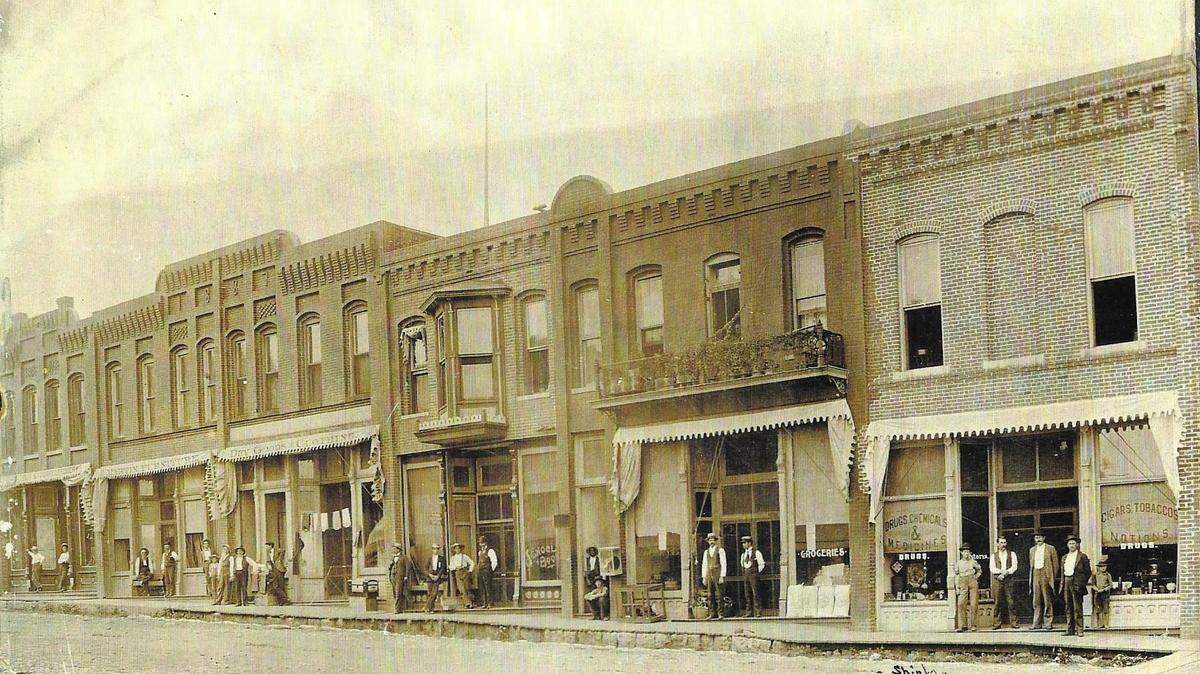
In the chill of the new year, many start contemplating cozy Norman Rockwell-like scenes.
Outside of New England, you couldn’t find a better real-life example than a historic image of Lee’s Summit. The railroad farm community was founded in 1865 by around 100 people. Today the population is 1,000 times that and growing, said Chamber of Commerce President Matt Baird.
Many who grew up in the tiny rural Jackson County town in the ’30s, ’40s and ’50s remember the days when everyone knew their neighbors.
Georgia Moore (nee Walberg) was born in Lee’s Summit in 1931.
“We did not realize how good we had it,” Moore said, adding that it was the perfect place to enjoy “being a kid.”
Robert “Bud” Hertzog recalled long-past holidays.
“My mother cooked many a turkey for Thanksgiving and Christmas,” said Hertzog, 90, who grew up in the city. The veterinarian treated many animals in his clinic in the town, though his “resume” also includes time spent treating animals at the Kansas City Zoo and the American Royal.
Those who have lived in the community for years remember the general location of the one traffic light.
“The center of town was Douglas and Third streets,” said Dorothy Purtle a lifelong resident.
Churches were on every corner, said Hertzog, noting that the town also had three drugstores and the Vogue Theatre, where movie tickets were well under $1.
On Saturday nights, families would come to town, drop their children at the movie theater, shop at one of the mom-and-pop stores, take the groceries home and come back to retrieve the kids. Lucky children had money for a soda.
From 20 students to over 1,300
Moore, one of 79 graduates in the high school class of 1949, says her entertainment centered on school and church activities, riding her horse in town and playing croquet. Moore’s parents bought George’s Grocery on Douglas in 1929 at the start of the Great Depression and kept it until an A&P moved in and undercut prices.
Hertzog’s education began at one-room Cedar Hills School, where Miss Hazel Smalley (who was required to be single) had 20 students, was paid $45 a month for eight months. Hertzog graduated from Lee’s Summit High School in 1948 in a class of about 50.
In 1949, the R-7 School District unified 16 small districts. In 2020, with 28 schools and 17,805 students — greater by far than the town’s population in 1970 — R-7 graduated 1,346 students.
Nicest suburb south of KC
Phil Acuff, class of 1949, describes Lee’s Summit as the nicest Missouri suburb south of Kansas City.
The retired developer and builder grew up in Lee’s Summit, where his father had one of the two car dealerships during the mid- 20th century. He recalls how any kid guilty of a minor offense would be chastised by one of the two or three police officers, and the incident was not repeated. Back then, the police force installed parking meters and borrowed a car with radar to raise money to support the department. Today, the force of 148 officers is well equipped.
Acuff recalls swimming at Unity, where the water was changed every week before chlorination existed. Legally it was open to only Unity members, but many kids managed to convince the right people to allow them access.
‘Termites’ at Longview
Purtle grew up at Longview Farm, where his father worked. The 1,700-plus acre farm was the country estate of lumber baron R.A. Long, who had his daughter, equestrian Loula Long Combs, in mind when he built the farm.
Purtle said Combs, who lived there until her death, called the children living in homes on the farm her “termites” and employed them to pull weeds near the horse barns. Town kids were not supposed to use the lakes at Longview, but in the winter she ignored those who ice skated on the frozen lakes, Acuff said.
Today, Longview Lake is owned by the U.S. Army Corps of Engineers. A community college campus, as well as residential and commercial districts, now sit on some of the land of the former self-sustaining farm. The historic Longview Mansion, now an event venue, has been restored to reflect its former glory.
From small town to city
Change happened quickly. In 1961, Western Electric came to town with thousands of new employees, and in 1964 the town annexed land, increasing the size from 14 square miles to more than 67 square miles. Population grew dramatically from 1950 to 1960.
Much of the city has been developed, though the largest private owner of land, the Church of Jesus Christ of the Latter-day Saints, owns many of those acres. Fifty years ago John Knox Village, a multi-faceted retirement community, was built.
Where only one medical clinic existed for years, there are now two hospitals and many clinics.
Laurence Pressly, also a 1949 graduate and a former head of the American Royal, recalls the two town banks. Now, he said, there are 80 financial institutions including branches and savings and loans.
He and others are proud of the vitality of the old downtown. Unlike many suburban communities where the downtown areas disappear to be replaced by box stores on the outskirts, Lee’s Summit broke the trend. Pressly and Hertzog are among those who have served on city councils and school boards.
Development and progress continue today as the population increases. Several large projects are underway.
“We don’t reminisce,” said City Manager Stephen Arbo. “We look ahead.”