
Ingram’s magazine names Lee’s Summit educator one of the ‘top 50’ Missourians
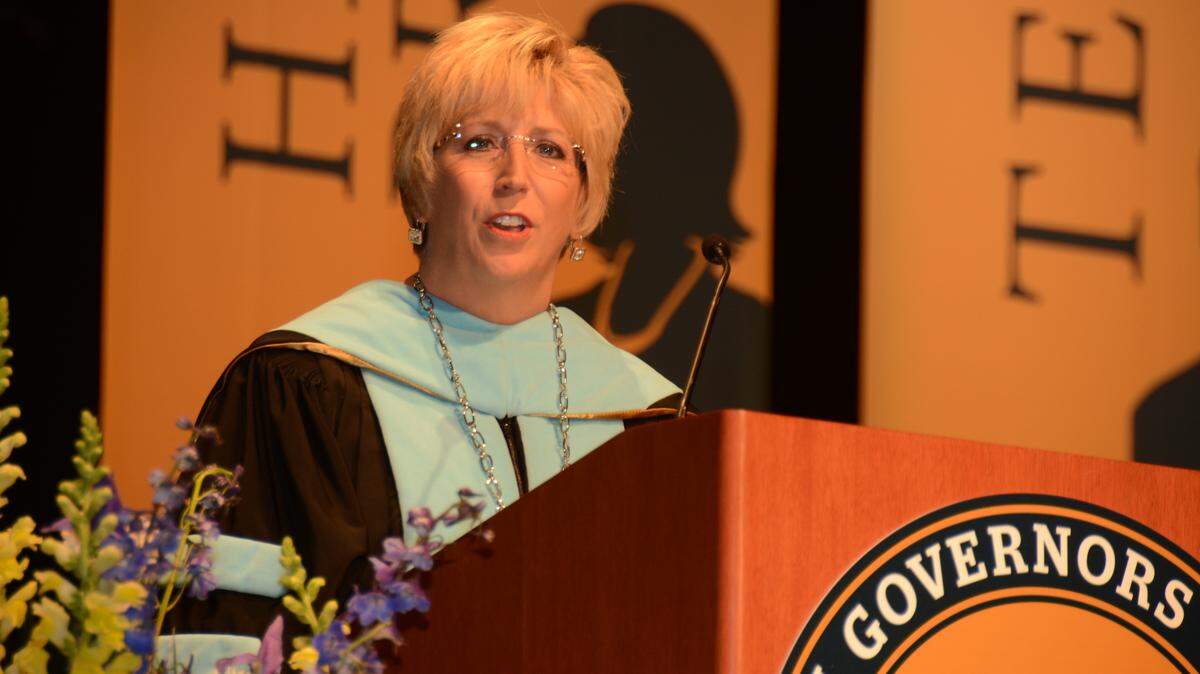
It’s quite an honor for a Lee’s Summit resident.
Angie Besendorfer has been named one of the “50 Missourians You Should Know” by Ingram’s magazine.
Besendorfer, chancellor of Western Governors University Missouri (WGU), was selected for her career of more than three decades in education, including her work in innovative curriculum in elementary and secondary education, and improving access to higher education.
“I decided that teaching was for me when I served my first year as a 4-H camp counselor,” Besendorfer said. “I loved the feeling of helping kids.”
Besendorfer was born and raised in Lamar, Missouri. After she graduated from Lamar High School, she pursued a bachelor of science degree in elementary education from Missouri Southern State College, now Missouri Southern State University, in Joplin.
She later earned a master’s of science in elementary administration from Central Missouri State University in Warrensburg, and her doctorate in educational leadership from the University of Missouri.
Besendorfer’s dedication to embracing innovative curriculum in K-12 education was evident when she was assistant superintendent for Joplin Schools and one of the leaders in that community’s recovery from the ravages of a tornado in May 2011.
“As part of the recovery process we made, a bold decision to not replace the textbooks at the high school level and instead move to a one-to-one laptop initiative using e-sources for teaching and no digital or physical textbooks,” she says.
“This dramatically transformed teaching because we provided the needed support for teachers to become proficient in project-based learning and real-world activities.”
She also led “the dream meetings” attended by hundreds of community members to help reimagine the high school.
“This meeting series resulted in the decision to implement the laptops for learning, using a career path curriculum model and rethinking the concept of time,” Besendorfer said, adding that the groups questioned why the traditional model requires the same number of minutes to learn algebra as biology and home economics.
“We re-imagined how time could be used to empower students to accelerate through courses to provide more time in their identified career path, enabling them to earn more dual credit or take more courses in their field of choice.”
Besendorfer became chancellor of WGU Missouri in 2014. WGU Missouri is a competency-based, online university, which offers more than 50 undergraduate and graduate degree programs in the fields of business, K-12 teacher education, information technology and health professions. These are offered at a tuition of $7,000 a year for most programs.
The university has grown in the past six years, with more than 3,845 alumni, current enrollment over 3,336, and a staff of 187.
Besendorfer says the opportunity to champion an innovative learning platform designed for working adults was exciting.
“I served my entire career in high poverty schools and districts with the hope that the 12 years we provided education would matter,” she said.
“Now through WGU, we could serve the parents of those children and break the poverty cycle within three years, allowing those kids to have a better opportunity while in the K-12 setting and making it three times more likely they would go to college, too.
“WGU grads are earning $18,000 more within four years of graduating, which changes the whole family for the better.”
Besendorfer says WGU was fairly unknown to her when she was named chancellor.
“Creating awareness and a positive reputation was the first and biggest task,” she said.
“This was difficult because many Missourians had bias against online education...
“I approached educating people about the WGU difference by engaging with as many people as I could and winning them over one at a time.”
Besendorfer says she is inspired by WGU graduates and students, who are typically in their mid 30s, working full time and raising a family while they attend.
“The spirit of our student body is incredible,” Besendorfer says. “This is coupled with their enthusiasm of finding a university that will work with their life to let them achieve their dream of a college degree.”
She says there still is a challenge to differentiate WGU from other institutions that have online classes.
“Especially with the experiences some students are having with the schools moving to remote learning, many people are having negative experiences,” Besendorfer says.
“I need to ensure that people understand how WGU’s competency-based education model is very different from typical online learning.”
She says the WGU model “empowers students to learn at their personal pace.”
She does worry about people who are leery of online courses because of bad online experiences
“I must help them understand that WGU’s online learning program has always been online,” Besendorfer says, adding that she thinks the school may benefit people needing to improve their skills to get a job as the economy recovers from the effects of COVID-19.
This story was originally published May 11, 2020 at 5:00 AM.