
In late winter, Lee’s Summit kids exchanged ray of artistic hope across globe
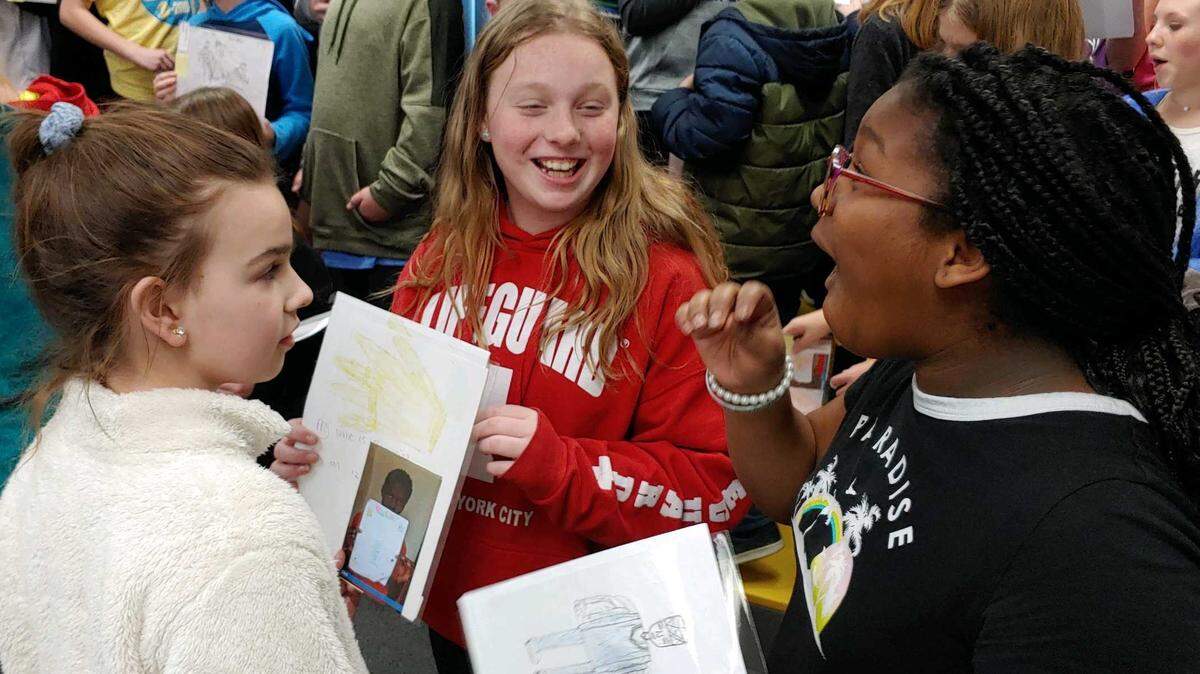
Earlier this year, before schoolrooms were empty, a group of Lee’s Summit students received proof that art can be a powerful tool to unify through an artwork exchange with students a half a globe away.
Denelle Stokes, art teacher at Hawthorn Hill Elementary, orchestrated the global learning opportunity, where a group of her school’s fifth- and sixth-graders exchanged artwork with students in Nigeria.
Sixth-grader Maryn Guilfoyle said she wanted to participate in the project because she thought “it would be a fun and amazing experience for me.
“I felt happy that someone across the globe would be looking at my artwork and smiling when they got it,” Maryn said. “I was so excited to get my picture. My picture was full of everyday things in my student’s life.
“It was so interesting to see how differently she drew things like faces. I loved every part on the artwork I had received and am glad I got to participate.”
The exchange was ignited by a postcard from The Memory Project that landed in Stokes’ school mailbox last September. The Memory Project is a Middleton, Wisconsin, nonprofit that promotes “intercultural awareness, friendship and kindness between children around the world through the universal language of art.”
“The postcard was about a global art exchange program with students from countries that are typically in tension with the United States,” Stokes said.
“I was intrigued by the art exchange for many reasons. Our school’s theme this year is ‘M.A.D. as a Hornet: making a difference.’ I thought, ‘Here is an opportunity for my students to make a difference’.”
At first, the exchange hit a possible obstacle because it cost $12 a student.
“My budget goes for art supplies,” Stokes says. “I didn’t see any way we could fund this project.
”Then, just a couple of days later, Hawthorn Hill principal Troy Hogg sent an email to staff about a grant opportunity that focused on community involvement.
“I felt like this project applied,” Stokes says. “Perhaps on a larger community scale than was intended, but the worst that could happen was a no response.”
But the grant was approved and given by Lee’s Summit CARES: Stokes got $600 for 50 pieces of art.
Stokes says the exchange aligned well with how she has been teaching art for the last five years.
“I believe in and run the school’s art studio using a Teaching for Artistic behavior,” she says.
“Teaching for Artistic behavior following these three statements: What do Artists do, You are the Artist, and This is your studio,” she says.
“I give brief demonstrations on art materials, skills, and concepts and then students choose to create artwork about subjects authentic to them with the art media they enjoy. I strongly believe children are artists and the artwork they create should reflect themselves. While it may not always produce ‘fridge display’ quality artwork, the art is authentic to the child and so is the learning.”
Stokes selected Nigeria based on a timeline that worked best with Hawthorn Hill’s school year. She asked students interested to sign up, giving priority first to the sixth-graders and then fifth-graders, and allowing students to sign up in pairs so more students could participate in making 50 pieces of art.
About 40 sixth-graders and 20 fifth-graders signed up, with students beginning to create their artwork last December..
Stokes says The Memory Project sent a video for the students to watch and be inspired.
It asked such things as:
▪ What do you see when you think of peace, friendship, or kindness?
▪ What place makes you feel most peaceful?
▪ Picture something that makes you feel happy.
▪ Paint or draw your family or friends.
“I observed my students being very thoughtful and creative in their art making,” Stokes says. “I was impressed with the amount of effort each of students put into their art exchange artwork.”
On each of the pieces of artwork from Hawthorn Hill, the students traced their hand, included a photo as well as their first name and age.
And off the artwork from Hawthorn Hill went.
Hawthorn Hill students received the artwork from Nigerian children in February.
The students gathered in the school’s music room and were handed the artwork. Each piece of artwork from Nigeria was carefully wrapped in a protective sleeve and included a picture of the artist.
“Honestly, I was surprised by my students’ reactions to the artwork they received,” Stokes says.
“The artwork we sent to the 50 Nigerian children was colorful, bright, and filled the page. The artwork we received was mostly pencil drawings with a few lightly colored images on thin paper. I was worried my students would expect a higher quality product.
“I’m extremely grateful my students were excited about the artwork they received. I did not hear a single negative comment. It just goes to show that the adult aesthetic is so vastly different from a child. My students were delighted to receive artwork from a Nigerian child who was fortunate enough to attend school.”
Stokes says one important element of the exchange is that a portion of the $12 a student fee paid goes to buying art supplies in exchange schools.
The project was perfect for Hawthorn sixth-grader Violet Grine.
“I love to be creative and share my art with other people,” Violet says. “I was even more excited knowing my art was going to another country. I was also excited to see what someone in another part of the world would draw. “
Violet created artwork with the word ‘hello’ in several languages.
“I felt excited to share my artwork with a student in Nigeria,” she says. “To know that my artwork was being sent half way across the world, that was pretty cool.
“The artwork I received was a drawing of a house. It was interesting to see that the drawing of the house looked like a drawing of a house any of my friends or I would have drawn. I was excited to hold the artwork that someone else in another country held.”