
Here’s how Olathe phone booth brings comfort to those grieving loss of loved ones
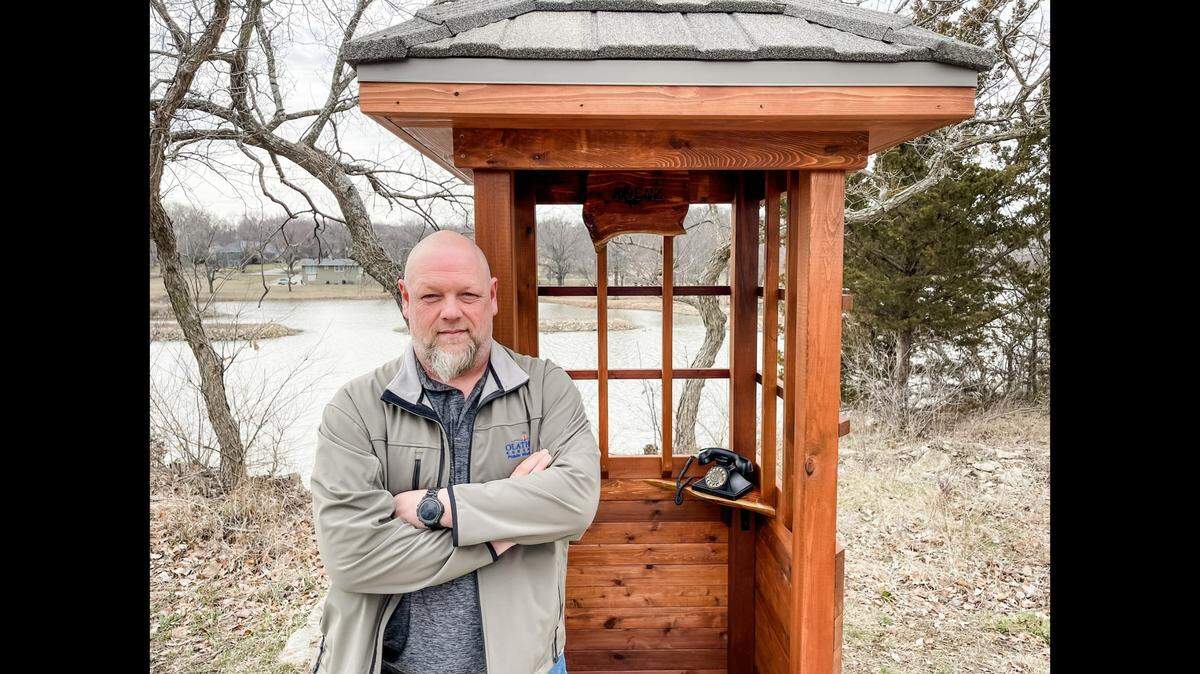
Some deal with grief and feelings toward a deceased person by talking to a gravestone.
But what happens if a grave doesn’t exist or it’s too far away to visit? With the new wind phone at Lake Olathe, Jeff Ratzlaff has taken inspiration from a 2010 innovation in Japan to try to fill that void.
A wind phone is a disconnected telephone, sometimes located in a phone booth, that anyone can pick up and talk into as if their loved one is on the other end. Just having that place to talk can be helpful.
After his sister-in-law died, Ratzlaff saw his wife struggling with grief and wanted to do something to help her.
Then one night last October, they were watching a documentary about earthquakes and tsunamis that mentioned the wind phone, first created by Itaru Sasaki in Otsuchi, Japan. They became well known after the 2011 Japanese tsunami, when many locals used it to deal with their heartache.
Since then, the wind phone in Japan has become almost a pilgrimage site for people trying to handle their sorrow, and people all around the world have duplicated the idea.
“I’m just sitting there at first thinking, ‘That’s a cute idea.’ That was a Saturday night. Then all Sunday, the more I thought about it, I’m like, ‘That might be useful in our case,’” Ratzlaff said.
As a street maintenance supervisor for the city of Olathe, Ratzlaff decided to bring the idea to the city as a public project. That Monday, he spoke with his bosses, who were onboard with the idea. After going through a few more layers of people, the project was set.
The city crew that builds playgrounds, fences and signs got together and made the phone booth. They installed it in late February at the southeast part of Lake Olathe, near the disc golf course.
“What they came up with, it was incredible. They just looked at old phone booths and came up with a structure,” Ratzlaff said.
The city is working with Johnson County Mental Health to put up a sign by the booth listing the 988 Suicide and Crisis Lifeline as well as a QR code that, when scanned, directs users to mental health resources and an explanation of wind phones.
So far, the wind phone seems to be a hit. Ratzlaff said his wife has used it a few times, and he’s seen numerous groups of people also using it when he’s been nearby.
Ratzlaff likes “just the idea of giving something tangible for people to use, something symbolic. Just knowing what my wife is going through, and I know countless other people (who find it) hard to deal with grief. If this is an outlet to give them some peace, then the more people it helps, the better.”
The city’s Facebook post about the wind phone many comments from people who had lost loved ones and plan to use the phone themselves.