
Ballet brings out the best in kids in KC 'Nutcracker' production
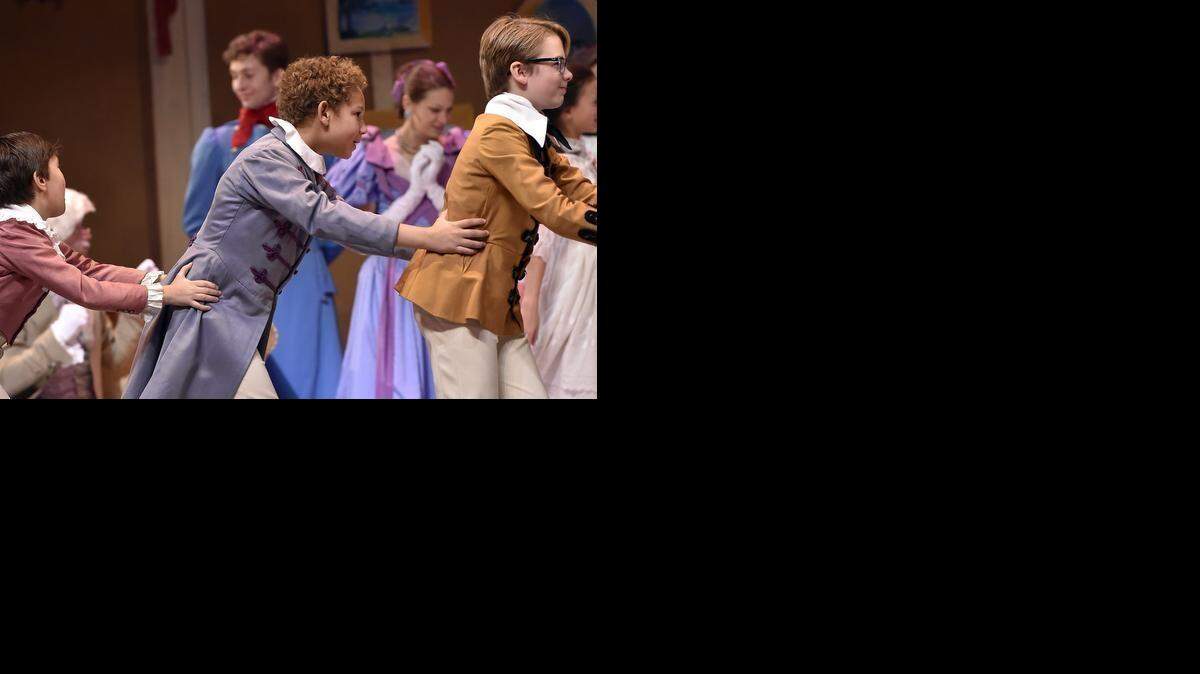
Tanner Mahoney had no dreams of taking the stage to dance when he was in fourth grade. In a way, dance reached out to him. The boy, now 11, was more interested in football than learning the basic positions of ballet.
Fifth position — feet together, toes turned out in opposite directions — is rough, he admits.
But from now through Dec. 24, Tanner will be on Kansas City’s premier stage downtown, assuming the role of a party guest in the Kansas City Ballet’s 42nd annual production of “The Nutcracker.”
His mom, Samantha Mahoney, points out what many in the dance world understand. Ballet builds endurance and strength.
“He was just picked as one of the best players on his football team,” said Mahoney, who lives in Merriam. “Given the choice between ballet or football practice, he usually comes here.”
She’s talking about the Bolender Center, where Tanner practices for hours a week.
Tanner has sensory integration disorder, which means he has difficulty responding to his environment. But he has advanced in his one year of dance, which shows ballet is helping him respond to instruction.
“Football helps his sensory needs,” said his mom. As does dance. When he was chosen for a role in “The Nutcracker,” she says, he was excited.
“This year was about broadening his horizons.”
For the children in the audience, a trip to see “The Nutcracker” is the finest of gifts. What could be better than watching a magical Christmas wonderland filled with toys come to life?
For more than 150 children in the Kansas City area who won a role in a September audition, the answer is clear: It’s being right up on stage in the spotlight, often moving alongside professional dancers.
Visitors to the Bolender Center in November were likely to see young performers in several studios, from students practicing a soldier’s march in one space, to students perfecting arabesques in another.
Few children seem to be aware that this is an important year for the Kansas City Ballet’s “Nutcracker.” For the past 33 years, former artistic director Todd Bolender’s production has drawn crowds in Kansas City. Artistic director Devon Carney will offer up his own version next year.
No matter what the choreography, it seems clear that children and teens will line up for auditions.
Through Dec. 24, they take their places on stage at the Muriel Kauffman Theatre in the Kauffman Center for the Performing Arts, playing party guests, mice, soldiers and angels, among other roles.
For some of the tiniest ballet dancers, this is their first time facing such a huge audience. Some of the older dancers — high school and college age — might aspire to be the Sugar Plum Fairy or Herr Drosselmeyer as part of a professional troupe like the Kansas City Ballet one day.
But many kids agree that while they aren’t sure a dance career is in their future, the skills they’re learning will carry them gracefully through life.
Talk to the parents who often have to drop their children off at the center only to run out and pick them up a few hours later nearly every afternoon during this season, and they’ll tell you the sacrifice is worth it.
Mom Dana Hughlett says it’s worth the sacrifice in time and money — not an insignificant factor with twins in the school. Costs climb as skill level rises, she says. The Kansas City Ballet School’s Academy consists of 10 levels: creative movement, fundamentals, pre-ballet for the younger students. They then progress from level one through seven. The students in levels one through seven audition for parts in “The Nutcracker.”
At one hour a week, a level-one student pays $79 a month; level-four students like the twins attend the school for 10 hours a week at a cost of $250 each.
It’s worth every penny, Hughlett said.
“The teachers and choreographers at this school are amazing.”
One of those teachers, Kansas City Ballet School Director Grace Holmes, laughs when she talks about identical twins Chloe and Anna Hughlett. The 12-year-olds, who live near Parkville, have just a bit of a competitive spirit, she says. The level-four students have now advanced to learning the pointe technique.
Holmes also points to the dedication of Tanner and another 11-year-old who has her own set of challenges: ArLeyah Tillman.
ArLeyah, who has Asperger’s syndrome, has risen through the ranks to level three; one more step to level four and she, like the twins, will be gliding en pointe.
Both ArLeyah and Tanner will touch on the problems that they face with everything from communicating to sleeping, but to really see how dance has changed their lives, watch them in action.
It’s a rare child who is offered a scholarship to attend classes at the Kansas City Ballet. But after instructors at the school spotted young Tanner in 2013, they knew he was a dancer in the making.
Through the Kansas City Ballet’s Reach Out and Dance program, which incorporates dance into elementary schools, Tanner was offered a scholarship, and his parents pointed out that such a gift should not be ignored.
Between football, his other passion, and ballet, the level two student is often worn out at night. And for a young man who sometimes has trouble slowing down, that’s a blessing.
“I felt like banging my head against the wall some nights, but now I’m so tired I just go right to sleep,” Tanner said with a grin.
His mother, Samantha Mahoney, says dance and football slow down his “revved-up engine.
“He needs to be grounded, because he’s a feather who can fly away,” she said. “He’s very much a rule-governed child, and he’s extremely humble about everything.”
Including his skills, says his teacher, who praises the boy’s dedication. At a recent rehearsal, he sits patiently waiting his turn to step onto the dance floor. He’s quick to rattle off the steps he’s learned, from fondu to relevé, in his two years.
And as he moves gracefully across the room during a rehearsal for the party scene, you can see the budding athlete.
As to what “sport” is more arduous, Tanner laughs.
“It’s ballet,” he says. “You don’t see people walking around in first position, and when you get out there, you’re using muscles no football player uses.”
This performance is important to the boy if for one reason.
He glances up at his mom before tugging on the sleeve of his shirt nervously.
“My mom said she saw this when she was little,” he says, glancing up at Mahoney with an expression that would melt any mother’s heart. “Now she’ll get to see me in it.”
Shoulders back, expression serious, ArLeyah Tillman looks every part the soldier — one of her roles in “The Nutcracker.” While other girls and boys giggle and are sometimes distracted when their director shouts out instructions, ArLeyah follows each suggestion with military precision.
Toe to heel, she seems to float across the room at the Bolender Center during a recent rehearsal.
Here, in this dance studio, ArLeyah shines, says Tena Tillman. The proud mom described her daughter, who often has trouble in social settings.
“She’s on the higher-functioning end of the autism scale, but she is painfully shy,” Tillman said, adding that her daughter has been taking lessons since she was 5.
“When she’s dancing, she becomes a different person,” Tillman said, stroking ArLeyah’s hair on a break before practice. “This has helped her more than therapy.”
The petite dancer shrugs when asked how dance inspires her. It’s a simple answer: She likes it.
“I’m happy when I’m here,” she says, looking eagerly up the stairs that will take her to her class.
It’s a safe place where nobody teases her, her mother explains.
“Dance brings her to life,” Tillman said. “Who knew? You’d think that stage would terrify her, but it doesn’t.”
A combination of factors allow the shy little girl to take a proud turn in the spotlight. It could be Tchaikovsky’s dramatic score. It could be the hum of her fellow dancers around her, or the calm direction of her instructors backstage.
But when ArLeyah performs for the masses, the girl who seems slightly fearful of the stage that is life steps fearlessly into the spotlight.
Unless you see them standing side by side, twins Chloe and Anna Hughlett are pretty hard to tell apart. Chloe tops Anna by a couple of inches, but both share blond hair, willowy figures and broad grins that reveal braces.
They’re now in level four at the school, a level instructor Holmes enjoys immensely.
“The older students know the basics, so to see the finesse and refinement is gratifying,” Holmes said. “To see the enlightenment on their face when they really get something is great.”
And she’s seen it over and over with these twins.
“They work really hard in class and have a friendly sibling rivalry going on,” she said. Now, she says, they’re learning two roles: soldier and mouse. “We thought it would be fun for them to fight onstage.”
Chloe quickly squashes any notion the sibling rivalry is serious.
“I think it’s more like we compare each other, and we learn from each other,” she said as her twin nodded.
Although neither has committed to a career as a professional dancer, both say they’re enjoying this stage, and the time they spend with the pros.
“With this production, you can see all the diverse ages,” Anna said. “You can see what you were like in the past, and what you have to look forward to in the future.”
Hughlett says she loves watching her daughters’ excitement before taking the stage. She and her husband have been shuttling the girls to dance lessons since the twins were around 4. Hughlett, a cello teacher, takes turns with drop-off and pickup duty with her husband as many as six days a week.
She’s impressed by the discipline her twins show, juggling hours of practice every week on top of schoolwork.
“At the end of ‘The Nutcracker,’ they come out with everyone to take bows,” Hughlett said. “That’s pretty exciting for them. You can tell that’s a highlight.”