
Prepared for emergency? OP classes teach people to help themselves, family, community
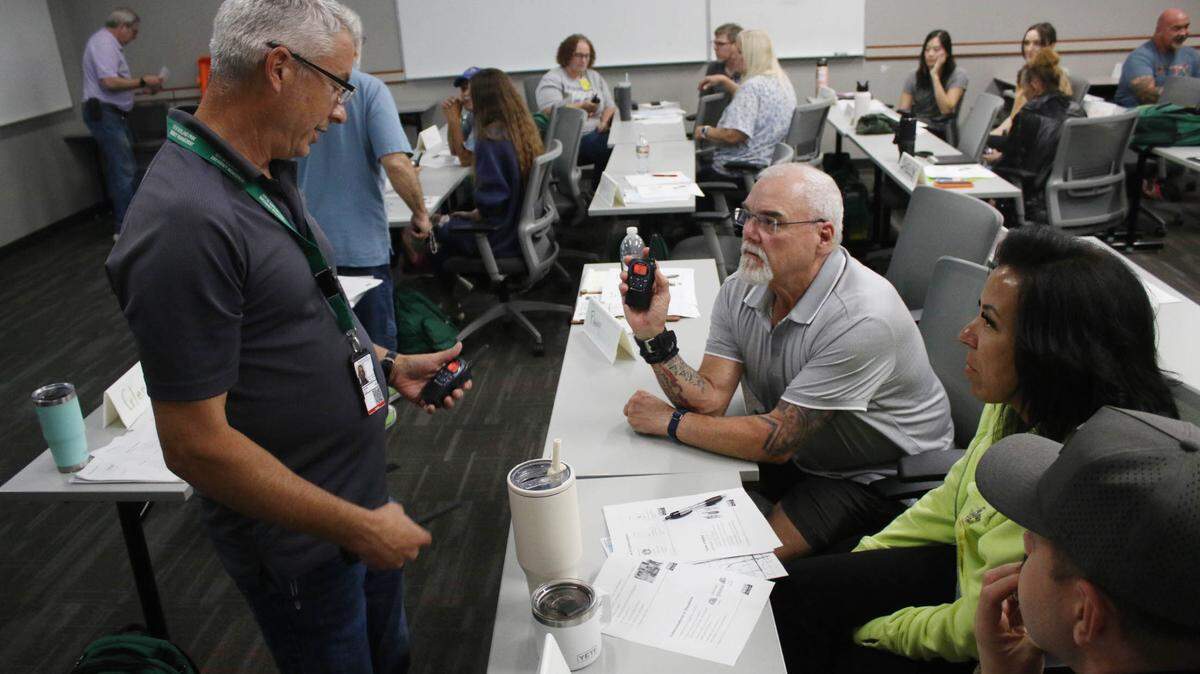
A series of classes from the city of Overland Park has allowed the municipality to build a team of ordinary citizens who are prepared to help others in a crisis.
Between 25 and 30 people make up a Community Emergency Response Team, and the courses — in which attendees commit to three-hour classes weekly for seven weeks — typically run four times a year. This year, only two were offered, because the city was preparing a new curriculum.
General guidelines for the sessions come from the Federal Emergency Management Agency, adapted for specific situations that might be encountered locally.
“It is a very diverse group. We’ve had classes where we’ve had everything from the mother who wants to know some additional skills to keep her family safe in their house all the way to West Point grads,” said Jared McPhee, emergency management coordinator for Overland Park.
Recently, he’s seen a lot of interest from local college students, but plenty of senior citizens also participate.
Sessions can focus on topics such as advanced first aid or shutting off the gas in your house. A big focus is understanding how governments respond to disasters and organize their responses.
“We teach them skills that not only help them and their communities and their neighborhoods and their house, but also skills where they can help the city if they choose to be a Community Emergency Response Team (CERT) member,” McPhee said.
People can take their class just to expand their own knowledge, but they can also, upon completing it, sign up to be part of the CERT team that mobilizes for things like severe weather or other situations where the city can use extra hands.
Currently there are 260 active members of CERT, with 150 signed up for the active deployment team. Those who are active continue to do various bits of training throughout the year and might spend 15 to 20 hours on actual deployments outside of training.
That might mean manning a drop-off point for storm debris or helping operate a temporary shelter for displaced people.
Last July’s storms illustrated one such situation. After a call was put out, CERT members showed up at 2 a.m. to the emergency operations center, McPhee said.
“They helped us track data that was coming in from various sources as far as what trees were down, what houses were damaged,” McPhee said.
Members also perform such services as providing extra hands at large-scale events such as the Star-Spangled Spectacular in July.
A drill near the end of the class helps simulate an emergency situation, such as the aftermath of a tornado, so students can get used to communicating and responding in intense conditions.
“We allow students to really decide their level of participation,” McPhee said. “We would never make anyone do anything they’re not comfortable with. During that exercise, we really identify their strengths, so we know who has a mind for the medical side versus who are the natural leaders.”
Although the first aid part is the toughest, McPhee said, it’s the part people like the best overall.
Overland Park residents Glenda Ritter and Joyce Richards are part of the latest group to undergo training.
“I think the world is and probably always has been a very scary place, and I think that all of us need to do everything we can to be prepared for anything that might happen,” Richards said. “It’s smart to think of it ahead of time, all the scenarios and ways we might alleviate any issues, because if it happens in the moment, you might not think clearly.”
After just one class, Ritter was already trying to help her neighbors.
“Now, I’ve been talking to friends, asking them, ‘Do you have a fire extinguisher?’” Ritter said.
Both appreciated learning so much for the classes.
“It covers a huge amount of ground. He’s moving pretty fast for us, I think, but it’s amazing how well-prepared and ready they are, and the people who are teaching the classes are just incredibly knowledgeable,” Richards said.
McPhee said that even if someone doesn’t choose to volunteer after the class, building up the knowledge base “builds resilience in the community.”
There is a waiting list to get in for the next classes in 2025. For more information on how to sign up, go to opkansas.org/cert.