
‘Art is a language that can be spoken by anyone.’ In this studio, artists are fluent
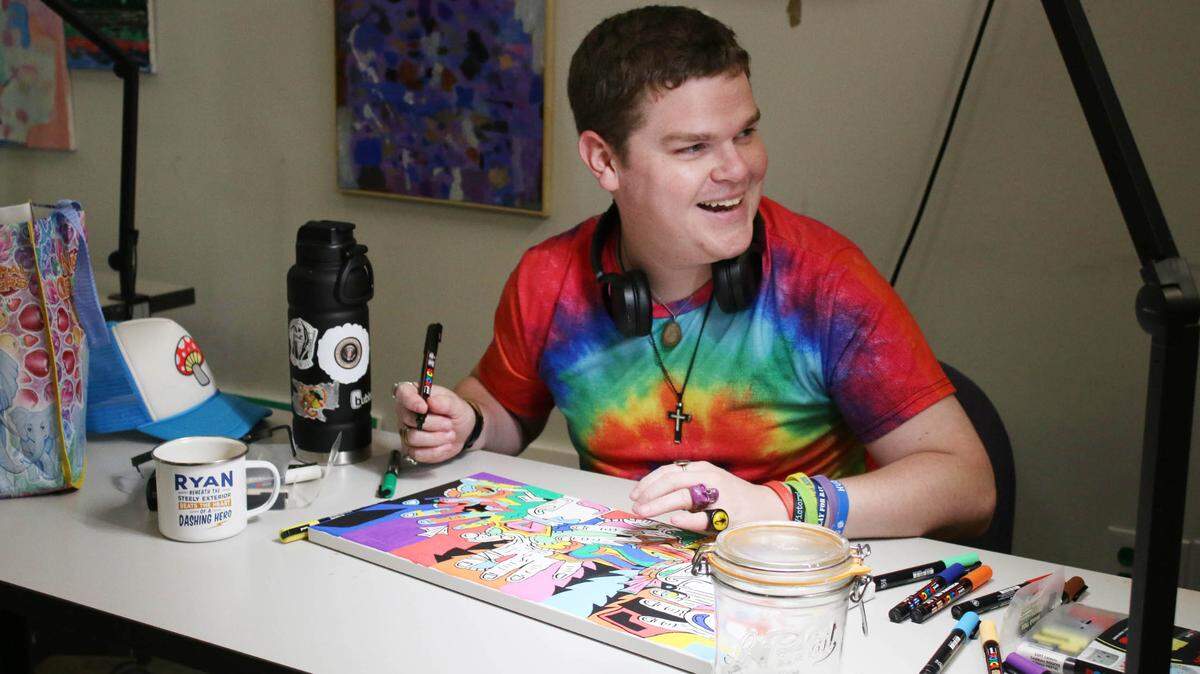
The Johnson County Arts and Heritage Center is home to a collective of artists you might not know yet. But if you’ve been to the Central Library branch this month, you’ve seen their work.
The Emerging Artists program from Johnson County Developmental Supports gives studio space, materials and encouragement to artists with intellectual and developmental disabilities. Shows like the one at the library, running through Aug. 21, give the artists exposure so they can sell their work.
“Art is a language that can be spoken by anyone,” said Amanda Burkhart, arts program specialist.
Up to five people work in the studio each day, and each of the 17 artists in the program has his or her own flair.
Ryan Sikes, who has been with the program for seven years, said his style has evolved from abstract to psychedelic.
“For years, I was a good artist, but it wasn’t until this year or last year I had this breakthrough,” Sikes said.
Packed with bright colors, his work is distinctive. For Sikes, art means “being able to express your inner thoughts: your inner being.”
The program has been running for 11 years, first at the Elmore Center in Lenexa, and then at the Arts and Heritage Center for the past seven years. It’s currently running at capacity, with no open slots.
Artists have an opportunity to share their work at least once a month, sometimes as a group and sometimes in a solo show.
Burkhart said the program functions a lot like your average studio — not an art class — with the participants as artists in residence. She and Kristen Devlin, program coordinator for Emerging Artists, are the studio managers.
Everyone has their assigned days to have access to the studio, as there isn’t space for everyone to be there at the same time.
Although the artists work independently, Burkhart and Devlin are there if anyone has a question about materials, trying a new technique or even applying for a grant. They also help guide the artists through the process of how to present, price and sell their work.
The studio is open to visitors from 9 a.m. to 3 p.m., Monday through Friday. If you can’t see them in person, they frequently post their work on Facebook and Instagram.
“We always share with the artist what the comments are. It’s nice to feel supported,” Devlin said.
In addition to the library, various city halls have hosted their artwork, and Devlin said they’re always looking for more venues. Typically, all the work exhibited is available for purchase, and the artists receive 80% of the money from the sales. The other 20% goes toward the collective materials supply at the studio.
As with any art, the prices vary, from a $5 greeting card to an $800 painting.
“It is a job. It is about understanding worth, but it’s also about spreading joy and artistic vision,” Burkhart said.
Most of the artists paint or draw, but there have been some who do sculpture and even some textile work. Devlin said they’d love to expand their ability to do digital art, and she’s currently looking into grants that would allow the program to purchase more equipment.
What makes the studio special is the community of artists it’s built.
“I love hearing artists talking each other through blocks,” Burkhart said.
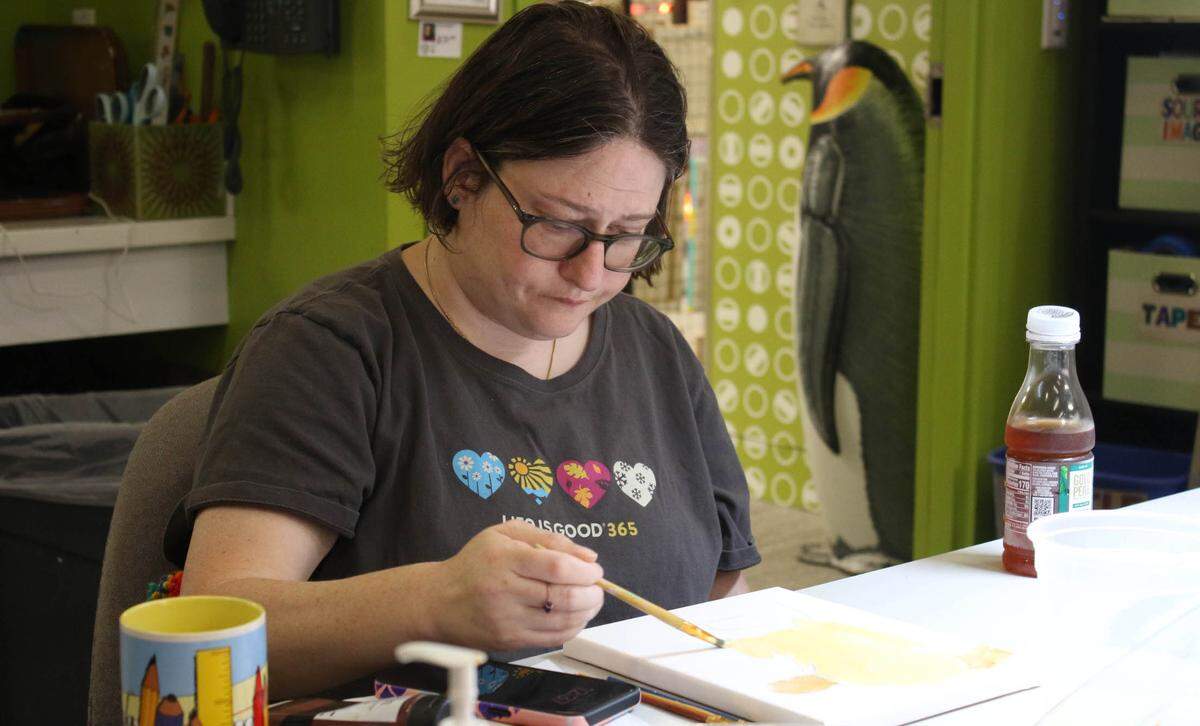
Artist Amy Isenberg, who specializes in animal portraits, has felt that support.
“I like talking with them and getting to know them and the confidence they give me when I struggle,” said Isenberg, a three-year Emerging Artists participant.
Sometimes artists in the studio collaborate on a piece.
“I like watching the evolution of everyone’s art. You can tell when they’ve been working in the studio together, because you can see where one has rubbed off on the next,” said Courtney Fitzgerald, community relations manager for JCDS.
Building their confidence and community is a real driving force for Emerging Artists.
“Even if you have a mental disability, you can go further than you think,” Sikes said.