
‘You have to know how things react in space.’ These JoCo students shoot for the moon
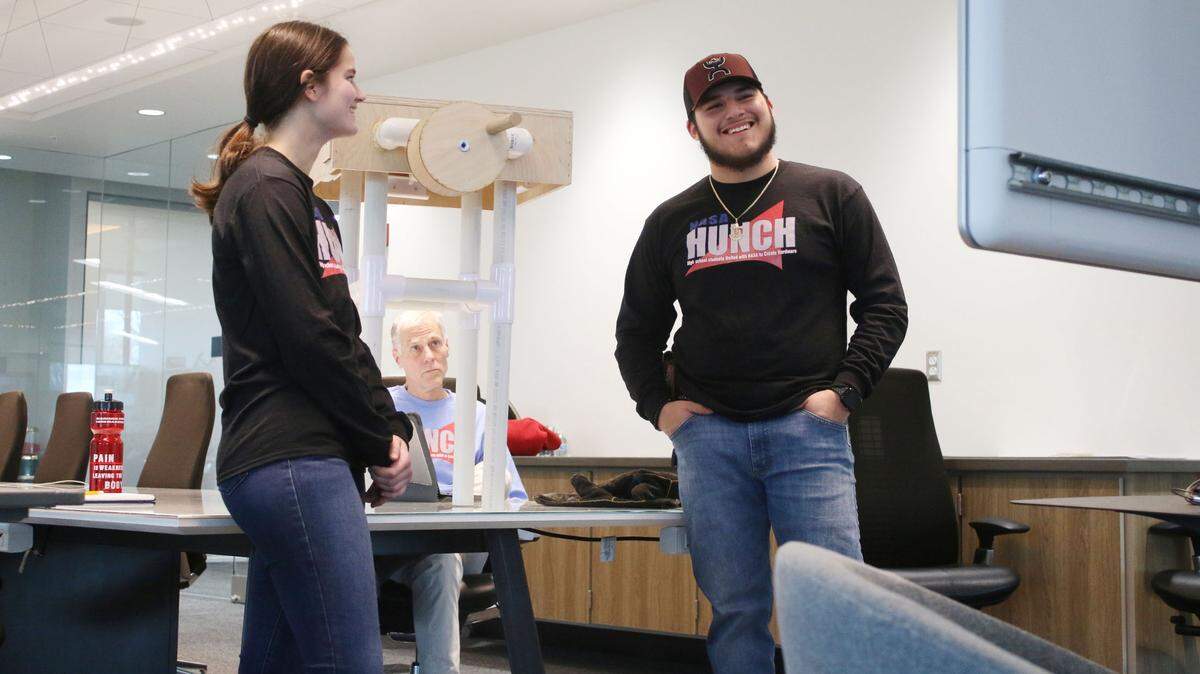
A group of Shawnee Mission engineering students have been working on projects that are out of this world — literally. As part of NASA’s HUNCH program, they’re coming up with designs that astronauts could use when lunar missions resume soon.
Eight high school students, working in pairs, spent the past semester designing and building prototypes for their choice of 11 projects outlined by NASA. They are the only students in Kansas — and the whole metro area — taking part in the program, and this was the district’s first year to try it.
In addition to researching and developing their projects, they also got the chance to present their ideas to and consult with a senior systems engineer at NASA’s Jet Propulsion Laboratory.
“I was surprised how much they were engaged. The engagement level was high because the problem was real, and also the stakes are kind of high, because it’s for a serious issue,” said Greg Thiel, engineering instructor.
All the students are part of the engineering program at Shawnee Mission’s Center for Academic Achievement.
Samantha Herron and Luis Montanez, 17-year-old seniors from Shawnee Mission North, recently presented their project, a worktable meant to be used outside on the moon’s surface.
“We just felt like it was something obtainable, that we could actually try and improve for them. It’s something we could build here,” Samantha said.
The table had to be able to hold 100 pounds, be suitable for the moon’s surface and be reasonably easy for the astronauts to assemble.
“They gave us 10 requirements, so we couldn’t just go at our ideas out of nowhere,” Luis said. “We had to follow those requirements. If we want it to hold 4 meters of board, how are we going to hold that? The outlets — how are we going to prevent the dust from going into the outlets?”
Because certain items are a little expensive for a school to purchase, they built their prototype with PVC pipe and wood, even though their actual design calls for aluminum.
And of course, when building something for the moon, you have to keep in mind the differences in the environment, like extreme temperatures and gravity.
“It’s a fun way of seeing things. What if I drop this? Is it going to float? Is it going to fall straight down? You have to be in their shoes. That’s where the research comes in, because you have to know how things react in space,” Luis said.
They faced an additional challenge in that many students participating in this across the country are in a year-long class, but Shawnee Mission’s engineering design and development class is only one semester.
That made them step up their timetable — and the mentors from NASA were happy to help accommodate them.
So far, they’ve had three video conferences with their NASA mentors, including one in December that was a critical design review. Normally, that critical review would come in February. Samantha doesn’t look at it as a disadvantage, though.
“I thought it was really good feedback, and since we do have a lot more time than other teams (after the review), we’re able to take that feedback and put that into our project and improve it,” she said.
She and Luis plan to continue working on their project, even though their class is over. If NASA chooses them, they’ll get to travel to the Johnson Space Center in Texas to present their idea in April.
The review itself was very complimentary toward their project.
“I was just happy the students got that kind of validation of their work. That team in particular has worked very hard,” Thiel said.
Overall, NASA may use all or part of the designs students submit in constructing equipment for the lunar mission.
Samantha and Luis estimate they put in more than 100 hours, both in and out of class time, to develop their prototype.
“I enjoyed being able to work with my hands, creating an idea and being able to actually make it,” Samantha said.
Thiel is pleased with what his students have learned from the process.
“Students often are creative. They can design, but the design won’t go anywhere if you can’t communicate it to someone else,” Thiel said. “The students will run into situations where they have to explain something technical to someone who doesn’t have technical knowledge. That is one of the greatest things they learn in this program.”
This story was originally published January 4, 2023 at 5:30 AM with the headline "‘You have to know how things react in space.’ These JoCo students shoot for the moon."