
Nan Kanter is ‘A bridge to bring people together’
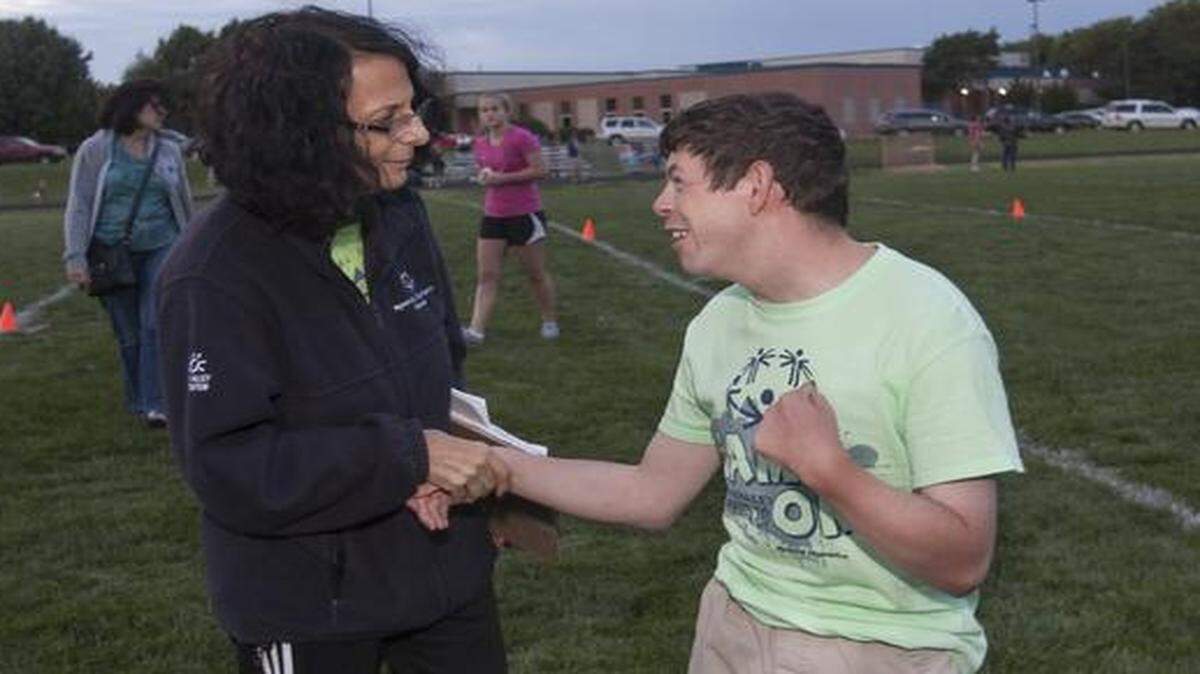
Nan Kanter does not stay put. At least, not for long.
In any given week, you might find her in a number of places: on the soccer field at Leawood Middle School, running from lane to lane at AMF College Lanes in Overland Park, or in the Aquatics Center at Blue Valley Recreation.
She’s not an athlete, although her stamina and energy might tell you otherwise. Instead, she is the motor behind Blue Valley Special Olympics.
For 25 years, Kanter has been a coach, a parent, a master organizer and the point person for families and athletes involved in the program.
In the late 1980s, Kanter and her husband were looking for a way to get their son, Michael, who is disabled, involved in programs around Johnson County. When Kanter found minimal options, she took matters into her own hands.
With a degree in special education and years of experience in the classroom as well as in her personal life, she partnered with the Blue Valley School District and the Blue Valley Recreation Commission to form the first Special Olympics team in Blue Valley. Now, thanks to Kanter, the options for kids in Blue Valley with special needs are plentiful.
And as the number of athletes and sports in Special Olympics continued to grow, so did Kanter’s desire to expand the community she was helping.
After Special Olympics, she started Blue Valley Special Populations, offering social events outside of athletics for kids and adults with disabilities.
And in 2009, Kanter created Ahoovim, an organization built as a spiritual and social outlet for disabled adults in the Jewish community.
Kanter was recently honored by KC Kollel, a group created by local rabbis to educate Kansas Citians on Judaism, for her creation of Ahoovim.
The night was a celebration of Kanter and the program she helped found, but it was also a chance to recognize what she’s done in Johnson County.
After all, Kanter has done more than plan events and fill schedules. She has built a community that makes those in it feel like they belong.
“She’s impacted the lives of hundreds of individuals, and really, when you extend that to all of their family and friends around, you’re talking about a large population of people,” said Rabbi Binyomin Davis, who works with KC Kollel. “We all are trying to leave our mark on the world, and Nan’s somebody who’s just gone ahead and done it and she’ll continue to do it as long as she’s able to.”
After Kanter’s son Michael was diagnosed as developmentally delayed at 15 months old, she quit her job as a special education teacher to focus on raising him and his older brother.
The more time Kanter spent trying to get Michael involved in the community, the more she realized the lack of options for kids like him.
Sports were a natural outlet for Michael, even as a young kid. Kanter’s husband, Sid, played tennis on the USTA Missouri Valley circuit before becoming the tennis director at Homestead Country Club.
At the time, Special Olympics programs existed in Olathe and Shawnee Mission, but not in Blue Valley.
When members of the Blue Valley school district called Kanter to a meeting about Special Olympics, she became an integral part of the organization’s birth.
Working with the Blue Valley School District and the Blue Valley Recreation Commission, Blue Valley Special Olympics was born.
In 1989, Blue Valley Special Olympics officially started with 10 athletes and a basketball team. It has evolved into a program that offers something for everyone, from cheerleading and swimming to soccer and bocce ball.
Blue Valley Special Olympics now has more than 150 athletes from age 8 to 60, some the original athletes from the first year, and 13 different sports to participate in.
“A lot of the athletes, they truly care about the sport, but they also love coming and being with their friends,” Kanter said. “So often you think of someone that has special needs, that they’re not capable of doing certain things. Many are very good athletes and they’re always learning new skills, so it makes me happy when they’ve accomplished something like that.”
But Kanter doesn’t do it alone. With the help of parents, volunteers and care providers, kids and adults with special needs are able to socialize through Special Olympics.
On a late Friday afternoon at AMF College Lanes in Overland Park, neon pink, purple, green and orange balls slide and crash into white pins as the Special Olympics athletes practice their skills.
Chicken tenders and mini pizzas are ordered and smiles spread across the faces of the athletes as well as the faces of their parents, volunteers and care providers.
Bowling bags, backpacks and cups of soda litter the area. Some bowlers stay focused on their release, while others look to their audience for encouragement.
Between the crash of the pins and the chatter, applause and praise rings throughout the bowling alley.
Kanter is easily noticeable in her lime green hoodie as she moves from lane to lane, answering questions and making sure the athletes are set up correctly.
One athlete approaches Kanter and points proudly to the score above his lane.
“111? That’s awesome!” Kanter exclaims, as she ushers him underneath the scoreboard and snaps his picture.
When she’s not snapping pictures, Kanter is helping the bowlers with their techniques and giving them tips to help them improve.
In the fall, the Blue Valley Blue Streaks Special Olympics Bowlers meet here each Friday to practice bowling before their official competitions.
Sandy Schweikert’s 30-year-old son, Marc, became involved with Blue Valley Special Olympics five years ago after they moved to Kansas.
“This is probably the best program for special-needs young adults that I’ve ever been in,” Schweikert said.
Because her husband is in the military, they’ve moved from state to state and been involved in a number of different Special Olympics programs. None, however, has compared to Blue Valley.
“There’s a large variety for the kids,” Schweikert said. “There is something almost every month of the year.”
Another thing that sets Blue Valley apart from other Special Olympics programs, according to Schweikert, is the affordability. Blue Valley Special Olympics charges a small fee to participate in each sport, though it waives the fee for those who can’t afford it.
“Nan works very hard to get donations, to keep it affordable,” she said.
Those donations are raised through the annual Bowl-a-Thon, an all-night affair Kanter started shortly after Blue Valley Special Olympics was established.
Last year’s Bowl-A-Thon raised more than $50,000 for Blue Valley and included more than 300 participants, a stark difference from the first event, which raised about $3,000 and had about 35 participants.
It’s the organization’s only fundraiser, and the money raised at the annual event goes toward game uniforms, equipment and awards.
But Special Olympics benefits more than the athletes — it also allows parents to compare notes, provide insight and form friendships with each other.
“It’s a bridge to bring people together,” Kanter said. “I think that’s an added plus.”
“It’s really kind of a support group,” Sid Kanter said.
Shortly after Kanter started Blue Valley Special Olympics, she recognized another need in the special-needs community.
Although Special Olympics in Blue Valley continued to grow, there were adults and kids with disabilities who needed a way to become active and social that didn’t involve sports.
With the help of the Blue Valley Recreation Committee, Kanter created the Special Populations program, which plans social events for kids and adults with special needs.
Of all of the events, which include a girls’ and guys’ night out, a hayride, cooking classes and open gym sessions, the dances are by far the most popular.
“I think Nan just has a genuine passion for the work that she does and for working with special populations,” said Steve Baysinger, executive director of Blue Valley Recreation. “She has taken it a step further with special pops participants who may not necessarily feel like sports is their forte.
“She’s always looking at what else can we do and adding a variety to what is available,” Baysinger said.
Regardless of what stage of life the participants are in, the events Kanter plans are something they’ve marked in their calendars and anticipate each month.
“A lot of our participants have moved into some group homes,” Kanter said. “Several of them have jobs, some don’t have jobs, but they know they’ve got that special activity to look forward to.”
The dances, which occur about once a month, often bring in young adults who aren’t involved in Special Olympics or Special Populations, but hear about it through word of mouth.
Betse George’s son became involved in Special Olympics at age 6, and now, at the age of 27, has a whole network of friends close enough to call family thanks to Special Pops.
“It gives him a social network and things to do and things to look forward to, especially as they get older and they’re out of school,” George said. “Life gets a little challenging unless you have things to do, and all of Nan’s special programs have made for a really great social life for him.”
The behind-the-scenes work to organize the Special Populations events could be a full-time job itself, but Kanter doesn’t flinch.
She tries to lessen the work load by delegating tasks to others and letting volunteers take the reins when they’re able.
But as Special Olympics and Special Populations continue to grow, so does the list of events on Kanter’s calendar. She estimates that she still attends 98 to 99 percent of all events.
“I still, after 26 years, am enjoying what I’m doing, even though we keep getting bigger and it takes up more and more of my time,” Kanter said.
Although Kanter first developed Special Olympics to socialize her son, he wasn’t the sole motivation for the programs she created. Her eyes were set on an entire group of people in need.
“She amazes me,” Sid, Kanter’s husband, said. “She’s got a lot of energy. She didn’t do this for Michael, but the fact that we had Michael pointed out that there was a real void there.”
On a Sunday night at the Jewish Community Center in Overland Park, Kanter is hard to find among a crowd of people outside of a banquet hall.
Kanter’s petite frame is lost among the large group, who are there to honor her for her work in the Jewish community.
Five years ago, Kanter was approached by Rabbis Ben and Allan Gonsher from the KC Kollel, a Jewish organization focused on educating and engaging the Jewish community in the metro.
The rabbis needed Kanter’s help establishing a program for adults with special needs in the Jewish community, and together they created Ahoovim.
The Hebrew word for “beloved,” Ahoovim provides a social network for the adults who learn about Judaism through Shabbat celebrations, a mock pre-Passover, Sukkah hops and the Torah.
Now run by Kanter and Rabbi Elchanan Schulgasser, the program combines Judaic learning and a social activity about once a month and has about 15 participants.
At the event to honor Kanter, members of Ahoovim shook hands and welcomed each new guest as they walked in, enthusiastically filling their roles as greeters.
Kanter navigated the clusters of people spread throughout, warmly greeting each and making small talk as wine and hors d’oeuvres were served.
It was a large crowd for a Sunday night, with a mix of people involved in all three of Kanter’s programs. A dinner was served and speeches delivered in Kanter’s honor, all to recognize a woman who saw a need and filled a void years ago for the Johnson County community.
“Nan has stood up and always championed for those with special needs around Kansas City,” Davis said. “Her work is magnificent, it’s unrelenting and tremendously patient. Somebody like that is in my mind a hero. It’s somebody the commuity should be thanking and honoring.”
Debbie Sokoloff met Kanter at a therapeutic horseback riding class for children with disabilities when her son Daniel was 9.
Through Special Olympics and the Special Populations programs, Daniel and Kanter’s son, Michael, have formed a long and steady friendship. They’ve been to hayrides together, competed in different sports and stayed connected as they grew older.
For some, Sokoloff said, it becomes challenging to maintain relationships with others when school is over and interacting with others at social events becomes less organic. But thanks to Kanter, those challenges are easier to overcome.
“Daniel has been able, through Nan’s work, to have friendships with other special-needs adults,” Sokoloff said. “I think socially, it’s so important. Because I don’t think other people realize how hard it is for these guys who don’t have the ability to drive; many of them don’t think about calling somebody.
“They really need something external, an event or somebody who’s willing to organize a get together in order for them to have friendships, and what’s so crucial to being a whole human being is having social relationships other than your family. To me, that’s a treasure.”
Blue Valley Special Olympics Bowl-A-Thon
Nov. 8 at AMF College Lanes
Minimum donation of $25
For more information, go to www.bluevalleyrec.org.
This story was originally published September 30, 2014 at 8:09 PM.