
For Johnson County’s volunteer firefighters, working in the fire service is a lifestyle
Mike Shaw keeps a change of clothes hooked on his bedroom door, just in case he has to respond to a fire in the middle of the night.
He also keeps his truck stocked with gear — his boots, gloves, a coat, a helmet — so he can respond quickly if a significant structure fire breaks out while he is at work or home.
“I just want to be able to respond as quickly as possible,” he said.
Shaw volunteers with Fire District No. 1 of Johnson County, one of a handful of fire districts and departments in the county that use volunteers to help keep the fire service running smoothly.
Although those volunteers might pay their bills by working at an insurance brokerage firm or a remodeling business, they spend hours and hours each month doing the job of a paid firefighter.
They are driven by the desire to serve their community, sometimes in hopes of eventually doing so full time.
Many spend nights in fire stations and spare time in training. And when a call comes in, they head out to the scene.
“It’s a lifestyle that we all live,” said Cory Neal, a Fire District No. 1 volunteer captain.
For Shaw, that lifestyle means being ready to respond if a fire breaks out and he’s available, even if his everyday life is interrupted.
Because at the end of the day, he knows he’s helped make someone’s worst day a little better.
“Just knowing that you can help somebody like that, it just makes you feel good,” Shaw said.
Shaw, 57, parts director for McCarthy Auto Group, figures he puts in at least 25 to 30 hours a month for the fire district — weekend shifts, trainings, special events, plus time spent responding to calls.
The time he spends volunteering can vary depending on how many calls the department receives. He might respond to four or five calls in a day or six to eight calls in a month for the district, which spans 100 square miles of southwest Johnson County.
Once, he had to leave work early to respond to an apartment fire. Other times, he has left a restaurant or a family event to lend his hand at the scene.
For Shaw, that’s just part of the commitment he’s made as a volunteer firefighter. It’s not something he can just decide he doesn’t want to do.
“If you make the commitment, you have to be prepared to commit 100 percent,” he said.
Commitment has marked Mike Shaw’s three years volunteering with the fire district, which is staffed by a combination of paid and volunteer firefighters.
That dedication sometimes has to happen in spite of difficult situations. Shaw still recalls the first fatality accident he responded to. As Shaw was heading back to the station, the gravity of the day hit him: He’d never seen anyone die like that.
“When you make the commitment, you’ve got to know that kind of stuff is going to happen,” he said.
Shaw has had to dedicate himself to learning the craft of firefighting. He didn’t have any training with the fire service when he started, so he worked every weekend and stayed overnight a few times to gain the skills he needed. He bought training books and equipment so he could continue learning the intricacies of the fire service.
He had to be sure he knew what he was doing before he could do work similar to a full-time firefighter.
“There’s just so much to it, it’s unbelievable,” he said.
In fact, he realized that by the time he learned everything he needed to be a career firefighter, he’d be ready to retire. So he’ll remain a volunteer firefighter as long as he feels able because he finds gratification in helping people.
But if he’d known 25 or 30 years ago what he knows now, he’d be a full-time firefighter.
Shaw’s wife, Lora Shaw, said she is absolutely supportive of her husband’s time with the fire service and is proud of his contributions.
“I’m thrilled for him that he’s found something that he can be passionate about,” she said.
Across the country, volunteers make up the majority of the fire service.
The National Fire Protection Association estimated there were more than 1.1 million firefighters in the U.S. in 2012. Almost 70 percent were volunteers. Ninety-five percent worked in departments serving fewer than 25,000 people.
A tradition of volunteerism is part of how the fire service evolved, said Ken Willette, public fire protection division manager at the association. From colonial times, fire departments were neighborhood based, and that sense of community and camaraderie has been a part of the service ever since.
“Those folks are saying, ‘If it works, and it ain’t broke, don’t fix it,’” he said.
In some cases, sustaining a volunteer force is impractical. Several factors led the Merriam Fire Department to end its volunteer program a couple of years ago.
Firefighters needed more and more education and potential volunteers couldn’t give the time. Plus, the people who volunteered were mostly looking for full-time positions. By the time the department trained them, they would leave to take a paid job elsewhere, said recently retired Fire Chief Bob Pape. The department is now merging with Overland Park’s.
Shawnee ended its volunteer firefighter program in 2009 as interest in volunteering waned and the department hired more career firefighters to keep up with city growth, Fire Chief John Mattox said.
Yet volunteers still play a vital role in a few Johnson County fire departments and districts.
Some use a combination of paid and volunteer firefighters. In those cases, volunteers provide needed additional hands on a call, said Mark Billquist, interim chief of the Northwest Consolidated Fire District, which uses both. That’s another firefighter the district can put on a truck when a call comes in.
“It just seems like every additional firefighter helps so much more,” he said.
“It’s a benefit of knowing you are sustaining something that’s an important part of our heritage,” Deputy Fire Chief Michael Casey said.
In the city of Lake Quivira, the fire department is staffed entirely by volunteers who serve a small community where the costs of hiring full-time firefighters would be astronomical. And in a residential community with about 400 homes, most of the people the volunteers serve are family or friends, said Fire Chief Mark Stephan, who works as a regional sales manager at Bullard.
“It’s almost always personal, and that is probably the driving motivation,” he said.
That close sense of community was a big draw for Assistant Chief Bill Biron, who has been with the department for about 30 years.
“It’s just really a sense of giving back to the community in a productive and constructive way,” he said.
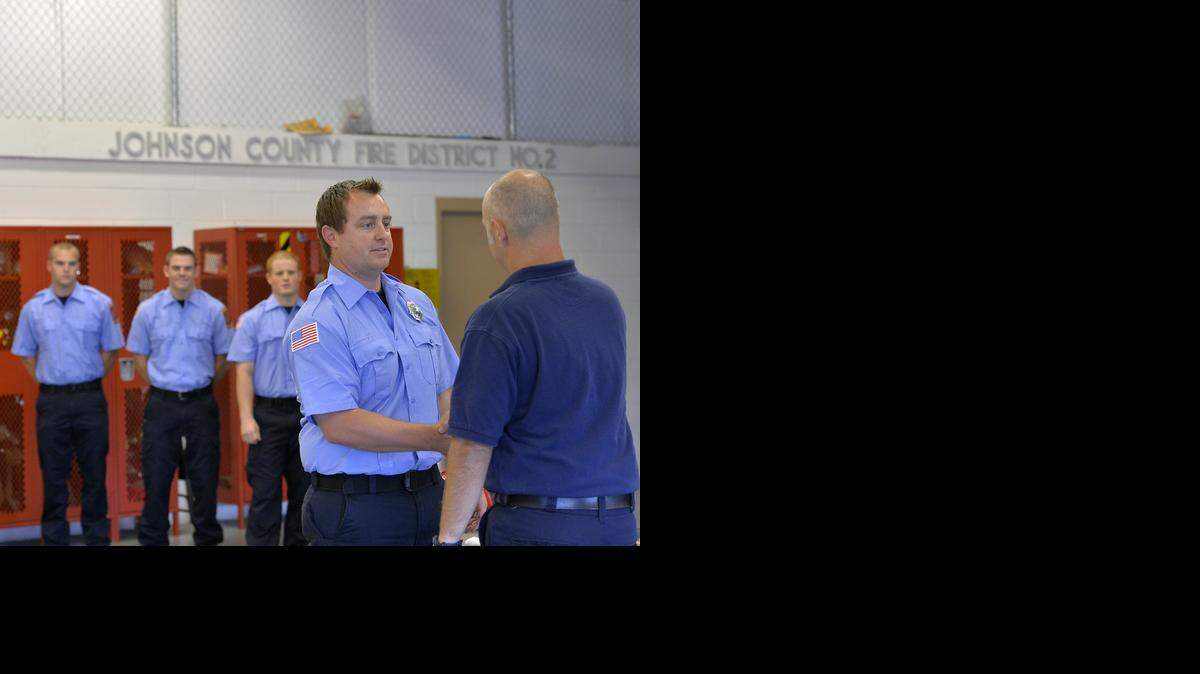
On a recent Saturday afternoon, about 30 people sat in the bay of Johnson County Fire District No. 2’s Spring Hill station. Bright silver badges lined a table in front of them.
Cory Sapp, 27, walked to the front of the room, where Capt. Brad Davis pinned a badge to the blue button-up shirt all the recruits received to wear that day.
Sapp was among eight volunteer firefighters who attended the day’s graduation. He and the other recruits spent just over a month learning what it takes to volunteer in the district, which uses both volunteer, part-time and full-time firefighters.
“That was probably the happiest moment in my life so far, besides being married,” Sapp said.
During training, Sapp spent as much time as he could at the station, trying to take in as much as possible — studying the district’s roads and intersections, learning the trucks and asking a lot of questions.
“Learning their way of doing things was literally what we did all day long,” he said.
Earlier this summer, Sapp was at the station training when a house fire call came in, but he didn’t expect to go to the scene. Instead, the battalion chief told the new recruits there to hop in his truck if they wanted to come. Then they hauled across the district to Sapp’s first fire.
He and the other recruits went to work, grabbing ladders and tools and hoses and watching the other firefighters. Afterward, he helped clean up the scene.
Moments like those show him that all the training he’s been going through pays off, and he has the chance to help someone in need.
“The fact that we can do something to help out, that’s the exciting part,” he said.
Sapp is working toward ways to help even more. On top of volunteering with the fire district, he is taking classes at Johnson County Community College that will prepare him to apply for paramedic school. Eventually, he wants to become a fire medic and land a full-time job in the fire service.
“It’s a lot of work ahead of me, but you have to pay your dues in the fire service,” he said.
For many Johnson County volunteers, their time at the station is a stepping stone into a firefighting career.
“This does get your foot in the door,” Sapp said.
Many municipal fire departments require new hires to have some kind of experience, Billquist said. Volunteering serves as a training ground for people interested in the fire service to get that exposure.
Plus, volunteers create a ready pool when the districts they volunteer for are looking to hire. When a full-time spot opens up in Fire District No. 1, the district often hires from its volunteer roster, Battalion Chief Trig Morley said.
At the Olathe Fire Department, volunteer experience can be a big plus when it comes to landing a job. Though the department doesn’t have volunteers, the majority of people applying there have experience either as a volunteer or as a paid firefighter in a smaller fire department, Assistant Fire Chief Tim Richards said.
Volunteer experience shows him that job candidates truly cares about helping people, he said, since they’ve already been doing the job for free.
“That says a lot about how you’re wired up,” he said.
And having experience means candidates know more about what it actually takes to be a firefighter.
That includes not just fighting fires, but other aspects of keeping the station running: being on time, cleaning the trucks, sweeping the floors.
“There’s not a fire all the time,” Morley said. “We spend most of our time in the fire station training and cleaning and maintaining equipment and things like that.”
On a Saturday morning in De Soto, Brad King, a volunteer with Northwest Consolidated Fire District, crawled through the fire station’s bay. He was dressed in full firefighter gear, wax paper stuffed into his mask to obscure his vision.
Part of the station had been set up for a training exercise, and he and two firefighters were following a fire hose snaking under two trucks. Without the luxury of their sight, they had to figure out where they were.
Two other training stations were set up around the bay for the full-time, part-time and volunteer firefighters who had come in.
“Everyone’s expected to do the same job,” Billquist said. “They’re still saving the same lives, fighting the same fire.”
Even though they don’t take home a paycheck, volunteers are still generally expected to reach the same standards as their full-time counterparts.
Because when the fire trucks roll up, you can’t tell the difference between which ones are staffed by volunteers or full-time firefighters.
“In this department, it doesn’t matter if you’re volunteer, full time,” Neal said.
As soon as Tom Metzner, 41, arrives on the scene of a fire, the battalion chief doesn’t hesitate to line him up with the other full-time firefighters. He’s just one more part of the crew.
He’s accepted, trusted. And he’s living out a part of who he is.
“Early on in the fire department people kind of get baptized by fire,” said Metzner, an Overland Park Fire Department volunteer. “You find out real quick there’s not many people who are willing to run toward a burning building when everybody else is running away, so that really tests your character.”
Overland Park’s volunteer firefighter program is an unusual one in Johnson County. The department considers itself a career department but maintains a small group of volunteers as a way to pay tribute to its history. Plus, the volunteers offer extra help during major incidents.
The department primarily targets individuals who simply want to volunteer their time and aren’t interested in a firefighting career.
“I’m lucky to be part of that group, because they don’t need the volunteers,” Metzner said.
Although parts of the program are unusual, the work of an Overland Park volunteer firefighter isn’t. Metzner is required to put in 24 hours at the station each month, plus a training every other month. And even when he isn’t on duty, Metzner might still respond to calls.
“You kind of just drop what you’re doing and go,” he said.
Though the hours can be hard to predict, volunteering stays high on his priority list, so balancing his time isn’t much of an issue.
“It’s a passion, it’s more than a hobby,” he said.
In fact, it was enough of a passion that when a job transfer brought Metzner to the Kansas City area several years ago, he eventually settled down in Overland Park because the fire department took volunteers. He had volunteered with other departments in the past and wanted to continue serving.
And though he fights fires as a volunteer, Metzner’s full-time job focuses on preventing fires. As a senior loss control consultant at Lockton Companies, an insurance brokerage firm, he often works with companies to identify and correct potential fire hazards.
Although there’s no way to prevent every fire, Metzner’s volunteer work helps him coach his clients on ways to minimize the damage.
“So I get that aspect, and then I’ve got the fire department, which is a real passion, so I’m able to do two things that I love doing,” he said.
On a recent Saturday, a group of of Fire District No. 1 volunteers sat around rows of tables at a fire station in Gardner. They spent the morning in EMS training, and a pile of bag valve masks, used to help patients breathe, lay on a nearby table.
In between talking about their time in the fire service, they laughed and joked with each other.
“We have fun as you can tell,” Shaw said. “We became each other’s best friends.”
Another volunteer echoed him: “Brothers.”
In addition to the gratification of helping people, the friendships Shaw has formed in the fire service have made his volunteering worth it. It’s tough to pinpoint exactly what creates such a deep bond, but firefighters know no strangers, he said. If you’re a firefighter, you’re one of them.
“I know that if I go into a burning building with them, I don’t have to worry,” he said.
As the conversation wound down, a call blared over the phone at the edge of the room, a chest pain call at an assisted living center in town.
Most of the volunteers, assigned to the closest unit, jumped out of their chairs and dashed out of the room.
They were on their way to the scene.
This story was originally published September 16, 2014 at 9:25 PM.