
KC woman saw World War II from a different perspective
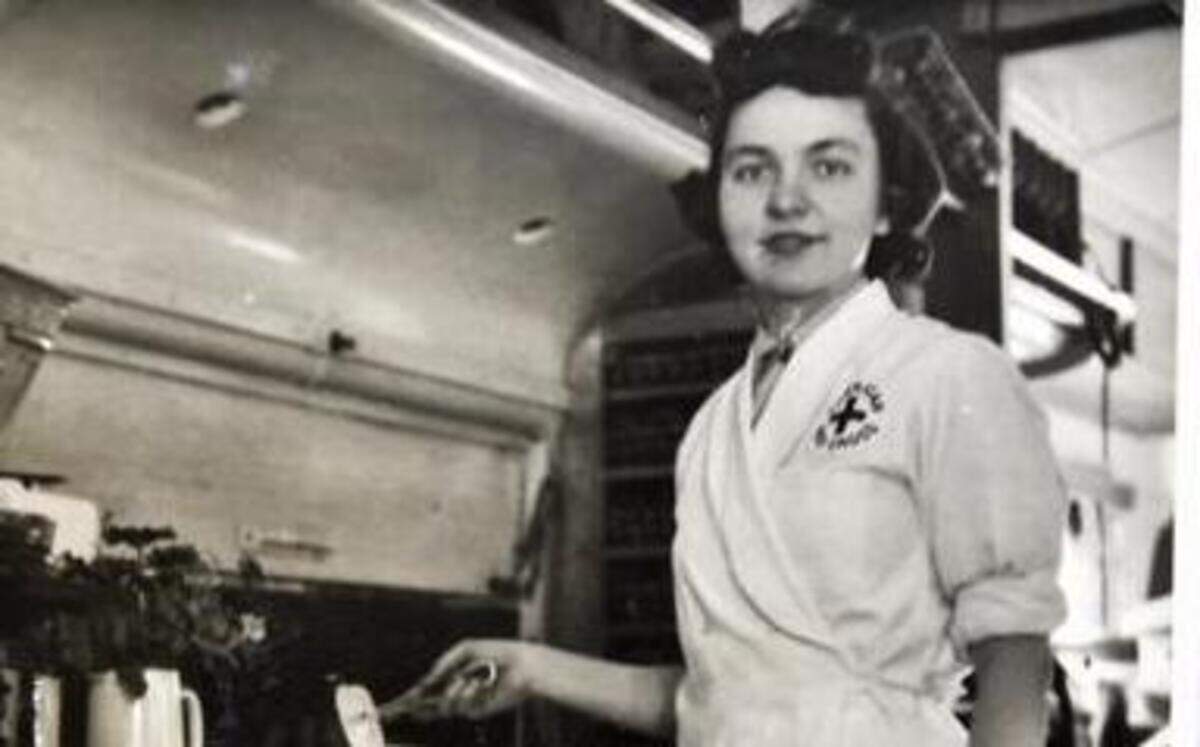
It was 1944, and 26-year-old Kansas City native Blanche Gangwere had been a widow for two years.
Her last name at the time was Barnes. Her first husband, the late Leslie Barnes, had been a second lieutenant and bombardier in the U.S. Army Air Corps. He was killed in North Africa in July 1942, when he was 27 and she was 24.
Her lingering grief over her husband’s death led her to sail across the Atlantic Ocean to Europe later in 1944. She stayed there for 15 months, and it changed her life.
Through it all, her music was with her. And at age 96, it still is.
In the spring of 1944, Gangwere was working on a master’s degree in music at Northwestern University in preparation to become a concert pianist. She went to see a movie one day, and she watched a newsreel about the “Clubmobile Girls” of the American Red Cross.
“It got me thinking about it,” she said at her home in Kansas City. “I was trying to find something (to do) that was related to the war, because everybody wanted to do something in World War II. It wasn’t like most wars. And I had just lost my first husband.”
Her first choice was the Women’s Airforce Service Pilots (WASP). She learned to fly and got her pilot’s license. But at 5 feet tall, she fell short of the WASP height requirement, and her application was rejected. She was disappointed, but not entirely.
“I’m not good at taking orders,” she said. “I had no interest in getting into the military.”
With the WASP out of the running, she applied to join the Clubmobile Girls, largely because it would enable her to travel while serving the war effort, she said. The application process was rigorous, she said, but she made it. Soon she traveled by ship to England.
The Clubmobile Girls was the brainchild of New York banker Harvey D. Gibson, the American Red Cross commissioner to Great Britain. He thought of it as a way of making Red Cross clubs mobile and taking them to U.S. soldiers in the midst of battle.
The Clubmobile Girls traveled in trucks to soldiers on the front lines and brought them coffee and doughnuts, cigarettes and magazines and other items.
Gangwere started her Clubmobile Girls service in England, and later served in France and Germany, traveling frequently to visit the soldiers in the field. She played a reed organ on the back of a Clubmobile truck at Sunday worship services.
In May 1945, she met the man who would become her second husband.
“Well, it was wonderful,” she said.
Another member of the Clubmobile Girls and she had been driving across Germany, trying to find the 12th Corps of Gen. George Patton’s 3rd Army, she said. An officer named McClung greeted her as she arrived at the hotel where she would be billeted in Regensburg, Germany. McClung was friends with George Gangwere Jr., a liaison officer in the 12th Corps who was from Youngstown, Ohio, and told Gangwere that “a cute little Red Cross girl just arrived.”
Gangwere had seen her a few weeks earlier while she was eating in the Army officers’ mess hall — her rank while in the American Red Cross was equivalent to a second lieutenant — at a base near Bad Neuenahr-Ahrweiler, Germany. Her future husband spotted her, he later told her. He had no chance to meet her that day, she said. But he didn’t forget her.
“He followed through,” she said.
They met, and soon he asked her out. They went to a dance on their first date. They spent about two weeks in each other’s company before she was assigned to Passau, Germany. Then they exchanged letters.
When he returned home from Germany around Christmastime 1945, he boarded a train from Youngstown and went to Kansas City, said her son, local attorney Robert Gangwere. She was back home by then.
He stayed about a week at her grandparents’ house, the southwest Kansas City house where she lives still.
He proposed, she accepted and they were married on June 25, 1946. The couple had three children.
George Gangwere died in 2003 at the age of 85.
Their son is writing a book about his mother’s life. The endeavor has opened his eyes.
“When I was a kid growing up, I always concentrated on my father’s service overseas,” he said. “But when I realized my mother served over there, too, I became really intrigued by it.
“The men were drafted; they didn’t have a choice. They were happy to serve, but they didn’t have a choice. My mother had a choice. I think her bravery was really out of the ordinary. I was always really proud of her for that. There were instances when her life was at risk.”
German V-1 flying bombs, also known as “buzz bombs,” flew nearby at times while she was serving with the American Red Cross. Their motors would suddenly shut off, and they’d begin their descent to explosion.
“Praise the Lord and keep the motor running” was commonly heard, she said. One time a buzz bomb landed across the street from where she’d been living.
“I’m not a person who gets afraid,” she said. “I got under the bed (when serious threats occurred). I got shot at once. A trigger-happy American sentry took a shot at me, in France.”
Coming back home brought a sometimes-difficult transition, she said. It also brought her back fully to her music. She’d started playing piano at age 9 and never stopped.
She spent five years working on a doctorate in music, during which she found a lack of reference books on certain aspects of music history from the fourth through the 16th centuries. So she used the work she’d done for her doctorate and wrote three reference books on those periods, published in 1986, 1991 and 2004.
“Those books of mine are saving a lot of doctoral students a whole lot of time looking for things,” she said.
Her focus on music continues. Most days, she’s up around 10 a.m., has lunch around 11, does her exercises, plays her pipe organ — on the first floor of her home — and works on her compositions for three or four hours.
She’s compiling about 10 of her compositions for a CD to give to family and friends. Her musical taste runs mostly toward classical, starting with Bach and Mozart, but she leaves room to stray from that standard.
“I like The Beatles,” she said.
In 1992 she formed a committee to ensure that any performing arts center that might be built in Kansas City would have a pipe organ, her son said.
Gangwere has attained recognition for her music, and — along with her Clubmobile colleagues — for her American Red Cross Service. In May 2012, the U.S. Senate passed a resolution recognizing the contribution the Clubmobile Girls made to the war effort.
While rendering that service, she witnessed some of the war’s terrible realities. She passed by the Dachau concentration camp a couple of months after the war ended in Europe. Former prisoners stood at the camp’s fence, looking little more than skeletal.
But the soldiers are what she remembers most.
“All those men — I can’t get over how wonderful they were,” she said. “Most of them had been drafted. They didn’t want to be there. They did their job and didn’t complain. They were just so glad to see an American girl. I was just so impressed with the way they were facing what they had to face.”
This story was originally published July 15, 2014 at 3:08 PM with the headline "KC woman saw World War II from a different perspective."