
Solar-powered cars in 1,700-mile race stop overnight in Overland Park
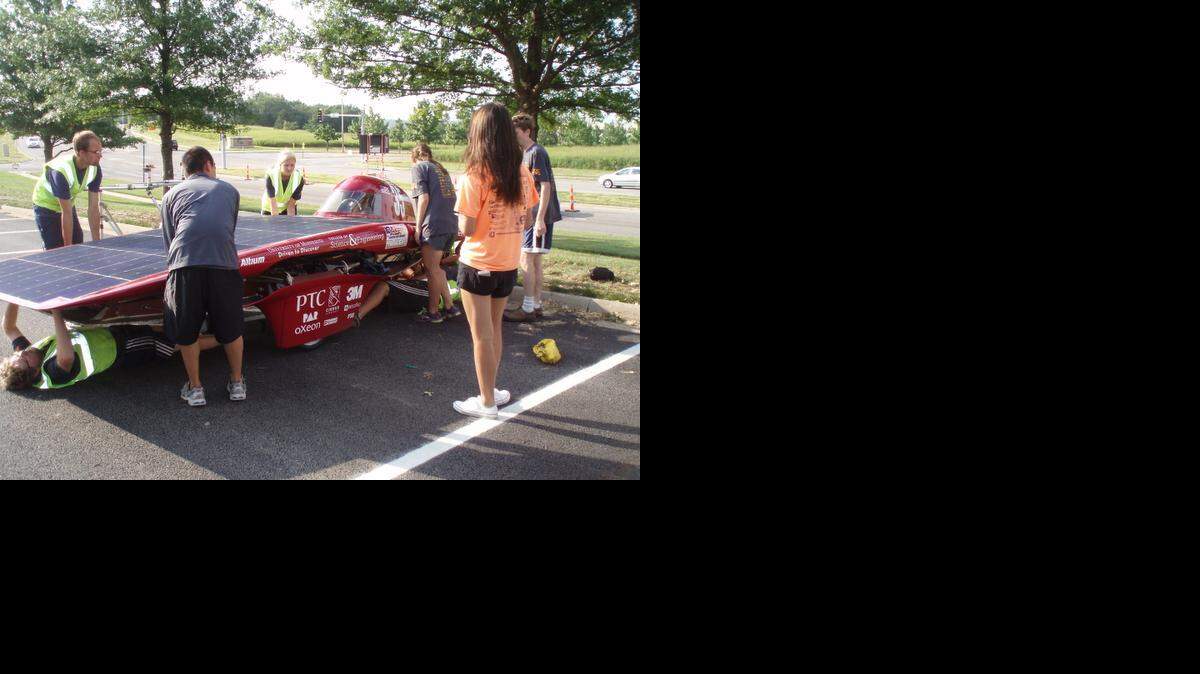
Eight solar-powered cars silently slipped into Overland Park on Thursday evening.
The cars, arriving from the previous day’s race stop at the Kansas Aviation Museum in Wichita, belonged to teams participating in the American Solar Challenge, a biennial college-level competition that the Innovators Educational Foundation began in 1990.
Teams are made up of students from universities across the nation, as well as some international schools, including Polytechnique Montreal and Qazvin Islamic Azad in Iran. The teams are not necessarily made up of engineers.
Principia College in Elsah, Ill., is represented but does not have an engineering program.
Gail Lueck, the event coordinator, said, “Many teams have engineers as well as people from other majors. It is important to note that the American Solar Challenge is a multidisciplined project — teams are responsible for the design and build of the solar car as well as doing their own fundraising, PR, and project management.”
This year, 20 teams designed and built their own solar-fueled cars, which run on a small electric motor mounted inside one of the wheels. Earlier this month, each team went through a process called scrutineering, a three-day series of inspections that also tested the skills of the drivers. Three teams were unable to pass scrutineering.
In order to qualify for the cross-country portion of the challenge, the remaining 17 cars competed in the Formula Sun Grand Prix, a three-day track race in Austin, Texas. Only 11 teams moved on from there.
After that, one team withdrew, one did not register for the cross-country portion and one was disqualified late in the process, leaving just eight teams to participate in the more than 1,700-mile course that runs from Austin to Minneapolis. The teams are crossing seven states in eight days, running through Monday.
“It is our hope that the disqualified teams are able to fix the items that kept them out of this year's event and return in 2015-2016 ready for the next challenge,” Lueck added.
The goal of the American Solar Challenge is to explore the possibilities and benefits of solar-powered vehicles and to give students the opportunity to test their innovations in real-life driving conditions.
Some of the cars are capable of reaching speeds of 100 miles per hour, but for the road challenge, most travel at speeds between 35 and 65 mph, depending on cloud coverage and how much energy is stored in the vehicle.
Team coordinator, Evan Stumpges, said that not much of the technology has changed over the past few years.
“We have seen an increasing number of teams switching away from old hub motors from NGM (Nu-Gen Mobility) to new motors from Mitsuba (based in Japan),” he said. “The new motors are still permanent magnet brushless dc motors but they use a radial flux configuration as opposed to axial flux.”
Stumpges said there have been “marginal improvements” in solar cell efficiency and lithium battery capacity since the 2012 competition.
“The cost of solar cells continues to drop significantly which is helping to lower the cost of entry for new teams looking to compete in the event,” he said.
Engineering firm Black & Veatch hosted Thursday’s stop, and at 9 a.m. Friday the company’s chief administrative officer, Jim Lewis, waved the green flag at the starting line, sending the competitors to Omaha.
The winner of the challenge will be the team that completes the route in the shortest overall elapsed time.
Follow the cars on Twitter at ASC_SolarRacing or on the American Solar Challenge Facebook page.
This story was originally published July 25, 2014 at 6:58 PM.