
Mizzou records give a rare peek at a campus constant: grade inflation
Want an easy A? Steer clear of R. Lee Lyman’s Fundamentals of Archaeology. He’s flunked students at the University of Missouri for decades.
In a sophomore class of 25 students in 2014, fewer than half earned an A. Two got D’s and two flunked. Last fall, only two people in the course scored an A. Four failed. In 2012, half of the dozen students in his archaeology class tanked.
What gives?
“I’ve used the same grading scale for the 30-odd years,” said Lyman, an anthropologist and now professor emeritus.
That makes him an academic oddity. Across the country at places like MU, at less selective schools and on the elite campuses of the Ivy League, grades keep going up. Professors such as Lyman take an ever lonelier stand to hold steady on the value of an A or a B.
Some analysts say grade inflation may be topping out simply because there’s nowhere higher to go. Some schools have begun experimenting with the A-plus, hoping to create room atop the crowded scale. Experts say we’ll sort the great from the good by running GPAs out farther beyond the decimal point.
In national surveys, faculty say they feel pressured more to boost grades than to keep them constant. Some of their colleagues urge them to resist inflation, but students, parents and campus higher-ups can subtly or bluntly lean on them for grading generosity.
A respondent in one national survey — voicing what faculty say privately — suspected his academic department lost out on university teaching awards that rely heavily on student evaluations. Strict grading doesn’t win much love from the student body.
Studies have shown that the higher the grades students expect they’ll get in a course, the stronger the evaluation they’ll give an instructor. College teaching careers hardly turn on those marks from students alone — evaluations from other faculty, published research, the ability to win grants can trump them — but they matter.
Students also tend to shop for courses that produce the most A’s and the fewest F’s.
“Everybody looks to find where they can get easy grades,” said Kurt Diable, an MU student from Liberty.
Professors who find too few students taking their classes risk their status at a school and their ability to stay on the faculty.
A 2000 study found that adjuncts gave higher grades than their peers. Those short-term or part-time instructors shoulder a growing portion of the teaching load. In 1971, they represented about one in five instructors. Forty years later, they made up more than half.
“In most cases, (adjunct instructors are) evaluated solely on student evaluations,” New York University education professor Jonathan Zimmerman wrote in an essay last month. “Who can blame them for trying to gin up their scores? After all, their livelihoods are at stake.”
Grade inflation — yesterday’s B student becomes today’s A-minus scholar — reflects a change in campus culture, said Stuart Rojstaczer. He taught environmental science, geophysics and civil engineering at Duke University before leaving to write a novel and study how grades have risen. His recently updated research shows them rising 0.1 points per decade without pause for 30 years. His findings conclude A’s are now three times as common as in 1960.
MU, in a way that few universities reveal, lists all the grades given in its courses from 1997 on. An analysis of those numbers reveals the average grade rose from about a B (slightly below 3.1) to B-plus (just shy of 3.3) over the last 18 years. (MU notes that the figures could exaggerate grade inflation because they include graduate classes — a growing part of the university and a level where A’s have long been the default score.)

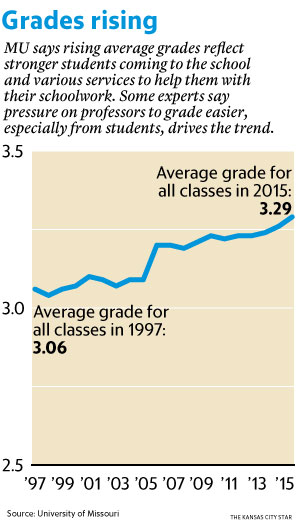
Rojstaczer said MU’s grade inflation puts the school at about half the national average.
The first national spike came in the 1960s and ’70s, he said, as professors worried that grading someone too low might jeopardize the student’s ability to stay in school. Kicked out of school, they could get drafted into the military. That leveled off for a time when the draft disappeared.
But grading rose again in the late 1980s and early ’90s. The latest ballooning of B’s into A’s, Rojstaczer said, reflected a cultural change.
“Students became customers rather than acolytes,” he said. “When you treat a student as a customer, the customer is always right. And the student customer wants a higher grade.”
Holding the line
Lyman, the one with the demanding archaeology class, concedes that even he hasn’t stuck to the standards he once set.
“I never thought grading on a curve was a very good idea. At some point, 20 percent on a test becomes an A,” he said. “(But) I feel like I’ve dumbed the exams down.”
Essay questions count for less. He includes multiple choice and true/false. Still, some kids don’t make the cut. Writing skills and the ability to think critically and express coherent thoughts have fallen as a greater percentage of high school students move on to college than did a generation ago, he said. Lyman said more students come to Columbia less prepared. (University administrators say students arrive better prepared.)
He pays a price for the grades he gives out. “I’ve had parents call me at home in the evening and curse at me for flunking their student,” he said.
Lyman said he feels little direct pressure from the university brass to go easy. Several years ago, he fielded a registrar’s question about how he grades. He said students get the grade they deserve. “That’s the last I heard of it.”
A few times over his career, faculty asked why he sets the bar so high.
“I take that as a compliment,” Lyman said. “I think what they’re saying is, ‘Hey, you might want to rethink how you award grades.’ ”
Like his archaeology class, MU’s Principles of Microeconomics has tripped up scores of students over the years. Dave Mandy, who headed the economics department for 10 years, said he’d never been asked by administrators about difficult grading.
“Conversely,” he said in an email, “we never receive praise from above for upholding high standards. So why do we do it? Because we think it is the right thing to do. Grades in our classes should mean something.
“But it comes at a cost. Instructors who uphold high standards endure more complaints and inquiries from students and parents and usually get lower scores on the evaluations students complete at the end of each class.”
A for a reason
Analysts caution against singling out high grades in a class as proof of falling standards. Honors classes, for instance, tend to produce abnormally high grades. But those courses draw the most ambitious, high-achieving students.
Introductory classes — think again of Lyman’s archaeology class — can produce lower grade averages. They’re populated by sophomores, freshmen and students taking classes unrelated to their majors. The subject matter is often new. Senior level classes, on the other hand, produce higher grades because they’re filled by students who have largely gotten the knack of a particular field.
Nursing, education, fine arts, the humanities and other fields have historically given higher grades than the hard sciences. Professors who grade too hard risk the employment and graduate school prospects of their students competing with graduates from other schools.
Structurally, some areas find themselves in a system that’s likely to produce higher grades. The MU numbers show, for instance, large numbers of A’s for some music courses.
There’s a reason, said Julia Gaines, who heads the music department. An ensemble class typically meets for 4 1/2 hours a week but carries just a single credit hour. Sure, Gaines said, most ensemble classes yield A’s, but they demand much more time practicing and attending class than a geology or engineering class that carries more credit hours.
And music students arrive on campus only after significant mastery of their discipline. A cello player likely comes with significant awards from high school, able to read symphonies easily and perform at an impressive level. A student in Lyman’s archaeology course, by contrast, is just being introduced to the concept of carbon dating.
“Our students come with a plan. We’re looking at them four years before they come here,” Gaines said. “Our students can’t come to music as a fallback. They’ve taken years of private lessons.”
Better teaching, better students
Administrators are skeptical that rising GPAs come from lax standards. They speak of rising admissions standards and the higher SAT and ACT scores of entering freshmen. At Mizzou, for instance, the average ACT score of new students was 25.6 in 2010 and 26.0 in 2015. That’s just one piece of evidence, the school says, that students land on campus increasingly prepared for college.
Once they arrive, they find tutoring, online help with writing projects and a range of other academic support services that dwarf what their parents had. Jim Spain, MU’s vice provost for undergraduate studies, said those factors — not easier classes — drive the climbing grade numbers.
“All those things add up to greater student success and one of those things is their grades,” Spain said. “We would be putting our students at peril and put our academic programs at peril if we didn’t maintain our academic rigor.”
Artificially inflated grades, he said, would quickly come back to haunt the school. Instead, Spain said, accounting graduates continue to do well on their CPA exams, nursing students earn their licenses, education graduates pass their teaching exams.
Administrators say the teaching profession has gotten savvier over the years.
“An increase in grades … doesn’t actually mean a relaxing of academic vigor,” said Steven Dandaneau, the vice provost for undergraduate studies at Kansas State University. “We’ve learned more about how to teach better. We have more tools, more technology at our disposal.”
He also said some of the pressures blamed for grade inflation aren’t universal. At K-State, for instance, only professors see students’ evaluations, so they don’t figure in faculty promotion or retention.
He sees worries about grade inflation as “old-fogeyism — ‘Things aren’t as tough as they were in my day.’ ”
“There’s no problem here,” he said. “Faculty are doing a great job. Students are doing a great job.”
Some analysts say grade inflation may be more complex, and less pronounced, than the popular perception. Cliff Adelman, a former federal education official and a senior associate at the Institute for Higher Education Policy, said grading has become easier. But only slightly so.
Students more often drop out of a class they’re struggling in, or retake a course — either avoiding or replacing a bad grade.
“That automatically raises the collective GPAs,” Adelman said. “What does grade inflation mean? It means that criteria of judgment vary, over time and from one school to another.”
He sees some wisdom in suggestions that we just dump grades or go for other measurements. Worry less about an A or a B and more about whether students achieve certain skills.
“You need to be more specific about what a student has to learn, let them know how they’re progressing and acknowledge that they’ve attained the skill,” said Trudy Milburn, director of campus solutions for Taskstream, a company working with multischool groups to find grading alternatives. Perhaps, for instance, students can prove they’ve learned not through grades but by the projects, papers and research they produce.
“So maybe you take the final paper (from a course) and put it in with papers from other institutions across the country,” she said. “Then you can evaluate a department or a state or a university” in a way that at least puts grades from one university in context with others.
Can grades be saved?
When Valen Johnson taught at Duke several years ago, he proposed a complex formula to even out grading practices and perhaps provide an incentive for a professor to avoid inflation. An A from an instructor who gave them out easily, for instance, wouldn’t be as valuable for a student’s GPA as the same mark from a tougher professor. The effort became a campus controversy and never took hold.
Johnson, now a statistics professor at Texas A&M and the author of “Grade Inflation: A Crisis in College Education,” has conducted studies showing that students who have a choice will sign up for classes with the easiest graders. Then they’ll give those instructors stronger evaluations than more stringent professors.
“There’s really no incentive for individual faculty to grade stringently,” he said. “Almost nobody has an incentive to push in that direction. Students don’t want it. The administration wants the students to be happy. … It’s just a difficult situation to fix.”
One faction that might change the dynamics could be the brightest students, said Linda Carroll, a member of the national council of the American Association of University Professors. She believes grade inflation is an “absolute reality.”
“Students regularly tell you, ‘Oh well, if I don’t think I’m going to get the kind of grade I need in this course, I’ll take another class,’ ” said Carroll, who teaches Italian at Tulane University.
Professors who grade strictly not only take heat in student evaluations, she said, but also online at websites such as RateMyProfessors.com. (The anonymous reviews there for Carroll give her high marks for helpfulness and clarity, lower for “easiness.”)
But at that website and elsewhere, Carroll said, she is beginning to see pushback from students irritated that recognition of their work gets watered down by high marks for classmates who don’t work as hard.
“That,” she said, “gives me some hope.”
A-rated
Students don’t often complain about good grades that come too easily. Neither do they deny that some classes are a cinch.
“You get an idea of who grades harder,” said Bailey Conrad, an MU sophomore from Geneseo, Ill., in a journalism honors program. “It seems like sometimes grad students grade a little harder than they need to prove themselves.”
Like other students, she finds both the courses and the grading in advanced classes challenging — and entry courses routinely “simple.” “It’s easy,” she said, “to get an A.”
Students say shopping for the right course and an easy grader is routine. RateMyProfessor.com stands as the go-to spot for scouting instructors.
“I do it more to find someone who teaches in a style that’s easier for me to learn,” said Alex Leicht, an MU junior from Fenton who is majoring in biology. “For the most part, you get the grade you work for. It’s all about the work you’re willing to put in.”
Diable, the student from Liberty, is carrying 19 credit hours this semester. He hunts for easy A’s in his general education courses so he has more time to tackle demanding classes such as organic chemistry.
“All my (general education courses) had barely any homework,” said the biology junior. “They grade a lot of those classes on a curve, and people ride that curve just to get by.”
The Star’s Jay Pilgreen contributed to this story.
Scott Canon: 816-234-4754, @ScottCanon
This story was originally published April 6, 2016 at 5:56 PM.