
Image problem: Negative views haunt Missouri’s Ozarks after slayings at Jewish centers
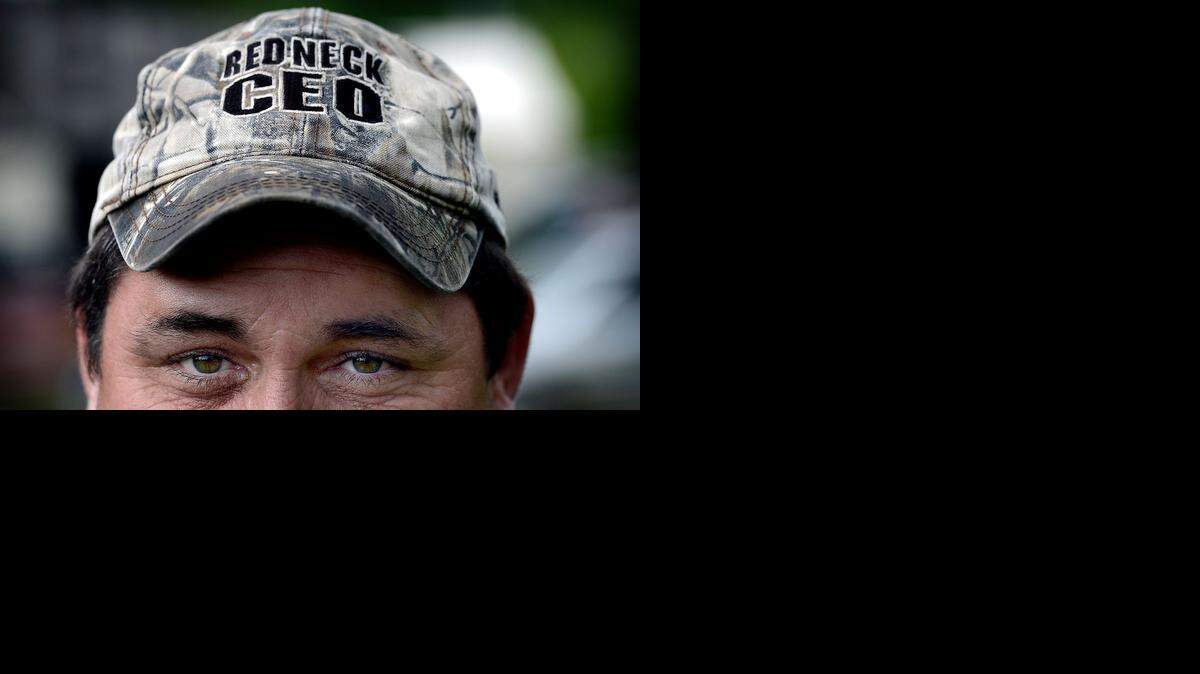
A pistol hanging from his belt, Greg Shoults took a seat on the deck outside the busy restaurant.
He and his wife had enjoyed a birthday dinner in their town of Ava, Mo., and now the sun was setting and Shoults was taking time to come up with his answer to how the rest of the U.S. views people in the Ozarks.
Too much time, apparently.
“You mean that we’re a bunch of backwoods, ignorant, gun-totin’ hillbilly rednecks?” Cheryl Shoults, his wife, threw in.
Well, something like that. That’s certainly an image forged over decades by books and movies, from “The Shepherd of the Hills” up to “Winter’s Bone.” Throw in a few seasons of “Hee Haw” and there’s a driving force of tourism.
Because as beautiful as morning fog over an Ozarks valley can be, kids in the backseat since the 1950s have wanted to see an old hillbilly smoking a corncob pipe.
But the shootings in April of three people at two Jewish facilities in Overland Park brought to mind another Ozarks image: that of white supremacy, hate groups and paramilitary compounds. It is true that just as those early settlers in the 1830s sought the isolation of these hills, extremist groups sought the same thing more than a century later.
And if that aura had cooled since 1985 when FBI agents surrounded the armed compound of the Covenant, the Sword and the Arm of the Lord south of Gainesville, Mo., near the Arkansas border, a man known as F. Glenn Miller Jr., the accused shooter in the April murders, poked those coals back hot.
Miller, an avowed white supremacist from just outside Marionville, Mo., reportedly ranted “Heil Hitler!” during his arrest. Another man, John Mark Reidle, who was known to fly a Nazi flag at his trailer in Aurora, just a few miles from Marionville, is charged with providing Miller with the weapon.
The national media flocked to the area and reminded the country once again of the dark side of the Ozarks.
“Marionville will always be labeled now,” Dustin Guess, 26, said of his hometown as he worked in a tire shop in Aurora. “My grandpa always told me there were good and bad people everywhere, but people around here aren’t like that (like Miller). That’s just the way it is, though. That’s who we are now.”
To get a sense of how people in the Ozarks view how the rest of the country sees them, The Star recently took a trip from Aurora to West Plains, a distance of 134 miles over blacktops and gravel roads, stopping to talk to people in small towns and farms along the way.
Nearly in verse, they blamed the power of the bad apple. But they also know that everyone smells like smoke after a big fire. And they know, too, there’s not much they can do about it.
The Southern Poverty Law Center, an Alabama-based organization that monitors extremist groups, locates such groups on a map on its website. Several icons on that map dot southern Missouri.
And in 1987, Miller, a former Ku Klux Klan leader in North Carolina, and two other men were arrested in a trailer in Ozark, Mo., after mailing a “Declaration of War” that established a point system for the assassination of federal officials, blacks, Jews, gays and others.
Robert Wilcox, who works at Pawnderosa Gun & Pawn in Aurora, said he doesn’t know anyone associated with white supremacy or a hate group.
He paused.
“But then there’s always somebody further out in the woods than you are.”
For some, such as Lisa Goodnight, the city clerk of Gainesville, Mo., the recent killings brought back hurtful memories. The CSA compound was just south of her town. Gainesville was also home to Gordon Winrod, a Christian Identity minister whose newsletter routinely attacked Jews.
Winrod, who lived with followers in a large house outside town, would refer to Goodnight’s husband, the county coroner, as “Jew Goodnight.”
Dave Goodnight, now deceased, was not Jewish. But to Winrod, he was part of civil authority, along with law enforcement and judges.
“They were all Jews to him,” Lisa Goodnight said of Winrod, who went to prison for kidnapping his grandchildren.
She knows the cruelty of proximity — how towns in the Ozarks get lumped together with evil deeds.
Aurora and Marionville are pretty areas, Goodnight said.
“But who’s going to think of that when they hear the names of those towns now?”
The Ozarks were home to mostly Native Americans, primarily the Osage, up until the 1830s, when settlers began arriving from Kentucky, Tennessee and South Carolina. These newcomers, mostly Scotch-Irish and Germans, wanted lives independent of government.
They found their wish in the vast timbered hills and valleys of that stretch west from the Mississippi River through southern Missouri, northern Arkansas and into Oklahoma. The area’s remoteness, isolation and difficult transportation made for lives disciplined by limitations.
“It was hard to get in and hard to get out,” said Mark Biggs, the interim associate dean of the College of Arts and Letters at Missouri State University in Springfield. “These people were very independent, very self-reliant. They had to be. ”
Biggs, who made a documentary called “Just That Much Hillbilly in Me,” said the driving forces in these lives were religion, family, work ethic and rugged individualism. Later, the lifestyle would be perceived by the outside world as backward and eventually evolve into the hillbilly image.
The landscape later appealed to extremist groups.
“This hills and hollows provided them the same isolation,” said Jim Baker, vice president for research and economic development at Missouri State and formerly the director of the school’s Ozarks Studies Institute.
In 1976, the Covenant, the Sword and the Arm of the Lord settled on 220 acres south of Gainesville. According to the FBI in 1985, the group considered “communists, blacks, Jews, half breed Mongoloid sinners, orientals and the IRS” among its adversaries.
Another FBI memo said CSA members should be considered armed and dangerous with unlimited weapons and ammunition. On April 19 that year, an estimated 300 federal agents and local law enforcement surrounded the compound, beginning a three-day siege.
The CSA disbanded after that. Other groups, such as Klan factions and Christian Identity churches, still exist. Thomas Robb, a Klan leader in northern Arkansas, has compared the Klan robe to a business tie.
Today, Robert Lee Mills of West Plains is the Missouri chairman of the League of the South, one of the dots on the law center’s map.
According to Mills, he is a 1968 West Point graduate who retired from the Army in 1989. He says he has nothing against African-Americans — he’s just more comfortable around white people. He believes President Barack Obama is a Muslim and he considers the Confederate flag a symbol of a glorious past and “hopefully a glorious future.”
The Ozarks saw several incidents of race violence in the decades after the Civil War. The ensuing exodus of African-Americans led to a demographic shift that made the area one of the whitest in the country.
Today, according to the U.S. census, the counties The Star passed through all have white populations of more than 96 percent.
But Biggs, the Missouri State associate dean, thinks that despite the hate groups, the image of the Ozarks could become more diverse and change because of a booming population growth led by retirees moving to the area. Also, he said, technology has tamed the isolation.
“We are all electronically connected to 24/7 news and a global economy,” he said.
Several miles south of Ava on Missouri 5, a red dirt road takes off to the southwest.
Up a hill, over a creek and then after a mile or so, a traveler can see a group of chairs under a clump of trees up on the side of the hill.
“People probably sit up there and drink moonshine and watch the sun set,” said Shawn Esterline, 43, an out-of-work welder.
He was dropping some kids off at a relative’s house. Dogs ran loose in the yard and an old, broken-down truck sat like it wasn’t running anywhere anytime soon.
Esterline isn’t your typical Ozarks dweller.
“I came from California, but these are my people now,” he said. “I like it here. I like to hunt and fish. The road ends at my house, and I got a ’67 Coupe de Ville sitting on a four-wheel-drive truck frame. You want to see it?”
Friends back in California won’t come to visit. They’ve heard the stories.
“But you have to understand the people here,” Esterline said. “For five years, I was a foreigner. They don’t warm right up to you. Takes time. They like to be left alone. They want to build a house without getting a permit. It’s hard to make a living here.
“Sure, this part of the country is 10 to 15 years behind on things like gay rights. But I don’t know of any white supremacy. These are good people.”
In Billings, hometown of Leon Rausch, lead singer for Bob Wills and his Texas Playboys back in the 1950s and early 1960s, two retired truck drivers sold kettle corn along business U.S. 60.
“We were surprised as anyone,” Pete Sullivan said of the Overland Park shootings. “I mean, yeah, you can see a few Confederate flags around, but white supremacy is rare.
“Besides, with social media now, people of like minds don’t have to live in the same place.”
Wilcox, back at the pawnshop in Aurora, knows all that, but he still figures the rest of country probably thinks the Ozarks are nothing but racists and gun lovers.
“I’m sure New Yorkers look at us that way,” Wilcox said. “We like guns, sure, but we’re just good old patriots.”
That’s why Greg Shoults, medically retired from the Army because of a car bomb in Iraq, open-carries his Glock 23.
“A lot of Americans died to give us the Constitution, and a lot of my brothers and sisters in arms died protecting that Constitution,” Shoults said. “I’ve had people come up and thank me for carrying.”
His wife said it’s all misconception.
“People down here are hardworking, self-sustaining, good, moral people who keep to themselves,” Cheryl Shoults said. “But because of a few stories, the rest of the country doesn’t know the difference.”
Finally, there’s author Daniel Woodrell. In his novel “Winter’s Bone,” he gave us Ree Dolly, a teenage girl through whose eyes we see a contemporary rural Ozarks of trailer houses, methamphetamine and people as bad as their teeth.
Along with other books, such as “Tomato Red” and “Give Us a Kiss,” he uses a genre he calls country noir to share his version of the hills of southern Missouri.
“I didn’t intend to stay here,” Woodrell said at his home in West Plains. “I went to California for a while, and I started to miss it — much to my surprise.
“I have friends who would never come here. Well, one did, but he was a trout fisherman.”
So Woodrell is close to his subject. And he knows well the place he writes about.
“It really reminds me a lot of south Boston,” he said. “Just change the accent.”
To reach Donald Bradley, call 816-234-4182 or send email to dbradley@kcstar.com.
This story was originally published July 5, 2014 at 7:07 PM.