
Kansas City’s dangerous-building problem contributes to crime
The small house at 1223 Askew Ave. is no longer on Kansas City’s dangerous-buildings list.
After the bulldozers were finished this week, it was a vacant lot.
One down, 846 more to go.
Kansas City spends about $1 million a year to demolish roughly 130 dangerous structures.
But what if the city could afford to spend a bit more? That was the intriguing trial balloon floated this week by Police Chief Darryl Forté, who said he could sacrifice part of his budget for new officers if it would help speed up the demolition of buildings and make other neighborhood improvements. Cutting five proposed new hires — from the 60 that Forté said he wanted last fall — could free up $250,000.
“This is not popular within the organization and with some people outside the organization,” Forté told The Star this week. “But I am willing to give up a little bit of money and not be so heavy handed on human capital and say, hey, let’s use some of that money to put in some sidewalks, to demolish some of these abandoned properties where prostitution and drug dealing happen.”
The idea took many by surprise when Forté made the same offer in public at a meeting of the Board of Police Commissioners. It prompted a lively discussion on Twitter.
“Chief, I agree that something should and MUST be done,” read one tweet. “Real investment needed. But empty lots not as good as occupied homes.”
Brad Lemon, president of the Kansas City Fraternal Order of Police, said: “There has to be a way to keep a well staffed department and save neighborhoods. No one served with vacant lots.”
Forté, a Twitter fan, responded:
“Was starting point for discussion. Many houses should be rehabbed. As a result of discussion other ideas generated.”
The correlation between blight and crime has long been recognized. Abandoned houses invite nefarious activities. Lots overgrown with weeds can conceal bodies and other things. Broken streetlights provide a cloak of darkness.
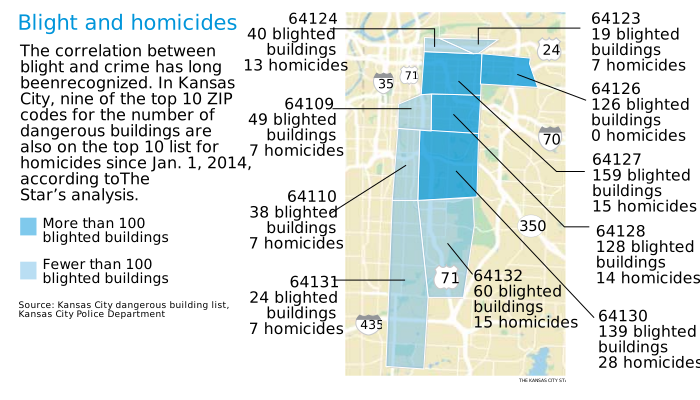
Nine of the top 10 ZIP codes in Kansas City for the number of dangerous buildings are also on the top 10 list for homicides since Jan. 1, 2014, according to an analysis by The Star.
The U.S. city with perhaps the biggest blight problem is Detroit, where it was estimated last spring that one in five parcels of land had a dilapidated structure. The city also was No. 1 in the country in violent crime.
Detroit, which struggled through bankruptcy, obtained $100 million in federal money for demolitions. The city had been razing 50 structures a week. But even at quadruple that rate, it could take a decade to clear all abandoned and dangerous buildings.
Kansas City has chosen to use its federal funds for construction and rehabilitation, while using local funds for demolition.
Kansas City Manager Troy Schulte estimated it would take $10 million to clear this city’s backlog of dangerous buildings that need to come down. And new properties are constantly being added to the list. The city has legal authority to tear down private property that is deemed dangerous.
In 2012, Mayor Sly James took the controls of a bulldozer and helped smash a house while announcing a plan to eliminate the backlog of what was then 1,000 dangerous buildings over two years.
It didn’t happen. Two years later, about 500 buildings had been torn down. Meanwhile, the demolition list kept growing during the foreclosure crisis.
Like Detroit and other cities, including New Orleans and Baltimore, Kansas City three years ago began targeting specific neighborhoods that could be saved instead of sporadically tackling properties that had been on the dangerous list the longest.
“What it does is it accelerates the perception that more is being done,” said John Wood, director of the Kansas City Neighborhoods & Housing Services Department. “You knock down a building here and there, and it won’t have an impact on a neighborhood. If you tear down all the dangerous structures in the neighborhood, then now you’ve created more opportunity for redevelopment of the area.”
Wood spoke Thursday while watching a worker remove debris from 1223 Askew. It was one of more than a dozen dangerous buildings within a few blocks in the Lykins neighborhood. There were two homicides nearby last year.
Kansas City’s old Northeast, along with the Marlborough neighborhood and the Prospect Avenue corridor south of 31st Street, is an area currently targeted for dangerous-building removal. Another house in Lykins, at 626 Cleveland Ave., is scheduled to be demolished Monday.
“We identified 95 properties in the historic Northeast area,” said Dalena Taylor, Kansas City’s neighborhood preservation manager. “We’ll be tearing down about 77 in this fiscal year.”
The city was approached by a developer, who prefers to remain anonymous at this time, interested in combating blight in the Northeast.
“They want to do some infill as well as rehabbing,” said Wood. “We were excited when they came to us with this idea. That’s the kind of thing we’d like to see more of.”
So would Jessica Ray, president of the Pendleton Heights Neighborhood Association, also in the Northeast. Pendleton Heights has been particularly successful in encouraging people to rehab houses instead of having the city turn them into vacant lots.
“Our feeling is if you just go in and tear the houses down, you destroy the fabric of the neighborhood,” Ray said. “We would be way better off incentivizing the repurposing of these structures.”
The Land Bank of Kansas City and other organizations have ongoing initiatives to find buyers and give new life to abandoned homes whenever possible. Since its inception in July 2013, the Land Bank has sold 180 homes for new occupants.
But some buildings are just too far gone to save. Kansas City has received some help getting rid of them from private companies. Kissick Construction Co. saved the city about $80,000 by donating its services to demolish 10 houses in the Marlborough East neighborhood and it put out a challenge to other companies. Taylor said Industrial Wrecking Co. had agreed to take down five properties at no cost to the city.
Margaret May, executive director of the Ivanhoe Neighborhood Council, strongly supports Forté’s offer to forgo a few additional police officers in order to help the city fight blight.
“We have a 40 percent rate of either vacant lots or vacant houses,” she said. “We have vagrants, prostitution, drug dealing. I think the chief is right on.”
But at least one neighborhood leader is not sold. Pat Clarke, president of the Oak Park Neighborhood Association, said he wants both more police officers and more money for demolishing dangerous buildings.
“If I had to pick, I would say it would be more important to get more officers,” Clarke said.
Budget season at City Hall is approaching, and there are plans to seek more money for dangerous-building demolition. Some Kansas City Council members are cautious. Third District at-large Councilman Quinton Lucas and 5th District at-large Councilman Lee Barnes said this week that tearing down buildings is a partial solution at best. Lucas noted the city already has thousands of vacant lots to maintain.
But the Kansas City public has signaled repeatedly that it wants something positive done with all the dangerous and abandoned buildings in the city. In surveys in recent years, it has had one of the highest dissatisfaction levels of any service. In 2015, nearly 50 percent of respondents were dissatisfied with the dangerous-building demolition program.
Would a relatively small infusion from the police budget, which totaled nearly $229 million this year, to the demolition budget make much of a difference?
“It depends if it was used strategically,” said Wood. “If you have a block or a couple of blocks in a neighborhood where the criminals have been using these properties for illegal activities and there have been a lot of complaints, and the money was used to tear these properties down and remove the blight, remove the safety hazard, then yeah, it would have an impact.”
The Star’s Donna McGuire contributed to this report.
Matt Campbell: 816-234-4902, @MattCampbellKC
Lynn Horsley: 816-226-2058, @LynnHorsley
Glenn E. Rice: 816-234-4341, @GRicekcstar
This story was originally published January 14, 2016 at 7:03 PM with the headline "Kansas City’s dangerous-building problem contributes to crime."