
Support soothes anxiety and grief in the days after two Olathe teen suicides
Bonnie Swade got the call Monday that she would be needed at Olathe Northwest High School the following morning.
Like many in Olathe, the 67-year-old retired teacher and school counselor had heard the awful news from over the weekend: Two Olathe Northwest teenagers — juniors and members of the girls soccer team — had committed suicide just two days apart, leaving a community shaken and bewildered.
Swade’s job that day, along with a collection of other counselors, social workers and school psychologists on hand, would be to help navigate a grim situation.
In many ways, she was the perfect woman for the job.
For one thing, she knew the community well, having spent 40 years as an English teacher and school counselor in the Olathe School District before retiring in 2009. But more important, she knew exactly what many of the students, parents and administrators were going through.
In 2003, Swade’s son, Brett, committed suicide at the age of 31, an event that would leave her grasping for answers. She had come to know well the incessant questions and what-ifs that can haunt a person as they attempt to cope with such a tragedy.
“Even to this day, I still have to catch myself when I start thinking, ‘If I had just done this or that,’” said Swade, who along with her husband, Mickey, runs Suicide Awareness Survivor Support, a group that focuses on those who have lost a loved one to suicide. “(But) I know that ‘why’ is never going to be answered.”
Indeed, there’s no getting over the sorrow of a young person cutting their life short. Experience suggests peers will be thrown at first, but that with youth comes resilience.
Teachers and principals have learned to respond to suicides much as they would other deaths in the student body, but their powers to help have limits. And for parents, people like Swade who have experienced the fallout from suicide, there’s never really a recovery.
Since 2000, suicides have risen slightly nationally, according to the American Foundation for Suicide Prevention. In Kansas, which in 2012 featured the 11th-highest suicide rate in America, it is currently the second-leading cause of death for people ages 15-34.
In the aftermath, those involved are often left to ponder a number of questions, including: How does a community as close-knit as a high school cope with such a tragedy?
The answer, it turns out, depends on whom you talk to.
The students
For students at Olathe Northwest High School, last Monday morning must have felt like a bad dream.
Within two hours of a schoolwide morning announcement that a 16-year-old classmate had taken her own life the previous Friday afternoon inside her Olathe home, students got word in their second-hour class that another student at the school had committed suicide the night before.
“It was shocking,” said Samyak Badkul, a sophomore at the school.
In the days since, student reaction has been, predictably, all over the board.
Many have taken advantage of the slew of resources made available by the school. Many others haven’t. Some have grieved publicly, taking to Twitter or Facebook or the windows of their cars to write messages or remembrances. Some were simply unsure how to respond to the whirlwind that has engulfed their school in recent days.
“One young man came in and he didn’t know either girl, and his concern was, ‘I don’t really feel anything; what’s wrong with me?’” Swade said.
Nothing.
In a school of roughly 2,000 in which not all students are close, or even friendly, there is bound to be a range of emotions, according to mental health professionals.
Grieving is a process unique to individuals, though in cases of suicide it can often center on why the victim did what they did.
“They’re trying to fill in holes, they’re trying to figure out what happened,” said Martye Barnard, an adolescent behavioral psychologist at University of Kansas Hospital.
Suicides in particular can be difficult to digest.
“There may even be more intense concerns and reactions,” said Tim DeWeese, director of the Johnson County Mental Health Center, but two in such a short period of time, in a high school environment, can leave adolescents especially off-kilter.
“One suicide’s bad enough,” Barnard said. “And to be told that this is what happened and be told, ‘Oh, by the way, there’s been another one.’ You’re not even processing the first one before being traumatized by the second one.”
The good news is that adolescents can bounce back. So, even as the news was still fresh, Olathe Northwest’s students began to push forward in their own way.
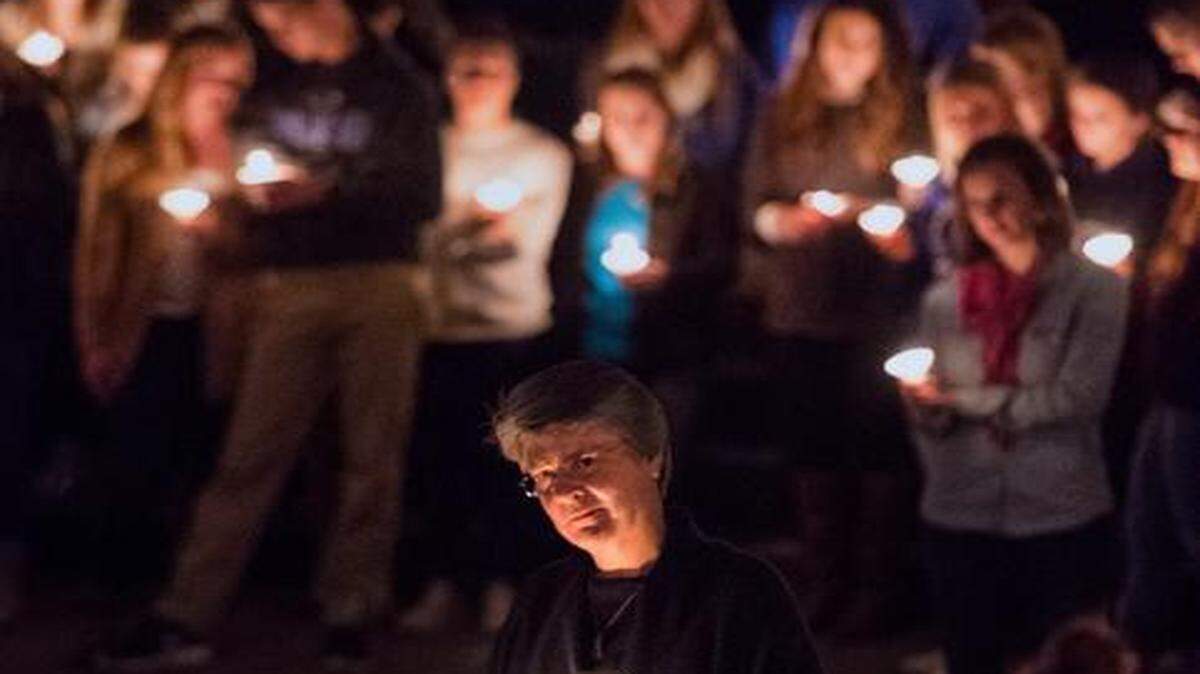
Two days after the first suicide, many students had gathered at the high school. even though it was a Sunday. Administrators had a slew of professionals on hand to talk through things with the kids or provide them with a haven. On Tuesday, hundreds of teens attended a candlelight vigil for the two girls, with dozens of friends stepping forward to share thoughts and memories.
There were tears, of course, as friends and family members spoke. But there was laughter too.
One by one, teenagers honored their classmates by relaying funny anecdotes — the copious amounts of food one of the girls was known to eat, stories of sneaking out of the house or clogged toilets. To some, the students’ ability to smile, even temporarily, offered an encouraging sign.
The parents
While students have dealt with questions stemming from last week’s deaths, so too have their parents.
Parenthood is an inherently anxious endeavor — particularly for those raising teenagers — and after the news about the two girls, concern among parents regarding how to talk with their kids about suicide has been widespread, say those who have worked with the district and its families.
“I’ve had several parents call me and say, ‘Do you think my child’s OK?’” Barnard said. “And we have to do hand-holding there too and make sure we support our parents.”
Unlike an accidental death, which can often be more easily understood, suicide can raise a series of complex questions. And for parents, navigating those questions can be a daunting process.
Though connected suicides are rare, accounting for 1 to 5 percent of all suicide cases annually, adolescents are more susceptible to imitative suicide, said Andy Brown, executive director for Headquarters, a Lawrence-based crisis center.
Keeping parents informed about how to talk with their children about suicide, then, is imperative.
Broaching the subject can be difficult. For some, mental health — and suicide, specifically — is a taboo topic.
Part of that, Barnard said, is the misconception among some parents that talking about suicide with their children might make them more likely to think about — or attempt — it in the future.
But discussing the subject can actually help ward off suicide, Barnard said. And in coming days, she said, it’s important for parents to make themselves available to their children.
In a letter sent last Monday, Olathe Northwest principal Gwen Poss urged parents to have a talk about suicide. In it, she highlighted a number of things to include in the discussion: Make it clear that suicide is not an option. That help is available. That there was nothing students could have said or done to prevent the girls’ deaths.
“It will be vital that you are closely monitoring your student’s social media for messages being sent and received,” she added.
In the end, though, the most important thing can be simply being there.
“The biggest thing that I’ve seen is parents worried about what is the right thing to do,” said DeWeese, whose staff has worked with Olathe Northwest students since the suicides. “The wrong thing to do is to do nothing. The right thing to do is just to show love and affection for your child and tell them that you care.”
The school
When things turned bad, Olathe School District officials didn’t spent a lot of time scrambling.
Instead, they turned to the district’s crisis management manual. In it are outlines for dealing with any conceivable issue — from a leaky pipe to a fire drill to a tornado — and in the hours after news of the first death, school administrators were already gathering.
“It’s kind of a checklist of what you need to be thinking through,” said Erin Dugan, an assistant superintendent with the Olathe School District. “It provides immediate focus and guidance.”
Long before the weekend ended, the school’s crisis team had a plan.
When students arrived Monday morning, resources were ready. Students could gather in a large room and either talk among themselves or speak to one of the counselors, social workers or school psychologists. On tables were paper and pens for students to write remembrances or feelings.
It’s part of the coping process. There will be plenty more to do in the coming days and weeks.
In her talks with students at the school last Tuesday, for instance, Swade was struck by how many had considered the idea of suicide.
“It’s frightening the number of students that I talked with who had attempted and who think about it,” she said. “And that concerns me — that this would even be a viable option to even think about.”
And so the school will continue to do its part. Poss, the Olathe Northwest principal, will be host of a discussion for parents Wednesday evening. Administrators will continue to make resources available for any student still in need of support.
“It’s horrific and it’s tragic, but this community will heal,” Dugan said last week.
“I believe we will heal. We will move forward.”
To reach Dugan Arnett, call 816-234-4039 or send email to darnett@kcstar.com.
This story was originally published November 15, 2014 at 5:42 PM.