
Once a homeless teen, woman will spend one more night on cold ground for a cause
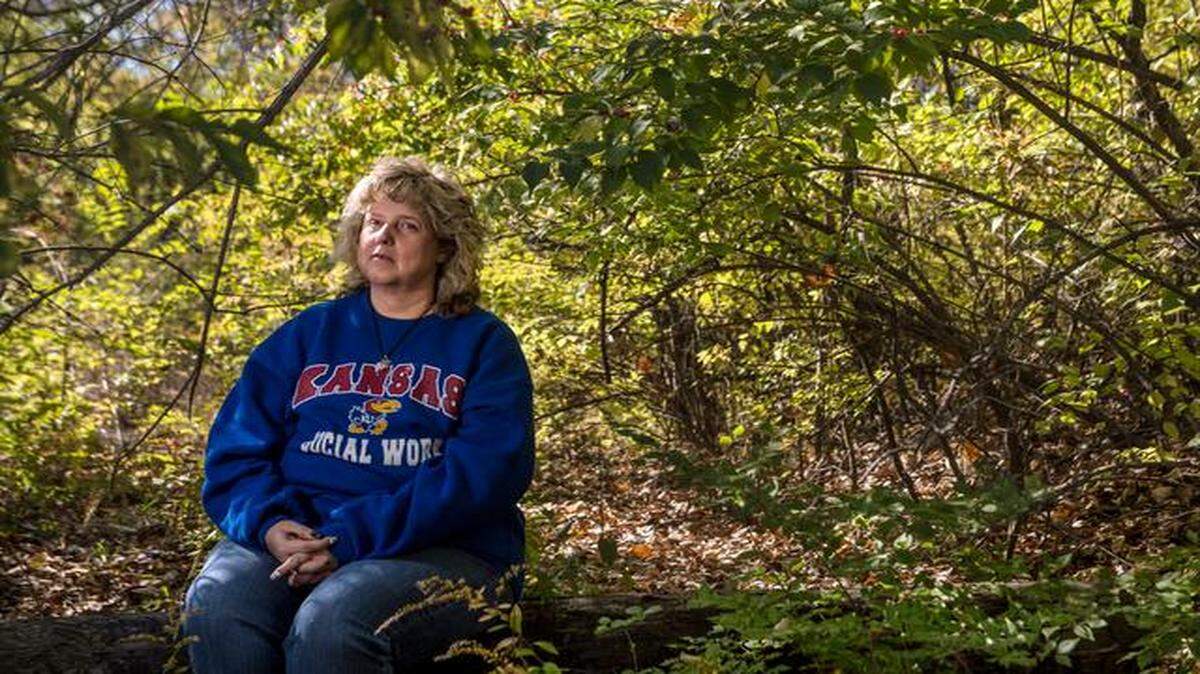
As an early spring sky dissolved into darkness, 13-year-old Jennifer Morris, alone and scared, curled up next to a rock in woods atop a hill on Mill Street in Kansas City, Kan.
It’s been nearly three decades since that first night Morris slept outdoors, something that became a two-year routine for the homeless teen.
Friday evening, Morris, now 42, will spend another night on the cold ground, but she’s looking forward to it.
This time it won’t be because she has no place else to go. This time she’s moved by a cause, helping to raise awareness of the 2,000 homeless teens in the Kansas City area who sleep on the streets or in cars or who “couch surf” most nights.
And she’ll have company.
As part of the annual One Homeless Night event to support homeless teens, Morris, who is pursuing a bachelor’s degree in social work, will join other students in the University of Kansas’ School of Social Welfare. They will be among several hundred people around the Kansas City area, mostly teens, taking part in the one-night event sponsored by Synergy Services.
The nonprofit Synergy provides housing — emergency, transitional or permanent — for homeless teens. The charity hopes to raise about $30,000, said Ann Harper of Synergy. “For the most part we are trying to change public perception of what a homeless teen looks like. It is more about awareness.”
When a classmate mentioned the event to Morris, she said, “I was like, ‘That is me. I was homeless.’”
Morris immediately began organizing a sleep-out for her classmates. “They told me I had given purpose to the event for them, me,” she said.
She remembers her days roaming the streets, begging for food, struggling through two winters without shelter. She remembers the other homeless teens who became her makeshift family.
Paternal grandparents had raised Morris after her mother left home when she was just 2. Her father, a Vietnam veteran, had come home with a stress disorder and could not care for her. Her grandparents took her into their small house in The Homes Inc., a housing cooperative built in the 1940s near the Fairfax district of Kansas City, Kan., to accommodate military members returning from war. Morris’ family had always lived there. She lives there now.
Her grandparents had known each other from birth, grew up together and later married. Morris, an only child, was close to her grandmother. “She was the one who kept me safe,” Morris said.
She was an A student at Open Door Christian School and later at Washington High School.
She was 13 when her grandmother died. “Grandpa was so devastated he went into a catatonic state,” Morris recalled.
“I knew something wasn’t right,” she said. “I was scared.”
She would leave the house and spend her days with teens who hung around Memorial Hall in downtown Kansas City, Kan. Many of them were homeless or lived in abusive homes or with addicted or alcoholic parents.
“There were about a dozen of us. No one talked about family and we were always on the street,” Morris said. “It was very much about each other and what we could do to help each other.”
Morris felt a part of something. “It was normal to have a mom and dad, but I didn’t have that,” she said. “I didn’t have the ‘Leave it to Beaver’ family. These kids on the street, they got me. They understood what was happening to me.”
She missed a lot of school, her grades dropped, and child welfare workers were alerted.
“The next thing I know, I’m riding in a police car going into foster care,” Morris said.
She remembers pinching a taste of food from a pot one day and feeling the sting of a foster parent’s hand across her face. She walked away that night with another foster child from the house. They went to Memorial Hall.
Morris adopted the street kids’ life. Some had homes, and she was always begging for a warm floor or a couch for the night.
“Drugs weren’t a thing. We didn’t use them. It was about survival, and you had to be alert to survive. ... You get resourceful,” she said, and sometimes lucky. But most times she slept in the woods.
“The first night, you are scared. You don’t sleep. The next night, at least you are familiar, so you close your eyes. By the third night, you accept it.”
A boy who lived in a home at the bottom of the hill would wait until his parents left for work in the morning, and then bring Morris a sandwich and invite her in to shower and wash her clothes. “Then I was back on the street with the group. You don’t want night to come.”
Morris called her dad. “I told him, ‘I’m still alive but I don’t know what to do. I feel like I’m going to die.’”
She went home and the law was waiting. “They locked me up. I was a ward of the state.”
Morris ended up in a youth home in Newton, Kan., until she was nearly 18. She met a man and moved with him and his 2-year-old son to Florida, where for 15 years she raised the boy and worked in accounting until hurricanes Ivan, Dennis and Katrina hit, destroying their home and their relationship.
She returned to Kansas. Three months later, her father died and she was alone again.
“I was no longer a daughter, a wife, a mother,” she said. It took nearly six years, including time abusing drugs and alcohol, and a stint in a treatment center, before Morris joined a support group that encouraged her to go back to school.
“I wanted to tell my story,” said Morris, who works part-time at Mirror Inc., a nonprofit that provides substance abuse treatment, community health and human services. “I want homeless kids to know that if I can do it, so can they. It is never too late. I have this amazing life now because people never gave up on me.”
She moved back to The Homes and now is caring for her ailing, 82-year-old grandfather.
The Homes, she said, is a fitting place for her and her classmates to stage their One Homeless Night sleep-out. More than 300 students have been invited.
Actually spending the night out is personal for Morris, who hopes to work as a bereavement counselor. But the sleep-out also stands to enrich the careers of her classmates.
“We hope that the experiences our students have equip them to pursue social justice, and increase their understanding of the journeys others have taken and of the system gaps and the tremendous vulnerability and danger these teens experience,” said Melinda Lewis, an associate professor of practice in the KU School of Social Welfare.
Anyone can grab a can or coat and donate, said Jaresa Ross-Bey, adviser for the KU students, “but being out there means more.”
“When you are a social worker, when you can walk in the shoes of your client, then your empathy skills grow tenfold.”
To reach Mará Rose Williams, call 816-234-4419 or send email to mdwilliams@kcstar.com.
How to help
To donate or learn more about Synergy’s efforts to help homeless teens, go online to synergyservices.org.
This story was originally published November 6, 2014 at 8:51 PM.