These Independence students spend their days building houses — and securing jobs early
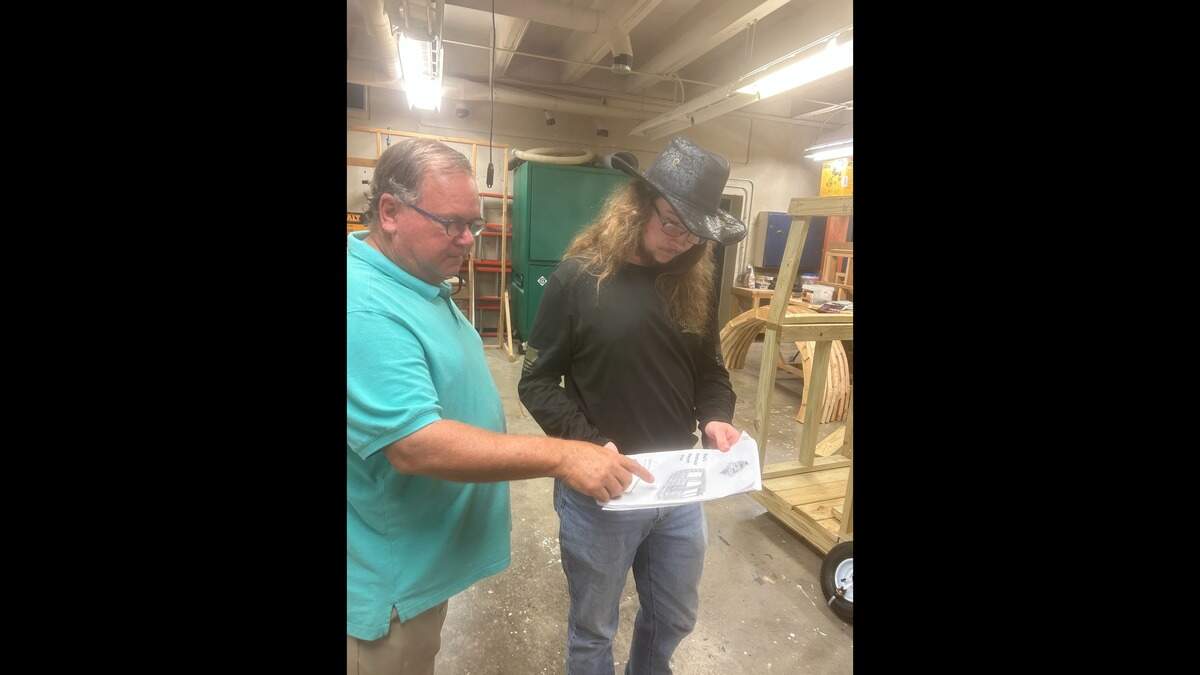
When Damian Gfeller started at Truman High School in Independence, he had one goal in mind: to get into a career where he could build things himself.
Gfeller’s father had always been a skilled repairman, and working on construction projects became a shared pastime over the years, Gfeller said. By the time he got to high school, he was actively considering a career in construction.
Then he learned that there was a series of classes within the Independence School District that could put him on the fast track to a construction job in the region. After a series of introductory courses in safety, woodworking and more, Gfeller applied to the Construction Trades capstone program within the Independence School District’s Industrial Technology Academy.
“It seemed more interesting to me than most other career paths, and so I wanted to explore that pathway,” Gfeller said. “I always loved working with my hands.”
During a capstone class field trip his senior year, Gfeller met several representatives from a local electricians’ union. His capstone teacher introduced him to several others, Gfeller finished an internship building low-income housing from scratch, and after graduating in May 2026, he joined the union.
Now, he’s on track to start an apprenticeship soon — and he credits the capstone with helping him get a quick start in the field.
“If I didn’t take the prerequisite classes and get myself into that construction trade pathway. I’d be in a completely different spot,” Gfeller said.
Over the past 12 years, dozens of students like Gfeller have benefited from the small but deeply resourced Independence School District program, geared towards real-world experience in the construction industry. Students graduate with multiple certifications, new technical skills and, increasingly, connections with local labor unions known for competitive entry processes.
District and program staff hope that the Construction Trades capstone program can give a head start to students who are looking to go into the trades, while addressing what the district sees as a growing need for skilled construction workers in and around Independence.
“Construction has been really strong in the area for a long time, and there’s always a need,” said Aaron Smith, the district’s career and technical education coordinator. “... With the new stadiums and the data centers that are all these big projects that Kansas City has in the area for the next five years, we don’t have the skilled workforce just in Kansas City to get this all done.
“For us, it made a lot of sense to bring that program on and try to produce more kids who were interested in that area.”
Building a construction pathway
Students attend construction pathway classes at the woodshop in the basement of Chrisman High School at 1223 Noland Road. ISD freshmen first encounter the program through the district’s Freshman Academy, an exploratory year when students can opt into a career training pathway for the rest of their time at Truman, Chrisman or Van Horn high schools.
The construction pathway falls under the Industrial Arts academy and involves two years of prerequisite courses in woodworking, followed by two years of capstone classes.
While the district offers several capstone programs, the construction pathway has become both more popular and more essential in recent years as the cost of secondary education continues to soar, Smith said.
“College degrees only represent about 30 to 40% of all of the jobs in the workforce,” Smith said. “If we’re trying to push 80% of our kids to go to college, we’re really doing a disservice to 30% of them or more.”
Construction pathway students used to travel to Herndon Career Center in Raytown for their coursework, Smith said, but space was limited to about eight students a year. Moving to Chrisman allowed space for more than 30 students plus a full-time instructor.
The woodshop, a tidy space adjoining a traditional classroom, is packed with circular saws, drills, buckets of nails and half-built wooden frames. For the past three years, it’s been the domain of Dennis O’Connell, who came out of retirement to helm the Construction Trades program.
O’Connell, a soft-spoken man with a keen eye for detail, previously taught woodworking at North Kansas City High School for 27 years while flipping houses during the summers. He said that the ISD capstone program has become one of his favorite parts of his career.
“He fills less of a teacher role,” ISD senior Chase Millentree said. “He’s more like a boss … he’s there in the process with us.”
Constructing a curriculum
From 30 to 50 applications, the construction capstone program matriculates about 32 students a year, split into four-hour morning and afternoon classes with about 16 seats each. Students from all three ISD high schools — Chrisman, Truman and Van Horn — feed into the program.
When choosing who gets to be in his capstone class, O’Connell looks at students’ attendance and disciplinary records. However, low grades don’t necessarily bar a student from getting in, he said.
“You have to be passing your classes, but I don’t really want straight As,” O’Connell said. “I want the right student that’s willing to work with their hands and get in and learn.”
The capstone pathway is based on a curriculum published by the United Brotherhood of Carpenters and includes three tests in two years. If students pass at least two tests before securing a job with a local construction union, they start one step higher on the pay scale than they would be offered otherwise, Smith said.
Students kick off the two-year capstone by earning their Occupational Safety and Health Administration (OSHA) 10 card, a basic safety training program that serves as a common prerequisite for unionized construction jobs. Students also earn a certification in commercial roofing skills and attend several career fairs throughout the year, often with copies of their resume in tow, O’Connell said. One upcoming class session will include a field trip to Clarkson Construction, a Kansas City firm currently involved in major reconstruction of Interstate 70.
“It can open up a lot of doors in the future,” Millentree said. “If you’re trying to get into the union, they’ll see that you’ve taken this class and that’ll give you a really great boost …over someone that doesn’t have that type of experience.”
Flipping and remodeling
The capstone ends with an opportunity for students to work on an actual home in Independence. Throughout the program’s 11 years, students have worked on four houses, remodeling two and building two from scratch in partnership with Habitat for Humanity.
The Independence School District typically spends between $30,000 and $35,000 on the teaching house each year, Smith said, with the help of grant funding. The budget includes building materials, tool replacements and payments to subcontractors who come in and teach specific home renovation skills as needed.
The most recent capstone project, another full remodel of a house purchased by the district, spanned three years’ worth of cohorts. Students worked directly with plumbers, HVAC technicians, electricians and other industry professionals to refinish the structure over time.
“We can’t do this without our business partners,” Smith said. “... Whatever the kids are doing, it’s almost always real-world. They’re working with real clients.”
The district’s primary pathway partners include the Home Builders Association of Greater Kansas City, the Professional Remodelers Collective and the National Institute of Construction Excellence. The most recent teaching house was completed in partnership with the Community Services League and is set to go on the market within the next month or two. Smith said that the sale will aim to provide an affordable space for a low-income family in Independence.
When students first got to the teaching house, the structure was “fully gutted,” Gfeller said.
“When we got in there, it was pretty bare bones, and we got to just enjoy learning how to get it all put back together,” Gfeller said. “... There was no shortage of interactions with different companies and trades to kind of get an idea of what you might want to do and different insider knowledge from people that do it for a living.”
At one point, staff at Con Carpet Tile and Design, a firm based in Blue Springs, spent several days volunteering to teach students how to lay tile. They also sold the district flooring materials for the house at a reduced industry cost, O’Connell said.
“We’ve had a lot of good partners,” Smith said. “We had concrete partners, insulation partners, electricians and plumbers, and just general contractors who worked with our kids over the years to really give them great experiences.”
This year, the program is moving onto its next iteration of final projects: a series of tiny houses built on trailers.
O’Connell said the tiny homes will be smaller in scale than the teaching houses, but will allow students to be involved in a home renovation process from start to finish no matter when they join the program. Students will be involved in selling the tiny homes and using the proceeds to budget for the next year’s tiny home.
Construction on the first tiny home will start near the end of 2026. The goal is to finish the home by May 2027, O’Connell said.
Lifelong connections
Some ISD seniors entered the construction pathway with several years of experience at family businesses under their belt. For these students, the construction pathway is less about technical knowledge and more about learning how to connect with people in the industry.
Diego Hernandez, a senior, entered the cohort with hundreds of hours of construction experience at a family business. He said that since his experience has centered on remodeling apartments, he sees the program as a practice arena to perfect his design skills.
“I already do construction outside of school,” Hernandez said. “I thought this would give me an extra helping hand in actually getting into the business as a construction manager.”
ISD senior Makayla Mize — the sole female student in the afternoon cohort — said she was initially inspired by her uncle’s construction career. Now, she’s hoping to build her expertise in framing a house, or building its skeleton out of materials like wood and metal.
“My uncle Charlie was a woodworker and he was in the army as well,” Mize said. “So I plan on joining the army and doing construction through there.”
Some students also use the program as a way to earn course credit for full-time, paid internships, O’Connell said. At least one participant this year reports directly to a job site every day, coming back to Chrisman twice a month to share his experiences with the cohort.
“They still get credit for school, but they’re actually learning all the different parts of being on a job site,” O’Connell said.
While some capstone graduates pursue two- or four-year degrees in construction management, Smith said, most go directly to work. One of Gfeller’s former classmates, now two years out of the capstone, is rising quickly through the ranks at a pipefitting company, he said.
Another former cohort member is now a superintendent at J.E. Dunn, a national contracting firm headquartered in Missouri. One former student got an apprenticeship with the International Brotherhood of Electrical Workers after graduating from the capstone last year, a program that O’Connell described as highly competitive.
“It’s kind of like anything; you get out of it what you put in,” Gfeller said. “But as far as opportunities go, it’s hard to find anything better.”
Although students’ skill sets vary greatly at the beginning of the program, O’Connell said that he’s seen graduates build self-confidence across the board.
“When they come in, they’re not that confident,” O’Connell said. “And then the more they use the stuff, the more they’re around people, the more they work with different students … I like seeing what a student has done when they leave.”
This story was originally published September 25, 2026 at 4:00 AM with the headline "These Independence students spend their days building houses — and securing jobs early."