$15,000 art sale could mark turning point for Black Kansas City painter
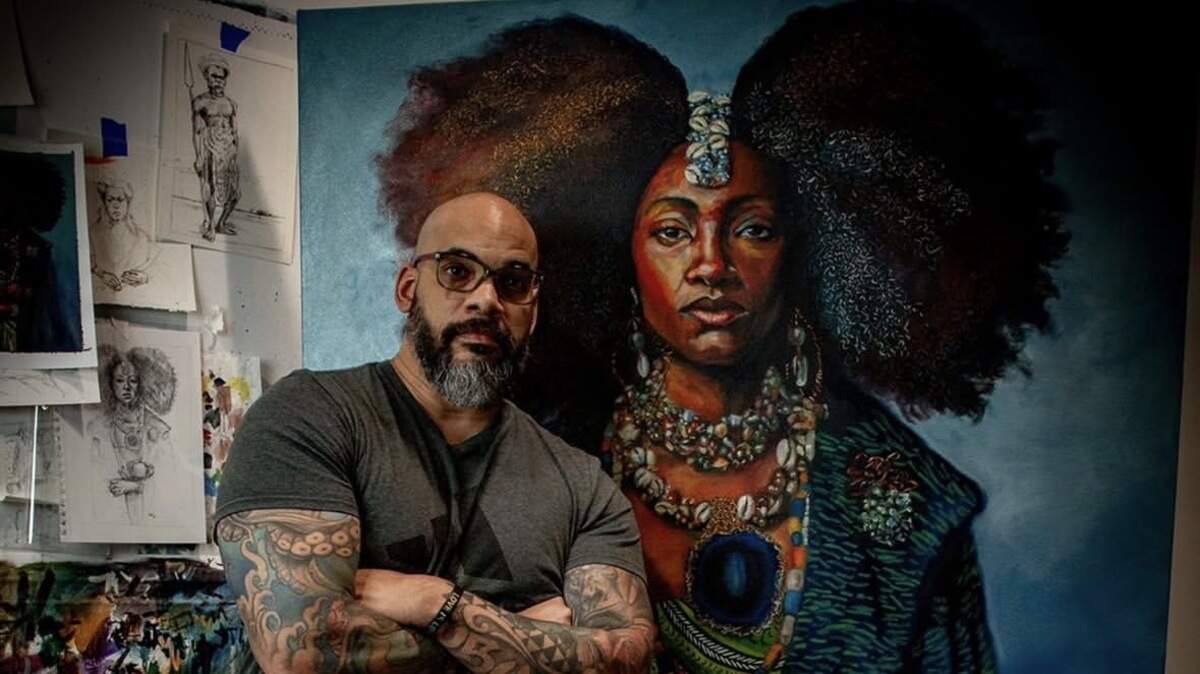
For Kwanza Humphrey, the $15,000 sale of his painting “I Will Not Halt to Look Behind” represents more than the highest-priced single work of his career. The acquisition by Kansas City Kansas Community College places his work in a permanent public collection and signals a broader shift in how local Black artists are being valued by institutions.
The oil painting, currently featured in Let Me Introduce Myself at InterUrban ArtHouse, was purchased during the exhibition’s Juneteenth opening reception. Brokered by InterUrban ArtHouse, the acquisition is believed to be a record-setting institutional purchase for a living Black painter from the Kansas City area.
“It’s validating that I’m doing good work, and I’m excited to be in another public institution,” Humphrey said. “It’s been a long road, and I’ve just enjoyed doing the work. Having it be acquired like this is just very validating.”
While Humphrey has previously seen his work enter the collection of the Nerman Museum of Contemporary Art and has exhibited at the Nelson-Atkins Museum of Art, the five-figure purchase represents another step in a career that has steadily grown over more than two decades. It also comes as institutions nationwide continue examining whose stories are represented in their permanent collections.
“It’s a little surreal and really kind of unreal to think about it, but it’s exciting, and I hope it continues to elevate the art scene for local Black artists here in Kansas City,” he said.
The acquisition grew out of Let Me Introduce Myself, an exhibition organized through a partnership between InterUrban ArtHouse and The Gift of Troost Black Artists Collective. The Overland Park exhibition invited Black artists from across the Kansas City area to present work that reflected their identities, encouraging each artist to define themselves on their own terms.
As executive director and curator of InterUrban ArtHouse, Wolfe Brack said the exhibition was designed not only to introduce the collective but also to demonstrate that Black artists belong in every exhibition space, not only those specifically centered on Black culture. When Kansas City Kansas Community College gallery director Shai Perry attended the opening reception looking to expand the college’s permanent collection, Humphrey’s portrait immediately stood out.
Brack said institutional acquisitions carry weight beyond the immediate sale because they provide artists with financial support while validating the long-term significance of their work.
“It sends a message that Black art is worthy and important like any form of art,” Brack said. “It also shows that the institution understands the importance of local artists and pulling from your own backyard because that helps fuel your own economy.”
Humphrey’s painting itself is the product of collaboration. The portrait features fellow InterUrban ArtHouse studio artist Elise Kahinde as the subject, wearing jewelry created by Kansas City jeweler Clarissa Knighton. Humphrey said the work explores the difference between outward presentation and authentic identity, using portraiture to ask viewers what they truly see beyond appearances.
The artist, who works professionally as a lead UX/UI designer while maintaining a daily painting practice, said the recognition demonstrates that artists working in Kansas City can reach major milestones without leaving the region. He hopes the acquisition encourages more institutions to seek out local artists and invest in their work.
“I think it shows that there is a market and there is an opportunity for you to do great work and be compensated for the work that you do,” Humphrey said.
“I hope it continues to elevate the Black art that’s here in Kansas City, but also pushes me personally into regional, national and international spaces, with the thought that this work was produced out of the Midwest, out of Kansas City.”
For fellow Kansas City artist Harold Smith, the acquisition carries significance well beyond Humphrey’s personal success. He believes it demonstrates that Kansas City’s Black artists are producing museum-quality work capable of attracting serious institutional investment, something he says has too often gone overlooked.
Smith said the purchase has the potential to draw greater attention from collectors, critics and museums outside the region while helping establish Kansas City as a destination for contemporary Black art.
“It shows that you have artists that are producing high-value works, fine art that is collectible by institutions,” Smith said. “It shows we belong. It shows that we’re here.”
The exhibition Let Me Introduce Myself remains on view at InterUrban ArtHouse through July 30. While Humphrey’s record-setting acquisition may stand out today, those involved hope it becomes less of an exception and more of a precedent for how Kansas City’s institutions value the work of local Black artists.
“There is incredible talent here. I think it just hasn’t been seen on the broad scale that it needs to be seen,” Smith said.