
In 1974 two naked dudes disrupted KU graduation. It was a big year for streaking
AI-generated summary reviewed by our newsroom.
- In 1974 streaking spread across U.S. campuses, including Kansas and Missouri.
- About 600 students streaked past the University of Missouri columns on March 5, 1974.
- Two students streaked across KU’s Memorial Stadium during the 1974 commencement.
On March 10, 1974, none other than The New York Times used precious ink to explain how a very peculiar trend was spreading across college campuses from coast to coast.
Students were stripping down to nothing but the skin they were born in and streaking — “a pastime first popularized by Adam and Eve and later politicized by Lady Godiva,” the Times reported.
In what became a banner year for streaking on campus, the trend spread like wildfire and centers of academia in Kansas and Missouri were not immune.
Students disrobed and cavorted at St. Louis University, Washington University in St. Louis and Washburn University in Topeka.
Students at the University of Missouri in Columbia took the fad to record-setting new heights on March 5, 1974, when 600 or so naked folks ran past the historic columns on campus while a crowd of about 1,500 people cheered them on.
And two months later. in May at the University of Kansas in Lawrence, two dudes streaked across the Memorial Stadium field as Chancellor Archie Dykes addressed the class of 1974.
Jim Cooper watched it all unfold.
Streaking had taken on a life of its own on the Lawrence campus that spring, the 74-year-old Cooper told The Star.
The first streaking event took place just hours after those hundreds of MU students stripped down in Columbia, according to the University Daily Kansan student newspaper, aka the UDK.
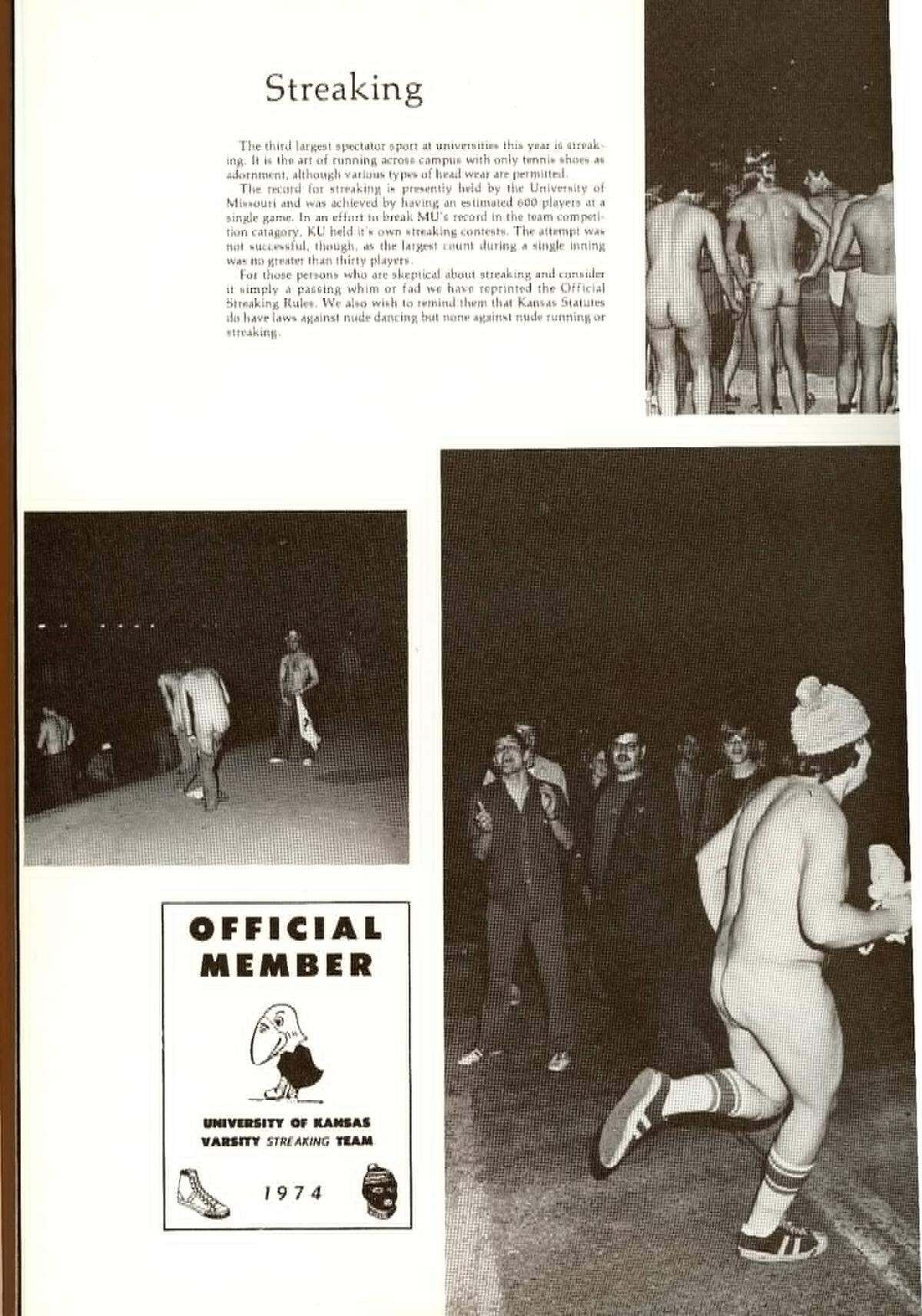
The KU yearbook that year devoted two pages to the trend — words and pics — noting that “the third-largest spectator sport at universities this year is streaking. It is the art of running across campus with only tennis shoes as adornment, although various types of headwear are permitted.”
Large-scale streaking outings were considered sport; the “playing field” at KU extended from the Chi Omega fountain at one end of campus to Watson Library. That first outing attracted only 25 streakers ... but 1,000 lookie-loos.
“The record for streaking is presently held by the University of Missouri and was achieved by having an estimated 600 players at a single game,” the yearbook wrote.
“In an effort to break MU’s record in the team competition category, KU held its own streaking contests. The attempt was not successful, though, as the largest count during a single inning was no greater than thirty players.
“For those persons who are skeptical about streaking and consider it simply a passing whim or fad we have reprinted the Official Streaking Rules. We also wish to remind them that Kansas Statutes do have laws against nude dancing but none against nude running or streaking.”
Per the rules, it was considered a foul for anyone to “engage in the laying-on-of-hands during streaking. This shall be designated as an Illegal Forward Pass.” Punishment was left to the discretion of the naked person.
“At one point in the spring people were putting up flyers either in the UDK boxes or somehow you’d come across these mimeographed flyers that said, ‘Tonight at the Chi O fountain they’ll be streaking at 10 o’clock,’” recalled Cooper, a diehard Jayhawk who lives in Lawrence.
“Then these crowds would gather. And I have to say I was a young, hormonal male, so you think, ‘Oh, this will be great.’
“Then you go out there and you usually have one or two or three people ... they were people that shouldn’t have been streaking or even thought about streaking. And usually the crowds were so big that when you get there it was like, ‘Where are they? Oh, they’re over there. They’re already gone.’”
That year KU — which made the Final Four under the auspices of beloved basketball coach Ted Owens — was locked in heated rivalry with K-State, Cooper said.
After the teams played each other at Allen Fieldhouse that semester, “they announced there was going to be streaking by the Chi O fountain,” he said.
“So everybody, a whole bunch of kids, we marched up the hill from Allen Fieldhouse up to gather around the fountain.”
The New York Times seemed perplexed by the “precise social significance of streaking.”
“But some academics, none of them known streakers, say the fad is an innocent asexual flouting of social rules, a 1974 version of wearing long hair or a nonviolent way to demonstrate the generation gap,” the Times wrote. “There may be, however, a simpler explanation: It’s fun.
“Although the novelty of nudity will probably fade in many places soon, the current epidemic of epidermis has already developed its own etiquette, national ratings, fashions and, of course, ardent opponents, many of them anonymous.
“Streaking has led to numerous incidents, a few police confrontations and generally favorable comparisons with some more violent campus demonstrations of the nineteen‐sixties.”
.PNG "IMG_1973 (1).PNG")
That same spring, a singer named Ray Stevens made the Billboard Hot 100 chart with his novelty song, “The Streak,” that captured the running-naked-in-public zeitgeist. And at the glittery Academy Awards that year, a male streaker ran onstage behind British actor David Niven as he was introducing Elizabeth Taylor.
Niven’s quip lives on in Oscars history.
“Isn’t it fascinating to think that probably the only laugh that man will ever get in his life is by stripping off and showing his shortcomings?” he snipped.
‘They don’t have shoes on’
The class of 1974 made KU history as the first graduating class to hold its commencement ceremony entirely outdoors, according to the school’s archives. Graduation that year featured speeches by several prominent figures, including then-U.S. Sen. Bob Dole.
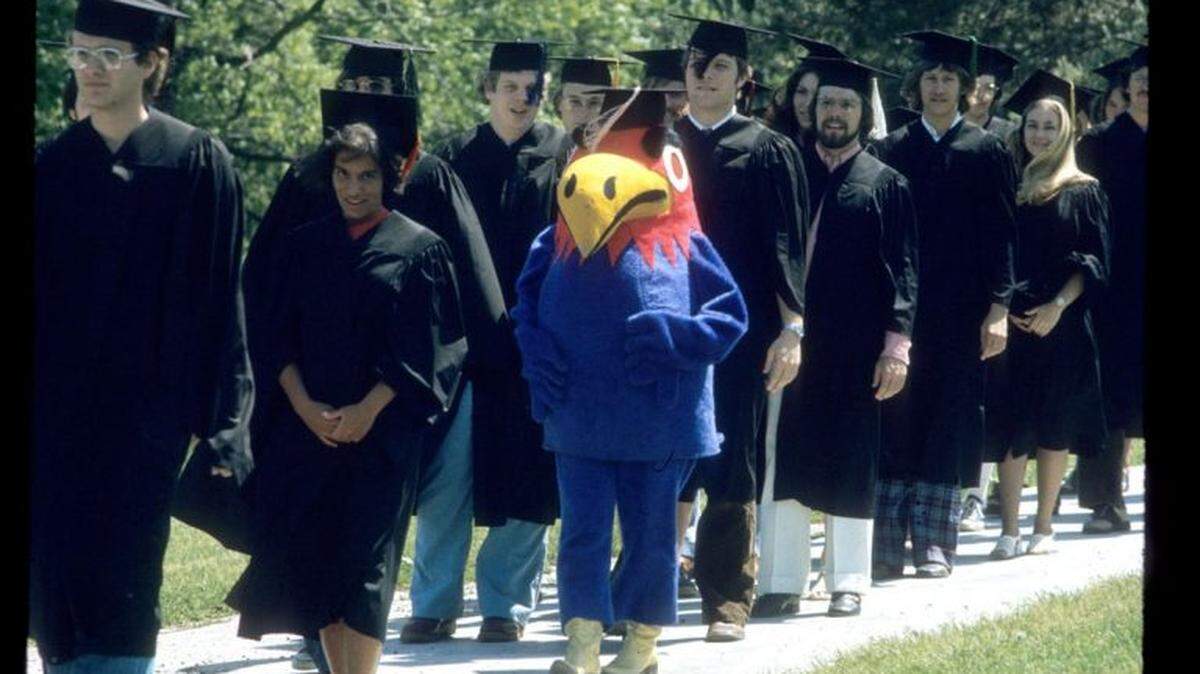
By tradition, KU grads “walk the hill” in their regalia. They gather on Memorial Drive and march down Mount Oread into the stadium. At the top of the hill they process through the Memorial Campanile, the limestone tower built in 1950 to honor members of the KU family who died in World War II.
Cooper, who graduated with a degree in political science, walked down the hill with a buddy in the School of Liberal Arts. As they filed into their seats in the stadium, Cooper noticed something odd about two guys who sat down in front of them.
“I said to my buddy, ‘Hey, those two guys, they don’t have shoes on.’ I noticed that their legs were bare,” he said.
His buddy told him, “They probably just have shorts on, don’t worry about it.”
So he didn’t.
The ceremony began. Chancellor Dykes got up to speak, “and as soon as he starts making remarks, these two guys jumped up, ran to the end of the row and ran down the aisle to the stadium floor,” Cooper said. “And it wasn’t a football game, so there were no guards preventing people from running onto the field at that point.
“And they got to that point and took off running. And now their gowns are flapping behind them, so you can see, oh, they aren’t wearing anything.
“I don’t think we knew for sure what was happening until they hit the field and then they weren’t out on the field for more than maybe a couple of minutes, running as fast as they could, which lends to the effect because their robes were literally at their necks, flying out behind them like Superman.
“And there was absolutely not a stitch on except for their robes.”
Security guards appeared and “wrestled them to the ground and kinda took ‘em off,” said Cooper. “And of course these guys ... they’re flashing victory signs and all this kind of stuff. We’re all laughing like, what the heck.
“Now the next day I heard a rumor, which I’ve never verified ... somebody told me they were both psych majors. I don’t know if that’s bonafide information, but that’s what I heard.”
Here’s how the Lawrence Journal-World described the moment, which made the front page the next day: “The unscripted appearance of two streakers added a note of levity to the ceremonies,” and the “stadium rang with laughter as the two, wearing mortar boards, unhooked black robes and nothing else, ran the length of the football field and out a gate at the south end of the stadium.
“The streakers made their appearance just as Chancellor Archie Dykes completed his ‘Farewell to Graduates,’ telling the Class of ‘74 that ‘the mark you leave upon the university is an indelible one.’”
Cooper and his buddy were both in Navy ROTC at KU, “so the next day we got commissioned and went off to fly airplanes for the Navy,” he said. He served 30 years, spending his last few as a professor of naval science at KU until 2004.
The story of the Streakers of 1974 pops up every now and then, usually around graduation time, often on Facebook.
Four years, ago one Facebook user — class of ‘74 — wrote that her father came from the tiny town of Elsmore, Kansas to watch her graduate. “That was the year that some KU grads threw off their robes and ‘streaked’ across the field,” she wrote. “Dad got quite a show to go back to tell everyone in Elsmore.”
“I mentioned it a couple of times to my seniors, my midshipmen seniors, and said don’t even think about streaking,” said Cooper. “If you steak you won’t get commission.”
Most recently the incident came up in a short back-and-forth on a Facebook page where one of Cooper’s fellow 1974 graduates wrote, “Even after 50 years I can’t unsee those two bare butts running towards the south end zone. What an era!”
Unfortunately — maybe fortunately? — “back then we didn’t have cell phones and none of us had cameras,” Cooper said. “So if something like that happened today, you’d have a million pictures.”
Commencement for KU’s class of 2026 takes place Sunday in David Booth Kansas Memorial Stadium.
Clothing required.
.jpg)