He’s powered concerts with batteries. Now rapper is powering KC’s green movement

Kansas City musician AY Young has spent more than a decade building a music career around using clean energy to power live performances. What began as an attempt to create opportunities for himself eventually evolved into Battery Tour. Instead of relying on conventional gas-powered generators or venue electrical systems, Young built performances around solar energy stored in battery systems that has taken him across the country and overseas.
Young traces the start of his professional music career back to 2012, when he appeared on the second season of “The X Factor” at what was then Sprint Center. Performing in front of judges including Simon Cowell, Britney Spears, Demi Lovato and music executive L.A. Reid, Young said the experience gave him an early education in how the music industry operated.
Young, who now describes himself as a pop artist, began his career as a rapper but later began to diversify his sound, blending genres and styles.
But after the show ended, he said he repeatedly encountered the same obstacle: a lack of infrastructure and opportunity for independent artists trying to break through. Young’s DIY model was born out of necessity rather than ideology after conventional music industry routes proved difficult to access.
“You want people to hear your music. You want to have a platform,” Young said. “I kept being told no all the time. Couldn’t play at the Midland, couldn’t play here. Agents and managers were asking, ‘Do you have a million followers?’”

Rather than waiting for access to venues, Young began experimenting with powering concerts himself. Using marine batteries and solar panels, he started storing renewable energy to operate live performances independently. Those early Battery Tour shows became both a performance platform and an experiment in sustainability.
Young said the earliest Battery Tour shows were public performances in Kansas City locations like the Plaza and Westport, fueled by audience donations rather than conventional ticket sales.
At the same time, Young said Kansas City audiences helped shape the philosophy behind the project. Audience members donating money to support the shows began referring to themselves as “outlets,” language that eventually informed the broader mission of the tour.
“People would donate and say, ‘We’re your outlets. We power the tour,’” Young said. “That’s when I had this moment where I realized everyone in the world is an outlet for change.”
Building out the Battery Tour
As the Battery Tour expanded beyond Kansas City, Young said his understanding of energy shifted from performance logistics to a broader humanitarian issue. Traveling through different communities exposed him to areas without reliable electricity, including rural regions internationally and underserved areas closer to home.
That realization pushed the project beyond music. Young began restructuring performances around impact-based goals, using concerts to raise support connected to energy access, food and water initiatives. He said advocacy became part of the business model itself rather than a separate campaign attached to the music.
“Most musicians and artists, their model is to extract, make as much money as possible, sell as much merch as possible and move on. Ours is kind of the opposite,” Young said.
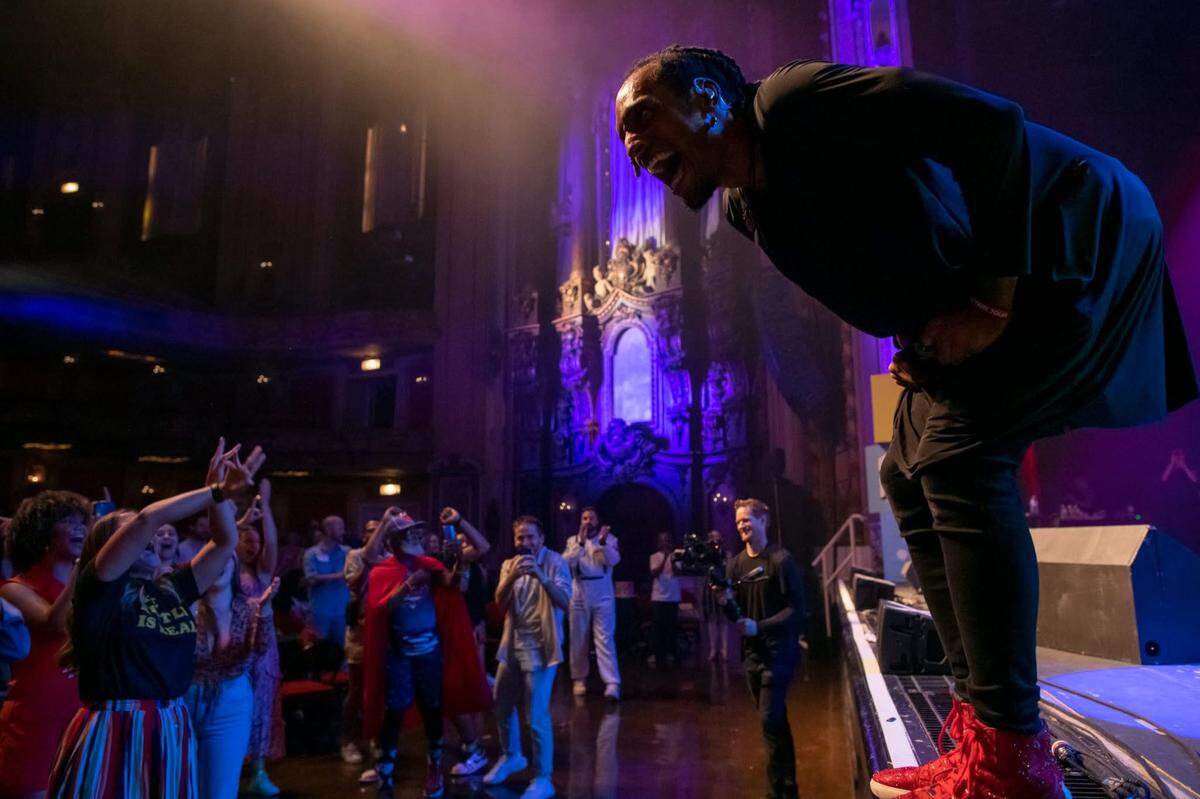
Over time, the work drew international attention. Young said he had already completed hundreds of clean-energy concerts that began in Kansas City expanded into a touring model that Young says has reached cities across the U.S. and projects in multiple countries like Honduras and Rio de Janeiro.
The work brought energy access projects to multiple countries before hearing directly from the United Nations. The organization named him a Young Leader for the Sustainable Development Goals, recognizing his work connected to clean energy initiatives.
Young said the recognition came unexpectedly after years of independently building the Battery Tour.
“They called me,” he said. “They were like, ‘You’re helping people get energy. You’re achieving one of the goals.’ That’s what happened. I just got a call from doing the work.”
Today, Young says the Battery Tour has completed more than 960 concerts powered through clean-energy systems, making it what he describes as the longest-running clean-energy concert tour in the world. Along the way, he has opened for artists including Wiz Khalifa, Shaggy and other national acts while continuing to advocate for cleaner live-event infrastructure.
Though Kansas City is Young’s hometown he grew up and considers his base of operation, he spends much of his time traveling and performing.
He also points to a broader cultural shift that has occurred since he first introduced the concept more than a decade ago. Artists and entertainment companies now increasingly discuss sustainability in touring and event production, conversations Young said were often dismissed when he first began pushing the idea.
“The world seems to have caught up to this idea,” Young said. “People laughed at me back then. Now these conversations about sustainability and clean energy are landing differently.”

New role for AY Young
On Earth Day, it was announced that Kansas City had appointed Young as its first sustainability ambassador, formalizing a role city officials say is intended to connect environmental goals with public engagement and storytelling.
According to Jensen Adams, the city’s chief environmental officer, the city partnered with Young because of his ability to connect sustainability work with culture and community outreach.
“AY is a champion for sustainability and the arts,” Adams said. “He brings people together through music and dance powered entirely by solar energy and batteries.”
The city’s Office of Environmental Quality is working with Young on a storytelling campaign highlighting businesses, institutions, organizations and neighborhoods connected to Kansas City’s sustainability goals. The campaign aligns with the city’s climate and resiliency framework, which focuses on mobility, energy supply, homes and buildings, natural systems, circular economy and food systems.

As part of the effort, Young is conducting interviews and producing short-form content focused on how sustainability work appears in everyday life across Kansas City.
Adams said storytelling plays a central role because it makes complicated ideas more approachable for residents and visitors alike as Kansas City prepares for increased international attention leading into the 2026 World Cup.
“Stories help make ideas accessible to Kansas City residents of all ages and interests,” Adams said. “Sustainability is a team sport. Everyone has a role to play.”
For Young, the appointment represents both a continuation of his work and an opportunity to broaden awareness about the city itself. He said many people outside the region still know Kansas City primarily through sports, barbecue or celebrity associations, while overlooking the organizations and individuals working to shape the city’s future.
“They may know Kansas City for BBQ or Patrick Mahomes or Taylor Swift,” Young said. “But there’s so much more here. We want to show the depth of the city and the people doing the work.”
Even with the official title, Young said he views the ambassador role as an extension of what he has already spent years doing through music, advocacy and global travel while continuing to represent Kansas City wherever the Battery Tour goes.
“I feel like I’ve been the ambassador forever,” Young said. “I never stopped representing Kansas City.”
This story was originally published May 18, 2026 at 5:00 AM.