Domestic violence is getting worse in KC. City is taking new approach to help
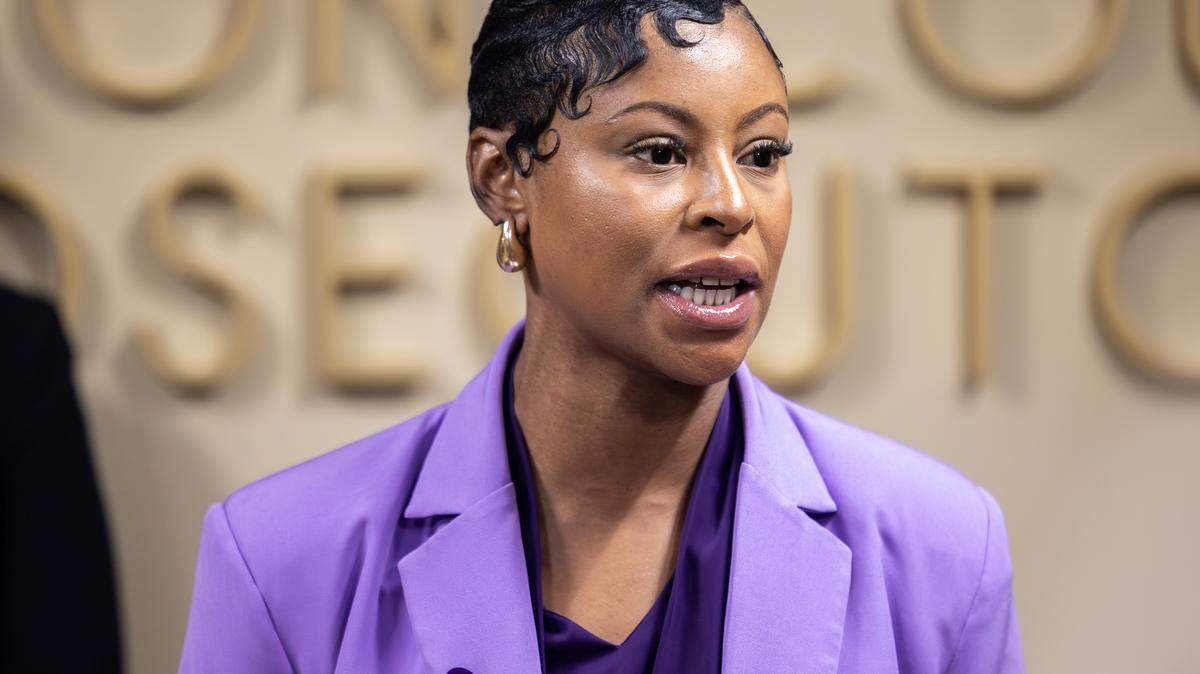
Backed by a $400,000 grant from the Bloch Family Foundation, Kansas City leaders on Friday announced the immediate launch of an “Intimate Partner Violence Intervention Program” aimed at decreasing rising domestic violence.
“Last year, like many communities across the country, Kansas City saw an increase in domestic violence, many of which involve people with no criminal record,” Kansas City Mayor Quinton Lucas said at a press conference in the lobby of City Hall. “That reality underscored the need to do more than just respond after harm happens. It demands that we intervene earlier before violence escalates and before lives are lost.”
Lucas was flanked Friday morning by Kansas City Police Chief Stacey Graves, Jackson County Prosecutor Melesa Johnson and representatives of four nonprofits serving survivors of domestic violence: Hope House, Synergy Services, Rose Brooks and Newhouse KC.
Lucas said the program, also supported by $75,000 in city funds, is designed to reduce “repeated intimate partner violence.”
“Intimate partner violence,” he said, “is one of the most devastating and persistent public safety challenges we face. And, too often, it’s one we’ve responded to after the fact.”
The program’s goal is to break the cycle of partner violence before the next incident occurs. Modeled on a program in Pittsburgh, Pennsylvania’s Allegheny County, Kansas City’s approach will involve a collaboration between the KCPD, the Jackson County Prosecutor’s Office, nonprofit service providers and the Kansas City Health Department.
“Our goals here are very clear,” Lucas said. “Reduce repeat harm. Disrupt cycles of violence. And protect the safety and stability of families in Kansas City.”
Lace Cline, Kansas City’s assistant city manager for public safety, said the program will operate similarly to the SAVE KC, a deterrence program in which the police, the prosecutor’s office and community stakeholders have helped reduce crime by identifying and focusing services on high-risk individuals, laying out consequences and offering intervening social services.
That program, she said, helped reduce homicides by 40% between 2024 and 2025 and non-fatal shootings by 60%.
“Those results give us real confidence that a similar strategy can be effective in addressing intimate partner violence,” she said. “But we also know that intimate partner violence often looks different from group violence, which is why we need a different approach.”
Cline notes that many domestic violence-related homicides involve individuals with little or no criminal history.
“Which means we have to intervene earlier before the patterns of violence get hold,” she said. ”It combines clear communication, clear accountability for people who cause harm, and access to services for people causing harm and people being harmed. We will directly engage individuals at risk of causing harm with a consistent message that the violence and abuse must stop.
“There will be swift accountability and consequences if it continues and there are services available to support real, lasting behavior change for those who take advantage of the opportunities for them. At the same time, we will ensure that victims are connected to coordinated services that support their safety and stability.”
Cline said the approach has resulted in a 20% reduction in intimate partner violence in Allegheny County and Pittsburgh.
Johnson, the prosecutor, presented stark Centers for Disease Control and Prevention statistics: 55% of female homicides are related to intimate partner violence.
“In Kansas City we’ve seen that firsthand,” Johnson said. “In 2025, one in three homicides were related to domestic violence compared to one in 12 in 2024. In some cases, we track a pattern: a prior assault, or a pattern of control. But, far too often, identifying a pattern is not easy or apparent.
“The Intimate Partner Violence Intervention Initiative is a proven way we can do everything we can to prevent escalating harm.”
Johnson emphasized that individuals who commit repeated intimate partner violence will be dealt with.
“We are committed to prosecuting to the fullest extent, pursuing the toughest plea agreements, seeking special convictions for probation and execution of their prison sentence if they commit a new act of IPV or other crime,” she said. “At the same time, for first time, for lower level defendants who are at risk of escalating, participation in this program looks like flooding them with resources and enforcement messages before they become offenders we never want to see in our courtrooms.”
Graves, the police chief, notes that in March one year ago, the police department initiated a call-to-action to combat domestic violence.
“This time, last year, Kansas City reported 12 domestic violence homicides. That’s an alarming number,” she said. “Today, one year later, after a lot of work, Kansas City has reported two domestic violence homicides. That’s still two homicides.”
Graves said the KCPD’s domestic violence section is currently staffed with eight detectives, a special victims unit, crime analyst, a domestic violence support team for arrest and survivor contacts, as well as having strong connections with advocacy and shelter groups.
Intimate partner violence, Graves said, comprises up to 65% of aggravated domestic violence cases. The numbers, she said, “confirm why focusing specifically on intimate partner violence is needed from both a prevention and risk-reduction standpoint.”
“I want Kansas Citians to hear our message,” Graves said. “Know we are a lifeline. . . We are here to end the cycle of domestic violence, hold abusers accountable and assist survivors with a safe, healthier quality of life.”
This story was originally published March 27, 2026 at 6:15 PM.