King’s War: How a neighborhood feud on a KC street of $400K homes turned deadly
The morning began cold, below freezing, that Monday, Jan. 12, of this year when, at 7:34 a.m., the residents of Maple Woods Estates in Kansas City’s Northland heard the sharp bang of close gunfire — one shot, two shots, three, then more — echo across their neighborhood of groomed $400,000 homes.
Awake already, Tom Lancaster, a resident on the block for 35 years, separated the mini-blinds of his second-floor office at the front of his house. He peered outside.
“I see a person laying right there,” Lancaster said.
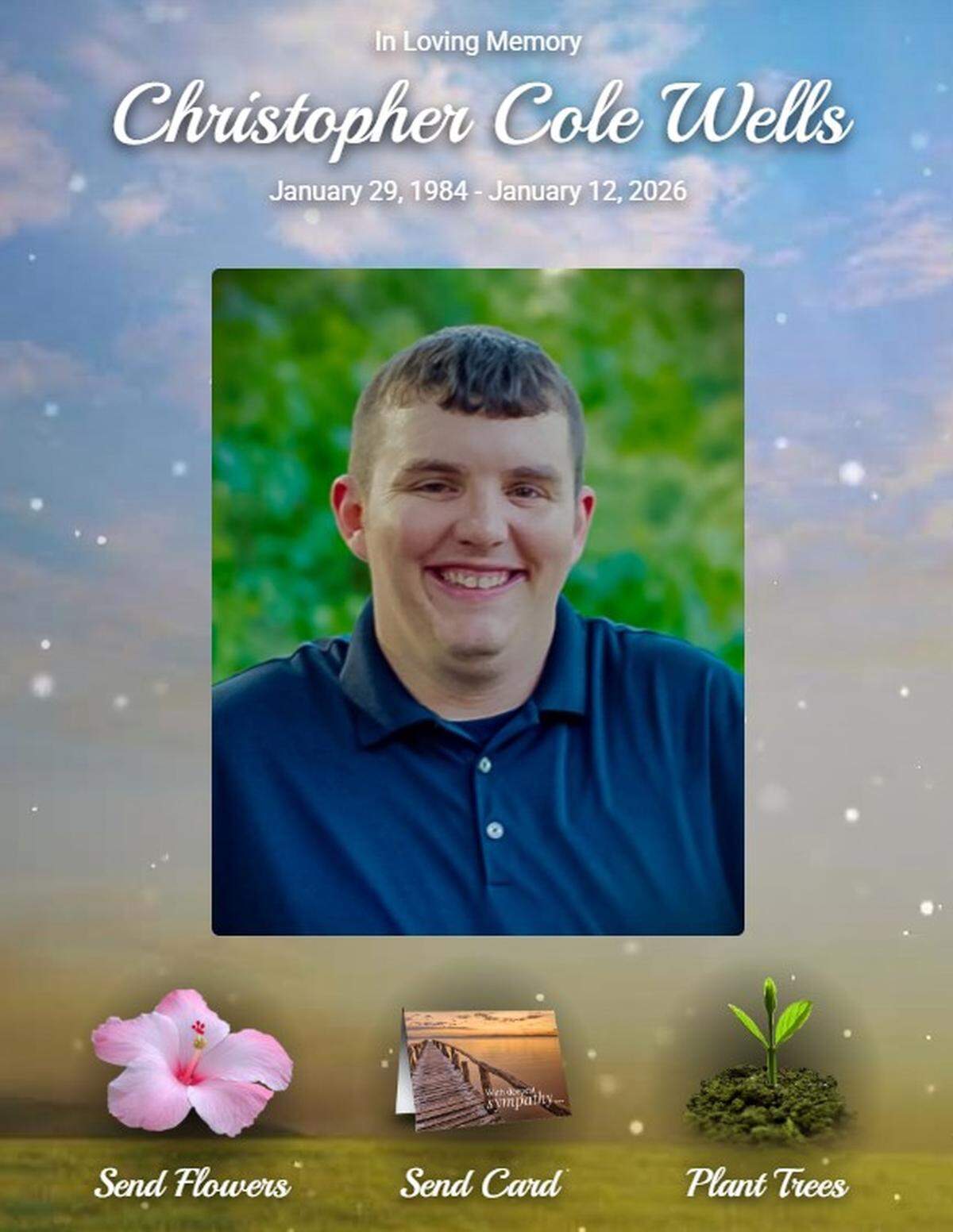
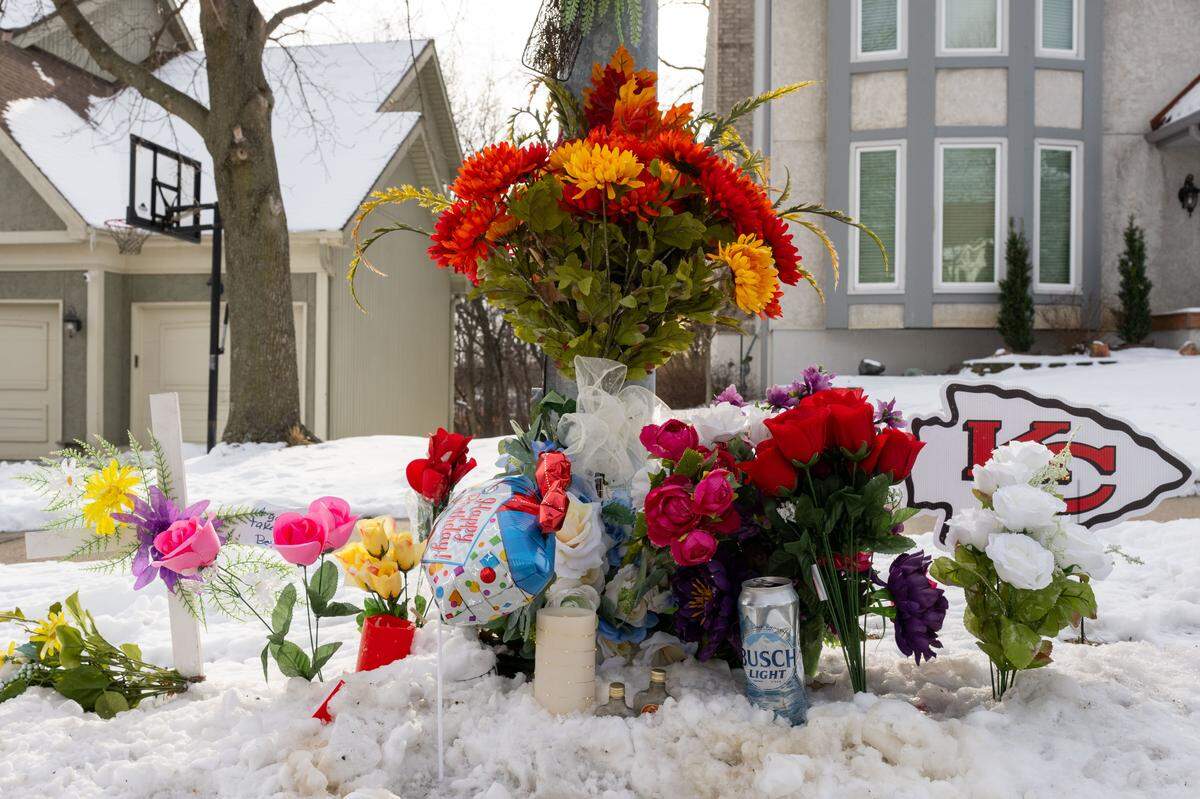
He pointed to the center of Northeast 78th Street., where, just days later, a roadside memorial of flowers and candles sat propped on a grassy median. It was only feet from where Chris Wells, his 41-year-old well-liked neighbor, a husband and beloved father of four children, was fatally shot, lying face down with what police would count as five bullet holes in the front of his body, eight in the back.
Neighbors said Wells’ wife, Kirsten, screamed for help, “My husband’s shot!”
Standing over the body, Lancaster alleges he saw another neighbor with a gun.
It was Jeffrey Traviss King, 42, his next-door neighbor who, over the last eight years, residents insist, had become the villain at the center of a petty, sinister and outrageous neighborhood war of torment and retaliation that — while it may have started with a feud with one neighbor — would eventually come to envelop the entire block. It escalated to a killing.
It is also one, many residents believe, that was preventable, as the neighborhood for years had complained about King, filing scores of complaints about him to their Homeowners Association, to 311, to Kansas City Police, City Hall and the mayor, all of whom insist they responded as best as the law allowed.
“The story here,” said one former Maple Woods Estates resident who had moved away, in part because of King, “is that the city didn’t take it seriously. We had police officers who were not doing their job, and it was dismissed.”
“Nobody took it seriously,” said another, “even though everybody in the neighborhood was saying this guy is dangerous.”
Neighbor Mike Galetti, who was once friendly with King, said that he urged authorities to take more serious action as recently as a month before the killing.
“You know, they kept saying, ‘Oh, there’s nothing we can do,’” Galetti said. “And I said, ‘Well, we’re all going to look back and see if this ends tragically. We’re going to look back and say we should have done something, and we should have done it quicker.’ I said that to many people — to the police, to the city.
“... If this guy lived across the street from (Kansas City Mayor) Quinton Lucas, how long do you think this would have went on? I guarantee it would not have gone on for two or three years.”
One neighbor is now dead.
Another neighbor — a former U.S. Marine, the divorced father of two sons — sits in Clay County custody, in lieu of $5 million cash bond, having pleaded not guilty to one count of armed criminal action and one count of murder in the first degree. No trial date has been set.
Once-quiet block gripped by fear
Despite King being behind bars, nearly all the block’s residents talk about their ongoing fears — fear that King might somehow make bail and be released. Fearful, too, that he could eventually be acquitted and return home. King’s defense attorney, Matthew Merryman — who declined The Star’s request for a comment or to speak to King — has hinted that he may seek a “stand your ground” defense. He’s noted that on Jan. 12, as the police probable cause statement recounts, it was Wells who waited for King outside his home and attacked King, punching him repeatedly, before King fired his 9 mm handgun.
“Mr. King was ambushed at his home,” Merryman said after a recent hearing.
Fear of King runs so deep in Maple Woods Estates that nearly every resident, but a few, who agreed to speak to The Star would only do so on the condition that their names not be revealed out of concern for retaliation.
“I don’t want to put a target on our backs. I’m scared,” said one resident. “If he gets out on bail somehow, I think there’s a lot of people who will find another place to go.”
“If he gets out,” said another, “we’re terrified because he’s going to come after us. I know he will. I have no doubt that if he got out, he would do something to somebody in this neighborhood. It would not stop.”
“If he shows back up into that house,” Lancaster said, “this place is going to go bananas.”
Said another neighbor, “I want to make it clear. This wasn’t just some random, one-off thing. This has been going on for years and years. Everyone saw this coming a mile away. . . It’s shocking, but it’s also not surprising.”
It wasn’t always this way.
Clay County Recorder of Deeds documents show that, with a $200,000 mortgage, King moved into his four-bath, four-bedroom home in 2012, with his then-wife, and young son, soon to have a second.
From August 2001 to August 2006, King’s military record shows, he was a U.S. Marine and served mostly as a Marine security guard. For one month in 2002, he was deployed to Operation Enduring Freedom. Neighbors said that when King and his family arrived, he initially worked for a financial advisory company, before leaving the company.
Social, talkative, and friendly, King was “incredibly engaging,” a neighbor said. He seemed present for his sons. Helpful, he swapped garage security codes with others so he could secure their packages when they weren’t home.
Life in his first few years on the block was generally serene, they said, until matters turned sour.
‘No Better Friend, No Worse Enemy’
In 2015, his spouse filed for legal separation and later divorce. (The Star reached out, but she declined to be interviewed.) That same year, records show, King filed for Chapter 13 bankruptcy. The divorce was granted in 2016.
“It just seemed like it started going downhill from there,” Lancaster said.
But what ignited King’s war did not seem to be the failure of his marriage, neighbors said.
In 2025, just before tension in the neighborhood hit its peak, King, himself, wrote a revealing single-spaced, two-page letter to members of the Maple Woods Estates HOA, offering an initial apology and explaining his side of what he called a “feud” and hints to how and why it began.
At the top of the letter, he placed a Marine logo, an American eagle astride the globe, encircled by a saying, “No Better Friend, No Worse Enemy.”
Stuffed into HOA members’ mailboxes, the letter was sent to neighbors prior to a vote on newly proposed HOA bylaws that seemed purposefully crafted to curb what neighbors saw as some of King’s most vexing behaviors, including the jumbled state in which he kept his lawn, piled with belongings, and the fleet of junk cars he kept parked on the street.
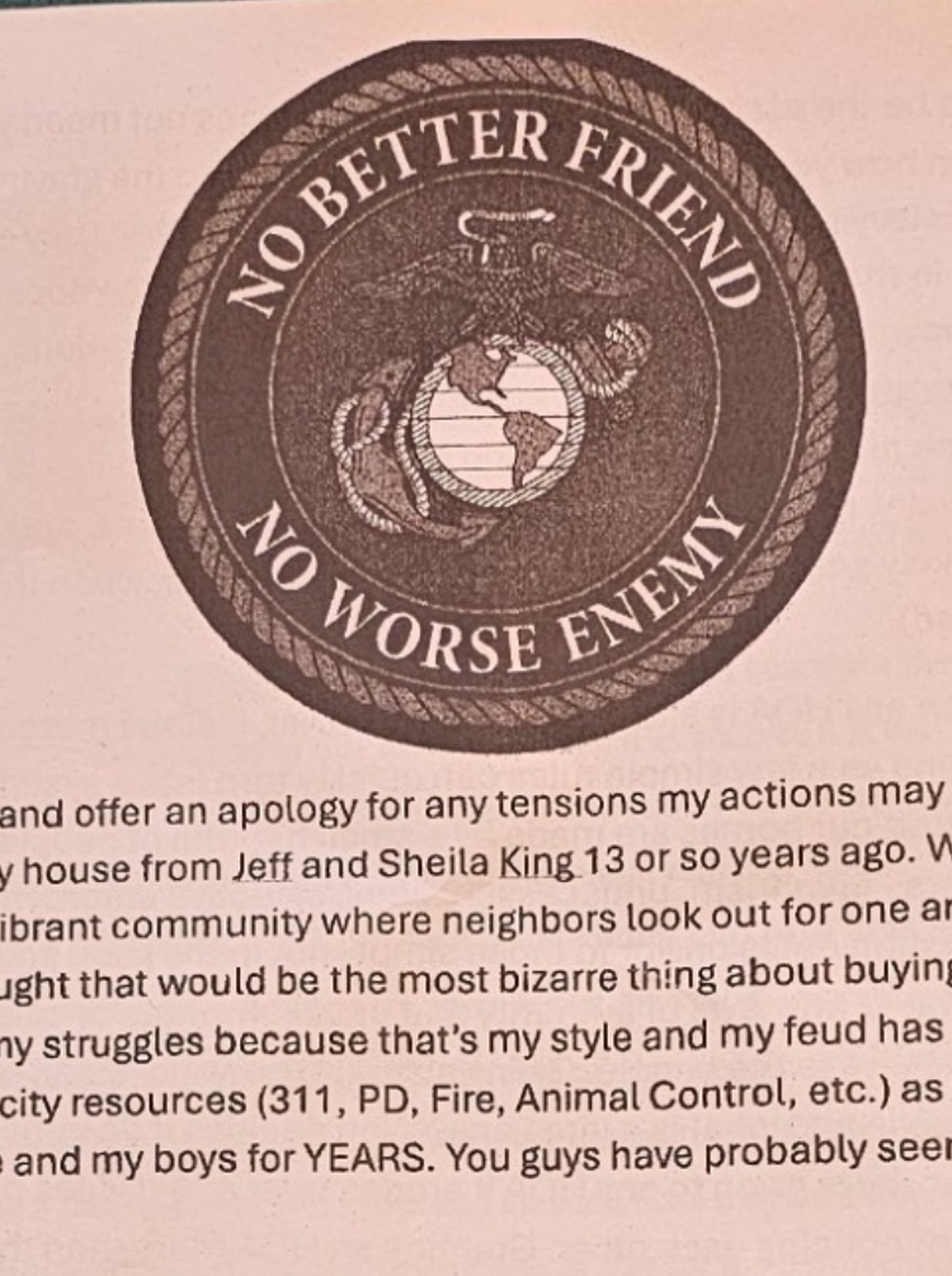
King’s response letter, a screed against HOA overreach, began:
“Dear Neighbors, I’d like to introduce myself and offer an apology for any tension my actions may have caused you.” It went on to say, “my feud has only been with a couple select neighbors.”
“Listen folks,” he continued, “I’m not innocent in this whole ordeal. I spent my formative years as a young man in an organization that standing up for what’s right is the only option. I’m more than willing to be the asshole to stand up to pettiness and passive aggressiveness here in the neighborhood. I don’t need anyone to like me.” King then named an individual, saying it all began with a former HOA member who lived nearby, but who, had since moved from the neighborhood.
He held that the neighbor was the initial instigator who “harassed me (by) calling the fire department when we would have fires for s’mores in the backyard, the police every other day for whatever BS reasons he could think of. . . This went on for years. . .
“When I brought up his behavior or him trespassing on my property and letting my dogs out of my backyard with camera footage on Facebook, the (HOA) board did nothing.”
He urged his neighbors not to give greater control to the HOA.
“Remind the board that their job is to serve, not rule,” he wrote, adding toward the end, “Acquiescing to BS, evil, or pettiness by silence and tolerance is not my style. I believe it takes courage to stand up to bully’s (sic) and not tolerate the behaviors listed above. . .”
He signed off with the Marine Corps motto, which means ‘always faithful.’
“Semper Fidelis, Jeffrey King.”
‘Stupid, petty things’
Excusing King for nothing, some neighbors conceded that there was truth in what King wrote.
“He is 100% at fault in this, 100% at fault,” a neighbor said. “But he was also targeted unnecessarily for years. He received plenty of harassment from this neighborhood and from people who left the neighborhood. And I think he just got tired of being targeted, so he started doing really stupid, petty things.”
“He always said the reason he was trying to punish the neighbors is because they would call the police and never ask him to clean things up,“ said neighbor Galetti, noting King complained that, “’Nobody ever came and asked me to do anything. All they did is turn me in.’”
One neighbor described King as having a mercurial personality, in which he could switch from kind and caring, at times generous, to unhinged and out of control, spewing vicious rantings
Galetti said he tried as recently as this fall to reason with King, when he walked over to King’s house and asked his neighbor for a talk.
“He sat me down in his front yard and said, ‘What’s up?’” Galetti said. He then told King that he had made his yard “look like a . . . trash heap.” And he said he told King that he was making his home life miserable.
“My wife was distraught and my daughter fearful,” Galetti said. “He said he looked at my family as the Switzerland of his neighborhood war and we were unintended victims of collateral damage. I told him that he had made his point and asked what was his end game?”
Galetti said he suggested to King that “we all bury the hatchet” and that he could gather a “detail of the men on our street” to help King clean up his yard and “we could get back to some civility.” King said he would think about it, Galetti said.
“Regretfully, several days later,” Galetti said, “(King) yelled across the street that he had decided he wasn’t going to clean up anything.”
Around 2018, King fired what neighbors remember to be his first salvo at his then-HOA neighbor whom he felt had targeted him. High up in his yard, King returned fire by erecting stadium lights that flooded the man’s house with bright beams. Then he cranked up the tunes.
“He played jazz music,” — along with rap and club music, others said — “at just the legal decibel limit right at the house.” a neighbor said. “It was bad. It was not excusable. It was bad.”
King told neighbors with whom he was friendly that if his personal feud came to affect them negatively, to let him know, and he would try to rectify it.
But the lights weren’t lasers. The beams and music spread. The siege was relentless, reportedly lasting months. Neighbors’ tolerance was tested.
But in 2019, when the neighbor that King found vexing moved away, the floodlights went dark. The music ceased. The battle stopped, at least temporarily. By then, neighbors said, friends and allies of the HOA member — as well as others just generally upset — had taken sides against King and began reporting other violations to 311 and the police.
The Star filed a Missouri Sunshine Law request with the Kansas City Police Department for an accounting of the volume of calls to King’s property over the last several years. Police frequently fulfill such request within hours or days. In King’s case, police said, due to staff shortages and a backlog of requests, as well as “the scope and complexity” of the request, gathering the calls for service could take as long as six months.
“Anything that Jeff did became something that people would file 311 complaints on,” a neighbor said. Twenty-one property violation complaints were filed in 2024 and 2025.
Boats, motorcycles and chickens
Neighbors’ recollections differ regarding the countless battles, what happened and when. What they all agree on is that King’s actions were highly strategic, making sure that whatever actions he took were within the law, or on the edge of it.
“He knew exactly what he could get away with,” one neighbor said. “He knew city codes better than most city officials know city codes. He was able to go right up to legal.”
Neighbors count the ways, beginning with the boat.
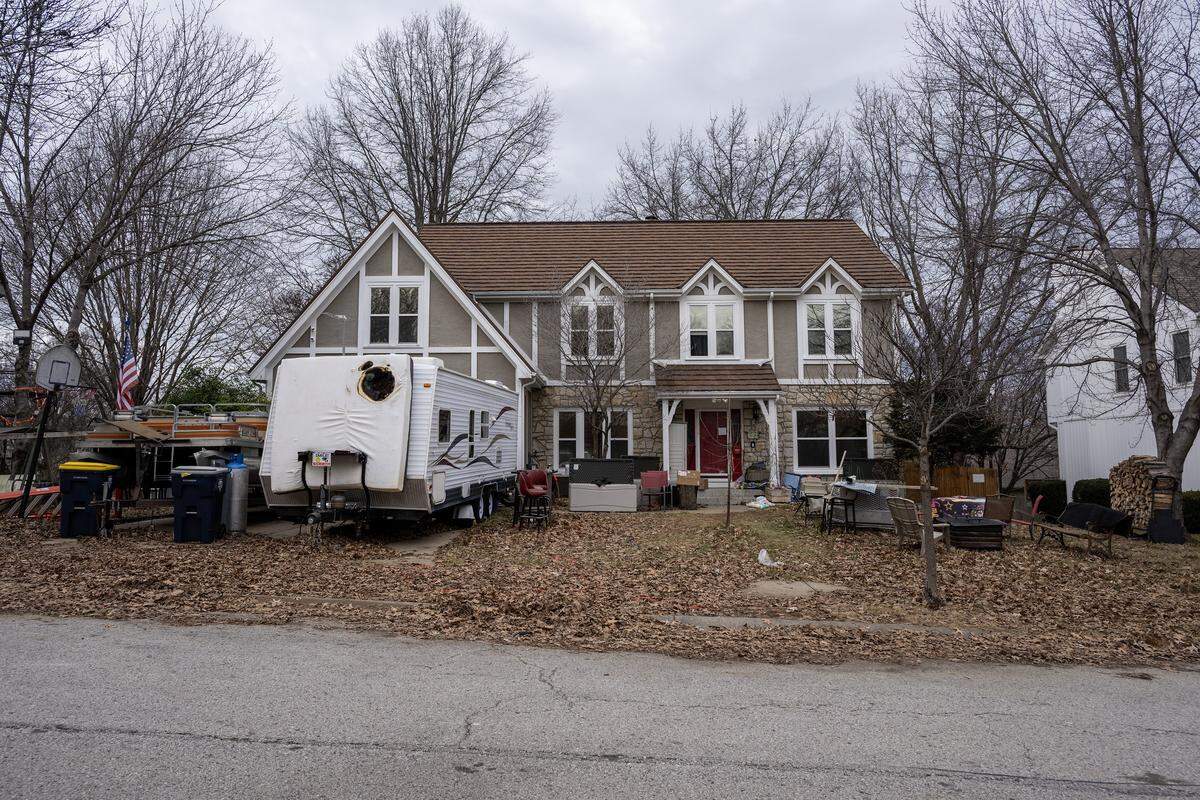
King had access to some lake property elsewhere. At one point, he hauled a pontoon boat in its trailer up to his house on Northeast 78th Street, and parked it at the curb. It was only supposed to be temporary, a neighbor said. King had planned to later haul it to the lake property so he could go boating with his sons.
But before he could do that, neighbors filed a complaint about the boat. Police came. They said to move it. Instead of driving it away, King thumbed his nose at the neighbors and moved it into his front driveway. There was no law or HOA rule against it. But, again, people complained.
“So guess what he did?” a neighbor recalled. “He found a cheap RV, and then he added the RV to his driveway. And guess what? People were upset about that.”
A Marine, King dug in.
“He never used them,” said Steve Sohl, a neighbor for six years. “Never went on a camping trip. They’re just sitting there.”
Next, King parked a motorcycle out front. Again, more complaints. In response, he removed it. In retaliation, he dragged a living room’s-worth of patio furniture he had in his backyard and placed it in his front yard. If neighbors were going to go big, neighbors said, King would go bigger, using whatever Kansas City ordinances or HOA bylaws — or lack of ordinances or by-laws — to his advantage.
“If somebody reported him,” Sohl said, “it just seemed to make things worse. Everything that somebody did, made it worse.”
Neighbors said people complained about the smell of King composting. He would also get a chicken or rooster, and people complained about that.
In time, the front of King’s driveway and yard filled: a hunting deer stand perched in a front yard tree, a half-cord of firewood stacked on the lawn. King tended to get a lot of Amazon boxes delivered. When neighbors complained, he bought multiple large plastic bins. He shoved the boxes in there and placed the bins around his yard.
Ever more police reports were filed, and 311 calls made, that might result in tickets or minor fines.
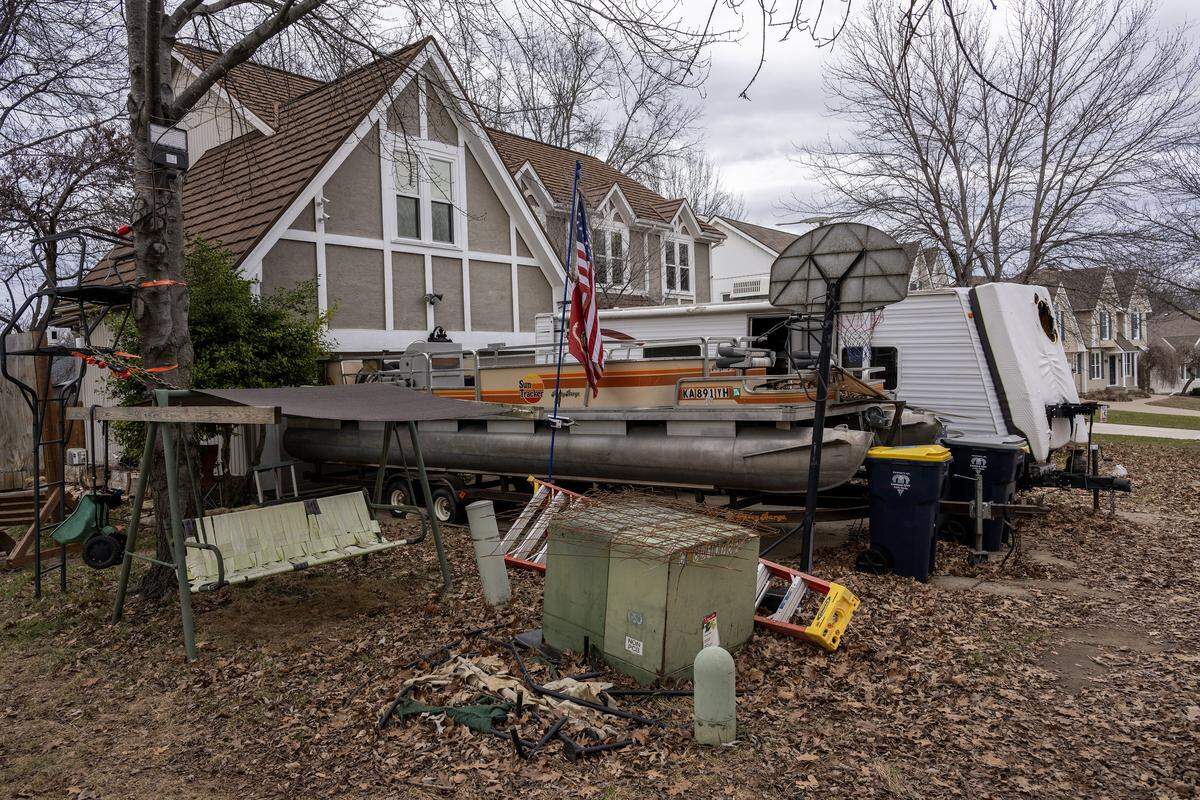
“What 311 and police finally said,” a neighbor recalled, “is, ‘You guys, you are calling 311 and 911 nearly every day. And we told you everything he is doing is legal. You don’t like it, but it’s not illegal.’ And Jeff told the police, ‘If you keep doing this, I am going to file a harassment charge.’ And he would have had a case. Plenty of people in this neighborhood had their cars blocking the sidewalk. But he was getting ticketed for that. Nobody else in the neighborhood was.”
Friends were asked to intervene. One said he asked King, “’What is it you need to be done with this?’ He was very clear, ‘I want people to stop harassing me. Stop calling 311, calling the city on violations. Everything I’m doing is legal.’”
His defiance, they said, was resolute.
“I’ve got more time and money,” King reportedly told a neighbor, “then you all have patience.”
There was no capitulation.
“If I would have heard him say to me, or anyone, ‘Hey, tell you what. Let’s call a truce and I’ll clean up my, you know.’ But that never happened. Nothing like that ever happened.”
One neighbor described the neighborhood feud with King as a fine-tooth gear being clicked tighter and tighter.
“It’s a spring, right?” the neighbor said. “It’s gradually gaining tension.”
Then, in late 2024, King clicked the gear again.
Choke point
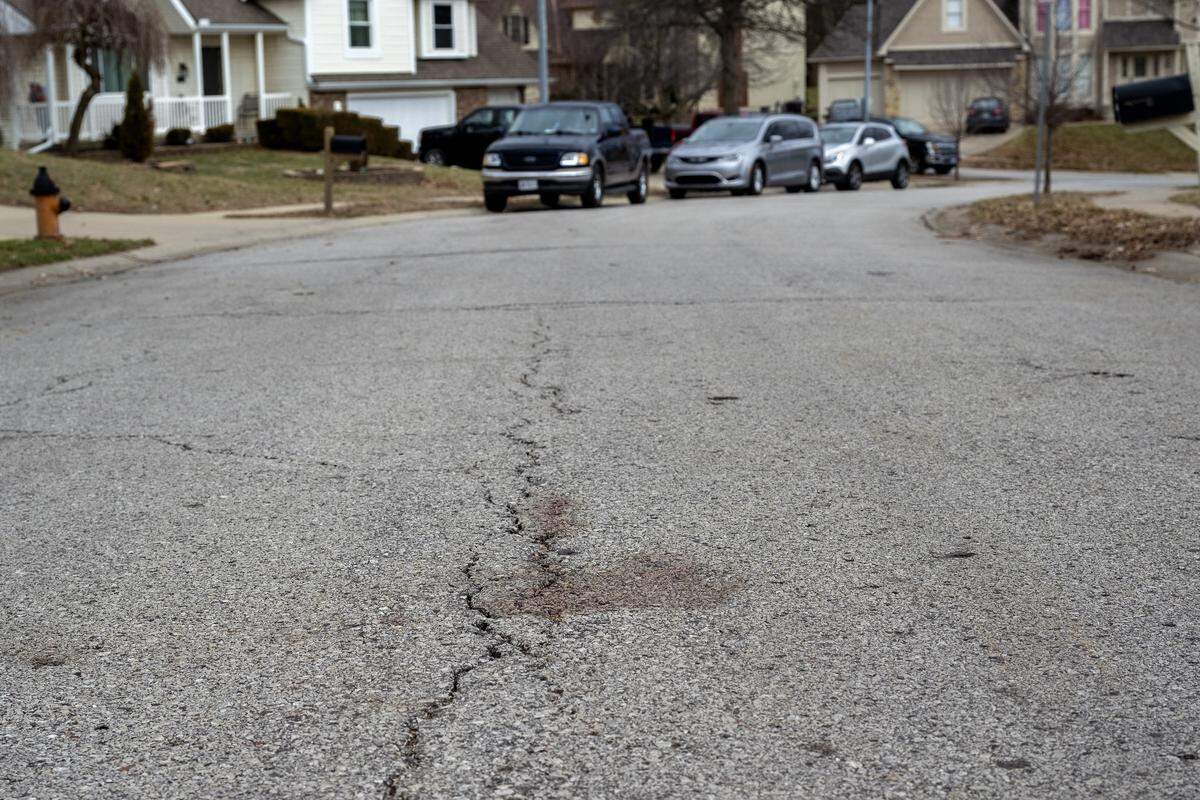
Northeast 78th Street in the Clay County part of Kansas City, 10 miles north of downtown, is a narrow road. King decided to make it narrower, according to neighbors, sending neighbors into fits.
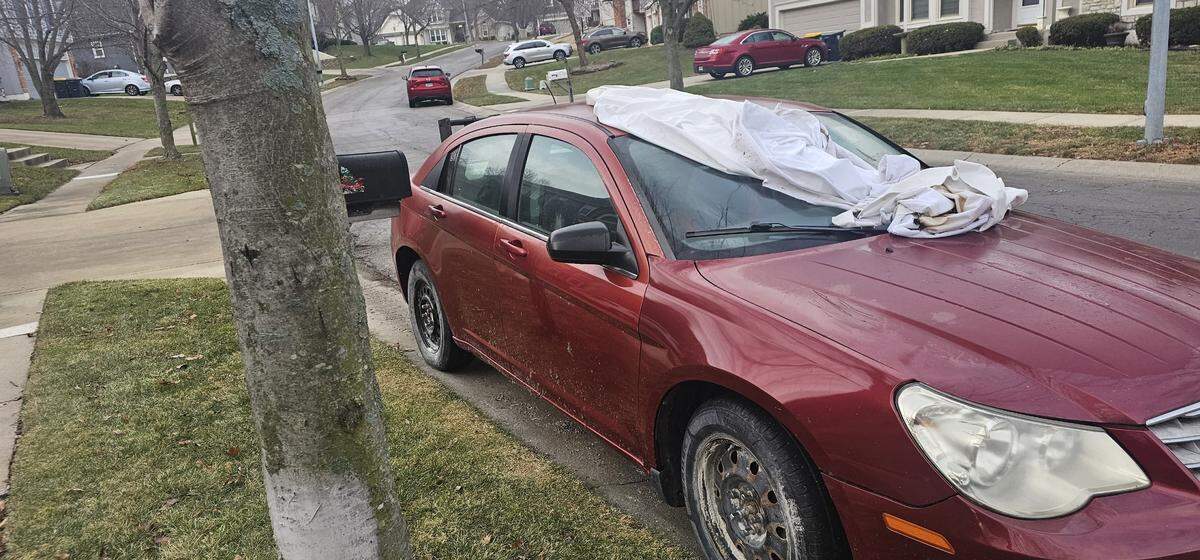
At the top of his block, where Northeast 78th Street makes a “Y” with North Wabash Avenue, King parked two old cars — one on one side of the street, the other on the other, in parallel, across from each other.
No ordinance prevented it. No sign forbade it.
Each car was parked, per law, just less than one foot from each curb. Multiple neighbors spotted King making sure the distance was correct and legal, bending down to the wheels and using a tape measure.
Situated in that way, the two cars created a choke point, a path so narrow between them that sedans and SUVs could barely inch through. Anything bigger could not.
“You couldn’t get emergency vehicles through,” a neighbor said. “School buses couldn’t get through. Snow plows couldn’t get through.”
Sohl said, “I kept thinking of my fellow man. Let’s say there’s a house on fire down the street, or somebody just had a heart attack. The ambulance or the fire truck, they couldn’t get through. This was a real danger.”
The cars weren’t in front of King’s house. They were in front of his nearby neighbors’ homes. Angry drivers, mistakenly thinking the vehicles belonged to the neighbors, began honking, cursing at them, flipping them off as they walked the street.
Neighbors who had been friendly with King appealed to him. They remembered his promise to try to rectify matters if his war began to affect them. But he refused, they said, reportedly telling one, “This is bigger than you and I. This is now war with anybody and everybody. . .Until they change the ordinance, I’m going to keep parking.”
Then, for a few days around Christmas 2024, he softened, moving the cars to one side of the street, until, once again, a neighbor filed another 311 complaint against him for something in his yard.
That was enough. The cars and choke point returned. The war continued.
Outraged over such disregard for safety, even those who had held uneasy friendships with King cut him off. Not too long after, their homes, too, would be targeted by floodlights.
Instead of complaining, or engaging King in battle, one neighbor found a way to deal with it: They bought blackout curtains.
But for the rest of the neighborhood, the dangerous choke point was one provocation too many.
They decided to act. Tension increased.
Chris Wells becomes an enemy
In 2025, neighbors looked to thwart King.
They appealed to the city requesting “No Parking” signs on one side of 78th Street, effectively allowing them to destroy King’s choke point and make the street passable.
Chris Wells took on a leadership role. In so doing, neighbors said, he quickly became King’s enemy.
The Wellses had moved onto the block only two years before. An outdoorsman whose greatest joy was being a dad, Wells worked for 12 years at Bayer Crop Science in Kansas City, working 12-hour shifts.
“You couldn’t ask for a better neighbor,” Galetti said.
Wells made it known to neighbors that he was not one to put up with bullies. King’s purposeful choke point continuously kept the school bus from reaching Wells’ children. Time and again, neighbors said, King would be disrespectful to Wells’ wife, Kirsten.
“He (King) would stand in his yard, and he would yell down toward the school bus stop with elementary school kids there,” a neighbor said. “He’d yell at Kirsten — pardon my French — he’d say, ‘“F*** you.’ He’d call her a c***. He’d say, ‘You’re worthless. You’re trash.’”
She was far from the only one.
“He would sit there,” one neighbor said, “and, I mean, with the police standing in his yard. He’d flip off other neighbors, ‘F*** you!’ And the cops would say, ‘That’s harassment. That is threatening language. You just threatened them.’ And the officers would explain, ‘Could I have taken him into custody at that point? Yep. But what would happen then? Slap on the wrist. He’d come back home. He’d pay a small fine. And then, guess what, he would ramp up again.’”
In May 2025, the city posted “No Parking” signs in three waves.
King, neighbors said, responded by bringing in even more junk cars, as many as eight to 11. Instead of parking on both sides of the street, he parked them up and down one side, in front of the mailboxes, which was a federal offense, but not against any city ordinance at that time. (On Feb. 5, 2026, in the wake of Wells’ death and citing King’s actions, the Kansas City Council passed an ordinance making parking it illegal to park in front of a mailbox.)
Over time, some of King’s cars would get ticketed and towed. To prevented it, King shuffled them around so they couldn’t be deemed abandoned. Lancaster, his next-door neighbor, recalled a time when he, himself, was in his car talking on his cellphone and spotted King backing one of his clunkers in front of Lancaster’s mailbox.
“He gave me this look,” Lancaster said, mimicking a scowl. “You know, like, ‘I’m showing you, you bastard.’”
Property damage and Jeffrey Epstein
The conflict between King and the Wellses, neighbors said, grew particularly intense.
In August, it escalated. Caught on the Wellses’ outdoor security camera, footage recorded King stepping onto the Wellses’ property, wielding a hammer and smashing a side mirror of Chris Wells’ blue truck.
“I have said to people that I’m not a clinical psychologist,” Lancaster said. “But I think he (King) was a sociopath. I mean that’s an uneducated view, but, again, he is retaliatory to people that do something to him, but he will do the same thing to somebody else and think nothing about it.”
Convicted in November of property damage, King was sentenced to 30 days in jail, but it was suspended. He was given two years probation under specific conditions. The first was that he have zero contact with Kirsten Wells. He was to stay away from the Wellses’ house. He was to complete 10 hours of community service. He also was ordered to pay $303.20 in restitution to the Wellses within six months.
One month later, in December, King vexed the neighborhood again, slinging large banners over a burned-out mattress on the back of his RV. One, printed with the face of convicted sex offender Jeffrey Epstein, included the message, “This Flag Did Not Hang Itself,” a reference to Epstein’s suicide by hanging.
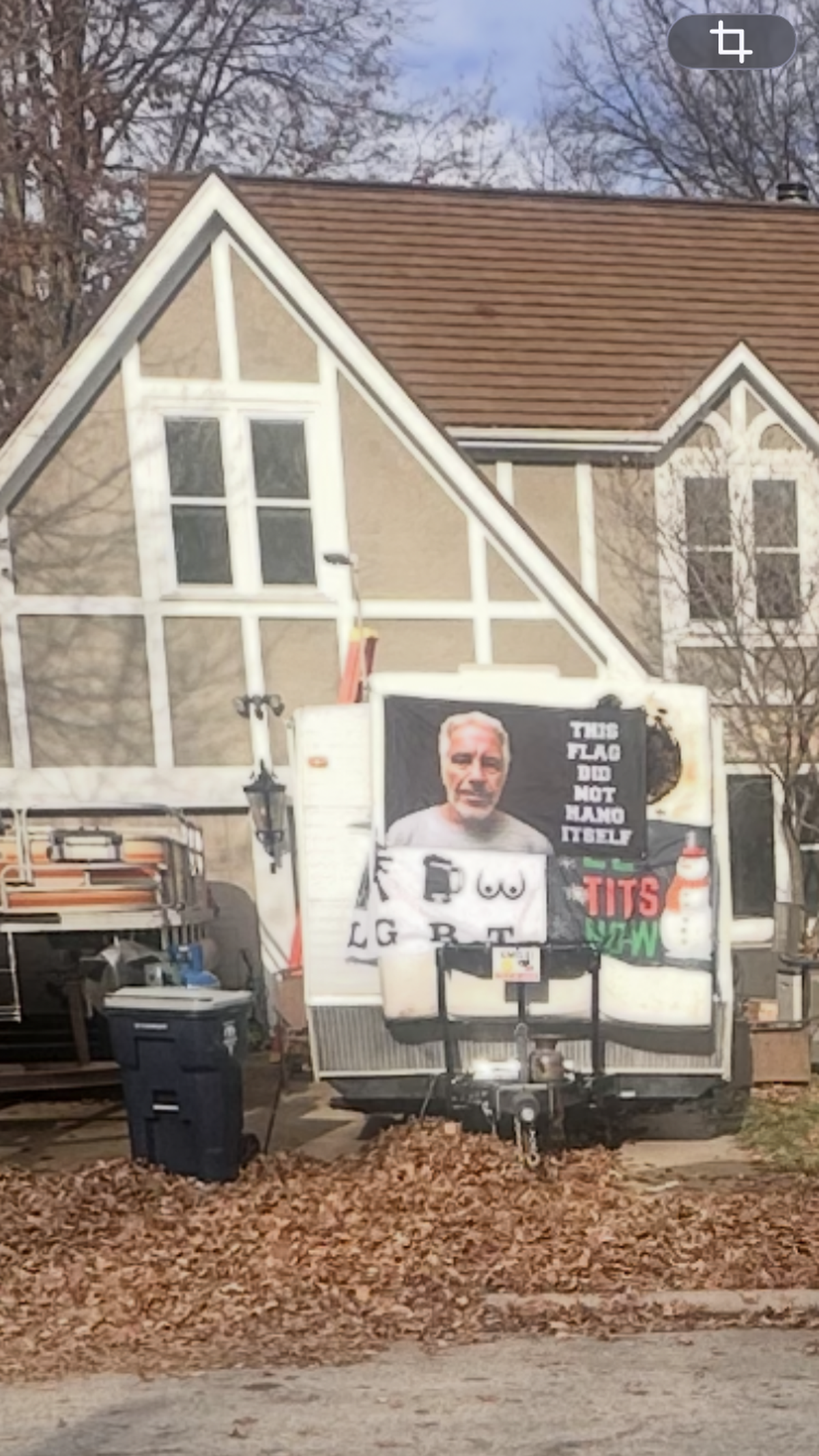
Another, with a snowman, included the message “LeTITSnow” with the four central letters written in bold red. A third included images of a gun, a beer and a woman’s bare breasts.
When authorities asked King to remove the breast banner as vulgar, King taped over the nipples with stars made of tape or Magic Marker.
“Then he went out into one of his junker cars,” Sohl said, “and honked the horn for three minutes.”
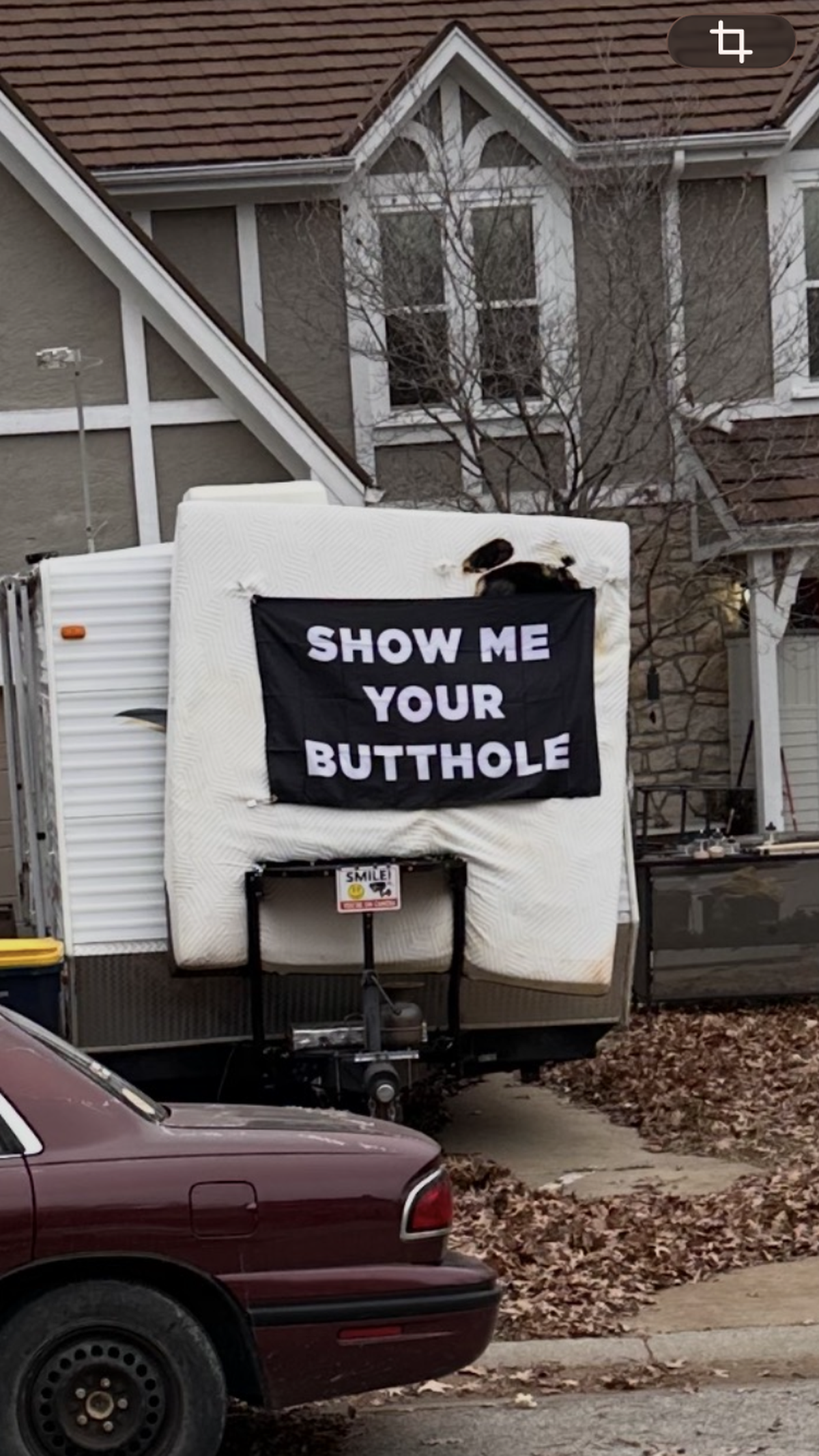
Soon after, he swapped out those banners with a black banner with all white text: “Show me Your Butthole.”
“He took pleasure in it — tormenting, taunting, I would say,” a neighbor said.
7:34 a.m. — The Shooting
Numerous neighbors heard the gunshots on the morning of Jan. 12. Several immediately dialed 911.
Some, looking from their windows, had an uncertain view of the figure lying still in the street. Their first thought was that perhaps Jeff King had killed the Wellses’ dog, a frightful notion on its own.
The truth became more horrifying.
The Kansas City police probable cause statement spelled out the basic details:
Kirsten Wells was walking her dog up the street when she saw a vehicle running on King’s property. She turned around to head back home because of the no-contact order, but then noticed King approaching her property with a blanket in his hand. He tossed it onto the grass of her front lawn.
Neighbors said that King would sometimes place blankets or tarps on top of the old cars that he lined along the street. Occasionally they would blow off. They suspect that one may have blown off of one of the cars outside the Wellses’ house and someone placed it on King’s lawn. They guess that King was returning to sling it back on Wells’ property.
“Due to the long history of King harassing her and other neighbors in the area, (Kirsten Wells) called the victim (Chris Wells) to notify him while he was work,” the police document reads.
Wells returned home. He walked “toward King’s property to confront him.”
The document goes on to say that a fight broke out. Video from neighbors’ security cameras would later show that Wells waited outside King’s property for King to return from wherever he had gone.
A video captured by a neighbor reportedly is said to show Wells punching at King’s face as many as three times.
.jpeg "Image (1).jpeg")
“The victim is then seen backing away from King, apparently raising his hands as he backs away,” the police statement reads. The video is obscured at that point. Eight gunshots ring out.
Two juvenile witnesses told police that they watched from their car as King stood over Wells and shot him in the back as he lay face down in the street. Another witness said that he, too, was in his car, when he saw King in the street with his hands up, and with Wells lying on the ground. He asked King what had happened, and reported that King told him, “He attacked me. Punched me in the face and I shot him dead.”
Police also talked to Wells’ work supervisor, who had spoken to him right before he rushed home. Wells, the supervisor told the police, said that he had an encounter with King that night before, Sunday, “in which King cursed at him and said that he would kill him.”
In January 2025, King filed papers to begin his own business, Fidelis Firearms KC, centered on “weapons, guns, classes.” A search of his home, would later turn up 16 9 mm handguns and other firearms.
By 7:58 a.m., he was led away in handcuffs.
A tent was eventually placed over Wells’ body.
‘Stop talking to my wife like that’
No one in the neighborhood doubts who’s to blame.
“Mr. King is 100% at fault for this, 100%,” one neighbor said.
“Jeff is at fault for escalating to the point of non-recovery,” said another. “Chris went to defend his wife.”
One neighbor said that the tension had begun to build on the Sunday before the shooting.
That day, the neighbor said, Wells decided to park his truck in front of King’s house to specifically show King that he was not afraid of him. Neighbors, spotting the truck, visited Wells to change his mind.
“This isn’t going to end well,” the neighbor said he told Wells, who reportedly responded, “Well, if he can park his cars in front of my house, I’m going to park my truck in front of his house.”
Wells was angry, the neighbor said. Friends sought to dissuade him from engaging. “He (Chris) made the point of he was willing to take the assault charge to prove to Jeff that he can’t intimidate his wife.”
They convinced him to calm down and return his truck to his own home, which he did.
“I kept saying, ‘Don’t play this game,’” the neighbor said, adding about King, “that’s just what he wants. He wants somebody to engage so he can say, ‘Look, he hit me.’ That’s exactly what Jeff wanted, to have someone be the aggressor so he can look the police dead in the eye and say, ‘What did I do? I’m following the rule. Here it is. Yes, it’s annoying, but I didn’t break any rules. But look at this. He gave me a shiner. You’ve got to go arrest that guy because he hit me. . .
“Up until the point where the gun was drawn, it is my belief that Chris had done exactly what Jeff wanted to happen, which was to have somebody assault him to prove, that see, ‘I’m not the bad guy here,’ and be the victim.”
On Monday morning, one day later, Wells rose to the provocation.
“We’re not surprised that Jeff would do something like that at all,” another neighbor said. “We are disappointed that Chris wasn’t wiser. Everybody laid low. Everybody walked on eggshells. Chris, come on, don’t be macho.”
To others, however, Wells is viewed as a champion unwilling to bow to a bully who had been tormenting the neighborhood and routinely verbally assaulted his wife.
“I look back at him as our warrior here,” Galetti said at a candlelight vigil on the Tuesday evening after Wells was killed. “He’s our William Wallace, ‘Braveheart.”
“I mean, his motivations were honorable,” another neighbor said. “Basically, it’s like, ‘Stop talking to my wife like that. Like, how dare you?’ Like any man would never be OK with somebody else yelling at their wife.
“These guys had multiple confrontations. What we think, wonder, is if Jeff had been trying to bait Chris into a physical confrontation — which he did, which he did, which is the really sad and scary part.”
Should the police, city have done more?
If blame is to be parceled out beyond King, numerous neighbors would place it on institutions, ranging from their own HOA, to police, to City Hall, to Kansas City Mayor Quinton Lucas.
“If someone wants to be mad, be mad at the city,” a resident said. “Be mad at our damn mayor who did nothing when Chris Wells reached out to him.”
Neighbors insist that Wells sent the mayor emails, voicemails and reached out on social media.
“Ask Mayor Q why he could go ahead and get a code changed for this ICE (proposed Immigration and Customs Enforcement) center he is worried about,” the neighbor continued, “but for three years, when we’ve been up here asking him to do something about this, it’s ‘Sorry, it’s the Northland. I don’t give a s*** about those people.’ Be pissed at Q. Be mad at the city.”
In a written statement, Megan Strickland, the mayor’s press secretary, wrote, “The Mayor grieves for the family of Christopher Wells and all who loved him and knew him.”
“Based upon the allegations averred by the Clay County Prosecutor, Jeffrey King, a neighbor and local firearms seller, bears the responsibility for the tragic murder of Mr. Wells. Despite past citations from the City, Mr. King appears to have used and abused civil and legal processes and the local press in his ongoing efforts to persist against the City in nuisance activity and harassment of his neighbors.
“Having lived in neighborhoods with shootings and homicides during his time in public office and having sought civil orders of protection himself in recent years, the mayor understands the concerns of Mr. Wells’ neighbors about individuals who threaten their neighbors and our entire community. The City will continue to investigate all violations of the Code of Ordinances, issue citations as it did with Mr. King, tow vehicles and other actions, as it did with Mr. King, and address concerns present in any part of our community equally, using every enforcement tool available within the City’s powers.”
She noted that Missouri law rarely permits incarceration of individuals for property nuisance activities for lengthy periods, nor does it permit seizure of property except in limited circumstances.
“But,” the statement said, “the City will continue to evaluate changes to the nuisance code that protect the property rights required by law while eliminating the behavior of a local nuisance who, in this tragic circumstance, became a violent offender.”
While some neighbors point fingers at the police, others defend them, saying that while King’s behavior was obnoxious and taunting, the police did what they could, often issuing tickets. But more often, there was little they could do because King was acting within the limits of the law.
Sherae Honeycutt, the city’s press secretary , which operates 311, sent a prepared statement.
“First and foremost,” she wrote, “the City extends its sincere condolences to the family, friends, and all those affected by this tragic incident. We recognize the profound impact of situations like this and the grief they bring to the community.
“In moments like these, it is natural to reflect on what might have been done differently. The City has engaged with the property owner of the address in question on multiple occasions in the past, including issuing citations for ordinance violations and engaging in allowable remediation efforts.”
Councilman Wes Rogers, a likely candidate for mayor who represents the neighborhood in the Northland’s 2nd District, recalled working with Wells on a past issue and called him a delight. He said he understands the neighborhood’s anger and frustration.
“This neighborhood was letting us know that this guy (King) was a major problem,” Rogers said. “We need to look at every single thing that happened here and take a longer look at this, and it’s going to take time to do that the right way. And if people need to be held accountable, we will hold them accountable.”
Rogers said that on Dec. 26, one day after Christmas, he visited the neighborhood and attempted to talk with King. An aide had “escalated” complaints to Rogers. He said he thought, “This is terrible. And I literally drove to the guy’s house almost immediately.”
“I saw the signs, and I saw this crappy trailer. So I saw all that stuff,” he said. “So I knocked on his door, because I’m thinking, maybe we just need a fresh start here. Maybe he’ll talk to somebody who he hadn’t already gotten in a fight with.”
No one answered.
One of the offensive signs hung from the burned-out mattress.
“He pushed it as far as he could just to antagonize people,” Rogers said.
Until he pushed even further.
“I was a public defender for a year,” Rogers said. “I was a violent crimes prosecutor for five years. ... In politics, you deal with constituent issues all the time. This is, by a mile, the most difficult thing I’ve ever dealt with as an elected official, or as a violent crime prosecutor.
“You got neighbors telling us for months, this guy’s a menace, this guy’s a bully, this guy’s an asshole, this guy’s going to hurt somebody. And now he goes out and he (kills) a father of four.”
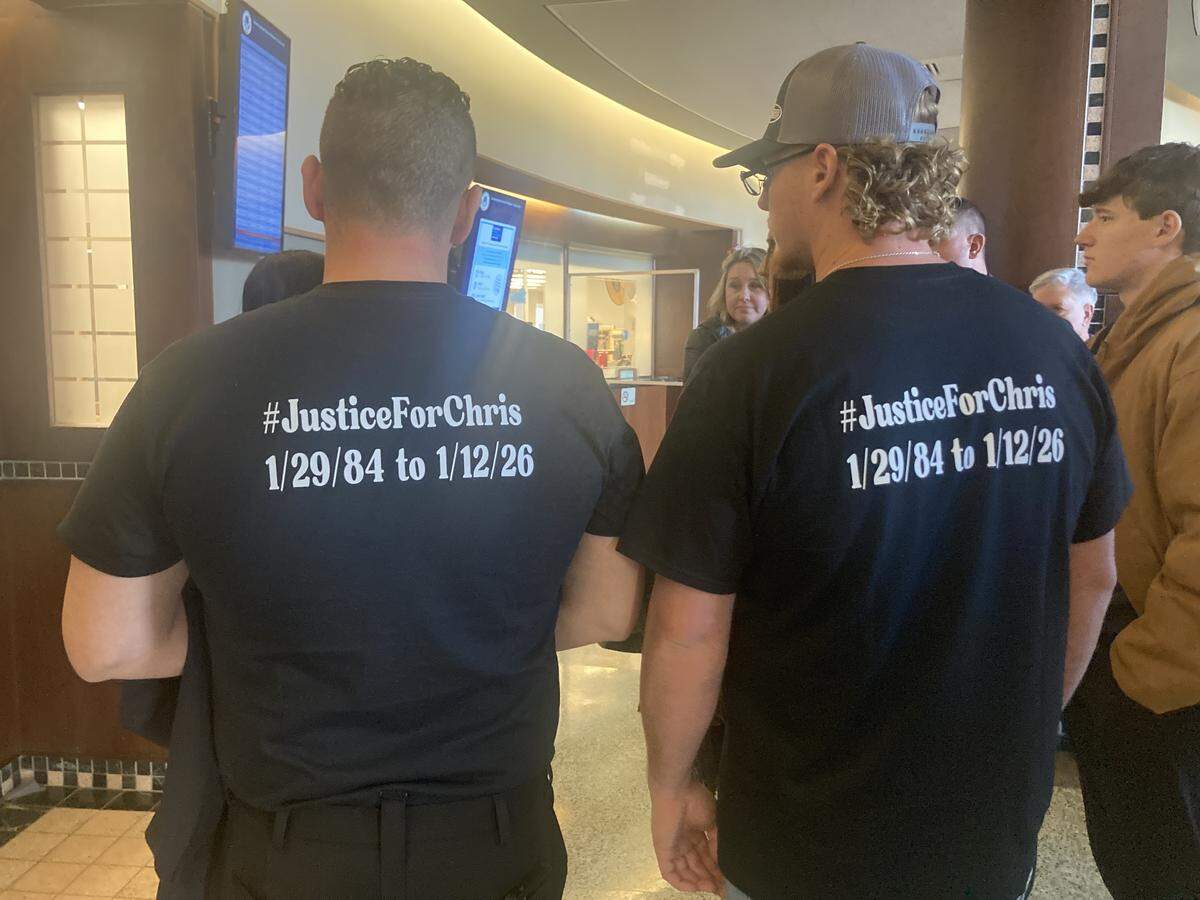
Christopher Cole Wells died just barely two weeks before his January 29th birthday. He would have been 42 years old.
This story was originally published February 3, 2026 at 9:12 AM.