Inside KC’s thriving African drum and dance community, younger than ever
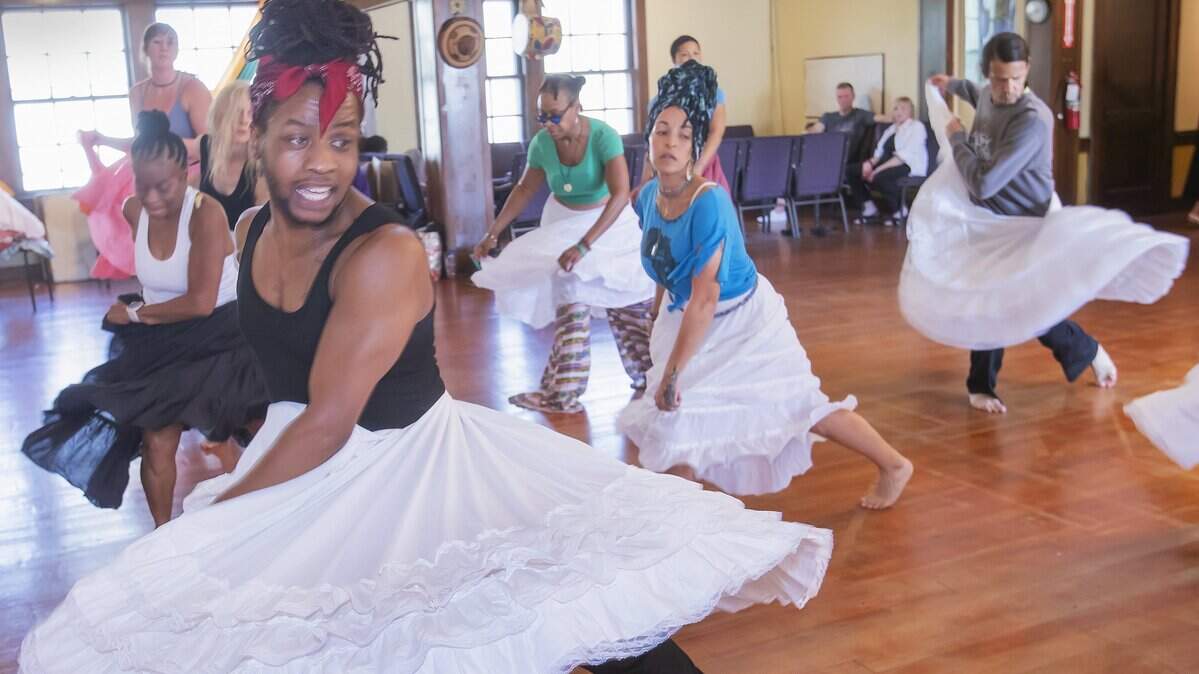
At the Traditional Music Society’s Saturday class, Kansas City percussionist Bird Fleming stood in front of a congregation of students from various races, ages, and genders. He introduced Selah Thompson, a dance instructor, to lead the class that day in Afro Cuban dance.
The rhythmic sound of conga drums echoed throughout the auditorium of the St. Marks’ Hope and Peace Lutheran Church at 3800 Troost Ave., where the Saturday session was held.
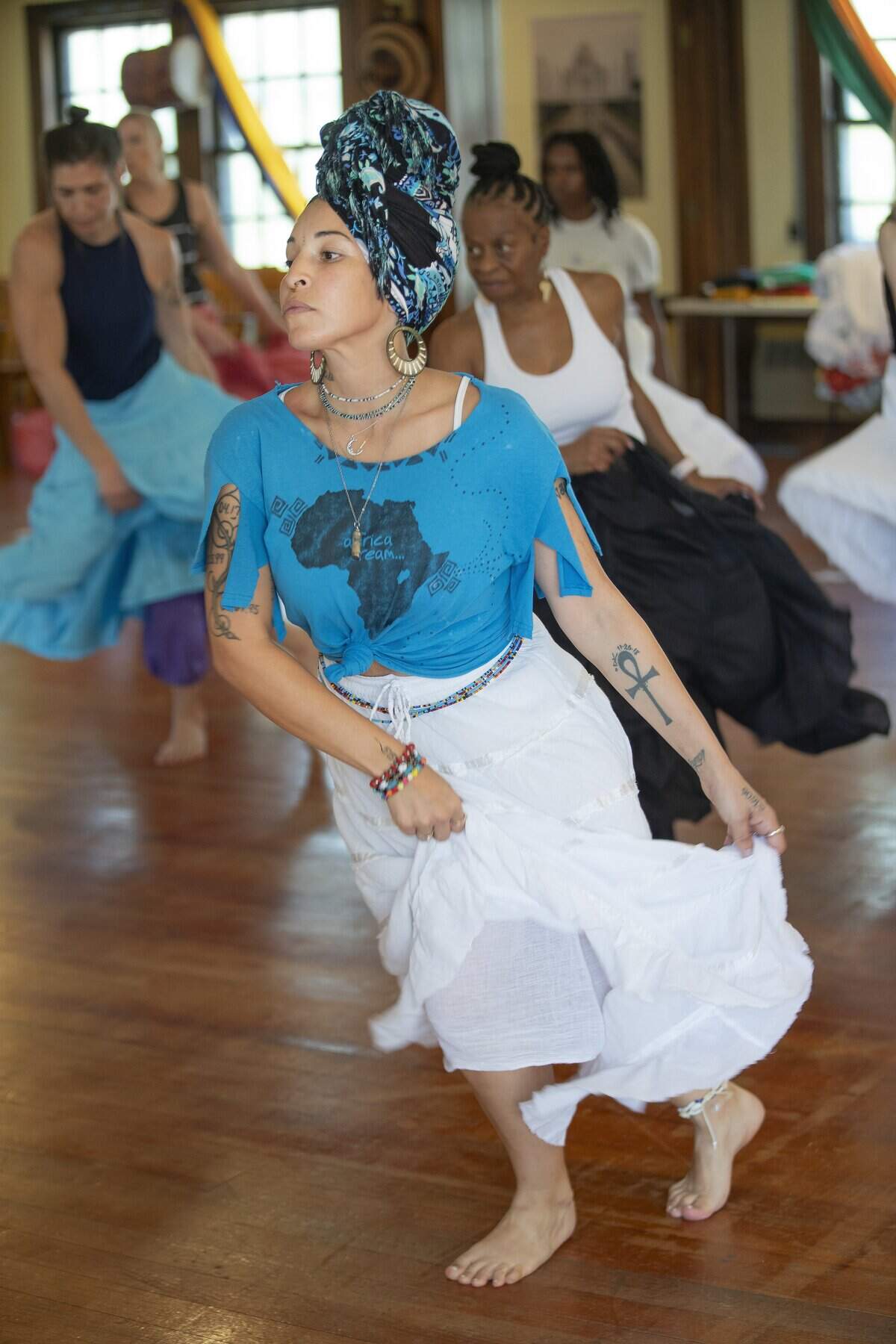
Thompson and his students donned flowing white skirts that swayed with every step, symbolizing the motions of nature.
The dance, Thompson said, is a story using the body to convey deep spiritual connections between humans, nature and the divine. This dance was one of water, a source of life and destruction.
But it was the syncopated rushing rhythms and intricate beat patterns played by a quartet of drummers that directed the movement, adding a sort of heartbeat to the story as the timbre of the drums vibrated throughout the church.
African drum and dance was virtually nonexistent in Kansas City until the 1980s. Thanks to two passionate percussionists — Fleming, with sounds rooted in West Africa, and Danny Hinds, who brings a Caribbean beat to his rhythms — this colorful, energetic art form has not only claimed a space in the KC music scene, but it’s thriving.
Their years of work and collaboration created a network of ensembles, classes, and school residencies reaching thousands in Kansas City. Fleming remembers starting off with classes that drew a small collection of Black students. Today, the numbers are greater and the demographic is far more diverse.
Now the two master teachers are handing the art forward to the youth, those they teach, and their own children who already have made music part of their professions. Hinds’ daughter is a recording artist and Fleming’s son is a music therapist.
THE SEED YEARS
Fleming came from Washington D.C. to Kansas City in 1981 to study at Park University and ended up discovering the passion — drumming — that would take hold of the rest of his life.
In fifth grade, Fleming wanted to learn to play saxophone, but his family couldn’t afford the instrument so he picked up the recorder instead.
Then one day — he was a teenager by then — he heard Stevie Wonder’s “Fingertips.” As he listened to the album, he was stirred by the pop of a full round beat just beneath the sound of Stevie’s harmonica.
“I said, ‘Ma, what is that instrument?’ She said, ‘Those are bongos.’ I said, ‘Wow, that sounds amazing.’ She said, ‘Now that I can afford.’ So that became my first instrument, percussion.”
Fleming learned all he could about hand percussion and traveled the country studying drums and techniques from around the world. His teachers corrected his posture and his hands; the angle of the arms and the way the wrist releases into the top of the drum, or drum head which usually is made from animal skin.
“It’s probably one of the most misunderstood instruments in the world,” Fleming said. “Because it looks simple to make, so people assume it’s easy to play. It’s not.”
Drums are instruments made up of numerous sounds, Fleming said. He said a teacher once mapped out 120 different tones on a two-dimensional drum surface.
From Barbados to Troost Avenue
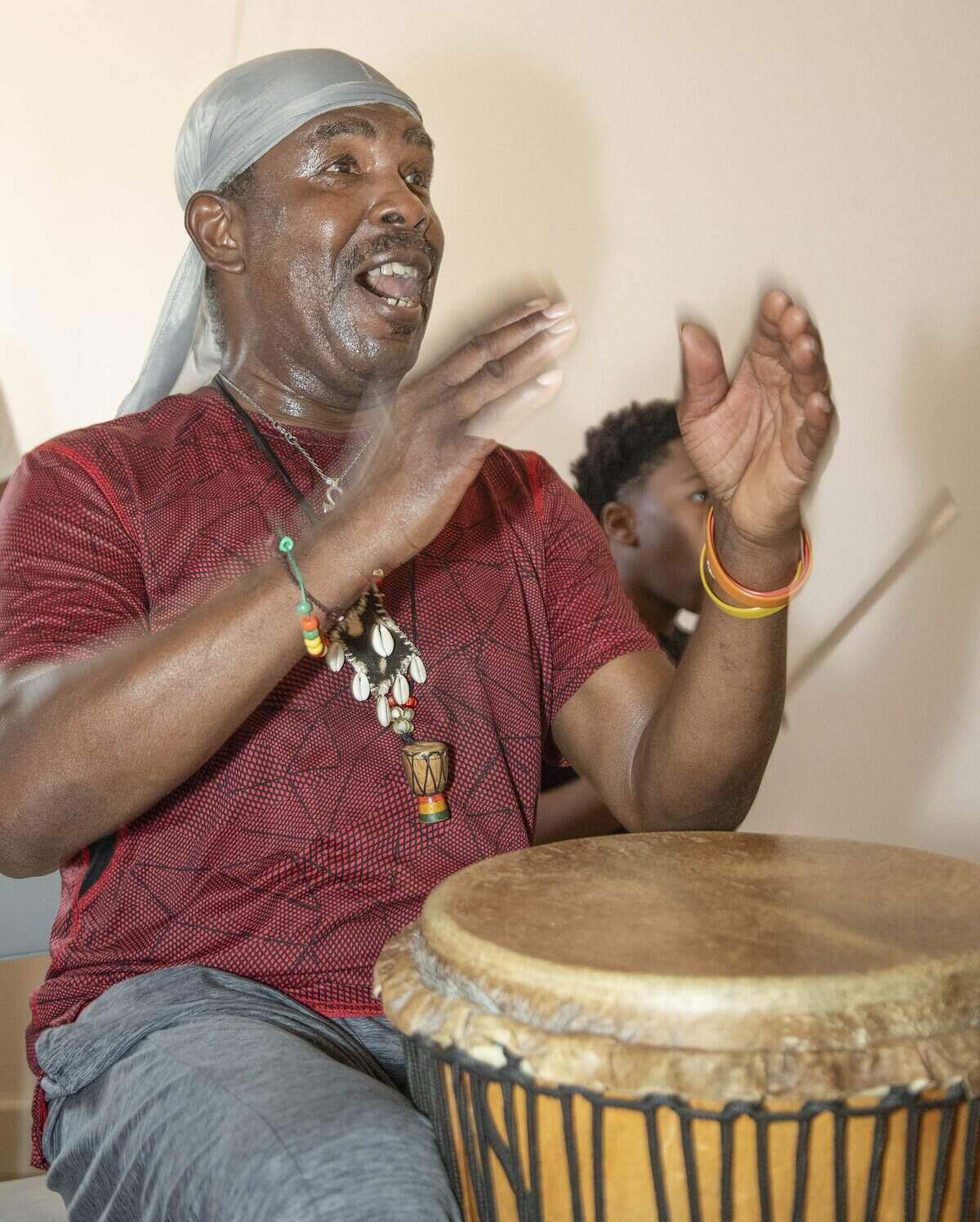
Danny Hinds was born in Barbados and drawn to the drums at age 13, when a West African dance company performed on the Caribbean island. The beauty, strength, power, and cultural aspect of the marriage between the drumming and the movement beckoned to him. He was enthralled.
Hinds immersed himself in art study and spent decades as a teacher, a musician playing African drums and a performer of traditional dance. He paints too.
In 1999, Hinds moved to Kansas City to work at Kansas City Public Schools’ African-Centered Education Collegiate Academy. After two years, he returned to Barbados when the government there asked him to train teachers. He stayed for nine years and then returned to Kansas City where he resumed his work teaching at the African-centered school.
“I vowed back in 1981 not to work in any environment that does not involve the arts,” said Hinds. “Everywhere I’ve been, whatever island I’ve traveled to, it is because of the arts. Whatever country I’ve traveled to, it’s because of the arts.”
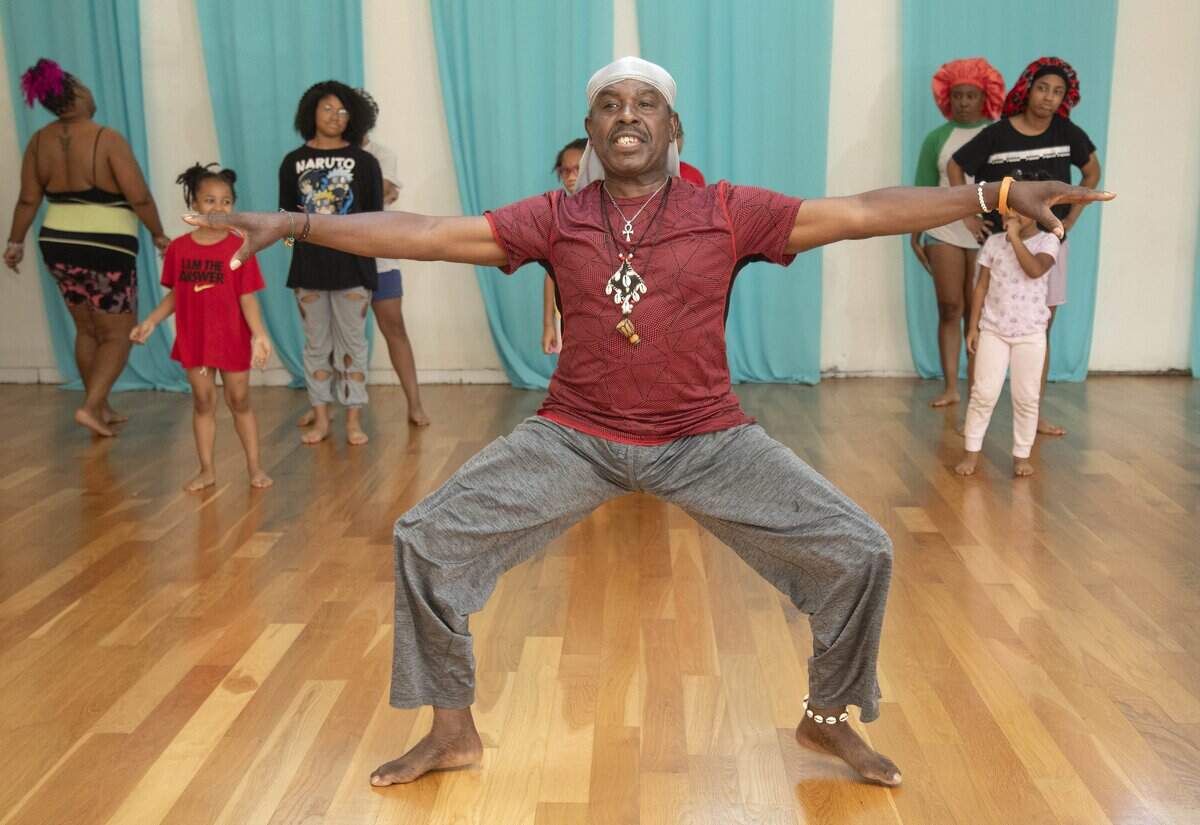
He founded Art in Motion as an LLC in Kansas City to merge art, music, and dance and holds classes at Inner Space Yoga, at 2711 Troost Ave., the studio where he holds dance and drum lessons when he’s not teaching public school.
In his school classroom Hinds’s mantra is sankofa, the West African concept of fetching what is valuable from the past to feed the present and future. The concept is associated with the popular image of a bird with its head turned backward, feeding from the past to bring forward to its youth. The Art In Motion founder said he believes that to teach to the future, he must go back to the past.
More than music
In a corner of his studio, Hinds stashes a collection of drums that are all different shapes and sizes. Different cultures use different drums.
“The djembe is widely played now, but it came out of Mali (West Africa), during the Mali Empire, which included peoples like the Guineans, Senegalese, Gambians,” Hinds said. The Senegalese use the sabar drum more than the djembe, but the Malian and Guinean people use the djembe, Hinds explained.
The djembe is a speaking drum, used historically in African villages to relay messages and information across the environment, and it’s used to lead dances, telling dancers when to change a step, start, and end. Each drum sounds different and is selected based on the type of ceremony or occasion it’s played for.
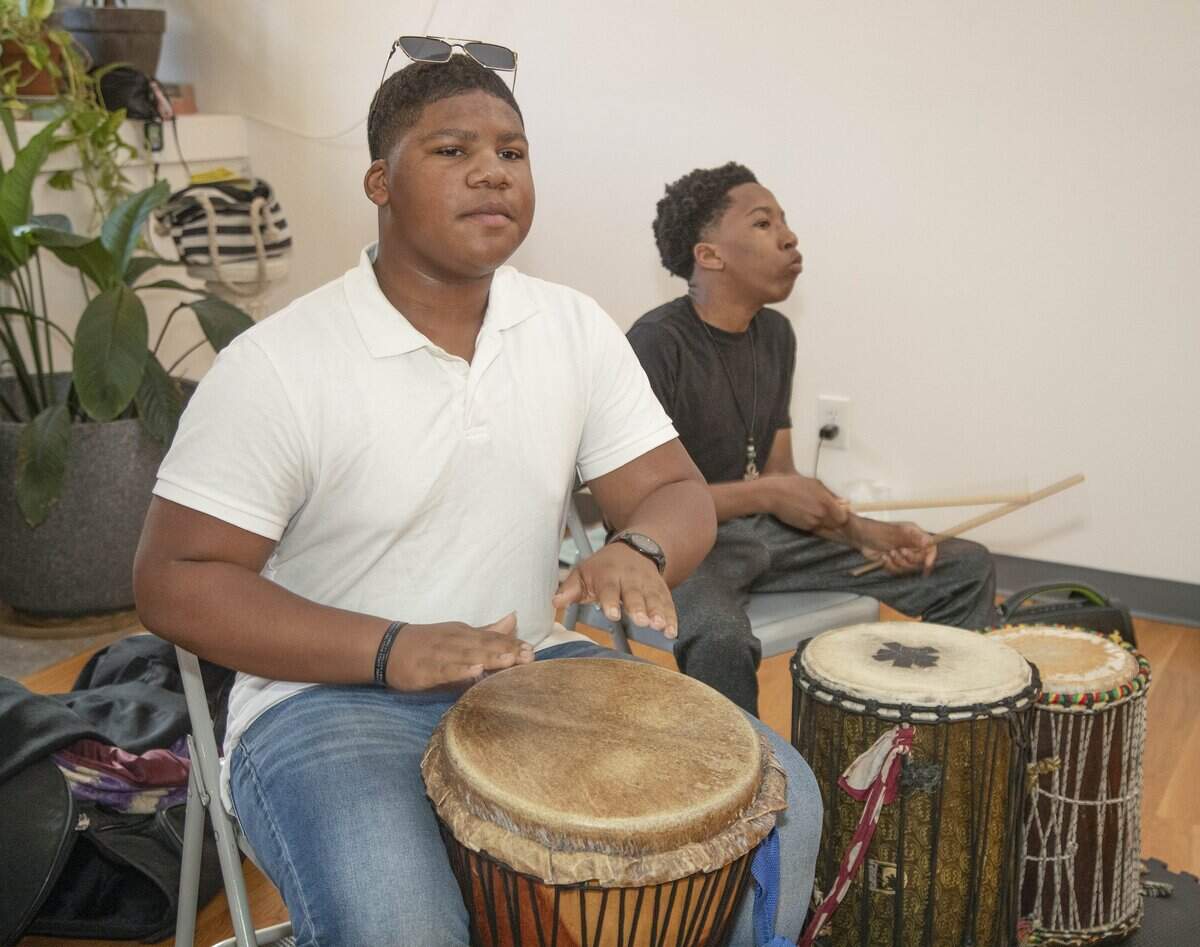
Caribbean musicians blended colonizer’s instruments and music styles with their traditional sound. In Barbados, the tuk band, which is a music style, is based on European marching drums, but drives Caribbean dances like the landship. — part dance, part marching, part parade mixed with ritual. Dancers form what looks like a ship to symbolize a determination to return to Africa despite obstacles.
He teaches this dance and music history so his students understand why a rhythm is played, what ceremony it attaches to, and what community value it embodies.
Fleming has done the same with his music instruction. Both teach the drum as a voice, not just a beat in the background. How it’s played, the tone of the instrument and handwork of the drummer help tell a story that’s illustrated through movement.
“Every rhythm connects to an African cultural expression, hunts, harvests, weddings, baby naming ceremonies, funerals, royal celebrations.” In places where history has not always been written, he added, the history is “codified in rhythm.”
The North American slave trade stripped Africans brought from their homeland of their language and culture, but their music the drumming and dancing was soul deep.
When people want to learn who they are, “they go to the drummers and dancers. They are the keepers of that knowledge.”
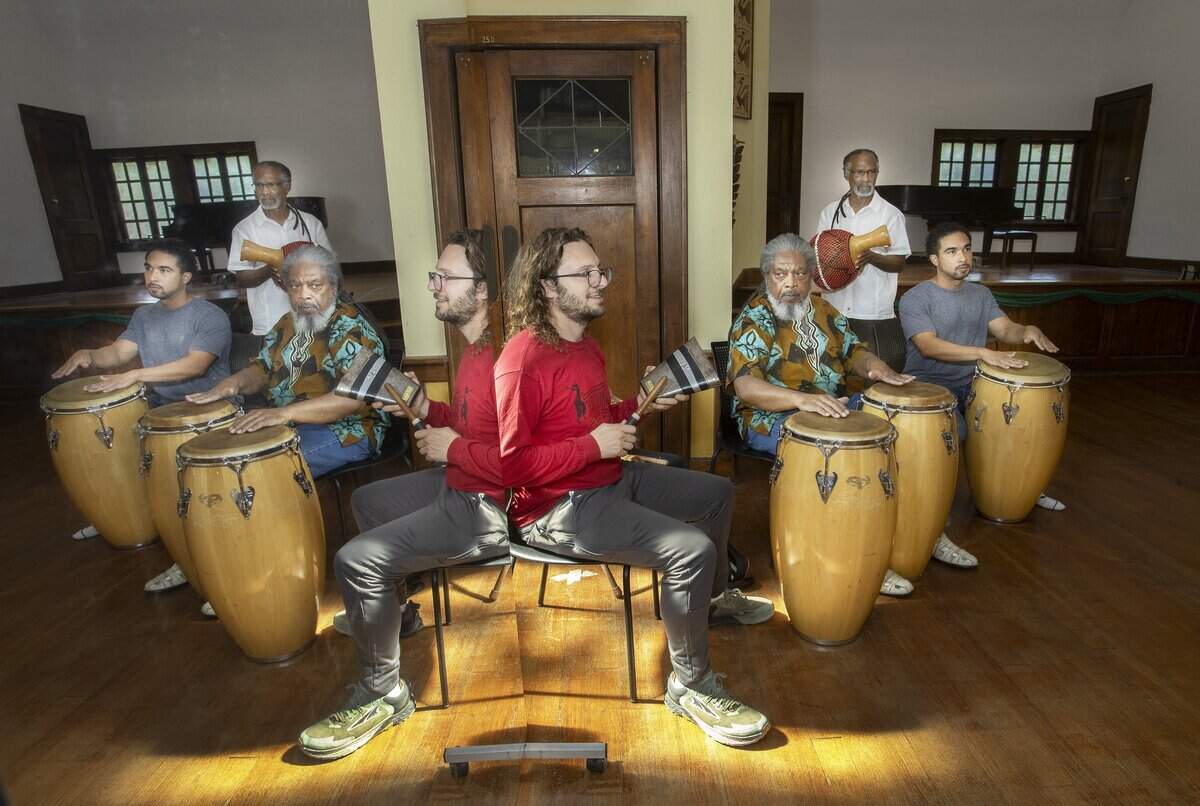
When Fleming went looking in Kansas City for opportunities to practice his music, he found almost no scene for what he did. So he began teaching others and eventually started an Afro-Cuban repertoire and formed a group called Manos, “hands” in Spanish.
A Brazilian teacher who was teaching a class in Kansas City from Seattle pushed him into samba; he built a second group for that, and added African drumming and dance.
By the mid-1980s, there were four ensembles connected to him.
In 1996 Fleming decided to combine all of his artistic avenues for African drum and dance. Along with co-founders Vanessa Gibbs and Norman Riley, he started the Traditional Music Society (TMS).
A close-knit community
Both instructors agree that students who pick up percussion gain additional skills in listening, communication and self-esteem. They use the drums to convey how information and identity are stored in rhythm. Fleming and Hinds, who have worked together in the past understand the importance of passing this hidden language to the next generation.
Vanessa Gibbs, originally from Little Rock, Arkansas, moved to Kansas City in 1989 and though she had a background in dance, she had no prior experience with African dance. She was instantly moved by the power of the drums, melodic rhythms and energy.
Today she performs and teaches African dance around the metro, as part of the local dance theater, City in Motion.
She also attends classes at TMS and Art In Motion every week to stay connected.
“ I love that we have these two classes in the metro because with Bird you get more of the West African style and Danny is more of a Caribbean, island style,” Gibbs said.
Gibbs has worked taught and performed African dance for the past 30 years and traveled to West African villages to learn from the masters. This trip had a profound effect on her and giving her a deeper understanding of traditional movement and new passion for spreading the art form throughout the metro.
“You see how this connection through dance is an emotional release, self-expression and sense of aliveness,” she said.
Sharing the culture
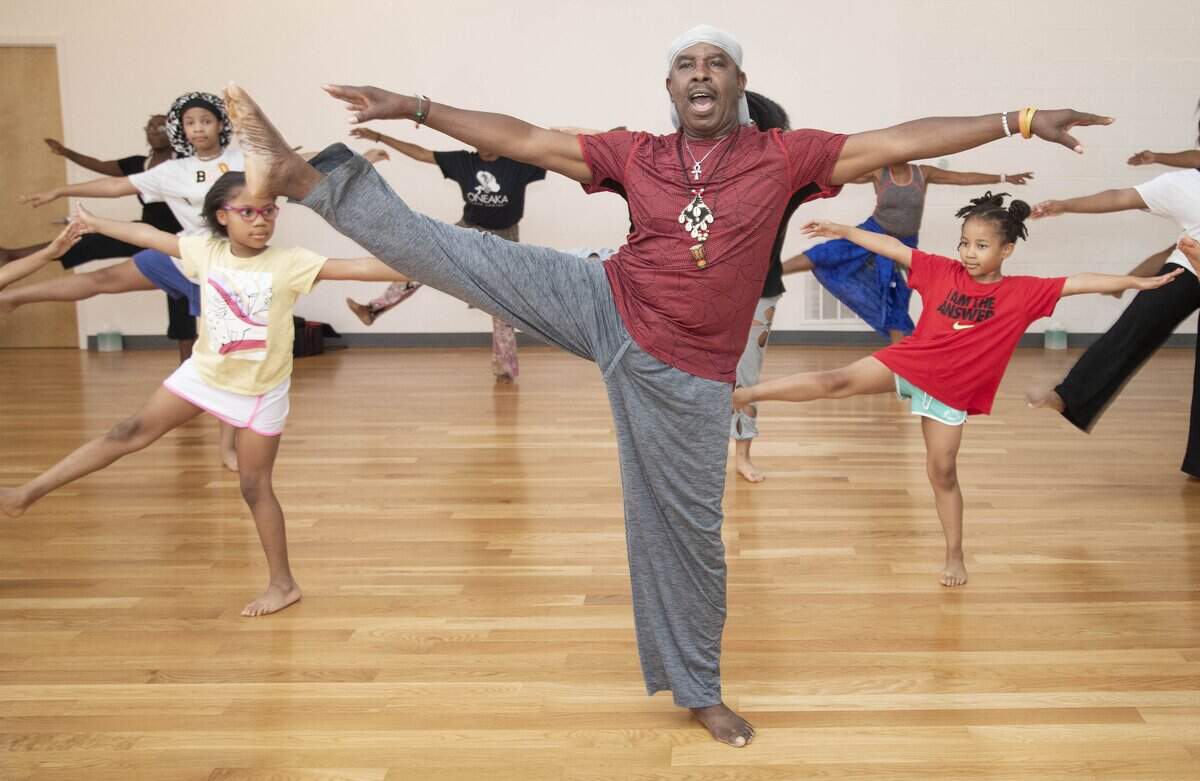
While Fleming’s classes in city classrooms and community centers with the youth are predominantly populated by Black youths, his Saturday classes are usually more diverse. He sees that as a reminder of how much his craft has grown in the metro.
“My African teachers always said this music is for everyone,” said the Washington D.C. native. “As long as people respect and preserve the culture, I’m fine with it. Music is too precious to limit if it makes people better human beings, that’s what matters.”
Chirag Jain, is another student of both African drum and dance. He attends two classes every Saturday. Jain moved to the United States from Rajasthan, India 13 years ago and has been living in Kansas City for a year and a half. He never imagined that he would find a passion for traditional dances of another culture.
“I was nervous at first,” said Jain. “But everyone was very welcoming and it was an eye-opening experience to see so much diversity in these classes with so many people from different backgrounds coming together to learn.”
Though Jain had no prior experience with African dance, he found similarities between what he was learning in class and the ceremonial dances he grew up with back in India.
The next generation
Fleming has passed along his passion and dedication to music to his son, Xavier Fleming, who grew up in a house with “more drums than furniture.” There was no cable; video games weren’t a thing. There were lessons. Percussions came first, and his father required piano to add theory and melody.
“By that time I got pretty serious, like, okay, I’m going to play, if not for a living, at least partially,” said the younger Fleming. “The identity of me as a musician certainly set in during high school.”
Today, at 40, in addition to being a professional musician, he is a music therapist at Beacon Mental Health. On stage, he plays the saxophone or percussion. In his clinical work, he uses the piano and guitar. Being able to learn about the history of African drums from his father allowed him to see the cultural transition in sounds brought from Africa and how they evolved into African-American music genres like jazz.
Hinds has also raised a child who has followed his musical path and learned from his mentorship and instruction. Tahirah Hinds, who performs under the name “Sweets,” blends Caribbean island vibes with soul R&B. For the past 15 years she has been a constant fixture at cultural performances around town like KC Reggae Fest, Juneteenth, 816 and The Kansas City People Choice Awards, using her platform to share the musical roots.
“In my dad’s company I learned to sing, dance, and act,” said Hinds. “The training built a personality, discipline, focus and made me a person who constantly wants to self-improve.”
This summer, Hinds was able to present her father with an award from the 18th and Vine Arts Festival for his years of work in the community. The moment gave her the opportunity to reflect on the many ways her fathers teachings had made her into the person she is and how she was proud of his decades of dedication to keeping history alive through the art of African drum and dance.
“He’s such a dad to all the kids he mentors,” said Hinds about her father. “He instills leadership, he instills discipline but most importantly, he teaches children to develop self and how to carry themselves.”
According to her dad, what he and Fleming do is not just about the drumming, or the dancing, or music, it’s about culture.
This story was originally published October 22, 2025 at 6:00 AM.