Mormon church owns tons of land in Lee’s Summit. City has plans to build on it
After five years of talks with the Church of Jesus Christ of Latter-day Saints, widely known as the Mormon church, the city of Lee’s Summit has developed a plan for nearly 4,000 acres of vacant church-owned land in city limits.
The tracts of land – which are split in two uneven portions but are collectively the size of nearby Prairie Village, Kansas – are owned by Property Reserve Inc. which is a subsidiary of the church.
The group contacted the city in 2019 to work in tandem to identify developers for the nearly untouched spaces. Now, the city and church are working with Kansas City real estate firm Newmark Zimmer to finalize a development plan, which could include creating new residential neighborhoods, retail areas, parks and trails.
Property Reserve Inc. and the city signed an agreement in the spring describing how both groups want the land to be used. The church hasn’t sold any land directly to the city yet, but has agreed to potentially do so in the future.
City-owned portions of the land would be used to build new infrastructure for both the municipal government and the Lee’s Summit School District, according to the agreement. Suburban Land Reserve – a Utah-based development company – also intends to buy portions of the land over time and then to resell it to third-party developers.
The high-profile land is split into two areas: 1,064 acres in the north next to the Lee’s Summit Municipal Airport, and 3,141 acres near the southern border of the city.
In a presentation to the Lee’s Summit City Council and Lee’s Summit R-7 School Board this week, development representatives said they plan to start with the smaller north section.
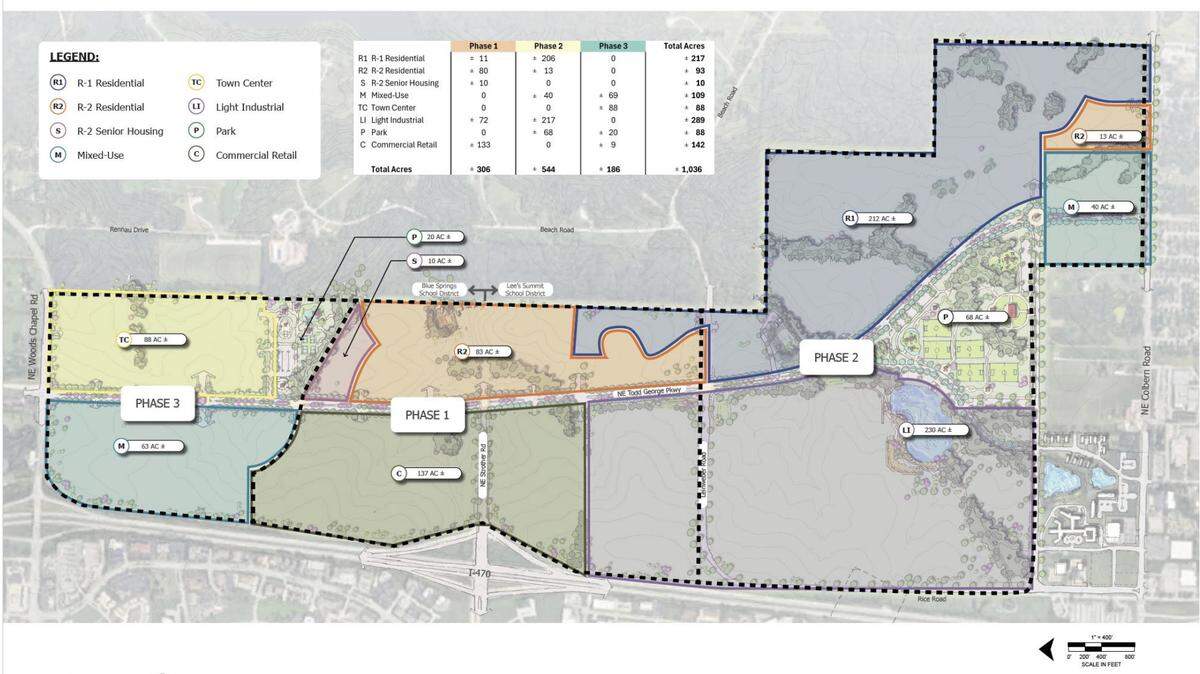
The 1,000-acre piece – which is about one and a half times the size of Central Park, or about 750 times the size of Arrowhead Stadium – is split by Todd George Parkway, which the city redeveloped in 2010.
The parkway project was mostly funded by federal grants and local tax increment financing, but Property Reserve Inc., the church’s development group, donated the necessary land ownership rights in the form of right-of-way agreements and easements.
Representatives from the city and the landowners said this week that they’re planning residential areas of three different densities for the north section, including senior housing.
They’re also planning three different commercial areas – zoned for retail, office and medical buildings and “light industrial” space – as well as a 20-acre park, a 70-acre park and a network of walking and bike trails. This week, the group proposed starting with senior housing and commercial areas, along with an 83-acre residential neighborhood right on the boundary between the Blue Springs and Lee’s Summit school districts.
The city estimated this week that for the north section alone, costs for public infrastructure needs - including electric systems, water mains and contingency funding - will be just over $103 million. The city announced that it has already secured about $45 million toward this project and proposed funding the rest through a 27-year-long 1% sales tax.
Along with funding from both the city and Suburban Land Reserve, any municipal development projects on the land will be paid for by sales tax revenues and potential grant funding.
The 3,000 acre southern piece of church-owned land – about the size of Kill Creek Area Park in Johnson County, or Heathrow Airport in London – was previously zoned as agricultural land. The city and landowners are expected to create a more detailed development plan in the near future, but the agreement between the city and the church suggests the possibility of building schools, police stations, fire stations, parks and sewer pump stations, along with new public transportation routes and “a system of quality retail and commercial development.”