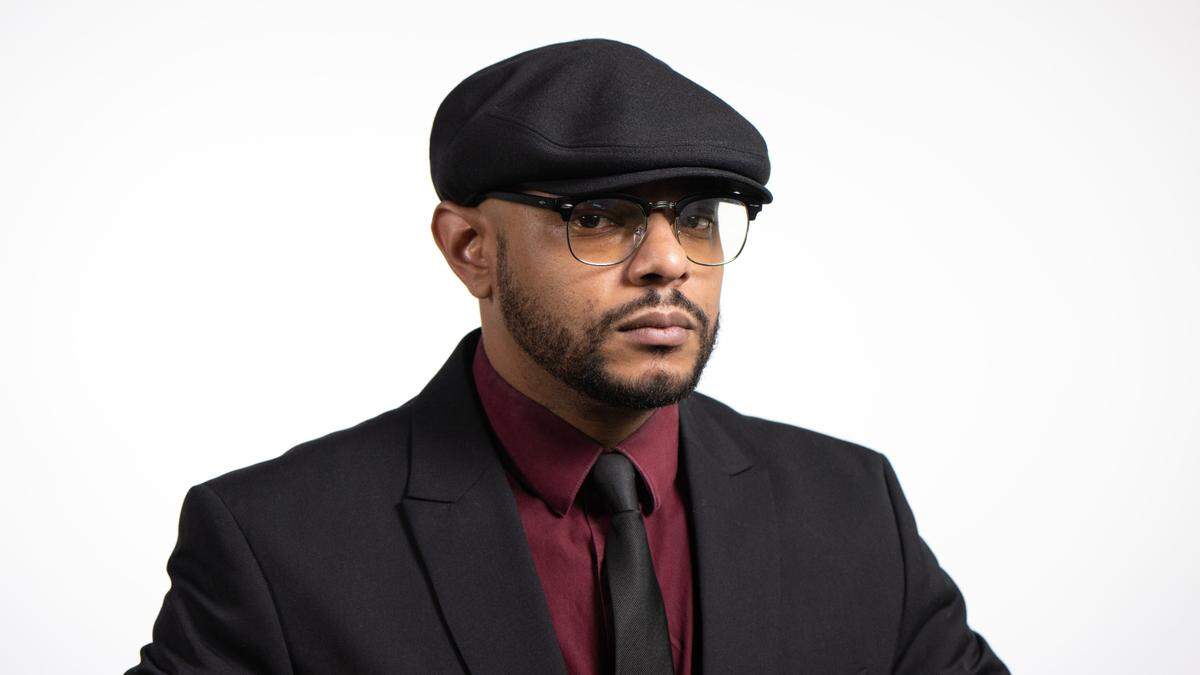
KC artist donates thousands of dollars in paintings to build cultural bridges
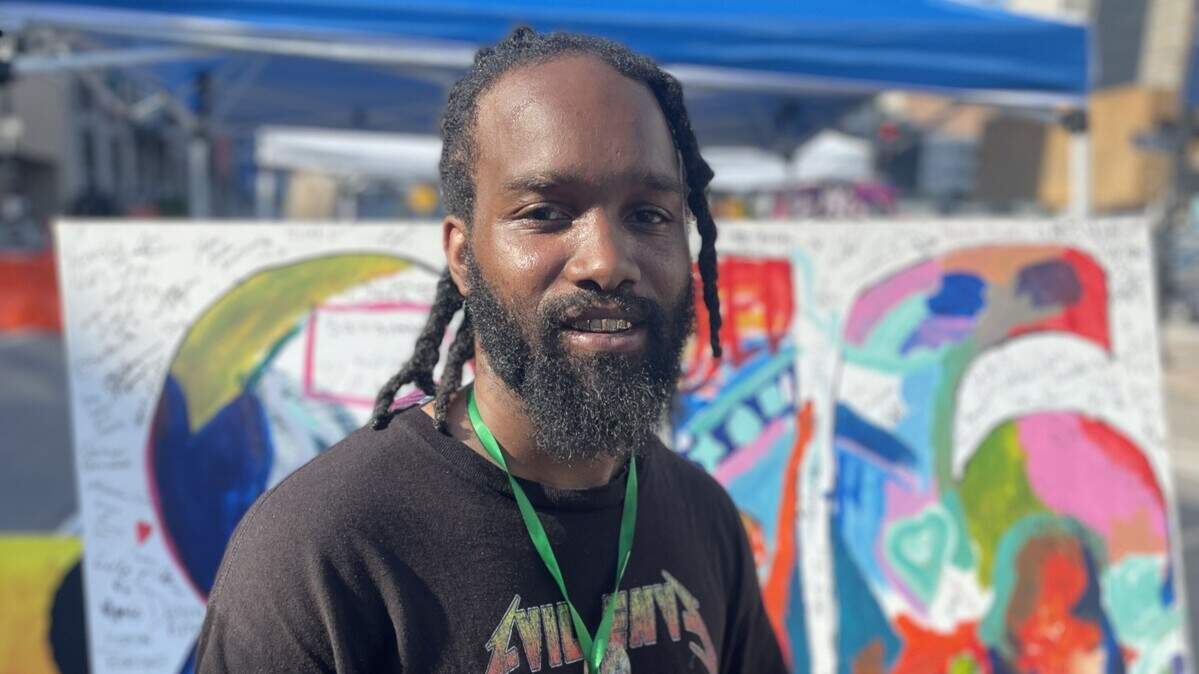
Deaunte Thomas is an artist deeply rooted in the Kansas City community, known not only for his versatile and compelling style but also for using his art to heal and bring people together.
Throughout his career, Thomas has created and donated heartfelt portraits for grieving families, providing a lasting tribute to their lost loved ones. One of his works was a tribute to Lisa Lopez-Galvan, who tragically lost her life during the Chiefs’ Super Bowl victory rally shooting. This portrait became a symbol of comfort and remembrance for her family and the wider community.
Thomas, 33, said that he has always viewed his work as a form of community service and uses art to foster connection and inspire hope. His commitment to giving back extends beyond individual portraits to larger community projects and murals that celebrate local culture and resilience. This dedication earned him a city proclamation recognizing his impact on Kansas City’s art scene.
As the artistic director for the 18th and Vine Arts Fair, Thomas plays a crucial role in elevating local artists and nurturing the city’s creative spirit, while his work as an art teacher allows him to mentor and empower the next generation of talent.
Recently Thomas sat down with The Star’s culture and identity reporter J.M. Banks to talk about discovering the power of a portrait, using his art as community service and building connections throughout the metro art scene.
Banks: How long have you been doing art and at what stage did you decide to make it your main career focus?
Thomas: I’ve always been an artist. Growing up, back then, we didn’t have tablets or cell phones. We had a notepad or some copy paper. You had a pencil or pen, maybe a box of crayons or something like that. That’s what you had.
I could always draw. I’d watch cartoons and try to draw them while they were playing. In those early stages, I’d draw off the cereal box. Or if I got a new Hot Wheels car, I’d draw that. Or a new PlayStation game, I’d try to draw the cover art.
I was in all the art clubs in middle school and stuff like that. I remember when I transferred to Van Horn (High School), my junior year. I was staying near 40 Highway, around the Hi-Boy (restaurant) and Van Horn is off Independence Avenue.
To go to art club, I had to walk all the way back home from there and that’s a long way, from Independence Avenue to 40 Highway. But I did it.
Back then, art was my therapy. It was my release. Even looking back now, from an early age, I had this ability to complete projects and not just one. I’d finish my project in class, then go do another one. I’d even help my friends with theirs.
Then I got to see great mentors. When I was a student at Crispus Attucks Elementary School there was Brooke Proctor one of my longtime people. Now, I see his impact in me and what he did as an afterschool professional.
He was a Black role model for kids, teaching them how to be young gentlemen, holding them accountable, being a good pillar in the community. He showed us a Black male role model who didn’t have to do anything illegal to be successful.
He gave us real game, something we could actually use in life, rather than entertaining nonsense that wouldn’t benefit us in the long run.
Art is my full-time job now and I’ve been full-time for six years now, since just before COVID. I’m teaching art at two sites within the Boys and Girls Club, one at Lee A. Tolbert (Community Academy) and the other at Noland Middle School.
You are definitely one of the most visible artists in the city at a lot of different community events. For those who have never seen or experienced your art, how would you describe your style and work?
I mean, if you’re in person, I would say it feels like you’re watching a story, like you’re seeing something unfold. You get to see it come to life from the opening trailer all the way down to the credits.
If someone is just seeing it for the first time, the style, you’re going to get some realism, some impressionism, maybe some abstract backgrounds, colors that pop. I’d say it’s better suited for the person viewing it to say how they interpret my style. But for me, it’s like one of those bird’s eye view moments, like I’m nearsighted. I see all the small details, but when you step back, you might see something else.
I do a lot of portraits of people, but also you’ll see how I approach things like signature boards, collaborative community projects, things like that. So overall, I’d say I’m more of a jack of all trades. It’s more about asking, “What can’t he do?” rather than just “What does he do?”
How do you think growing up in Kansas City contributed to your creative outlook as an artist?
I mean, it taught me that you’ve got to go get it. Nothing’s going to wait on you here.
Even though people think you’ve got to go to the big cities to make it. You can make it anywhere. But if you make it here, you’re going to have the ability to withstand any obstacle you face out there.
I really wasn’t knowledgeable about the art community or what the opportunities were until I got into this. And the main thing is just showing up. You show up, but don’t show up to be invisible. It’s cool to be a sponge, but you’re not just showing up for no reason.
I tell everybody: you can meet whoever you want to meet in Kansas City, because people are only like two degrees away from whoever you’re trying to reach. A friend of a friend of a friend. Somebody I know knows that person or knows someone who can get in touch with them, or at least tell me where to get an answer.
So I was able to do some great things without having to go too far. Whether it’s meeting celebrities or local figures.
Was there a specific moment where you realized that art could have a direct impact on people’s lives, beyond just being a well-painted picture?
I mean, there have been a lot of moments like that. I’d say one series I do that reflects that started a while back. It actually helped propel me to keep doing art during a time when I didn’t even want to do it.
I remember I had a cousin who lost both his dad and his mom. I didn’t really know what to say to him, but I thought maybe I could paint a picture, something symbolic enough to give him some comfort.
And I did that a few times, for him and then for other family members. And it’s not just a well-painted picture, it becomes the essence of that loved one when they’re no longer physically here.
It’s that moment that lives in your mind, but you don’t get to see it often enough to really appreciate it. So when I do that for people who’ve lost loved ones, that becomes a really special moment for them.
Because you never really know what that loss feels like until they’re gone and then you’re left searching for something to fill that void, just to see them again. But now, when you walk into your living room, you always see them. Or maybe you go into that one room you’ve dedicated to them and they’re there.
Now, how do you approach painting those tribute portraits? With them being so emotionally charged, do you have a specific process for those types of paintings?
Accuracy. You’ve got to be as accurate as possible, because you never want to misrepresent who that loved one was.
And the hard part is that you’ve never actually seen them in person. So you’re just going off of what you see in the picture.
It can be hard to fully capture all of their features, but I just try to do the best I can, get it as close as possible to the picture or visual reference that I’m given.
Then I also try to bring out other elements that reflect who they were, their personality and character, so it builds up the whole picture as something that truly represents them.
I remember one specific instance of you doing that was after the shooting at the Chiefs’ Super Bowl rally a few years ago. Could you walk me through what the process was like, making the portrait and tracking the family down to give it to them?
I was there at the parade and once it happened, you know, just seeing how everything unfolded and then going on social media and seeing people talking about things that, honestly, weren’t more important than someone losing their mother, auntie, daughter, or sister.
So I just wanted to show the family, on behalf of Kansas City, that, even though it wouldn’t replace her, it could be a token of appreciation for what she gave to this city.
For all the lives she influenced and inspired and for all the people who got to enjoy the day, even though it ended the way it did.
Social media really helped empower the whole process. I finished the painting and posted it on my Facebook, then I went to sleep.
When I woke up, there were like 50 to 70 comments and shares, messages from friends and family members.
I think I was able to get in touch with a cousin or another family member and they ended up coming to pick it up and gave it to her husband. The family said they were honored, for me to be able to do that for them.
What are generally the reactions you receive from families who get these portraits?
Man, it’s usually speechless. Just speechless. A lot of emotions, some people hold it in, some let it out.
They might not show it all in person and I know that, but when they get home and just sit with it, just look at it and stare, that’s when they really feel the full effect of it.
I try to capture those reactions as much as I can, just to show people how powerful art is. If that can motivate someone else to paint more, or to highlight people in their city who’ve lost loved ones, then it’s worth it.
And some people just want to see the journey too. That process.
As a teacher and mentor to young artists, what kind of values and lessons do you want to instill in them as you teach them the ropes?
First, it’s going to be patience. Painting is a game of layers, right? And just like life, it doesn’t all happen in one day.
It might be a little bit on Monday, a little more on Tuesday, then Wednesday. And by Saturday, you might finally start to see some real change, but progress happens over time.
Also, I want them to be intentional. Be intentional in what we do, what we say, how we show our emotions, even down to our facial expressions. Art can be therapy. It can be a release. It doesn’t have to be loud or dramatic. Me, personally, I can’t create when there’s a lot of drama in the room. So I like to create a space with good energy.
And not all the kids are going to be the same archetype. Some are quiet. Some like to be isolated. Some talk a lot. Some joke a lot. You’re going to get all of that.
So I’ve got to be the chess master, put everyone in the right place so they can be the best version of themselves, while also working on the things they’re not so great at.
Like, if I’m a “cool” kid, I might not like talking to people outside my friend group. But maybe there’s a project where I’ve got to talk to someone new, someone I don’t usually work with and we’ve got to make that work.
So in order to make that work, we’ve got to collaborate. We’ve got to compromise. We’ve got to say how we feel and we also have to listen to others.
But on the flip side, right, I give you the choice to pick who you want to work with. So you might pick all your friends, but guess what? All your friends don’t like to do work. So guess who ends up having to do all the work, right?
And that’s where accountability has to come in.
You’ve donated tens of thousands of dollars in art through your community work, what drives your generosity?
I mean, everything can’t be about the financial. There’s always going to be the yin and yang of giving, the give and take. You can’t always just be take, take, take.
The giving part helps balance out the more analytical, business side of things. Like yeah, if I had a million dollars, I could give, give, give so much more. But I do what I can.
And some of that giving ends up inspiring somebody, or maybe it motivates them. Even if it’s just one person, that’s enough to help keep the artistry going.
How did you get involved with the 18th and Vine Art Festival and your role as artistic director?
My first year, I started just as an artist. I worked with Quez ( Marquez Beasley, festival founder) before at the Jazz Museum doing similar work, but on a smaller scale. I was the art lead, bringing in artists each month to highlight a jazz legend, whether it was Nina Simone, Count Basie, Duke Ellington, whoever we were highlighting that month. Then, giving the artists a time slot to showcase their work to the museum patrons. Their art would stay up for 30 days, available for sale and exposure.
My first year, I was just learning how to be part of a festival. It’s much different than just being a vendor. The tent setup and all that first day, I didn’t even have a tent. That’s when Quez gave me a talk, told me I’m just as any other artist.
We knew each other well, so there was no special treatment. I had to be ready. The next day, I had a tent. And I started learning what goes into building all this. Then Quez offered me a position on the art director team and I worked under the Beasleys. I learned what goes into leading artists, what support they need. As the younger one, I handled more of the physical duties so they could focus on the planning and strategy.
This year, I became the lead art director. We grew from 50 artists to 91 and this year we had 108. I’ve grown into the role and tried to minimize the obstacles we face. If someone doesn’t have a tent, okay, where can we get one?
So I try to make everything more convenient, because not all of us are full-time artists. Some people are still trying to make this a full-time thing. Some are doing it part-time or alongside another full-time job. And people have kids.
Then there’s emotional support, encouraging artists going through a tough week, a bad month, or a big life pivot. Reminding them that this is something tangible they can actually do. Sometimes you just have to listen to them vent, do wellness checks and all that.
Honestly, it’s come at the cost of my own artistry. I haven’t had as much time to focus on my own collections or fully concentrate on my work. But the benefit is, way more people are getting something out of it than just me.
So, as the lead art director, if the emphasis is on the arts, you’ve got to highlight and give flowers to the people who are really doing it.
With you recently receiving your city proclamation, what did that moment mean for you personally and as an artist?
First, it’s that we are getting acknowledged here at home, right here in our community.
It’s that legacy statement, not only are we doing it in the historic district of 18th & Vine, but we’re also building a pillar for art to stand right alongside everything else.
With the city giving a proclamation to rapper NBA YoungBoy, who’s not from the city, do you feel like that diminishes the value or quality of proclamations given to local people who are actually working to make change in the community?
No. Something of that magnitude it don’t diminish anything. I mean, everybody’s going to have their own story of why they got their proclamation.
I believe to get something like that, you have to do something in your community, or at least be active somewhere. And I believe he probably does, wherever he’s from.
If his anti-violence prevention work from another city is shown to be effective and helps save lives, then that’s what matters. At the end of the day, if we’re saving lives, that’s the goal.
If you can get influencers like NBA YoungBoy to also push that message when he’s here and capitalize on the fact that he has most of our youth’s attention in one place, then we can actually send a powerful message to them.
What are some things you would like to see in terms of growth for the Black art scene here in the Kansas City Metro?
I’d like to see more accessibility into other festivals.
Also, I want to see more Black art on things like streetcars, bus stops... what else we got? It’d be great to see at each stadium. So if they want to hit me up, I can get them all done.
No, but really, I think art has a space everywhere. So, just more involvement overall.
And, you know, everybody has their niche, whether it’s coffee shops having a rotating gallery, or your local mom-and-pop restaurant needing some vibrant art, like a mural.
It shouldn’t just be on the business owners to search for artists, it should also be on the artists to search for new homes for their art.
So yeah, I think it comes down to more accessibility across the board. There’s a space for everything.
For more stories about culture and identity, sign up for our free On The Vine newsletter at http://KansasCity.com/newsletters.
This story was originally published October 11, 2025 at 6:00 AM.