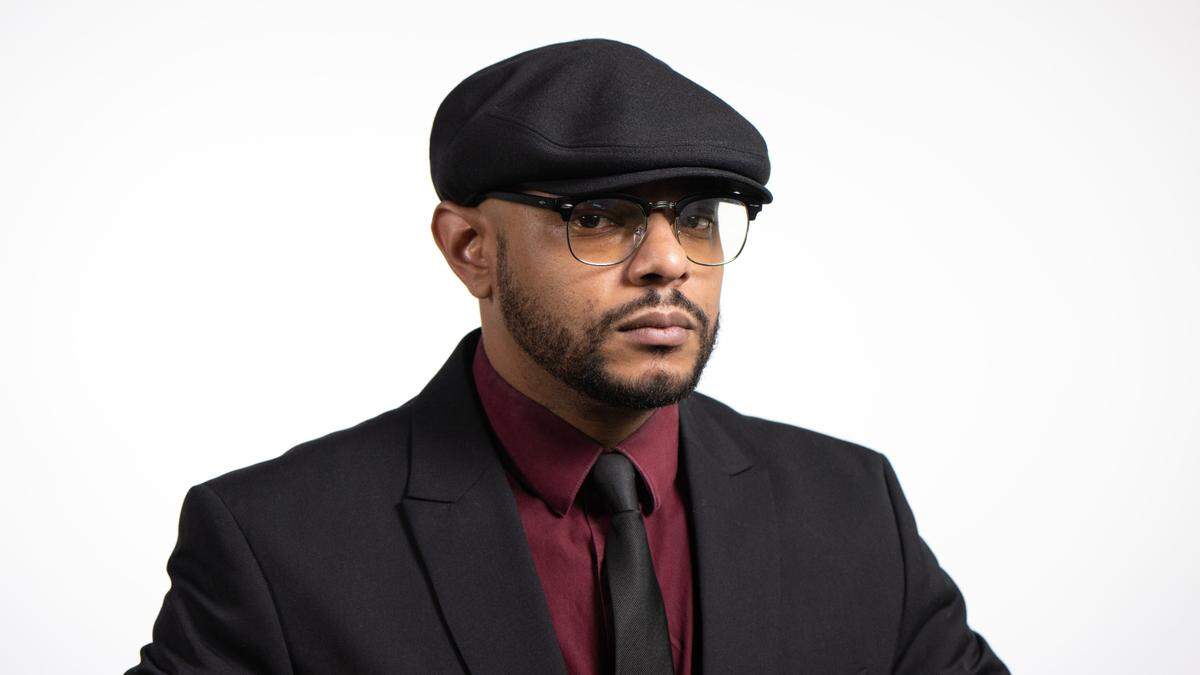
Clean-living KC hip-hop artist opens no-alcohol bar, with live music and art
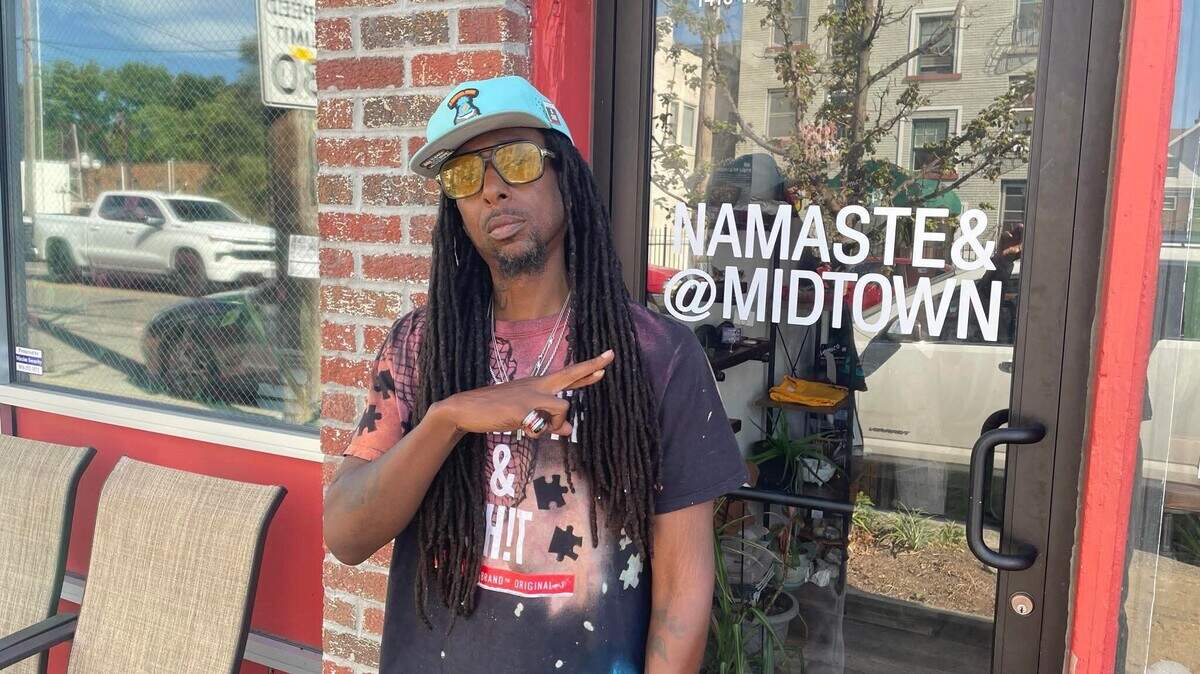
As a rising artist in Kansas City’s hip-hop scene, Alan Wayne faced a steady stream of setbacks. Despite his deep passion for music, he struggled to gain the traction he hoped for. Alcohol became his coping mechanism.
Years of heavy drinking nearly cost him his life. But a turning point in his early 30s changed his life trejectory.
After achieving sobriety, Wayne refocused his energy on his personal growth and creative pursuits, launching a clothing brand called Namaste & Brand, formerly known as Nomaste & Sh*t. What he began as simple merch, evolved into what he now describes as a lifestyle brand centered on clean living and resilience.
Wayne later teamed up with fellow creatives Moon Brown, a local LGBTQ advocate, and Andrew Beck, a former high school classmate, to this month open Namaste & Midtown, a non-alcoholic bar at 1415 W. 39th St. in Kansas City. The new bar also houses a marijuana dispensary, lounge, and a quait space where local artist perform and display their wares.
The space blends elements of street art and community engagement to create a platform that celebrates wellness and self-expression. Wayne and his partners aim to inspire others to embrace creativity as a powerful tool for healing and personal transformation.
Recently Wayne sat down with the Star’s culture and identity reporter, J.M. Banks, at Wayne’s new location on 39th Street in Midtown Kansas City and talked about his love of music, overcoming his challenges and about the opening of his new space geared towards healthy living.
Can you begin by telling me about your early life and upbringing here in Kansas City, and how that led you into your music career and forming your lifestyle brand?
I consider myself a Kansas City native. I’ve been here in Kansas City since first grade. I had been visiting here my whole life since birth. I was born in a small town called Rantoul, Illinois, on an Army base in Champaign, Illinois.
My father ended up getting into a situation where he had to do some time. We came to Kansas City and just never left. So I’ve been here since, right down the street on 39th Street actually.
As for my path into music, it kind of sounds cliché, a lot of people might say something like this, but it’s been my whole life. I’ve got baby pictures from when I was 3 or 4 years old with headphones on and a little Walkman. So music has always been something I was infatuated with.
It was probably around middle school when I realized I could do it myself. I started taking it seriously pretty quickly. Enough so that, by the time I was going into high school, my freshman year, they already knew the 8th-grade rapper from middle school was coming. All the high school rappers were waiting on me.
There was something like a talent show in my sophomore year, and the ovation I got has never left me.
When did you decided to pursue music as a serious career option?
I got an offer from a childhood friend who was into something. I don’t know how he got his investment money, but he was offering to back me.
We hit the ground running with that. This was still during the time when people were shopping records, trying to get signed, right before everything went fully digital and independent. So we started recording songs demo-style.
Then life got real and took a drastic turn. If it weren’t for a couple of marquee features (on other artists’ songs), I would’ve disappeared off the scene completely. Honestly, I almost disappeared off the planet.
What was the drastic turn and how did that impact you?
I was starting to gain some relationships and traction through (demo making). Somehow, some way, we ended up getting invited to a conference out in New York City.
But there was one particular A&R (talent scout and financer) there who I’d heard of in my own music studies.
He was behind a lot of that neo-soul boom like India. Arie and Musiq Soulchild. It wasn’t exactly what I was doing, but I knew I had something competent and I had a solid package to present. When I gave it to them, they acted interested.
We get back home, and like two nights later, I get a phone call in the middle of the night and it’s (the A&R). He’s driving around, listening to one of my songs and asks if I have anything else that I can send him.
I tell him, “Yeah, I can put a package together. Just give me a few days, like a week.” I said that even though I didn’t have anything ready, but in my head it wasn’t a problem.
Up to that point, anytime we needed to do anything, I could call my backer and we’d be in the studio the next day.
But this time, the first time ever, he didn’t answer the phone. He didn’t answer that night or the next. I finally got ahold of him like two days later. I can’t even remember the excuse he gave, but the gist was he was backing out.
We had just struck gold and he was stepping away. That experience broke me for a long time but eventually, I had enough. I was drinking, like really drinking.
But through the grace of God, I got some extra innings here. And when I got back to myself, the music picked back up. By some strange stroke of luck, it really caught on in a few regions, particularly in the Northwest.
Can you tell me about your struggles with drinking and what role did it play in you creating your lifestyle brand?
I started drinking at an unhealthy level around 17. I had this built-in tolerance that was crazy and I was highly functional, even into my early 30s. With alcoholism you don’t recognize the signs and as things around me slipped away I went deeper and deeper into the bottle.
Eventually, it became obvious the next drink could kill me. I knew it. But I kept going anyway. It was like I didn’t have the courage to end things myself, so I was letting alcohol do it slowly and I got awfully close a couple times.
One time in particular, I was at Research Medical Center and they were ready to bring in the chaplain. I thought I had just passed out for a day, it had been several. It was from different alcohol-related complications.
I was killing myself slowly with poison. My insides were going septic sometimes. My liver looked like it had been pounded on and when your liver stops working right, everything else starts shifting. My kidneys started acting up.
You wouldn’t have recognized me.
Can you tell me about the brand Namaste and Sh*t and the idea behind it?
I decided to stop drinking and I went to a small place outside of Austin, Texas, and I stayed for a stretch of time. I wasn’t there long before something lifted completely and I had no desire to drink. It was like something just left me. Instantaneously. Supernatural.
I was having a conversation with a young lady. As she ended it, she said, “Namaste.”
I was like what’s that word? She told me it translates to: the God in me sees the God in you.”
I said, “I like that.” I just instantly connected to what she told me the meaning of it was and I just said “Namaste and Sh*t.” The whole thing just fell together in one piece.
I knew it was more than just a clothing brand, but I didn’t have the language for it yet. I realized it was a lifestyle brand I wanted to develop.
I’d done that with somebody else, so I thought, let me give myself a shot. Put my own stuff out there.
The shirts, the hoodies, the sweatshirts, they started catching on. And before I knew it, “Namaste and Sh*t” was gaining more traction than my music. But it didn’t matter, because each one was feeding the other. My brand brought people to my music, and my music brought people to the brand.
I was able to meet up with Moon and Andrew who were both creatives who also had this vision of creating a space that aligned with what the brand stood for. We were fortunate enough to have the opportunity to take over this spot which was previously a kava bar and we decided to bring all of our worlds together.
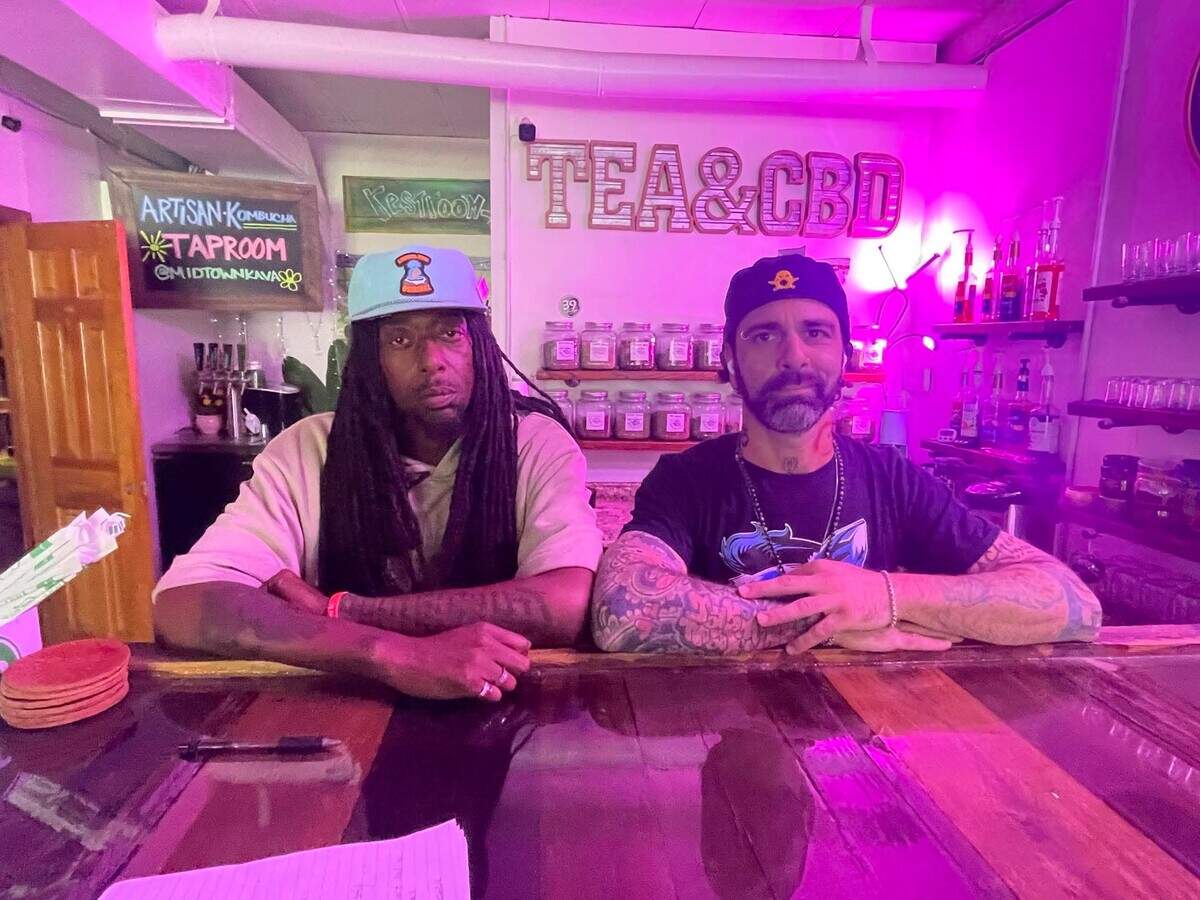
Can you give me the story behind the alcohol-free bar concept and how that all came about?
I think we wanted this place to be judgment-free here, especially coming from me. Alcoholism is probably one of the most dangerous drugs on the planet, and definitely the most readily accessible. A lot of people don’t have the wherewithal to use it responsibly. People are waking up to that fact, and as generations progress, less and less drinking is happening.
This place was already technically a non-alcoholic venue before we got here. With my background, it felt like divine intervention. I haven’t had a drink in 10 years. Before that, I was the worst kind of alcoholic you’d ever seen. But my recovery wasn’t typical, it was like, here one day, gone the next. I don’t fit into AA circles; it feels disingenuous because I don’t have those struggles or live that lifestyle. However, I have testimony and wisdom from my experiences.
A lot of people come here not to drink(alcohol), but because they’ve heard about what kava does. It’s a holistic, actually healthy, alternative.
Less and less people drink, and no one wants to be around people they don’t connect with. Especially now, people are leaning on each other more than ever for community during strange times. This space offers that sense of togetherness.
We’re even going to keep the place open later than 11 p.m. because people want somewhere like this. There’s nothing else like it around here, at least.
Why was it important for you guys to create a space where people could embrace sobriety and wellness?
It’s just an alignment with the times. There’s never been a stronger need for it. Reality is hard right now. I avoid the news for my sanity. I don’t push my beliefs on anyone, but if you’re having a rough time, I highly recommend this sentiment that’s in the air, a place where you don’t have to wear a mask.
It’s a non-alcoholic bar, but not necessarily a place only for non-alcoholics. You can come here and be yourself. You don’t have to pretend you don’t do something or act a certain way.
There’s an energy here because of the attention behind the brand and the space itself. People come here instead of Starbucks to do their daily work because there’s less stress.
It feels like a renaissance, a place like those you had to know somebody to get into.
Can you tell me about the Tiny Shell concert series held at your location?
The Tiny Shell concerts originally started last year, launched by Moon (Brown) under her Moulin Noir brand, before we took over the space and rebranded it into Namaste & Midtown. The concept was inspired by NPR’s Tiny Desk concerts, intimate, stripped-down performances with a focus on musicality and connection.
I was actually one of the performers in that first round of concerts. When we took over the location, we knew we wanted Tiny Shell to become a signature event, a hallmark of the space.
Each of us came to the table with our own creative brands, so joining forces to create a new space for artists to perform felt natural. We’re especially focused on emerging talent, artists who are still building their audience and we want our venue to be known as the place to catch them early in their journey.
We hold auditions and have had some incredible artists apply. We just locked in our lineup for the this upcoming season and we’re excited about what’s coming. One of the most special aspects is that we provide a live three-piece band to perform with the artists, for many of them, it’s their first time being backed by live musicians. That experience is powerful for both the artists and the audience.
Why did you want to make sure this place highlighted and gave a voice to local artists?
That comes with what I do. Kansas City isn’t small, but it’s not New York or Denver either. There are fewer venues, and fewer people own those venues. Those owners network with the networks they know, and many venues have been around for a long time.
So sometimes, even if you have a decent following, if the person in charge doesn’t know you, you’re not on the radar and can get lost in the shuffle. This space is an extra venue offering an alternative to what others do.
There are smaller venues and bigger venues, but not many spaces that can host what we do. It would be hard to host some of our events anywhere else but here. It feels like your front room.
How long is this next season of concerts?
There’s six concerts in each series, so we’ll be at the halfway mark next week. It’s biweekly, every other Thursday, so that’ll probably put us through September.
We’ll probably reconvene either late December or the top of the year. We also will introduce our open mic nights on Wednesdays, starting September 10th. But we’ve also had a lot of people come in with an interest in poetry nights, so we’re trying to figure out if we should just have it be an open mic slash poetry night, or should we do open mic this Wednesday
We’ve already got auditions for this next season We usually target some artists who have their own following but aren’t necessarily booked somewhere every weekend.
What challenges have you faced bringing people in while promoting the non-alcoholic partners?
That part hasn’t been too hard. We’ve been blessed with some good press, and the non-alcoholic trend is catching on. It’s kind of right place, right time.
But the challenge is running this space alongside the American Shaman Dispensary, which operates seven days a week, 365 days a year. There are three of us managing multiple ventures, so juggling everything is tough.
The space has been here about seven years, and bringing in the new without pushing out the old culture has been something we keep in mind. The previous owner was doing well culturally, but different from what we’re doing.
We don’t want people to feel like they have to leave the neighborhood. We want to keep it inviting, now everyone’s invited.
What’s your favorite part of being, you know, one-third of the creative force behind this place?
I’m a very detail-oriented person. Maybe it’s my astrological placement, but I see the things in between the things.
That connectivity of it all. It’s the unseen things, the very little things. For me personally, it’s kind of the unspoken grace of it all.
But I’m not blind to the fact that I always say that I’m in extra innings. I mean, on paper, I’m not really supposed to be here anymore. You know what I mean? And it’s not like I have this struggle or battle when I think about alcohol at all.
I always say the dreams have a dream, and they’re all I could ever envision with it all. I said, I know the Namaste thing was bigger than just clothes, I didn’t know exactly what that meant.
What are your plans for the future in terms of growth?
Okay, well, the concert series that brought me in the door is trending very well in the right direction. You know, that was just like the pilot season they did. So we’re already on season two.
The first two shows of this season have been wall to wall. Next week is the third installment of the second season, and I expect it to be just as packed as those two have been.
We’ve already had a couple of different groups and things in here because we also opened up the space for that. We had a couple of different women empowerment groups, and we’ve got several events like that coming up. Like I said, we’ve got the dispensary in here, so we have a gentleman doing like a blunt and bingo thing during the Halloween season.
We’ve got several different events planned that are going to help promote the space, and there’s a new artist here every day. Like the artist who painted the mural and a lot of the other art, she’s all over town, so we try to have the artists we want to meet.
So we’re always out there, and like I said, my third partner Moon, she’s behind a lot of the behind-the-scenes stuff like the art festivals and things, so we’ll have a presence there.
Just sponsored the basketball tournament over the weekend, that went well and we’re doing some things with some of the youth sports teams around town, so we’re just making our presence known, really about the community.
For more stories about culture and identity, sign up for our free On The Vine newsletter at http://KansasCity.com/newsletters.
This story was originally published August 27, 2025 at 4:03 PM.