Where did your KC fruits & veggies come from? Maybe this Amish produce auction
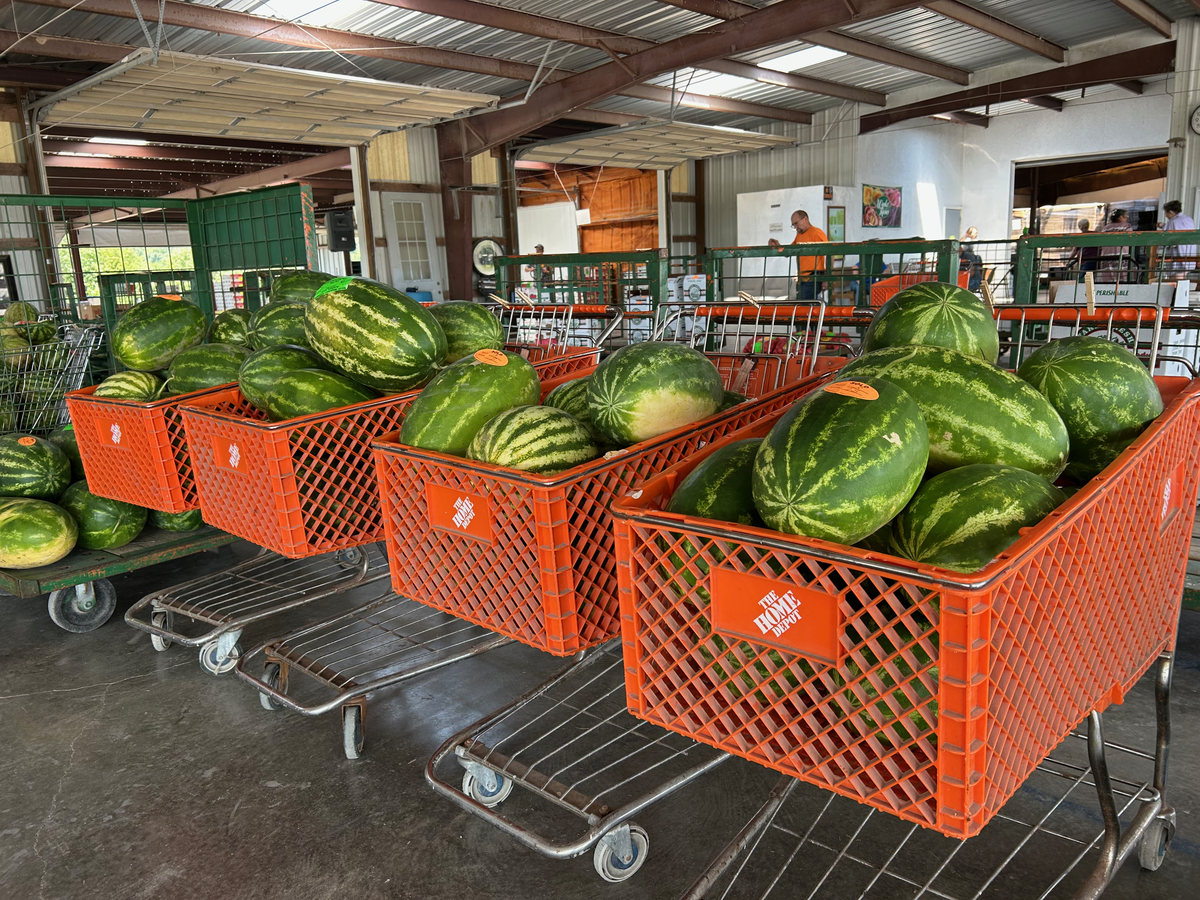
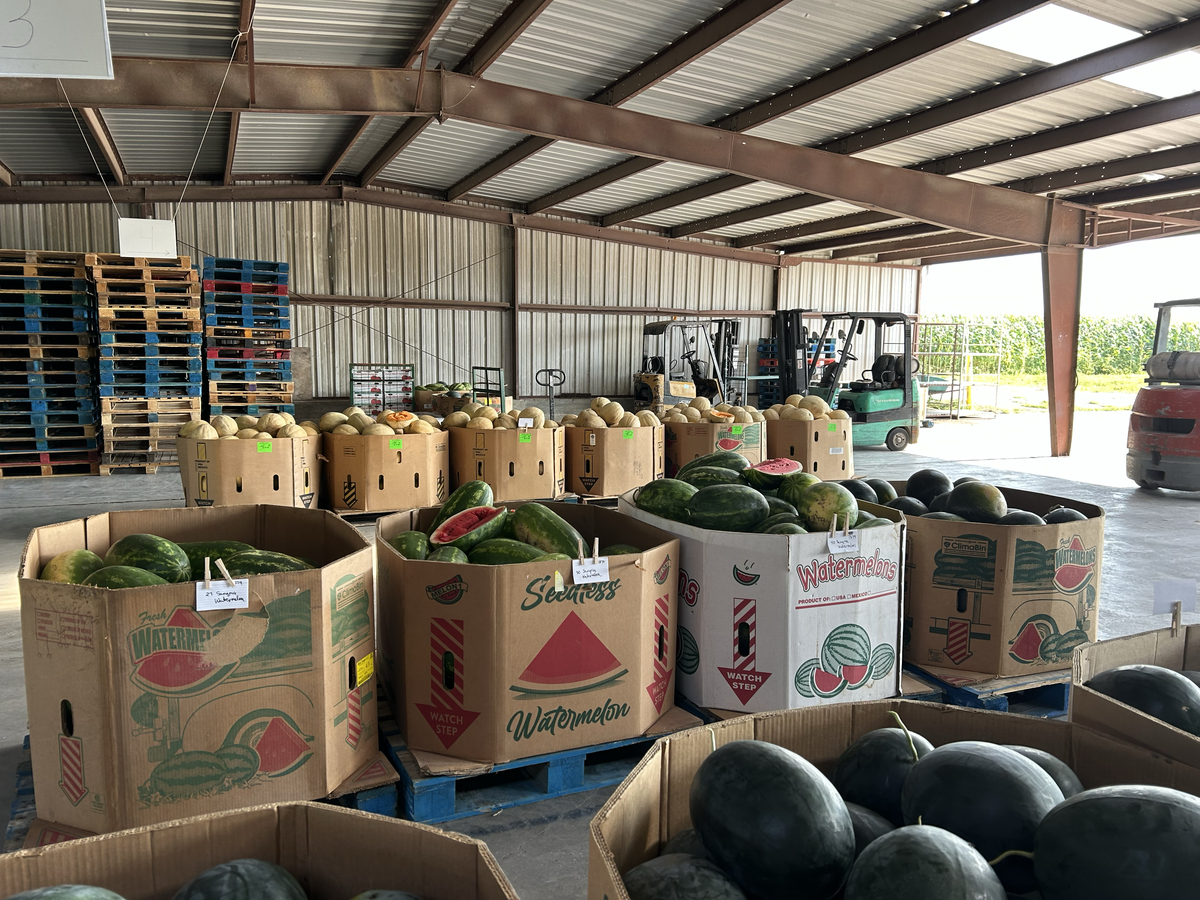
On a cloudless summer morning, a warm breeze drifts through the open-air patio at the North Missouri Produce Auction. It snakes through aisles of produce bins filled with hundreds of watermelons and cantaloupes.
It’s 9:30 a.m. on a Friday, just a half-hour until the auction begins. Auction manager Freeman Gingerich, 65, has already been at the facility for two and a half hours.
He wears a pale-brown, woven straw hat and dark-blue pants, fastened together with buttons — not zippers, as part of modest Amish tradition. Gingerich clutches a clipboard just below his curly, 5-inch-long gray beard, glancing up and down to make sure the produce bins are organized to his liking. Gingerich patiently waits for the last of the cantaloupes to arrive. They’re still being picked at a nearby farm.
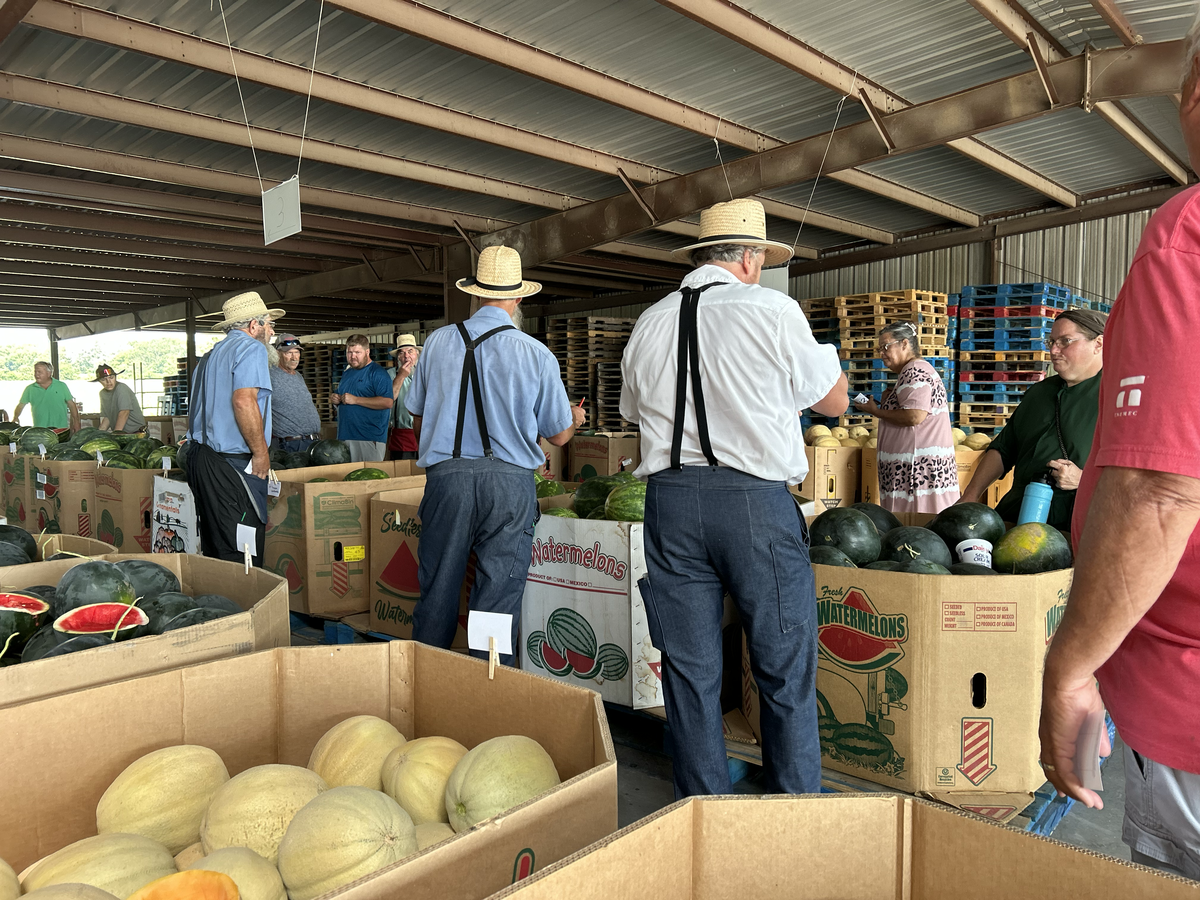
On the other side of the 27,000-square-foot auction facility, a dozen men — clad in hats identical to Gingerich’s, smooth button-up shirts and black suspenders — shuffle across the floor to unload white cardboard boxes of peaches and bell peppers.
There’s a handful of young women donning bonnets and long skirts. Half sort paperwork in the auction office, while the other half cook hamburgers and hot dogs at a concessions stand.
A few school-age children stroll through the produce aisles barefoot, their soles muddied.
It’s quiet. The air swirls with hurried anticipation. Soon, people arrive by car and horse and buggy. The parking lot gravel crunches under rubber tires and hooves alike.
Minutes before the auction starts, a mix of about 50 eager grocery store owners, produce purveyors and locals congregate. At 10 a.m., a standing black speaker flickers on. The nasally voice of auctioneer Andy Ropp, 48 and with a beard identical to Gingerich, booms across the facility, reverberating off the ceiling.
“I got one-twenty-five, one-twenty-five, now one-fifty, one-seventy-five, one-seventy-five, now two, now two, now two-twenty-five, two-and-a-quarter, now two-fifty, now two-seventy-five, two-seventy-five, now two-fifty, sold two-fifty.”
In less than 15 seconds, Ropp sells a bin of 51 watermelons for $2.50 per fruit, totaling about $128. Ropp and Gingerich saunter to the next watermelon bin, and the crowd follows suit. Ropp begins again, continuing for more than two hours until the auction floor is bare.
Amish roots
Three times a week from March until the first frost, Ropp grabs his microphone and sells a variety of locally grown produce to buyers across Missouri, including from Kansas City. Many are wholesale buyers: middle men looking to resell the produce at a grocery store, farmers market or roadside stand.
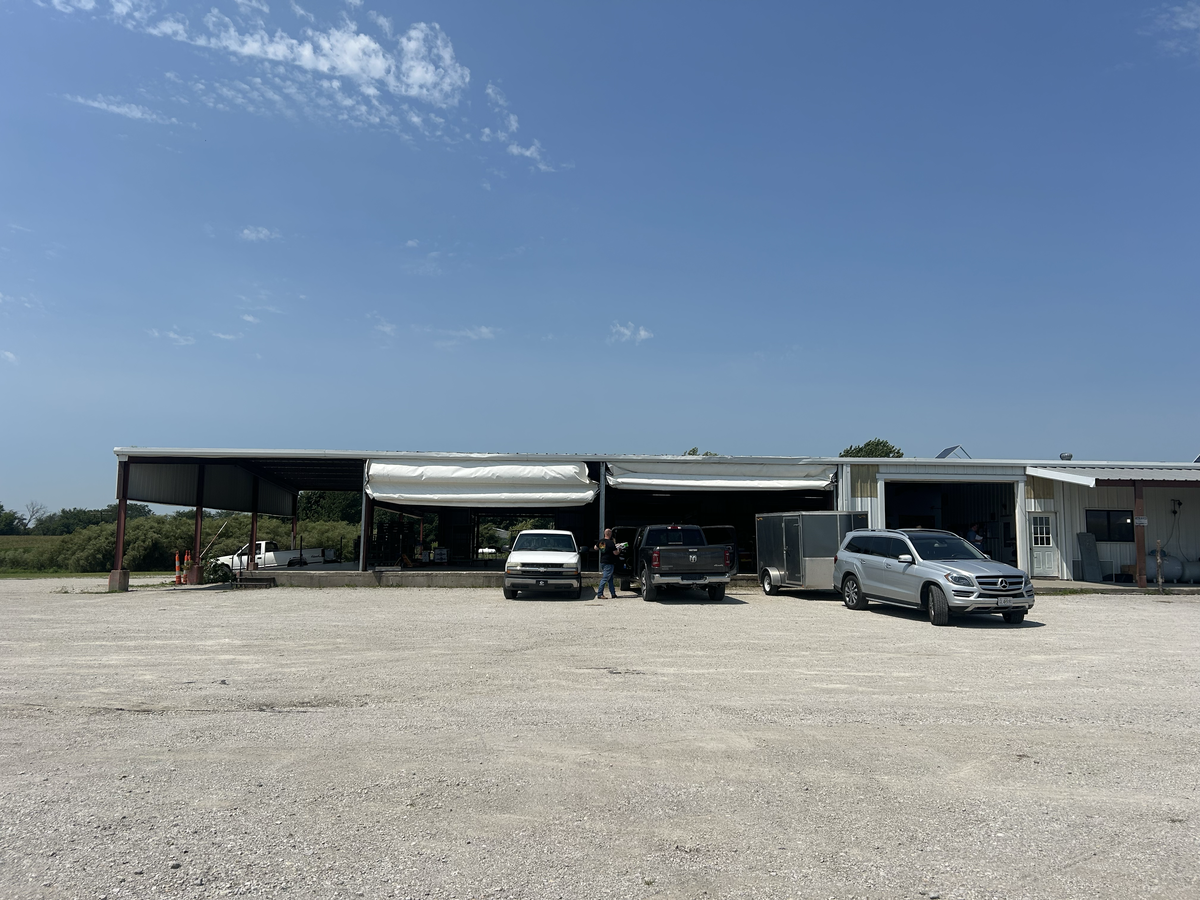
The majority of the auction’s supply comes from farms around Jamesport, Missouri — a town 90 miles northwest of KC with a population of 559 people, according to the 2020 U.S. Census. Jamesport is home to Missouri’s largest Amish settlement, currently consisting of around 175 families.
Amish people adhere to an agricultural, Christian lifestyle disconnected from the rest of society. The Amish strongly believe in simplicity, opting for a life devoid of technology, including electricity, cars and computers.
The North Missouri Produce Auction, which started in 2001, serves as a cultural middle ground between the Amish and modern worlds, where customs bend so local growers can take advantage of the current market.
The auction is a curious mix of old and new: Amish children, who are almost all barefoot, wander through the produce aisles alongside non-Amish folks who liberally use their smartphones.
There are some exceptions to the no-technology rule. One man drives a forklift to unload pallets of produce into a pickup truck. Some of the auction workers use calculators. Ropp uses a microphone, and Gingerich wears a headset microphone, both connected to a large standalone speaker.
The auction is a window into the Amish community’s self-sustaining lifestyle, and a study into what happens when it meets modern society.
Ins and outs of the auction
The auction started as a way for small-scale, Amish and local growers to access a larger metropolitan market, according to Gingerich, who has served as the auction manager since 2017.
Buyers travel hours for the auction’s cheap, bulk produce — like watermelons for less than $3 per unit and cantaloupes for under $2. Gingerich said this allows farmers, many of whom are Amish and don’t drive, to remain close to Jamesport.
“The auction opened it up for growers to stay home and farm,” Gingerich said. “That’s what the purpose was: helping the small grower farm.”
Gross sales for each auction hover between $18,000 to $24,000, Gingerich said. That figure is mostly generated by wholesale buyers, he said, who purchase thousands of pounds of produce daily.
The prices Ropp recites are per pound or per item, which Gingerich said can confuse first-time buyers who think the price is per bin (which usually contains hundreds to thousands of pounds of fruits and vegetables).
“They’ll come up to pay and go ‘Woah we can’t afford that,’” Gingerich said. “The new guys get caught sometimes, but the regular buyers have no problem at all.”
Since produce is perishable, Gingerich said the auction has a strict policy that the top bidder must buy what they won. However, if they can’t afford it, or if the produce doesn’t sell at all, the auction will buy the items and donate them to nearby food pantries.
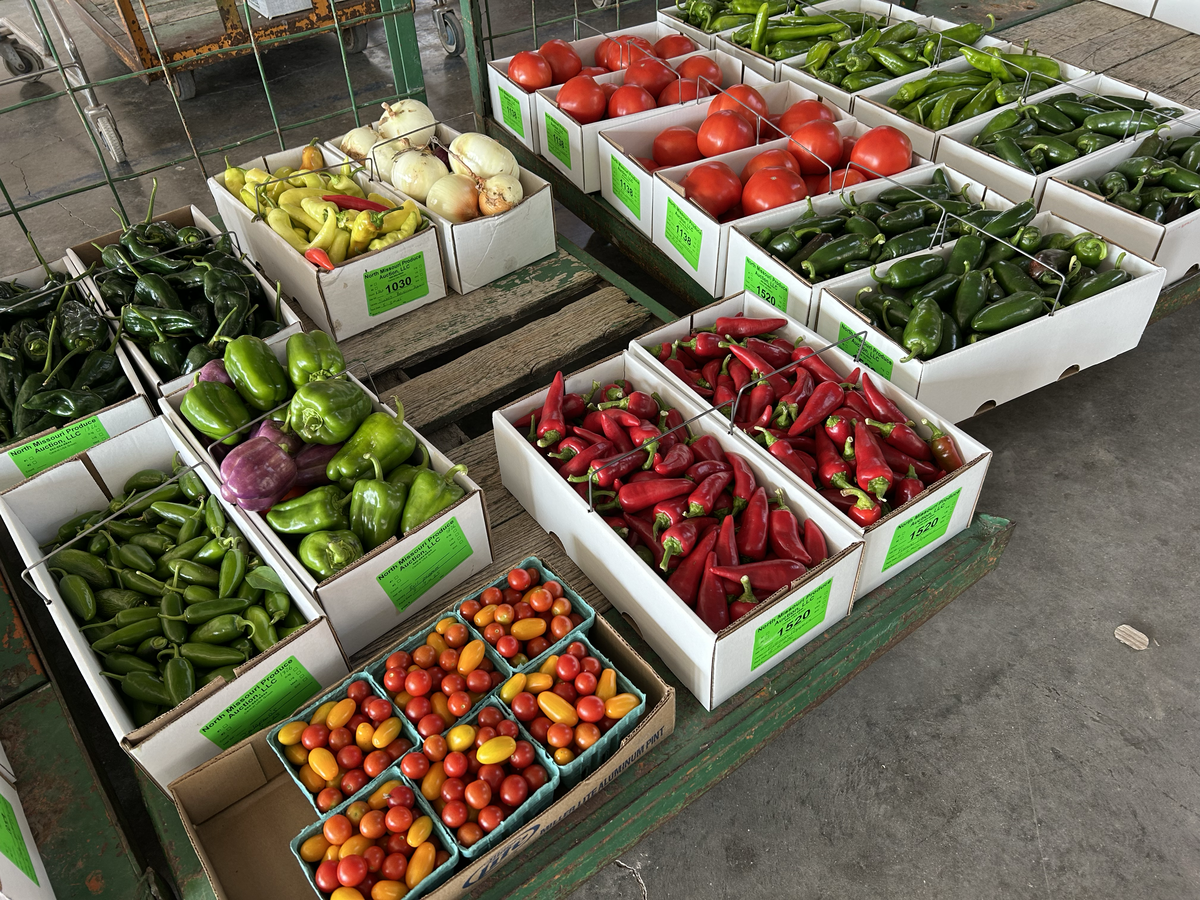
This year, Gingerich said the auction has had little produce to donate since demand has stayed strong.
Harvey Stutzman, a 55-year-old Amish man from Jamesport, is the auction’s order buyer, purchasing bulk produce for wholesale buyers who can’t be at the auction. On a given day, Stutzman juggles buying for 12-15 different people, including the Price-Rite Market & Deli in Kansas City and a farm stand in Blue Springs.
“It’s a lot like being an actor,” Stutzman said. “I try to do what they would want me to do.”
A healthy dose of competition
Before taking on this role, Stutzman grew and sold tomatoes, cucumbers and zucchini for two decades at his Jamesport farm.
“Until he got discouraged,” a young farmer quipped.
Stutzman smiled and said there’s always friendly competition among growers at the auction about who can grow the best quality and largest quantity. But, he said, the auction gives a strong incentive for all growers to do their best as a collective.
“One of the very positive things that this does for us is it creates a market where small growers can all pool the produce together, and then larger buyers can come and buy large amounts,” Stutzman said.
Gingerich said the more each grower brings, the higher likelihood larger metropolitan buyers will frequent the auction, which benefits everyone. He also said the auction style ensures prices are fair and competitive.
“If you have it the other way, you’re competing against your neighbor,” Gingerich said. “You’re trying to be lower than him so they buy it from you. This way, growers bring their produce here, unload it and it sells.”
Bargain hunting
Since 2019, buyer Dave Howe, 65, has driven an hour and a half from Lee’s Summit to Jamesport twice per week to supply his business ‘Mater Man, which operates honor-system produce stands in Lee’s Summit, Blue Springs, Greenwood, Raymore and Raytown.
In 2014, Howe opened his first produce stand at the end of his driveway to sell excess tomatoes from his home garden. Business took off within a few years, but Howe couldn’t keep up with the demand. He tried turning his spare bedroom into a grow room, cultivating 2,000 to 3,000 small tomato plants with indoor lamps.
Howe said that wasn’t sustainable, so he began buying his produce in Jamesport.
“I had to find somebody who had tomatoes that were good or better than I could grow, and these Amish people are very fine growers,” he said.
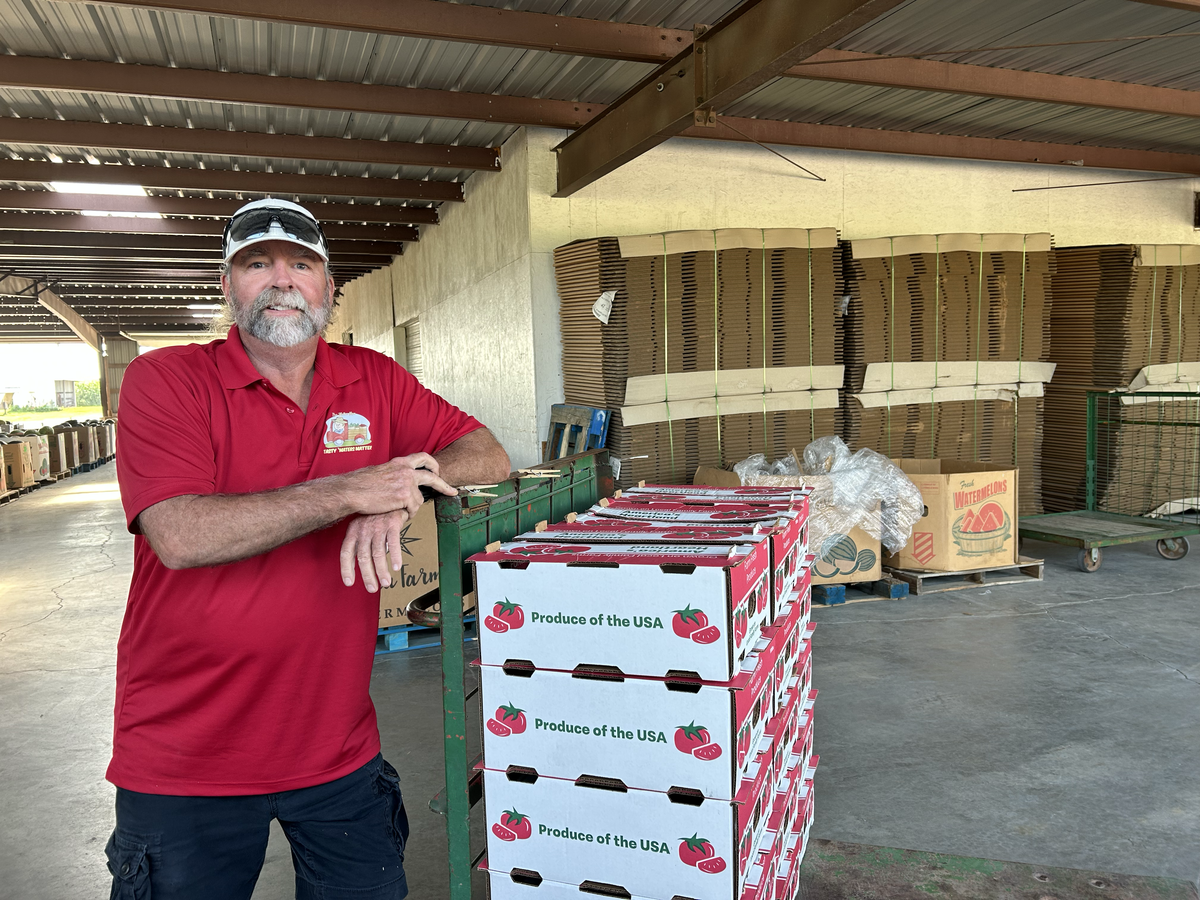
At a recent auction, Howe bought 1,500 pounds of tomatoes — half a week’s supply — at $18 per 10-pound box, which he said is double last year’s price.
“I can get them cheaper, but they won’t be as good quality,” Howe said.
The voice of the auction
The first time Howe came to the auction, he said he just watched to get used to Ropp’s machine gun-like pace of speech.
Ropp has served as auctioneer for three years. In his early days, Ropp practiced speaking at home, quickly reciting prices under his breath while crafting custom wood cabinets, his other job.
A master multitasker, Ropp reads off prices while studying buyers’ expressions, looking for any signal of interest, from a hand raise to a head nod.
“I’ve got to look for people’s faces pretty well. Sometimes people just stand there and …” Ropp said, leaning forward and winking.
Becoming an attraction
Between Ropp’s rapid auctioneering tempo and the sheer magnitude of produce, the auction has turned into a local spectacle, attracting people across the region.
For 20 years, Liz Kirkendoll, 83, has driven over 30 miles from Cameron, Missouri, with her husband Kitch, 85, to attend the auction.
“We like the people, we like the scenery,” Liz Kirkendoll said. “The crops are beautiful. We just enjoy being here.”
Recently, the couple came with their son Tyler, who was visiting from Fort Collins, Colorado, and said he always enjoys stopping by the auction when he’s in the area. The Kirkendolls will make a day out of it, visiting the town’s Amish Country Heritage Furniture Store and bakery afterward.
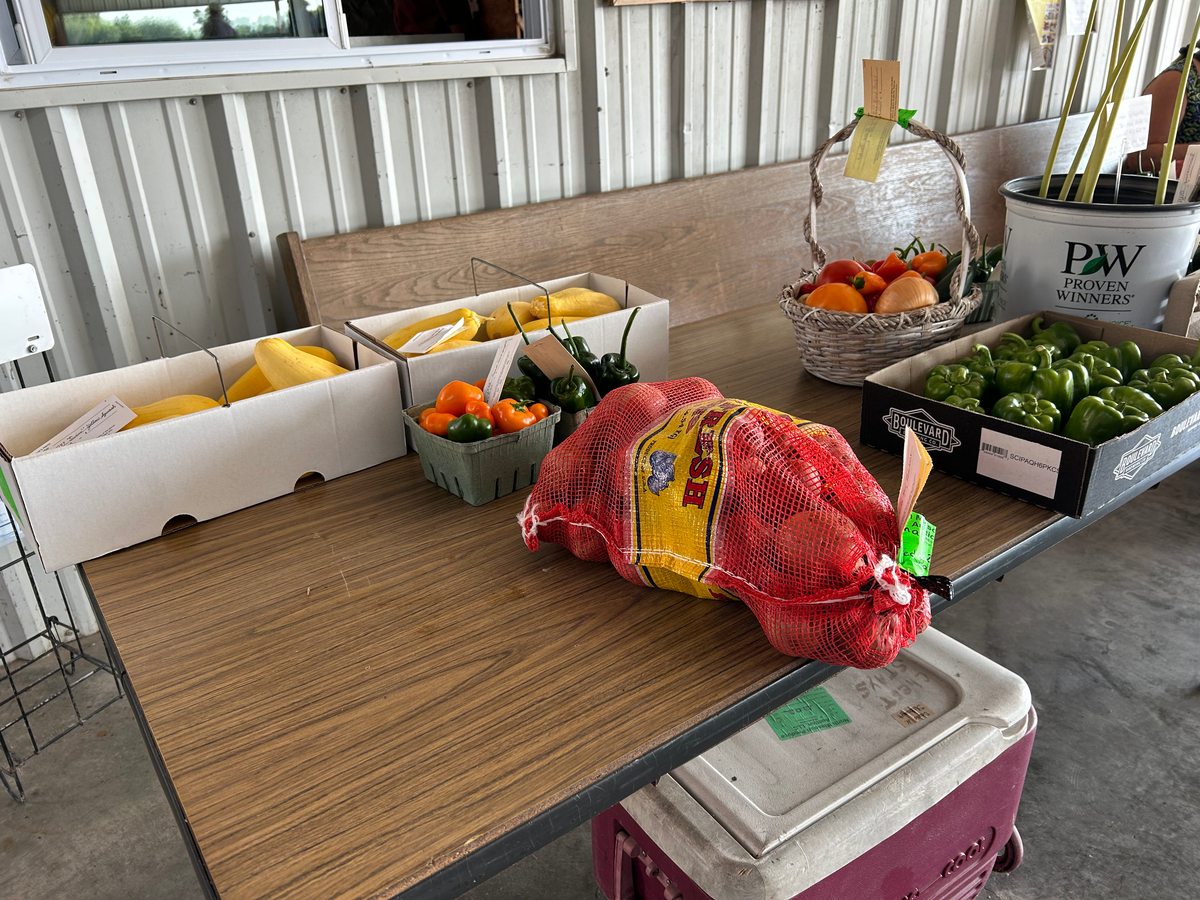
Sometimes the Kirkendolls will buy produce from the auction’s small-quantity table, most recently buying green beans, tomatoes, cantaloupe and potatoes. Liz Kirkendoll said the produce is too high-quality to cook with — it must be enjoyed fresh.
Doing it all again
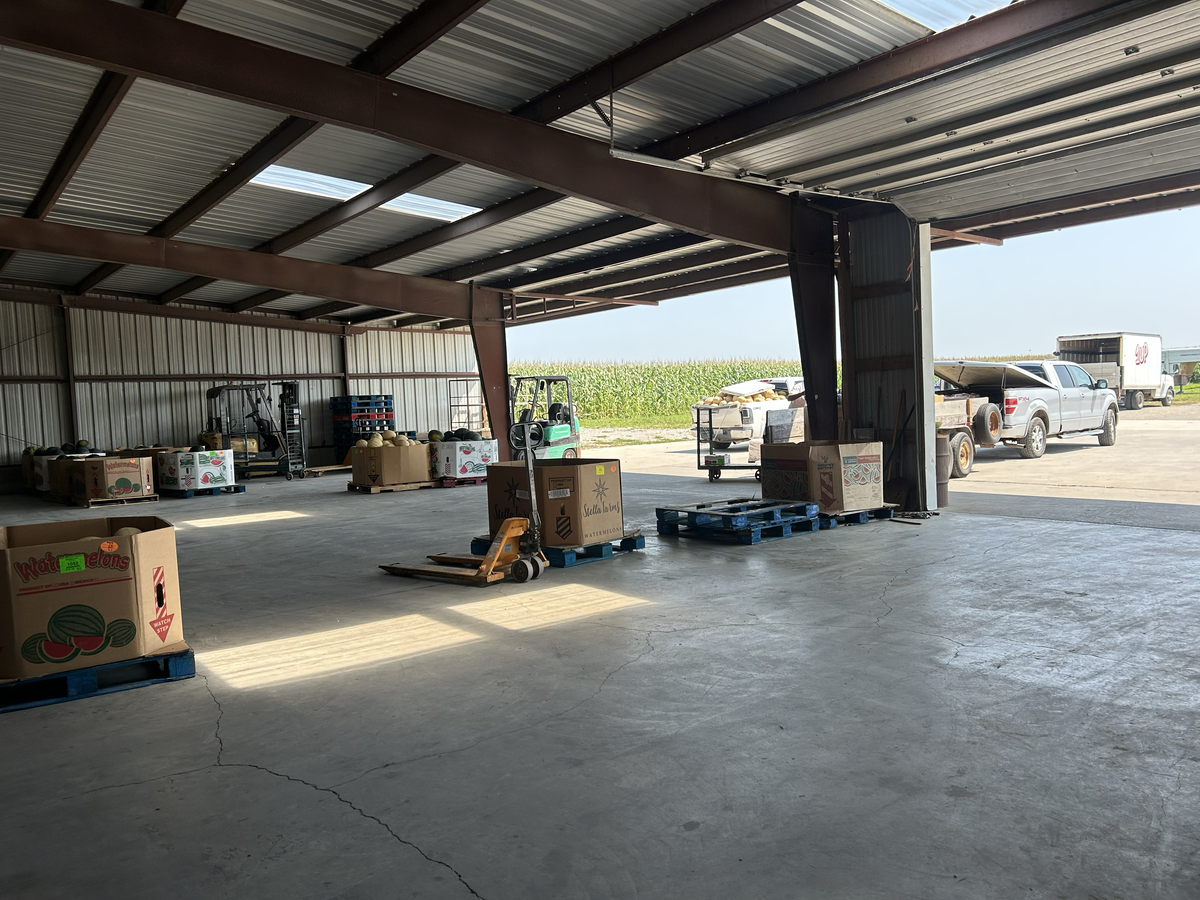
It nears noon, and the morning’s warm breeze has turned into a furnace-like gust. People tote produce to their respective vehicles. The auction floor empties. Only a handful of buyers remain.
Gingerich and Ropp stand by the folding table where the Kirkendolls purchased produce earlier. Ropp auctions off the final item, sweet snack peppers, at 12:30 p.m.
“That’s all for today,” Gingerich calls out. “We’ll be back here Monday at noon.”
It was a good day, Ropp said, because all the produce sold and prices stayed consistent.
Ropp’s dad Henry, who works as a dock worker and helps load and unload produce, passes by with a paper container of shoestring french fries from the concessions stand.
Henry said he’s worked at the auction for about five years. Gingerich interrupts.
“Oh, more than that,” he said, estimating it’s been more than a decade — which came as a surprise to Henry.
For the Jamesport Amish community, the auction is both ordinary and essential — a steady rhythm that brings crops grown in quiet fields to urban tables. It’s a balancing act, Gingerich said, guided by a principle as constant as the auction itself.
“We just try to stay as honest as we can, as fair as we can with everybody,” he said.