KC-area agency posted video of a woman in mental crisis, then backtracked. Why?
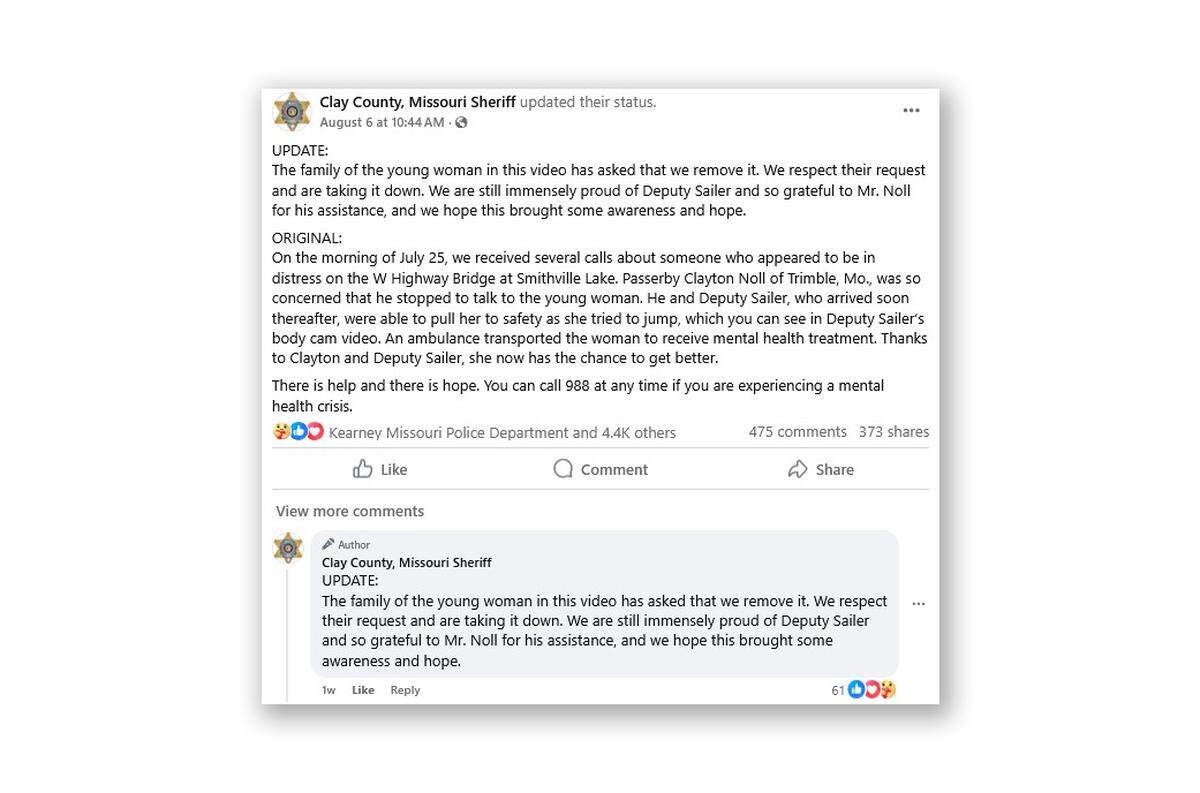
The Clay County Sheriff’s Office posted body camera video on social media earlier this month showing a woman experiencing a mental health crisis, sitting on a Kansas City-area highway bridge.
Hours later, the agency backtracked and took down the video at the request of the woman’s family.
The body camera video of the July 25 incident shows a Clay County deputy introducing herself to the woman, who is sitting on a railing above a Kansas City-area lake. The deputy tells the woman that people had seen her and were concerned and asks her to step back over the railing. After the woman stands up, the deputy and a passerby grab her and pull her to safety.
“I understand that you’re probably feeling hopeless and helpless, but I promise everything is OK,” the deputy says, holding onto the woman. “Everything is OK, I promise.”
“There is nothing that is unfixable in this world, I can tell you that,” she says. “OK? You’re not in trouble.”
In its original Aug. 6 post on Facebook, the sheriff’s office praised the response of the deputy and the passerby who spoke to the woman and then wrestled her back to safety. The post said the woman was taken by ambulance to receive mental health treatment and pointed those needing assistance to a mental health crisis line.
“There is help and there is hope,” the post said. “You can call 988 at any time if you are experiencing a mental health crisis.”
Many who saw the post applauded the response in a difficult moment and expressed sympathy for the woman. Some wondered why the department, which has 45,000 Facebook followers, was publicizing a video of a person in crisis and urged it to take the post down.
“This was a wonderful save; but a terrible decision to post visuals,” one person commented. “She is easily identifiable and no one deserves to have one of their worst moments shared in perpetuity without permission.”
Experts asked to review the situation by The Star emphasized caution in publicizing accounts related to suicide and mental health issues.
A few hours after the original post, the office said it was pulling the video at the request of the woman’s family. One Kansas City TV station published the department’s video and then later took down its post as well.
“We respect their request and are taking it down,” the sheriff’s office said on Facebook. “We are still immensely proud of Deputy Sailer and so grateful to Mr. Noll for his assistance, and we hope this brought some awareness and hope.”
Sarah Boyd, public relations manager for the Clay County Sheriff’s Office, told The Star she found the video compelling on several levels, pointing to the actions of those involved and the opportunity for the sheriff’s office to highlight resources for people in crisis and the situations law enforcement officers face.
She said they did not reach out to the woman’s family before posting the video, and instead attempted to hide the woman’s identity by blurring her face. She said when a family member of the woman called and asked for the video to be taken down, she relayed that she was sorry if the video had caused any hardship to the woman’s recovery.
“I am not a mental health expert, and if I had the same training and experience as them, I may see the situation through a different perspective,” Boyd said. “As it was, I did the best I knew how to do to use the video to highlight mental health resources and tell the story of the heroes involved.”
Urging caution
Experts urge caution to those who are sharing about suicide and discourage reporting on details and using images that show methods or locations in media accounts. It’s helpful for accounts to report on prevention and include messaging urging people who are suicidal to seek help and point people to available resources, the World Health Organization’s guide on reporting about suicide says.
Bill Geis, a professor of psychiatry at the University of Missouri-Kansas City and one of the founders of the Kansas City Suicide Awareness and Prevention Program (KCSAPP), said the psychiatry community tries to protect people in distress because of the stigmas around mental health issues and the shame that can come from a person’s struggles being made public. Vulnerable people who come in contact with a death or a near-death experience can be triggered to do something harmful to themselves, he said.
He described the situation as a teachable moment and applauded the department for listening and taking the video down.
“OK, it may not have been the best thing to do, but they recognized it, and they took it down,” he said. “But I’m not unsympathetic about some kind of celebration about really assisting somebody significantly who is in a mental health crisis. That’s a good thing.”
Tami Radohl, a social work professor at Fort Hays State University in western Kansas and a KCSAPP board member, said she appreciates that suicide prevention and awareness are being talked about more and that law enforcement is supportive and pointing people to available resources like the 988 crisis line.
But someone’s health information is theirs to share, she said.
“I think out of respect for the family and the person involved, pulling that information back protects that person’s privacy, protects that person’s personal health information, because mental health is a health care issue,” she said. “It protects maybe other things going on their life and why they found themselves in that crisis situation to begin with.”
An alternative way of sharing a person’s story centered on suicide would be to have them tell their account after the fact and share their relief at still being alive, said Maria Oquendo, the chair of the psychiatry department at the University of Pennsylvania.
“That happens all the time,” she said. “The method fails and then the person is really happy that somebody helped them stay alive.”
This story was originally published August 20, 2025 at 3:48 PM.