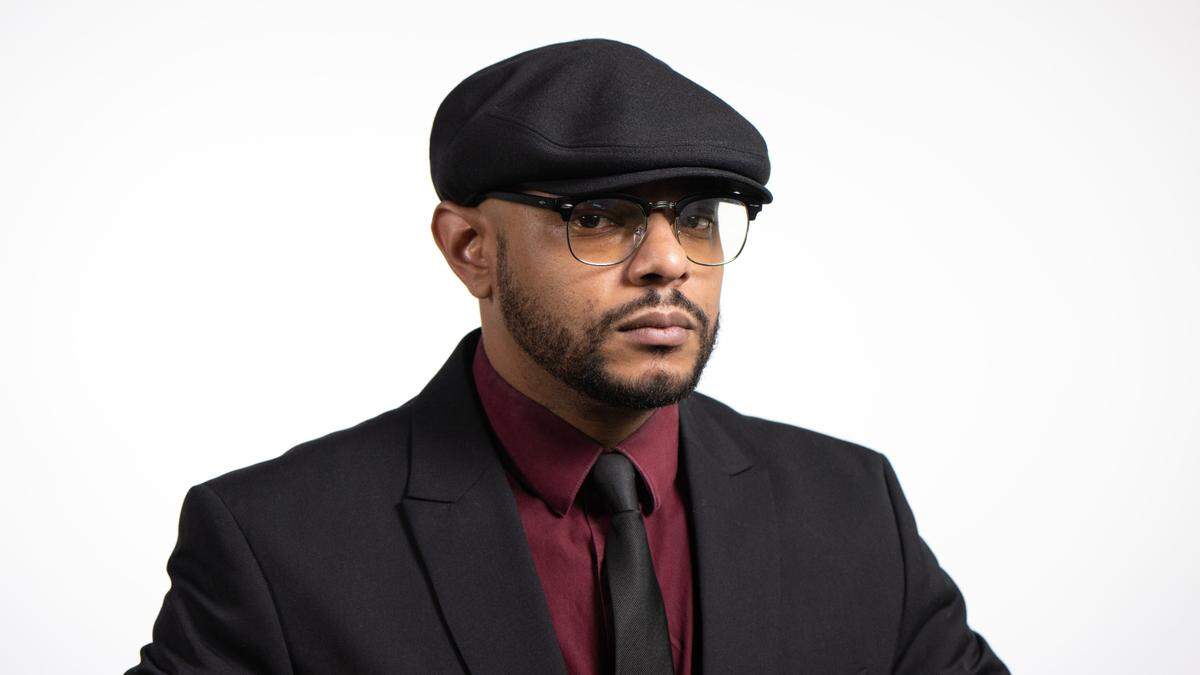
Kansas City’s Poet Laureate found a place to teach Black liberation, empower change
In the evolving landscape of Kansas City’s educational movement, Melissa Ferrer Civil is a powerful voice bridging the gap between creativity and liberation.
As both the city’s Poet Laureate and the director of B-REAL Academy — a freedom school focused on Black resistance, education, and leadership — she brings a unique blend of artistry and activism to her work, cultivating spaces where people can explore identity, community and social change.
At the heart of her work is B-REAL, organized this year by The Kansas City Defender, a grassroots initiative dedicated to nurturing revolutionary leadership. Through this 14-week program, Ferrer Civil guides students beyond the bounds of what they might learn in a traditional classroom, introducing them to radical histories, community-driven organizing and the power of self-expression.
Ferrer Civil says her approach is unapologetically transformative. An important part of what she does at B-REAL is create learning environments that honor lived experiences and center voices too often left out of mainstream narratives.
Ferrer Civils is helping to redefine what leadership looks like in Kansas City, shaped not by titles or institutions but by empathy, vision and a deep commitment to justice. The Star, in separate instances, has written about Ferrer Civil and the start of the freedom school. But with The Voices of Kansas City this year focusing on varying forms of education, it seemed fitting to include Ferrer Civil’s brand of instruction. So, to get all those details, The Star’s culture and identity reporter J.M. Banks sat down with Ferrer Civils in the studio at KKFI Community Radio to talk about her upbringing, her poetry and how she came to lead KC’s first freedom school.
Meet Melissa Ferrer Civil
The Star: Why don’t we start off by having you tell us a little bit about your early upbringing and what led you into the field of education?
Ferrer Civil: Yeah. I was born in Brooklyn and raised in Florida. I think, for me, school was always my safe place. Like, I loved to learn. I often say I was a good institutional child and I really thrived in school . When I lost my mother at 14, school became the one stable thing in my life. I was in like nine different clubs. I was the president of the poetry club. I was in band. I was in thespians. I was doing all this stuff and I really leaned on my teachers.
When I was five, I wanted to be five things: the first Black woman president, a professional drummer, a professional basketball player, a teacher, and a tiger breeder. I wanted to be a teacher because I relied on my teachers so much and I loved the role they had in the classroom, informing us, guiding us, loving us. So, between that five-year-old dream of being a teacher and school being the one thing I could count on when I couldn’t count on anything else, it made sense.
Later, I had a break from being that “good institutional girl” and started splitting myself, which we’ll get into later, because that ties into why I do B-REAL Academy now. But between all of that, in 2018, I came to Kansas City. I was looking for a job and living in a homeless shelter. I didn’t have those inner things we usually rely on, like a sense of direction, or knowing what excites you, or what doesn’t feel right.
I didn’t have any of that. It was all kind of taken from me through psychosis. But the woman who helped us find jobs at the shelter recognized that I needed something more intellectual. At the time, I was working at Wendy’s. I think she could just see that I was a shell of myself.
She told me about NP Connect, and I looked it up. If you don’t know, NP Connect is short for Nonprofit Connect. it’s basically a job listing board for local nonprofits. I was scrolling through it at the library and stumbled across what was then called KCTR, Kansas City Teacher Residency.
I kind of lingered on it, and I felt something pop inside of me. It was the first feeling I’d had inside myself in a long time, and I was like, that’s something. I remembered that when I was five, I wanted to be a teacher. And even though I had no direction in my life and no sense of what I was doing, I remembered that five-year-old desire and that sudden feeling.
So, I applied for the Kansas City Teacher Residency, truly on a prayer. I was like, I don’t know what’s happening, but I’m going to do this. It was a multi-level application process. One part required us to write an essay about the challenges we’d faced. I told myself, God, I’m going to tell the truth. So I told them about having mental breaks and psychosis. I talked about wanting to be a teacher, even though that desire wasn’t totally clear to me at the time. I was still in the process of remembering who I am.
I applied, told them everything and I got in. So they accepted me. I joined the program, now called the Educator Academy. It’s an amazing program for anyone looking to get into education. I got my master’s degree through it, because at the time they had a partnership with Park University. I think now they’re partnered with the College of Education over at UMKC (University of Missouri Kansas City).
I became a full-time teacher, teaching fifth grade English and social studies. During that time, I was also in the process of healing, of coming back to a sense of my own humanity and finding my why. Like, why do I want to be in this classroom? What is my passion when it comes to working with children?
And then I was able to identify it: I’ve always wanted to help people find their voice. Not just their voice but, to me, “voice” is indicative of someone’s agency, their position, their perspective, and their ability and power to express what they feel, think, and see. I was obsessed with helping children find their voice.
And I was doing that but I realized that, in the education system, it’s not exactly built for that, if that makes sense. I realized early on while I was teaching fifth grade, that the thing I wanted to do, I couldn’t really do in the position I was in.
There were just so many other things: state standards I had to teach, responsibilities outside of teaching. And mind you I was at an amazing school, with an amazing principal, and an amazing set of coworkers. People who were so supportive and helpful in my growth as a teacher and in each other’s growth as educators.
So I knew if I wasn’t thriving in that environment then this probably wasn’t the career for me, at least not in that way. Because I realized that the things I wanted to do, we barely had time to even get to in my classroom.
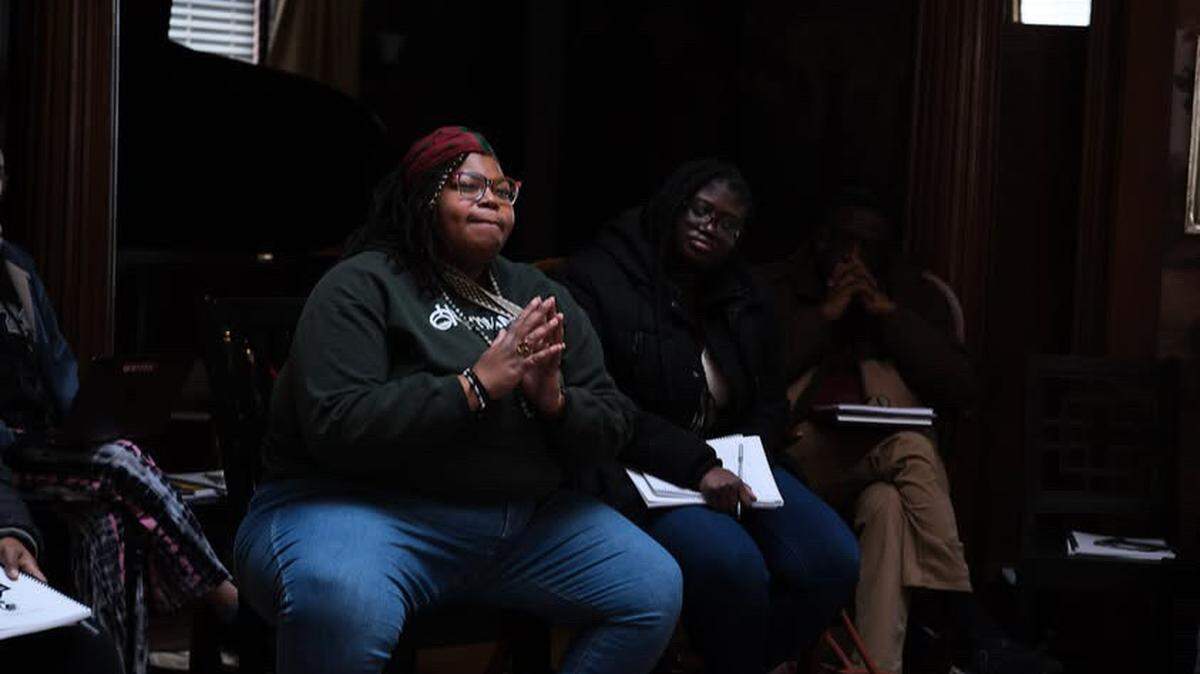
.jpg "unnamed (22).jpg")
And it was cool, people like to call their students “scholars” or “friends.” I called mine “change agents.” I would always tell them a few things. One, whatever you’re learning here, it’s not just for your future. It’s for you right now, because you’re alive right now. These are things you need to be able to apply in your life today.
I would also remind them that they were smarter than me. That because of their age and the elasticity of their brains, they could retain and work with more information than I could. But I had lived through a lot more. So they should still listen to what I said.
We would do things like watch videos about how kids around the world were living. This was around the time when Trump had children in cages at the border so we talked about that. We learned about how children can make an impact in their communities and in their own lives, right now, where they are.
And I realized that’s what I was passionate about. I didn’t care about the standards. I didn’t care about what I was “supposed” to be teaching on an institutional level. I was much more concerned with them as holistic human beings. So yeah, I left education. That was also in 2020. I had been a fifth grade teacher from 2019 to 2020. I left because of the pandemic.
You brought up an interesting point in regard to what the institution wanted you to teach versus what your heart wanted you to teach the kids. In recent years, there’s been a lot of debate about parents pushing back on teachers and what they’re teaching in the classroom.
How do you think teachers should navigate that kind of hostility from parents when they’re trying to build the “whole person,” as you say, and focus on areas not traditionally covered in school curriculums?
Yeah, I think there’s a difference between education and indoctrination, right? I think when we’re talking about parents wanting to, you know, kind of shield their kids from the world, right, it’s often because they themselves were shielded from the world in some way, shape, or form. But if you engage parents in a real conversation, like, how did that work out for you?
Did you feel prepared when you entered the world? Were you able to look at your neighbor and recognize them as your neighbor, or did you see them as an alien because you never received an education that represented them as well? These are the kinds of conversations that need to be had.
Indoctrination is when you try to implant an ideology into someone, more implanting than teaching. A certain perspective, a way of looking at the world. Education is about leading someone out of ignorance, out of darkness. And I don’t mean ignorance in a derogatory way. I just mean not knowing. It’s about becoming aware of what’s around them, perceiving and witnessing the world in a way that doesn’t project a false narrative.
For example, when I was teaching, we did a section on the Trail of Tears. All I did was present the facts. We had a project where students had to write daily journal entries as if they were experiencing the Trail of Tears from the perspective of Indigenous folks. I just laid out the facts.
Mind you, I’m not the kind of teacher who claims to know everything. I’m always learning with my students, and they’re also always teaching me.
In that particular lesson, I learned things myself. I didn’t know that Andrew Jackson was a land speculator. I didn’t know the Cherokee Nation appealed to the Supreme Court, and the Court ruled in their favor, that it was unconstitutional to remove them from their land. I didn’t know that Andrew Jackson told the Supreme Court, essentially, “Let me see you enforce that, because I’m not going to.” Then he signed the Indian Removal Act because gold was found on that land and he was a land speculator.
So when I present these facts to the kids, I don’t tell them what to think. I just say, “Here’s what happened.” One student raised her hand and said, “Miss Civil, you mean to tell me Andrew Jackson killed all those Native Americans for money?” And I go, “Well… this is what history tells us.”
And the student goes, “Meh, skip to it.”
And I think that’s the kind of thing that matters, being willing to ask questions. All I’m doing is presenting history. And if you want to hide history, then what are you trying to communicate to your child? I understand wanting your children to be safe, to never experience horror, trauma, or danger.
But that’s not the world we live in.
Education is a very scary thing because it uncovers the worst of us as humans, and we don’t learn unless we reckon with the past. Those who don’t learn history are doomed to repeat it. So yes, it’s interesting how we try to make education more palatable without dealing with the complex emotions that come with it, like learning about the Trail of Tears or Black Wall Street.
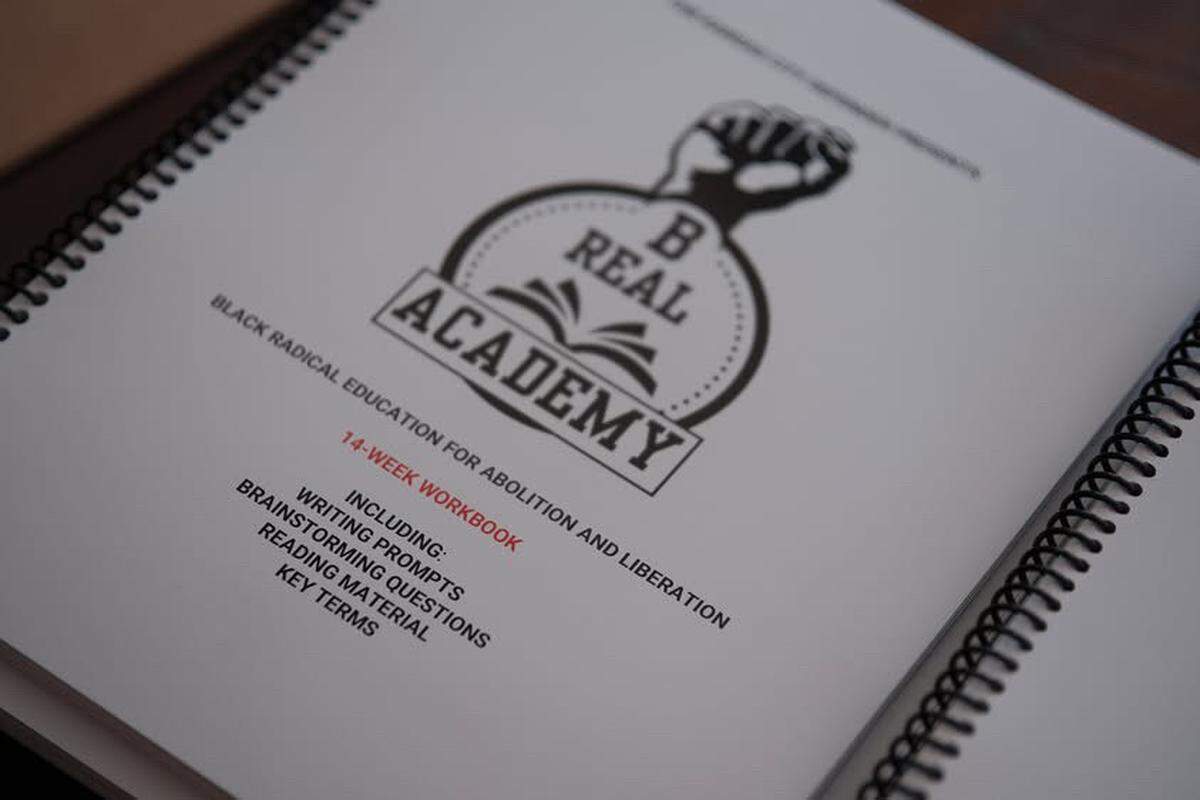
Tell me about the B-REAL Academy and how it came about?
Yeah. So B-REAL stands for Black Radical Education for Abolition and Liberation. It was something I was invited into. Ryan Sorrell of the KC Defender, had this idea for a school he wanted to start, using a curriculum from a movement school out in Philly called the W.E.B. DuBois Movement School.
We were building off that curriculum but wanted to create our own thing,focused on Black radical thought. A few of us began meeting back in September, putting together a curriculum of Black radical thinkers, with Indigenous perspectives and other marginalized viewpoints from around the world.
Why did we do it? One, we wanted more Black organizers in Kansas City. Two, we know we live under an institution that will not teach us our own history. Even those of us who had the most progressive education didn’t learn our own history. Things were always cut out, because they’re seen as incendiary or controversial. Three, we wanted our kids to be prepared earlier. I personally don’t believe in the “sink or swim” model.
I love holding people’s hands, because I always wished someone had held mine.
So we wanted to build something radical and actionable. A program where participants would feel prepared, or already invited to join organizations in Kansas City doing work around community building and organizing. If we had writers in the space, maybe they’d start writing for The Defender, too.
That was the thinking behind B-REAL. We just wrapped our first cohort. Our youngest student was 11. Our oldest was 73. We wanted intergenerational learning, breaking down these false hierarchies that separate people by age. We believe in learning from both the wisdom of the past and the imagination of the future.
It’s a participatory model. It’s not me standing in front of the class lecturing. Paulo Freire, who wrote Pedagogy of the Oppressed, talks about the “banking model” of education, where students are treated like banks that you deposit knowledge into. I don’t believe in that. The oppressed don’t need that.
What we need are models that reflect our agency, our critical thinking skills, our ability to say, “I don’t see it that way. Can you explain it more?” Or, “Here’s how I see it.” We need to engage, to converse, to be accountable and responsible to what we learn and what we do.
So that’s our model. It’s discussion-based. It’s still a baby. We’re reevaluating, restructuring, and learning all the time. Hopefully we’re building with our community, not just for them. We take feedback seriously to shape what our next cohort looks like.
How many people did you have in that first cohort, and what were the requirements?
We had 30 folks. The main requirement was that you had to be Black.
We had about 75–80 applications, and we curated the cohort. It’s never about judgment or value, it’s about relationships and what we felt we could handle.
Blackness is not a monolith. That was one of the most beautiful parts of the cohort, seeing all different kinds of Blackness represented. It gave us a wide spectrum.
So with this being the first core cohort, what are some takeaways you discovered that you’re really happy about, and what are some things that didn’t go as planned that you’ll need to recalibrate in the following years?
Yeah. I think one of the biggest things is, we know what time we’re in. We know stuff is bad right now. Things aren’t great. And I think one of the biggest things we didn’t fully plan for, well, I guess I did in a way, whenever I’m facilitating a space, I always plan for it to be as communal and safe as possible, a space safe enough for vulnerability and for being witnessed.
But I didn’t expect just how deeply the cohort would come together and become each other’s community. They really traveled through this in the way they needed. The times we’re living in can choke a person out, can make you feel like the walls are closing in, can make you feel neurotic or paranoid. All of that is valid, there’s plenty of reason for it. But more importantly, the current timeline can make us feel powerless, like there’s nothing to be done.
My greatest takeaway so far is the power in studying together, studying our own history, our own representation, learning about those who came before us: our ancestors, our predecessors.. And, unraveling those stories together, discussing them, valuing every voice in the space, including our own, and entering into real conversation.
The power that brings, the way it connects people, is insurmountable. It’s actually an antidote. It’s what we need right now: community. Honest, humble, intentional community. Not just “well-meaning” because a lot of people mean well but they’re not willing to listen and learn what true wellness really is. So yeah, that’s my big takeaway.
One of the challenges, I think, is retention. We started with 30 people and dwindled to about 15–20. So figuring out how to get people to stick with the program is something we’ll need to address. Some incredible people were with us at the beginning, but life happens. You can’t always plan for that. Capitalism pulls us away from each other. But I’m sure there are things we can do on our end to help people return and stay connected.
Another challenge, well, one of our desired outcomes is to get people plugged into organizations. We do organizer trainings, but how do we create better infrastructure to make that happen? How do we connect our cohort to real-world actions and organizations doing work in the city in more effective, sustainable ways? Those are the things we’re thinking about right now.
What was the frequency of your meetings?
They were Saturday schools, three hours each week.
Why do you think these kinds of alternative learning institutions are important for us to have in today’s times? Right now, they’re trying to ban books, which is the beginning of fascism. Well, we’re not at the beginning, we’re in it. They’re trying to limit what gets taught, what gets heard, what gets received. But they’ve always done that. We started our cohort talking about fugitive pedagogy and Black study. I can’t remember who writes the book, but there’s one called Fugitive Pedagogy. I think it’s by Jarvis R. Givens. It explains a scene in a Black school during the time of Carter G. Woodson.
You’ve got a Black teacher teaching Black students from a book in her lap. And then, when a school administrator walks in, without missing a beat, she looks up and begins reading from the book on the table, the institutional-approved text. But the book in her lap is the one her students really need .That’s fugitive pedagogy. That’s the third space. That’s Black study, a space outside the institution. A maroon space, if you will.
A space where people can come together and shed the institutional weight of a system that was never built for them, never meant for them. Let’s not get it twisted: this has never been for us. These third spaces are places for honesty and for learning what they’d rather we not know about ourselves.
And for me, someone who has experienced mental illness, James Baldwin said something that stuck with me. He was once asked about Black folks applying to higher ed institutions, and he said: “For a Black man to go to college is a courageous act because it means risking schizophrenia.”
That split-mind idea, the double consciousness, is also talked about by Frantz Fanon and W.E.B. Du Bois. These third spaces are important because they allow us to unravel. To not have to split ourselves. To not try to be something we’re not just to gain approval. To not be policed by some merit-based system that tries to define your value or worth.
To just say, I’m here to learn about myself and my people. I’m here to learn. I know this whole series is about education, and I am an educator, but I don’t believe we have an education system. It’s an indoctrination system. It doesn’t give us the freedom or liberation to remember who we really are and that’s by design. So yes, third spaces are for that.
Because you have such a wide range of ages, have you observed any differences in how participants take in information or approach certain issues?
Absolutely. Difference is deeply integral to learning. If everyone has the same perspective, then we’re missing something important. Yeah, we saw differences. Our 11-year-old takes longer to process certain things, sure. But they’re the one who brought the concept of sustainable currency into the space.
Our 73-year-old, a former Black Panther, wanted to hear what the younger generation had to say. And whenever he spoke, everyone listened, like, tell us more. He’d say, “I don’t want to bother you with my old man stories,” and we’d be like, No, we came here for the universe. The youngest participants may have been quieter, but when they did speak, it was always something significant.
And everyone in the middle, we’re all in the struggle. When you learn about yourself and your people, you realize, you already knew. You just didn’t see yourself represented, so you thought you were crazy. You thought you were the only one. But it turns out there are all these people, from different backgrounds and perspectives, who affirm what you’ve been seeing and feeling.
So yes, we do have a shared perspective, but from different vantage points. It’s a lie to say not every voice can be at the table. That’s a very American idea, that too many voices means nothing gets done. But organizing teaches us: when every voice is at the table, it does take longer to get something done but what gets done is more complete.
Do you see yourselves opening enrollment to other groups in the future?
That’s a really good question. I do see that happening, but it’ll be a slow open .For the first few cohorts, we want to keep it Black. And that’s because it’s important to start within your own community. If we’re being real about liberation, we have to start with those most marginalized and build from there.
So we’ll keep it Black for now, and then begin to open up. I think the next group we open it up to should be Indigenous folks. That means starting those conversations in our communities and while still teaching Black radical thought, also including texts like The Red Deal by The Red Nation, bringing Indigenous perspectives into the curriculum.
We can’t come home without acknowledging whose land we’re standing on. From there, we can include other oppressed and marginalized populations. Eventually, yes, we’ll open it up more widely.
How do you think these current and future revolutionaries will take what they’ve learned at the institution and apply it in their own struggles?
I hope they feel fortified, empowered and grounded. From what I’ve heard from the past cohort, they’ve said they now know they can create change in something they once thought was unchangeable, this world. One person said, “I now know that the time for beauty and joy has not passed,” which is such a powerful statement. Because it’s easy to look at the world right now and feel hopeless.
But they feel empowered. Validated. Another big part of our programming is envisioning the kind of world we’d like to live in. What do our systems look like? Our institutions? Our daily life? Who gives us our news? How do we build trust in that? We hope that by the end of the cohort and through continued engagement, participants take real steps toward building that world they envisioned. Once the vision exists, it becomes an inevitable outcome.
I think it’s “The Red Deal,” that says: “It’s easier for us to imagine a zombie apocalypse than the end of capitalism or oppression.” Our belief system often assumes the worst outcome is the most inevitable. We have to change that.
The first cohort kept its location private for safety reasons. Some might say that’s an over-exaggeration. Can you speak to why that was necessary? Yeah. I think part of Black liberation in this country has always included a level of fugitive practice, a level of hiddenness. It’s rooted in the history of maroons, escaped slaves building free communities in the wilderness. And for anyone who thinks that’s an overreaction: our liberation truly means the destruction of this current society as it exists. Because this society depends on us not knowing ourselves. It depends on us not desiring our own liberation. It depends on us selling our time, labor, energy, our communities, our people.
What are some things you hope to do in coming years in terms of growth and evolution for the B-REAL Academy?
We want coalition building. There are amazing programs like this popping up all over the country, and we want to build communication between those organizations. Locally, in Kansas City, we want to be plugged into everything that’s liberatory. We want to be part of that network, connecting our people to it.
So many folks are feeling powerless. And we’re not saying we have the power, though we do, but power lives in all of us .Power is the ability to do something. Anything. People need to know what to do with their hands. How to use their heart in a way that’s sustainable and life-affirming.
Radical just means thorough, rooted. A radical idea is that everyone deserves to eat. That everyone deserves shelter. Maybe it is radical but only because it’s rooted in what’s human. So we want to help people return to that, to their own sense of humanity and connect them to organizations creating the conditions for a more humane world.
Information:
Details about B-REAL Academy can be found on The Kansas City Defender page., and the academy’s Instagram: @bereal_academy. Calls for enrollment will go out in the KC Defender newsletter.
The next cohort will probably begin in September. It’s a 14-week program, Saturday school, three hours each week.