Kansas City radio station reeling from federal funding cuts: ‘Slash and burn’
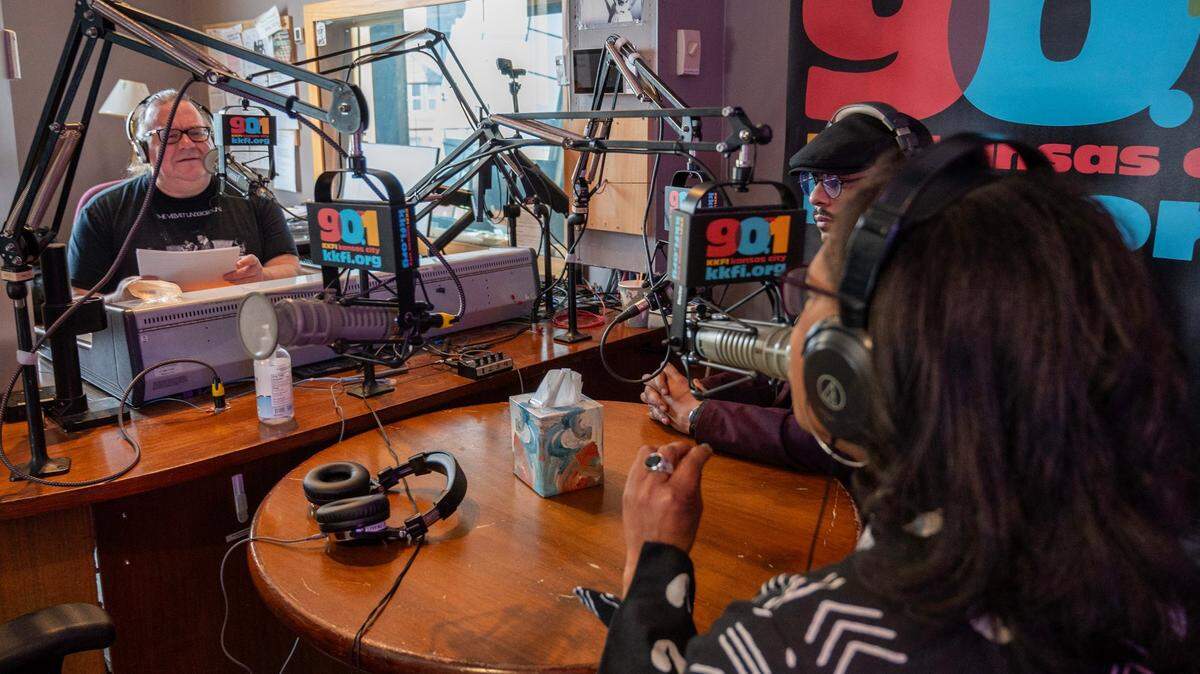
Kansas City’s independent volunteer-based radio station sees potential — in the artists it platforms and the communities its listeners call home.
Now, many of the voices uplifted on 90.1 FM over the years are speaking out against federal funding cuts that leave the station in a precarious position.
Like Kansas City’s NPR and PBS stations, KKFI will feel the impact of Congress’s decision to claw back more than $1 billion from the Corporation for Public Broadcasting.
Over the next two years, KKFI, Kansas City’s community radio station, will lose $170,000 in federal funding, or roughly 10% of its budget. The implications are broad, said Kelly Dougherty, the station’s director of development and communications.
“I’m not going to lie, it’s been tough trying to explain to people how this affects stations like KKFI,” Dougherty wrote in a message to listeners last week.
The Corporation for Public Broadcasting, or CPB, handles the music licensing agreements for noncommercial public radio stations like KKFI. The blanket licenses with performing rights organizations make it affordable for community stations to play music on the air.
“To negotiate those individually would be cost-prohibitive to many, many stations, and you know, it could very well be cost-prohibitive to us,” Dougherty told The Star, which has partnered with KKFI for the last three years to highlight the voices of Black Kansas City residents on the air and its website.
If KKFI were to lose that licensing, she said, the station’s programming could be limited and staff would have to undertake the demoralizing process of removing embedded music from archived shows.
That would be especially burdensome for a station with 85 volunteer-produced shows and just four full-time employees.
“People go, ‘If it’s all volunteer, why would you cut programming?’ Well, if you can’t afford to play certain kinds of music,” said Steve Tulipana, a performer who runs three Kansas City music venues.
“It’s flabbergasting and more than that, it’s infuriating why this is happening,” Tulipana said of the cuts. “A lot of it seems without any rhyme or reason. It’s just slash and burn.”
Emergency broadcasts
KKFI doesn’t have hard data on how many people tune in. The Nielsen Ratings are too expensive for the station to afford, Dougherty said.
But the 100,000-watt tower broadcasts its signal for roughly 80 miles, meaning it’s capable of reaching more than 2 million people, she said. The listenership includes people in the heart of Kansas City, but also many in rural areas where other FM stations have no signal.
That turns KKFI into a vital function when severe weather is bearing down on communities. For non-commercial stations, CPB is also responsible for funding the emergency warning system.
“All of that comes through community radio, through public radio, NPR, warning people about tornadoes and flash floods and things like that,” Doughtery said.
If funding cuts drive smaller stations off the air, people in remote areas would be left without that critical safety net when other communication channels are down, she said. “That’s really scary.”
Getting a break on KKFI
About 80% of KKFI’s programming is devoted to music, Dougherty said. Its offerings run the gamut from blues and jazz to hip-hop and world music.
“We play a lot of local, and we play a lot of people that tour, and when I say tour, I’m talking about they’re doing the little bars here and there and all of that,” Dougherty said. “So giving access to musicians and to community — it’s basically, access matters and that’s what we’re about.”
Many Kansas City area artists now touring the country got their start on KKFI.
“Giving local artists a place to showcase their music and get it in front of listeners of the radio station is a big opportunity,” said Ernest Douglas, known professionally as O.M.E., who helps manage the Unlabeled Music studio in Westport.
Not everyone understands the value of potential in emerging artists. KKFI does, according to Madisen Ward and the Mama Bear, a mother-and-son folk duo from Independence that has gone on to tour internationally and on major televised programs including “Today” and “BBC Breakfast News.”
“In the early days when an artist is probably at their most vulnerable, KKFI can help guide that artist into the professional world of radio in a way that’s comforting and helps to build confidence,” the band said in a message to The Star.
“When you hear your music played on their station, it shows us local artists what’s possible, and gives us the fuel to keep going.”
Community programming
KKFI’s public affairs coverage is also geared towards elevating perspectives that aren’t often centered on other platforms.
“You’re talking about ‘Heartland Labor Forum’ and you’re talking about the ‘People Power Hour,’ which is the KC Tenants Union here that has been helping people stand up against slum lords basically,” Dougherty said.
“Cowtown Conversations” delves into local social, political and everyday topics from property taxes to aging.
Congressional Republicans who led the charge to cut public broadcasting funding railed against stations that they said have been weaponized for political purposes.
“For us, this is not a right or left thing. It’s a civic thing,” Dougherty said.
KKFI highlights important work being done and publicizes community engagement opportunities, said Malek Azrael, an artist who has performed on KKFI. Underserved communities stand to lose if programming is scaled back, Azrael said.
“So you’re essentially taking more resources away from, especially the inner city, 18th and Vine district. It affects every community that needs that kind of voice,” Azrael said.
KKFI’s summer pledge drive is scheduled to end Thursday. Dougherty said they’re not planning to extend the fundraising effort, although they always accept donations.
“Our sister stations — KCUR, The Bridge, Kansas Public Radio — they’re all kind of doing little fundraisers as well. We’re very concerned about taxing our listenership,” she said.
KKFI staff and volunteers are well aware of the fact that many of their listeners don’t have much extra money to spend, Dougherty said.
“That’s why this is even more important to make sure that they have access to music, they have access to information that we can share.”
This story was originally published July 24, 2025 at 1:28 PM.