
Foxes are seen in Johnson County yards. Should homeowners worry for kids, pets?
.jpg "Foxes have been sighted this week in Overland Park neighborhoods as male foxes are out teaching their offspring how to hunt. Are foxes threats to children and pets?")
Homeowners who call the Johnson County K-State Extension office in Olathe after they’ve seen foxes in their backyard are often more worried than charmed by the frisky little dog cousins with soft, bushy tails and big, puppy-like eyes.
They don’t want foxes hanging around. They have kids. They have pets. What should they do, they ask.
If they chat with Amy Keigher, natural resources agent for the extension service, they might find out she’s a little jealous that there are neighborhoods in Johnson County that are hosting foxes right now.
Just this week in Overland Park, foxes have been spotted sitting on driveways in the early hours of the morning and lazing about in lush backyards in the afternoon.
Having a family of foxes move in is a good thing, Keigher advises worried homeowners.
Compared to other wildlife that call Johnson County home, foxes are considered to be some of the friendliest and most entertaining.
And, Keigher points out, they provide free natural pest control since they prey on rabbits, rodents, insects, squirrels and other animals considered pests by suburban dwellers.
K-State wildlife specialist Drew Ricketts will teach about foxes at 6 p.m. Sept. 22 at the extension office, 11811 S Sunset Drive in Olathe.
Before that, he’ll talk about bobcats at 6 p.m. Monday, also at the extension office.
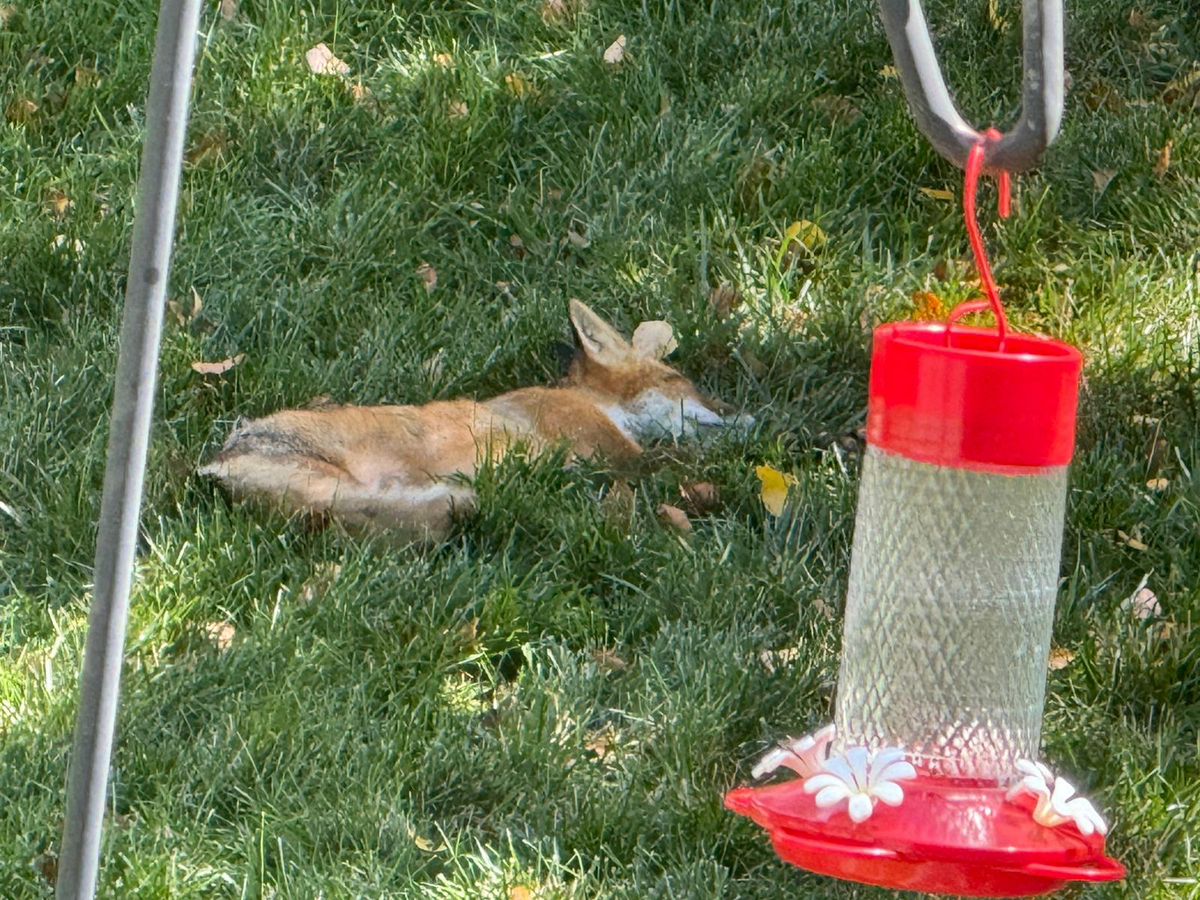
It’s that time of year when the pups — also called kits — have left the den and are out basically learning how to be foxes.
“The pups are starting to spend more time outside of their den,” said Keigher. “The male most of the time is the one that will go out and get the food.
“But right around mid-July and August, that’s when they start spending time teaching their young how to hunt, how to do different survival skills. So that’s kind of where we’re at right now. They’re spending a lot of time outside of the den and they’re going to start practicing hunting.”
The red fox is the most common species on both sides of the state line in the Kansas City area, a population that biologists say has been stable for quite a while, according to Keigher. “They’re pretty common, a lot more common than people think,” she said.
Foxes are loners, solitary creatures that get busy making families during winter breeding season and have litters at the end of March or early April.
Litters generally consist of four to six kits — who are born blind and deaf — and both parents will stay with the young until they are ready to be on their own in the fall.
“Right around the end of September, that family unit should start to break up,” Keigher said. “If they have male pups, they’ll leave first, but sometimes the females will stick around to help the next litter, but not always. So we’re kind of getting closer to the end of it.”
So “definitely enjoy it,” said Keigher. “They’re common but not everyone gets to watch them develop and grow. It is special and the negatives that are built up in your mind, they really aren’t as huge as you think they are.”
A threat to pets?
People who call Keigher’s office with concerns about foxes often “have a smaller pet that they’re worried about. But one of the things about foxes is that they themselves are very small,” she said. “They look bigger because they can be so fluffy, but they’re really only seven to 15 pounds. It’s very small.”
So foxes typically won’t go after anything larger than a cottontail rabbit, a two-to-three-pound meal. Household pets are usually safe, though wildlife experts recommend supervising kittens and toy-sized dogs when they are loose in the backyard.
“Now, not saying there’s absolutely no risk of foxes ever attacking a small dog or a cat,” Keigher said. “It’s just too risky for them to go after a small dog because all it takes is one bite from a dog — even if they’re able to kill the dog, then that one bite likely will turn into an infection and it will likely kill them.
“So they just weigh their options. It’s easier to kill rabbits or squirrels without getting injured than it is to go after people’s pets.”
Foxes are nocturnal and start getting active about two hours before the sun sets completely and darkness falls. Keigher said. “So during the day, honestly, you’re fine because foxes shouldn’t be out and active,” she said.
But at night?
She has a six-pound chihuahua and never lets him go out at night alone, “especially for extended periods of time,” she said.
“For me, though, it’s not that I’m thinking about foxes. I’m actually thinking more of, little dogs have been attacked before by raptors — owls, hawks, that kind of thing,” she said. “And we also have coyotes ... coyotes happen to be a little bigger, so they can handle a little six-pound chihuahua.
“But just you being out there watching is enough to usually keep foxes away.”
Foxes generally don’t like people. “They’ve gotten used to people enough that just being near someone, like being in someone’s backyard, isn’t enough to scare them,” she said.
“But if you actually went out there and started approaching it and expected it to come over for a little pet and cuddle, they’re most likely not going to do that. Generally just a person being present is enough to keep them away.
“Now, I will say this. The problem we have with little pets, not just little pets but pets in general, if there’s a fox den in a backyard, dogs are very inquisitive. They’re likely going to go over to the den and check it out. Maybe they’re going to bark and growl. Maybe they’re going to try and go in there.”
That kind of situation can cause drama, she said.
“If a fox is in the den, especially if it’s early enough in the summer ... and the pups are still kinda confined to the den and the mom’s in there, I mean, yeah, she’s going to defend the den, especially if something’s right there and they’re trying to come in and growl and all that stuff,” she said.
“So trying to create some sort of barrier so your pets can’t have access to the den, but the foxes can still come and go, that will save a lot of the drama that comes along with having foxes in your backyard and having pets.”
Do foxes harm children?
That’s the same scenario that could cause a confrontation between a child and a fox.
While it’s rare for a fox to bite a human, wildlife experts say better safe than sorry.
“So kids, again, should be absolutely fine playing in the backyard unless they go around that den, if there’s a den,” Keigher said. “They go there and they start messing with the den, that’s when they likely could have something happen.”
Parents can place an obstacle near the den to keep the kids away, she said. “Or you clearly mark it and tell them, ‘Hey, do not go over there. Leave it alone.’
“If they’re younger children, you should be keeping an eye on them regardless, but just make sure that they’re not messing with the foxes. Normally kids playing outside, they’re so loud and rambunctious that foxes won’t go over there.
“And again, the children are too large to be thought of as prey. Foxes aren’t going to go over there and eat the kids.
“You don’t want your child to get bit by a fox. But more than likely the child’s going to get bit by a fox if the child is going in there and messing with the den and the fox feels trapped.”
The more likely scenario, Keigher said, is that the fox will turn tail and run.
“Honestly, at the age that they’re all at, if you were to go over to where the den’s at, you might hear them growl. But if you were to really engage with them, they’d likely, their first (instinct) would be try to run away,” she said.
“They’d bolt ... a last-ditch effort of survival would be to attack, especially if it’s an adult. But even with a child ... they’re thinking ‘I’m going to get killed here and I’m going to try and survive any way I can.”
Foxes aren’t typically squatters
Often, foxes build their dens in old, abandoned groundhog dens, marked by a mound of excavated soil next to the entrance hole.
“It doesn’t have to be dug out in the ground. They’ve been known to use, if there’s a little shed that they can get into that’s kind of trashy and it’s got good cover, they’ll use that,” said Keigher.
“They’re not afraid of using whatever they can find as long as it provides good cover and they can kind of hide away in it. But normally it’s old dens from other animals, like groundhogs.”
People have also reported foxes living under their decks, she said.
“I will say this, foxes will usually use a den, the same couple will use a den maybe twice, three times,” Keigher said. “So like three years. But after that, most of the time they move on.”
Homeowners who decide they’d rather not have foxes living with them usually don’t like the idea of euthanizing them, she said. But trapping and relocating them is not easy.
“The problem is, especially during pup season, if you’re going to go in there and try to live capture them and just move them somewhere else, it’s really hard to trap foxes, especially when there’s a family unit like that and you’re trying to get all of them,” Keigher said..
“Most likely, you’re going to end up getting one or both of the parents, but not the pups. Or you’re going to have to trap them separately and then the logistics of trying to keep them together in one new area is difficult.
“And then on top of that, just in general wildlife have a very low survival rate when they’re moved. And it’s because, almost always, these are territorial animals and you’ve just likely moved them into someone else’s territory.
“They don’t know where any of the resources are at. And, they want to get back to their territory. So raccoons, but also with foxes, they’ll do almost anything they can to get back there, even if it means traveling in the wrong direction until they just keel over and die or they get hit on the road by a car.”
The other thing to keep in mind, Keigher said, is that once you remove an animal from your yard, especially if its territorial, “you’ve just opened up that territory and another one is most likely going to move in.
“And in the case of foxes and coyotes, particularly coyotes, you may get rid of a coyote that’s not that big of a problem and you may get another one filling that territory that is going to be a problem. You may be making it worse. You don’t know what’s coming.”
So Keigher’s bottom line with foxes?
“It’s so cool just to see that in your backyard,” she said. “I want that in my backyard even though I have a little dog. And once you understand that they don’t really pose much of a risk, just let them be and enjoy it.”
.jpg)