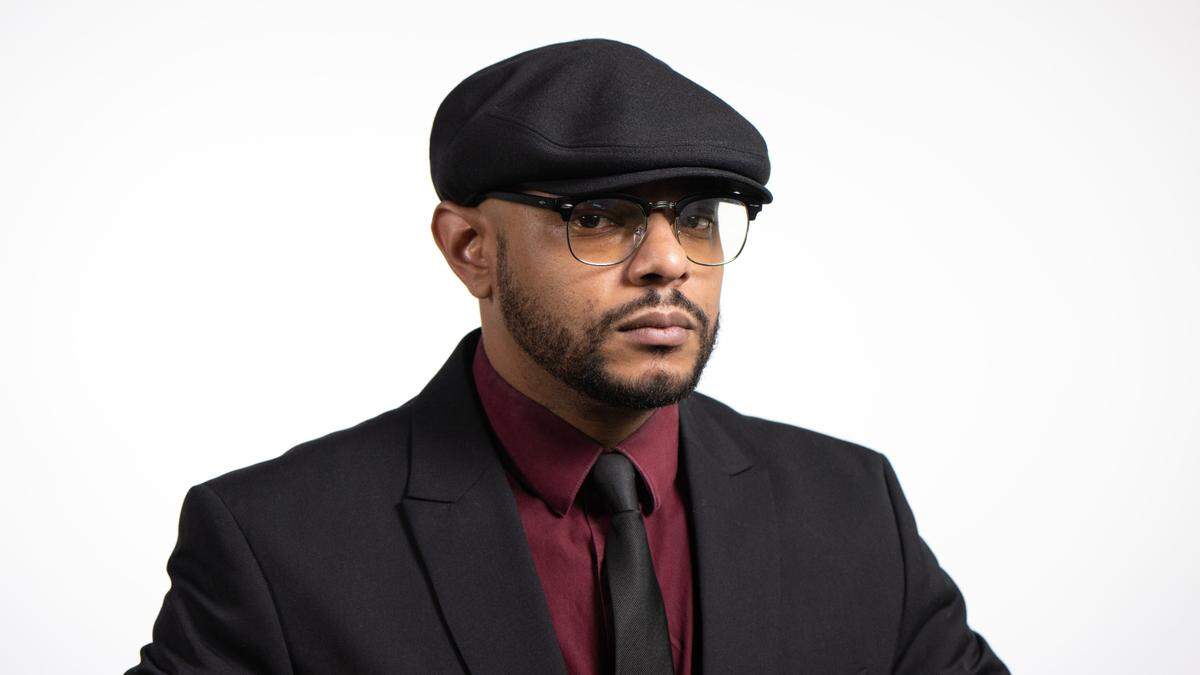
From Broadway to KC: Local costume designer directs “Macbeth” reboot, hip-hop style
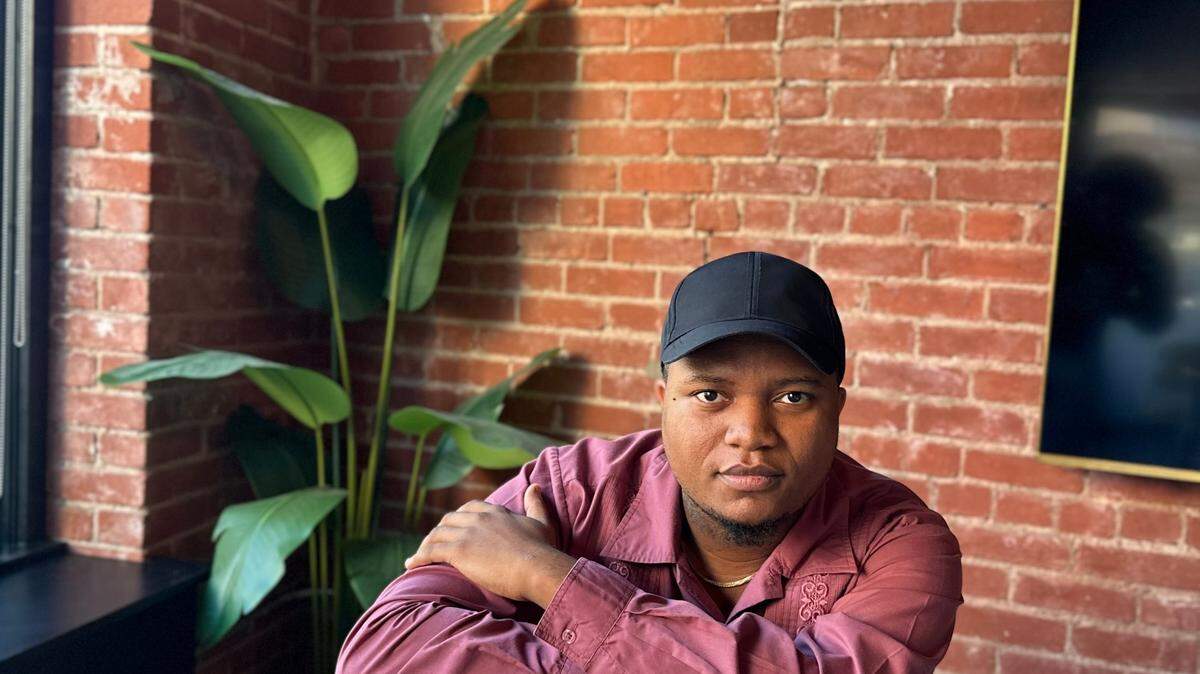
Keyon Monte’s journey through the world of theater has been shaped by persistence, reinvention and a deep love for storytelling.
From his early days immersed in music, fashion and visual arts at Paseo Academy of Fine and Performing Arts, his creative path has never followed a straight line. After spending time freelancing as a designer in New York and sketching costume ideas for Broadway productions, his return to Kansas City during the pandemic marked a turning point that brought new purpose and creative clarity.
Back home, Monte began creating portraits during the Black Lives Matter protests, reconnecting with his artistic voice outside of the theater. But it wasn’t long before the stage called him back. After receiving a fellowship grant from the Broadway Black Theatre Coalition, Monte, 28 will make his directorial debut, producing a radical, immersive reimagining of William Shakespeare’s “Macbeth.”
Set in a post-apocalyptic world where hierarchy and survival mirror the brutal ambition of Shakespeare’s original, Monte’s “Macbeth” brings a fresh and raw play. It draws on high fashion, hip-hop aesthetics, fused with futuristic decay to create something Monte hopes will help push urban theater in Kansas City to explore and experiment.
Monte sat down with The Kansas City Star’s culture and identity reporter, J.M. Banks, to talk about finding his passion for theater, his time in New York working on Broadway and making his directorial debut producing his first stage production.
Banks: How long have you been involved in theater and what first got you interested?
Monte: I’ve been involved in theater on and off since middle school. When I started at Paseo my major was technical theater, but I was involved in everything. I would be in the band room with the music students, in the fashion department working on costumes, in visual arts drawing and painting, and in productions performing. Teachers would tap me for different projects. I was everywhere. It was a very free and creative time.
What drew me in originally was Disney. I was a huge Disney fan and wanted to be an Imagineer. Then my family took me to see a touring Broadway production of “Beauty and the Beast” and I was blown away by the costumes, the creativity, how they turned inanimate objects into characters. That was it for me, I fell in love with Broadway, musical theater and storytelling.
As I got older, especially in college, I got more into straight plays and experimental theater. So it started with childlike imagination and evolved into telling more nuanced, sometimes darker, stories.
I went to the University of North Carolina School of the Arts. There, you had to choose one focus, I couldn’t double major. I wasn’t confident in my acting at the time, so I decided to study costume design, thinking it could still lead me to performance later.
It was a conservatory program, so super intense. I had no time to do anything else. Honestly, I often felt like I was failing. It was tough, but it was still a good experience.
Now, I freelance as an illustrator for designers on Broadway and off-Broadway. They hire me to sketch out their ideas and that’s how I make a living.
I’ve also been on a fellowship with the Black Theatre Coalition in New York and that’s how I’ve been able to fund this current project.
When did you decided to go to New York and how was that experience?
I went overseas and worked as a costumer on a cruise ship in Greece.The cruise ship has several shows happening at once, sometimes five at a time. Each show might have 50–60 costumes that I as the costumer was in charge of maintaining.
Each show rotated throughout the week and it was my job to keep all the costumes in top condition. We’re managing hundreds of garments. It was a lot.
Next was New York City. I had a mentor who asked if I’d come help with a project. At first, I wasn’t sure because it was only a month away. Luckily, my godmother sent me $225 for my birthday and I used that to buy a one-way Spirit Airlines ticket to New York.
I couch-hopped a lot. I couldn’t keep a steady job that paid well because I was freelancing and still learning how to navigate everything. I lived in places like Inwood and different parts of Brooklyn, Flatbush, for example. I moved a lot, lived out of one suitcase.
I was making $180 a week. That barely covered a subway pass and the rest I spent on food, clothes, and occasionally a Broadway ticket, because I still wanted to see shows. That was my life for about eight months until the pandemic hit. When it did, my mom, who had no idea I was living like that, bought me a ticket home and said, “You’re coming back right now.” And that was that.
After you came back to Kansas City during the pandemic, what was that time like for you, work-wise?
I didn’t work in the traditional sense. I lived with my mom and started doing portraits. It was during the Black Lives Matter uprising and I wanted to contribute somehow. I started offering free portraits for Black people as a way to show solidarity and raise awareness.
It became a black-and-white portrait series, with each image accompanied by a question or personal statement. That series really helped me build and strengthen connections locally. From there, I kept creating more and more art.
But I didn’t get back into theater, at all, until now. I was sitting on the balcony one day and prayed.
Not long after that, I got the idea for my play, “Ni--er Heaven.” That play has done more for me than anything else I’ve worked on. We’ve been workshopping it in New York and we’re heading back to do more in August. It really brought me back to theater in a big way.
It’s based on a photograph from 1942 of a man named Edward Atkinson, taken by Calvin Facton. It’s a three-act play, and it’s really propelled my return to the stage.
How has it been working with the local theater community since your return to Kansas City?
I had mostly stayed away from the local arts scene, but now that I’ve put down roots, got my own apartment, I’ve started getting involved again. I’ve shown my visual art in a few galleries, but this production of “Macbeth” is really my debut as a theater director in Kansas City.
What inspired you to reimagine “Macbeth” as an immersive, urban, dystopian, post-apocalyptic experience?
There’s a co-working space called High Coworking KC. They moved into this big, old, somewhat abandoned building downtown. It was once a factory, then an office space. I got an office there and so did Damron Armstrong (founder of The Black Repertory Theater of Kansas City.) He was rehearsing on the first floor, a space that’s always been vacant.
I sat in on one of his rehearsals and thought, “This would be a great place to stage something.” The ceilings are low, the carpet’s dingy, it doesn’t scream theater, but when it gets dark it transforms.
I knew I wanted to direct something and Shakespeare was the obvious choice. I was getting my glasses and the woman helping me mentioned she loved “Macbeth.” She started telling me about the play’s themes and Shakespeare’s intent and it all clicked.
As a costume designer, I was excited by the creative challenges like the ghosts, witches, supernatural elements, mental breakdowns. I thought, “How can I stage this in a fresh way?” That got me thinking of how do you maintain the stakes of kingship without going medieval?
I realized that if we set it after nuclear fallout, society would return to something primal and tribal, just like early Scotland. The setting allowed us to explore power, hierarchy, and survival in a way that honored the original play. Visually, I was inspired by things like Rick Owens fashion shows and YEEZY (a fashion brand founded by rapper Kanye West) concerts, those dystopian, high-concept aesthetics. That became the look and feel for “Macbeth.”
What’s been the timeline from conception to performance?
We’ve been working on it actively since May, but I started planning in April. So it’s been about three months of work. Everyone involved has lives, jobs, other projects, so I understood early on that this had to be flexible.
Shakespeare is tough, not because it’s impossible, but because it seems intimidating. So I gave myself enough time. Thankfully, I did, because some people had to leave town or take on other commitments. Giving actors that flexibility was important. Most of the people helping with this are volunteering their time.
With the themes from the play focusing on ambition, power, and fate, how do you envision weaving those elements into this futuristic world you’re creating?
For me, “Macbeth” isn’t just about Macbeth as a man. In my interpretation, he’s a character we see again and again, each person in the play represents a different version of Macbeth. I think every human being has a bit of Macbeth in them. That’s what I love about the play, it tells the truth about human nature and how we constantly steer toward chaos throughout history.
There’s a cyclical loop in “Macbeth” that keeps repeating, like he says: “Tomorrow and tomorrow and tomorrow creeps in this petty pace from day to day.” I wanted to emphasize the idea of this endless spiral, violence, ambition, greed, madness, that has existed since the first man and will exist until the last.
That’s where the post-apocalyptic, futuristic world comes in. Yes, it happened in medieval times, but it can also happen again in the future. The play starts and ends in similar ways, with characters returning to the same positions.
By the end, Macbeth has gone mad. That final fight between Macbeth and Macduff is almost like a video game. There’s a “Round One” feel to it. Macbeth has reached a point of apathy. He realizes it doesn’t matter what anyone does. It’s bleak, but it reflects something honest about who we are.
How are you reshaping the characters of Macbeth and will there be any deviations from the the source material?
We haven’t changed a word of Shakespeare, aside from a few cuts for length. I believe his words are universal, they can apply to any person. For me, it’s more about what Macbeth looks like. Once you figure out what he looks like, the story comes to life.
His heart and ambition can live in any man, so we’re not reshaping him to fit a racial identity. Racism doesn’t really exist in this world the way it does now. Yes, it’s still Scotland, but it’s clear that the people now living in what used to be Scotland look very different, it’s the last remnants of humanity.
But I don’t change Macbeth’s character to reflect myself. I focus on how he presents visually, his fashion and his presence. Characters like Ye (Kanye West) or fashion designers like Rick Owens inspire Macbeth’s look. The script describes him as flashy, materialistic, greedy, so I dress him in chrome on chrome on chrome. There’s a hip-hop edge to him, which fits naturally.
What was the most difficult part of those months of planning and rehearsing, and what was your favorite part?
The hardest part was maintaining faith that it would all come together. When you’re creating something new, you’re constantly fighting inertia. There are always obstacles. But trusting that those obstacles will resolve themselves, with a little push, was a challenge.
Also time management. That’s the biggest challenge. I do beautiful work when I can sit down and focus, but when deadlines overlap or schedules shift, it gets really tough. I’m still learning how to manage my time better, it’s a constant battle.
My favorite part has been watching things come to life. When you plant a seed, do the labor, and then see the harvest, it’s beautiful. You know you did the work to make it happen, but you’re not the one making it grow. Watching actors have breakthroughs, or seeing a scene finally click, or when they take your direction and begin to build something even greater within that framework, those moments are magical.
How has the grant you received through the Broadway Black Theatre Coalition fellowship assisted in bringing this production to life?
Having that support is the greatest gift. So often, projects don’t get off the ground because of lack of funding. But this grant allowed me, for an entire year, to stop worrying about bills or whether I could support myself and the people working with me.
Now I understand why Renaissance artists did such amazing work, they were funded by the church, or lords and they had patrons. That kind of support makes all the difference.
What do you hope audiences take away after seeing this production?
I hope they feel exhilarated. I hope they leave with a renewed appreciation for what Kansas City artists can do. I want it to open doors, not just for me, but for the cast and crew, so we can do this again and again, even if I’m not directing.
That means there’s an audience for this kind of work and that theater created by people who look like me can be a priority in this growing city.
What are your future plans and goals for your work?
I will be working on getting “Ni--er Heaven,” off the ground. That would be amazing. I’ve thought about doing another Shakespeare piece, or maybe something completely different. But to be honest, I want to go to sleep and just take some time to relax and unwind.
For more stories about culture and identity, sign up for our free On The Vine newsletter at http://KansasCity.com/newsletters.