Will bell toll for KC’s historic Loretto tower? Owner seeks to take it down
It is rotting. It is teetering. The question now is what to do with it.
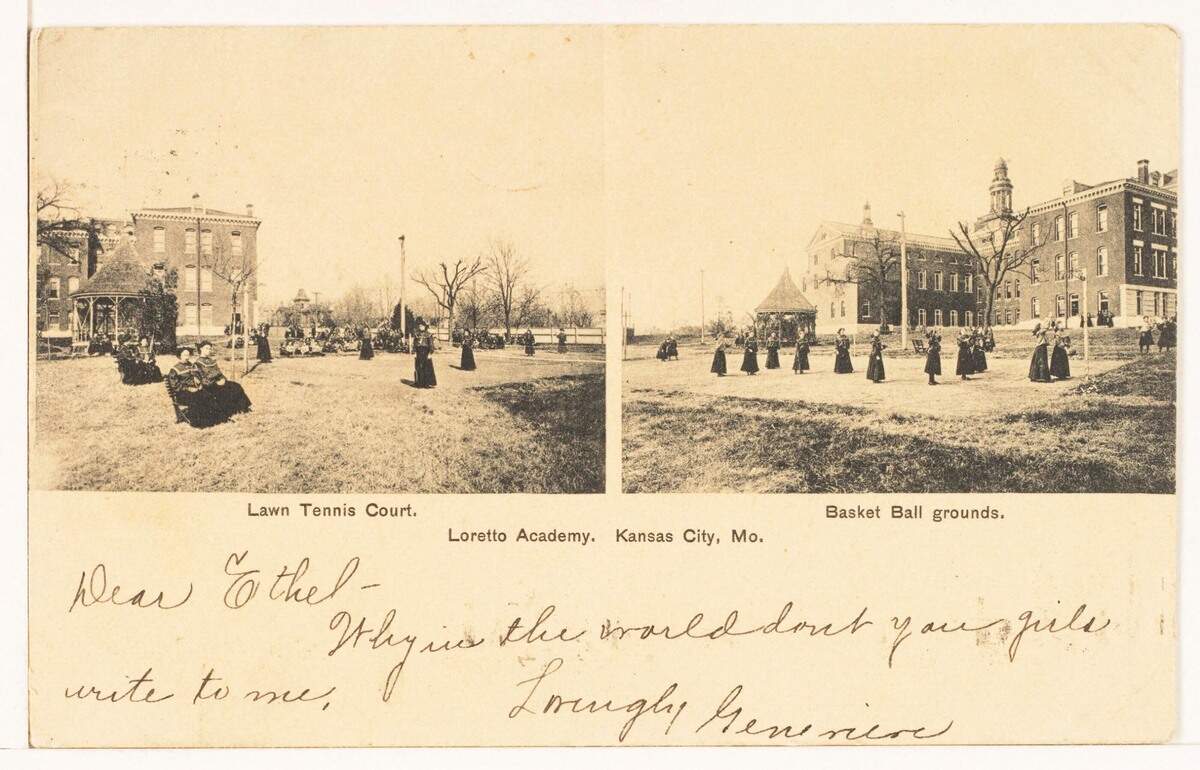
For 122 years, a 40-foot-tall bell tower, with its 12 classical columns, has stood atop the Sisters of Loretto Academy, a former Catholic school for girls at 1111 W. 39th St., that is now an event space and apartments.
Since 1983, the 1903 building has been listed on the Kansas City Register of Historic Places.
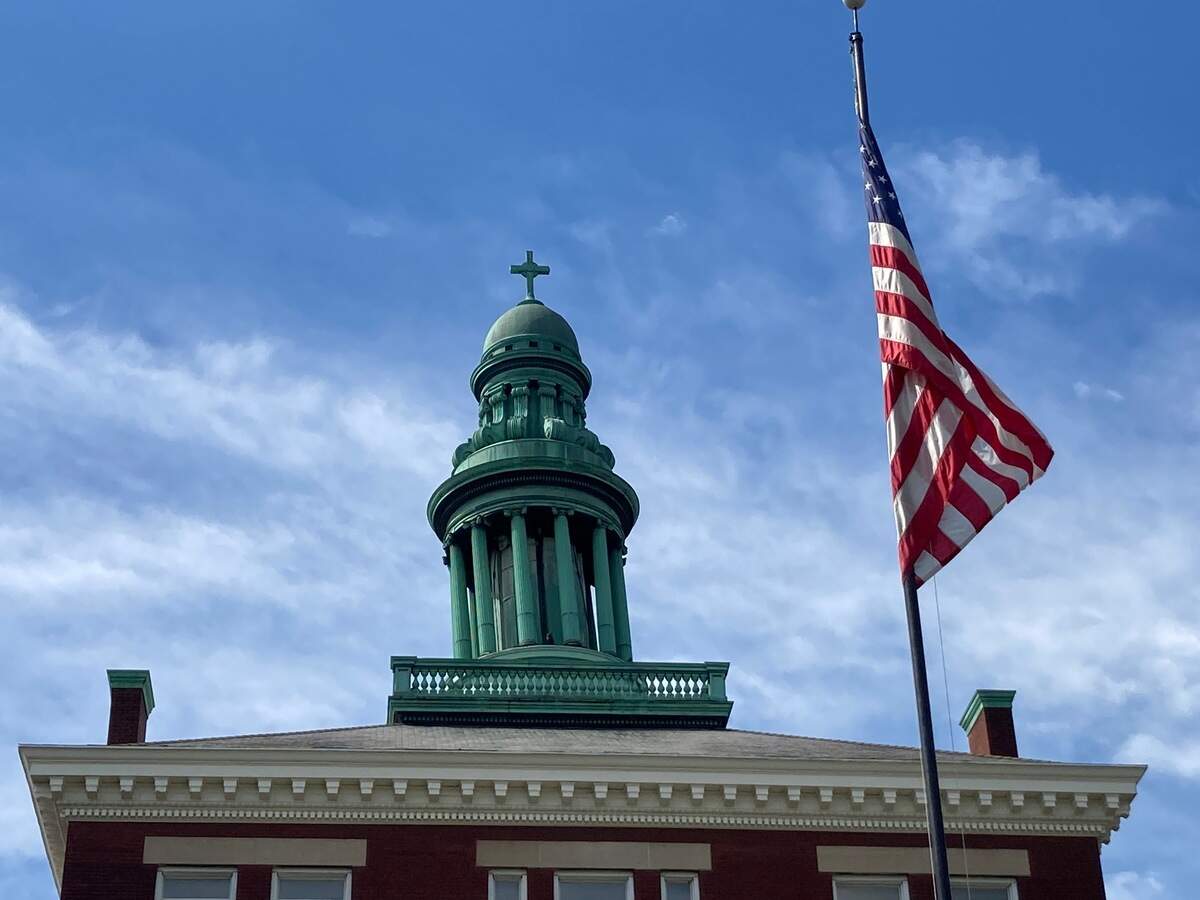
Weather and time has taken its toll on the structure — it currently leans precariously some 15 inches to the east — that in June, the owner of the building, Del Hedgepath, placed the bell tower before the Kansas City Historic Preservation Commission requesting a certificate of appropriateness to remove the tower and perhaps permanently display it below, on the Loretto grounds.
“I don’t want to take it down, but it’s been deemed dangerous, so it needs to come down. It can’t be repaired in place,” Hedgepath told The Star shortly before the commission was scheduled to meet on June 27. “It’s actually 40 foot tall, the height of a four-story building. I’m a preservationist, but there has to be safety before preserving.
“Hopefully it can go back up. But, at the moment, my time and energy is focused on the safety aspects, so it need to come down.”
Sisters of Loretto Academy
Hedgepath later canceled his appearance before the city, with a plan to reschedule. The commission next meets on July 25. But the issue of the tower’s long-term fate remains, with neighbors, Loretto residents and preservationists strongly against the tower’s permanent removal.
“I am totally opposed,” said Glenn Stewart, a Volker Neighborhood Association board members who has lived at the Loretto for almost 20 years. “There is no evidence that the current owner has done anything for repairs. Until there have been inspections, estimates and actual work, it makes no sense to move an historic fixture.”
The association’s president, Amanda Butler, who lives across from the Loretto called the building “the crown jewel of our neighborhood.”
The building’s history goes beyond its age. In a 1956 article, The Kansas City Call cited the Loretto Academy as Kansas City’s first racially integrated parochial school, admitting its first Black student in 1947, eight years before the landmark Supreme Court decision in Brown v. Topeka Board of Education ruled segregation in the nation’s public schools to be unconstitutional.
Butler, in a two week period, has garnered more than 570 names on an online Change.org petition titled “Save the Loretto Bell Tower,” asking for the tower to be repaired and preserved atop the building.
“We’re asking for either repair, restoration or replacement if it’s not salvageable,” Butler said.
Hedgepath, who has experience with the adaptive reuse of historic buildings, turning them into lofts, said he is unsure if the tower can be put back in place. His company, Del Properties, controls buildings that include the Norman School Lofts, 3514 Jefferson St.; Congress Lofts, 3535 Broadway Blvd.; the Buick Lofts, 220 Admiral Blvd.; the Historic Karnopp, 4301 Main St.; and others.
“There’s about a dozen historic properties that I’ve proudly preserved and placed back on the rent rolls,” Hedgepath said. “I’ve spent lots of money on the historic preservation of the Loretto. But this cupola. . . . I just can’t turn a blind eye and let it blow over and hit somebody on the head.”
Historic preservation
As part of his application, Hedgepath has included a general overview, a “preliminary condition assessment,” by Apex Engineers, Inc., of Kansas City, which describes the tower as “a wood-framed structure covered with decorative sheet-metal cladding.”
The overview notes “fungal decay” of the wood framing.
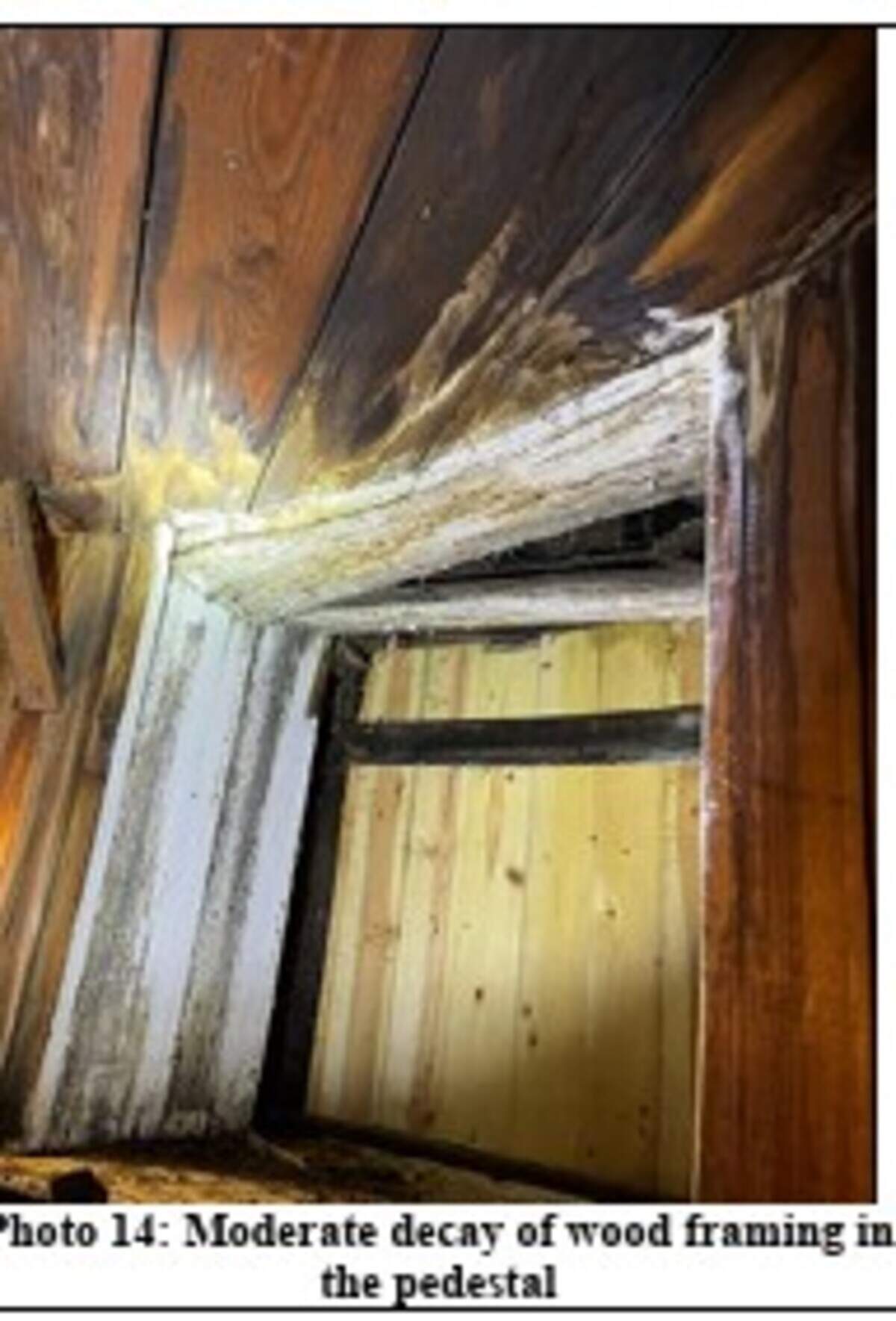
It said the tower is “visibly out of plumb,” leaning as much 15 1/4 inches. The structure is being largely held in place by six tension rods that were likely added later for stability, and four of which “are no longer under tension” and could be easily moved.
Given its condition, the report said, “it appears that the bell tower structure is at significant risk of catastrophic failure, including partial collapse, complete collapse, or separation from the supporting roof structure.”
The April report’s final recommendation: “Due to the serious nature of the risk presented by the failure of the structure, it shall be removed from the roof or repaired as soon as is reasonably possible within a maximum of six months of the issuance of this report.”
The report included photographs, showing the structure’s tilt and decay.
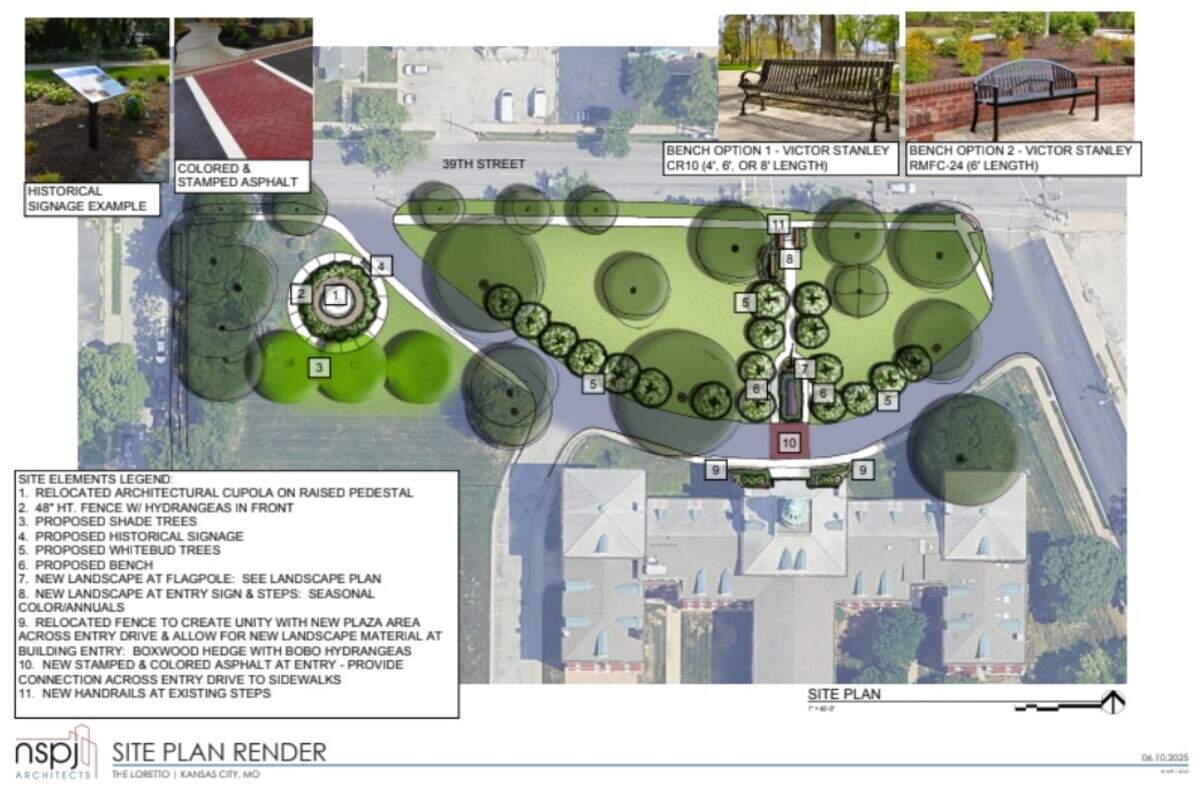
Hedgepath’s submission also includes renderings of a landscape plan, produced by NSPJ Architects of Prairie Village, whereby the bell tower would be placed on a raised pedestal on the grounds of the Loretto instead of replaced on the roof.
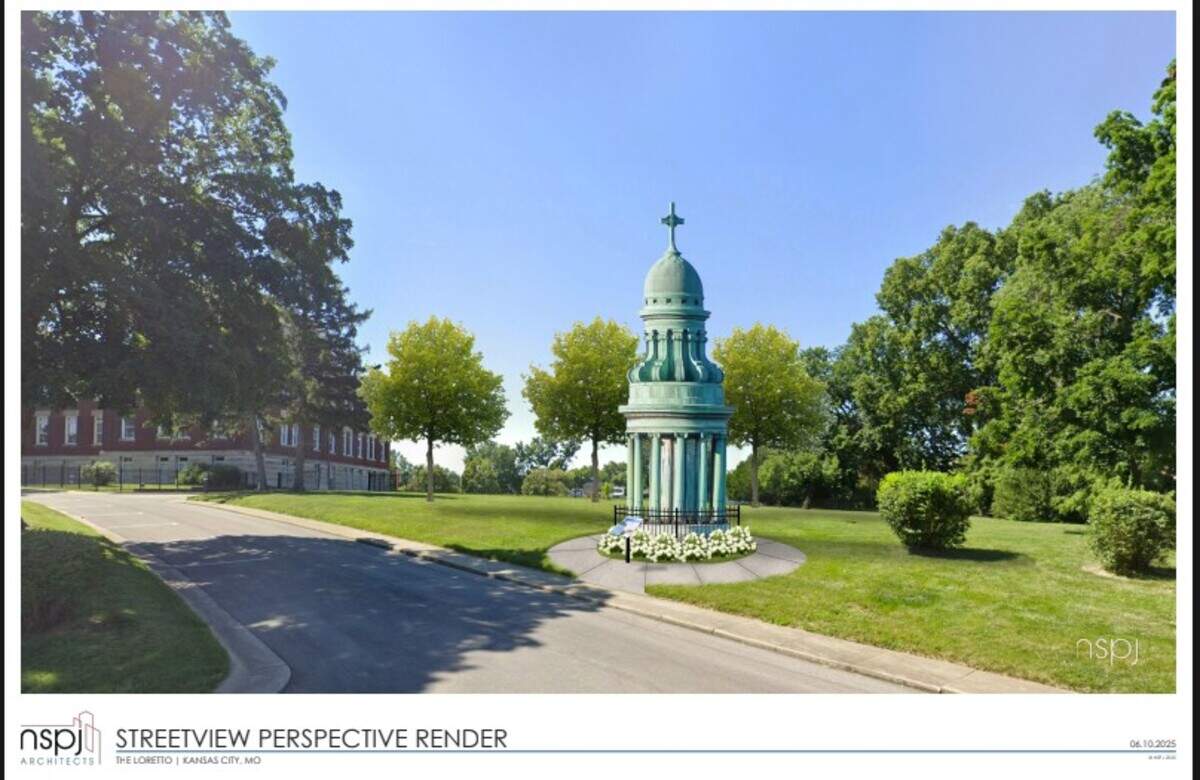
“If the cupola can’t be preserved and rebuilt and put back,” Hedgepath said, “the next best thing is to find, you know, a garden bed somewhere on the property, and it can be showcased that way.
“But that’s not a done deal. It kind of depends on what kind of shape it’s in. I’m a little bit concerned that once the darn thing is lowered from the building, down to the ground, it could be in 100 pieces, or could be rusty and dangerous and full of holes. I just don’t know.”
Because the Loretto is on the Kansas City Register of Historic Places, any significant changes to the exterior must first go before the Kansas City Historic Preservation Commission. If a certificate of appropriateness is not granted, that decision can be appealed if the case is made based on economic hardship.
In assessing Hedgepath’s proposal to remove the tower and place it in a landscaped area, the Historic Preservation Office notes in a staff report that doing so would violate standards No. 2, No. 5 and No. 6 of the Secretary of the Interior’s Standards for Rehabilitation.
Standard No. 2 states: “The historic character of a property will be retained and preserved. The removal of distinctive materials or alteration of features, spaces and spatial relationships that characterize a property will be avoided.”
Standard No. 5 states: “Distinctive features, finishes, and construction techniques or examples of craftsmanship that characterize a historic property will be preserved.”
Standard No. 6 states: “Deteriorated historic features shall be repaired rather than replaced. Where the severity of deterioration requires replacement of a distinctive feature, the new feature shall match the old in design, color, texture, and other visual qualities and, where possible, materials. Replacement of missing features shall be substantiated by documentary, physical, or pictorial evidence.”
Ethan Starr, executive director of the preservationist group Historic KC said the standards set forth by the Secretary of the Interior are there for a reason. Although it is unclear what the cost of restoring the bell tower might be, Starr notes that Hedgepath could offset those costs by applying for federal and state historic tax credits.
“What we hope for all historic buildings and local landmarks,” Starr said, “is that they can be economically productive and remain the anchors of our neighborhoods and landscapes. In the case of the Loretto ... this is a success story of an apartment conversion that has already been celebrated. And we hope to see that success continue.”
This story was originally published July 9, 2025 at 6:00 AM.