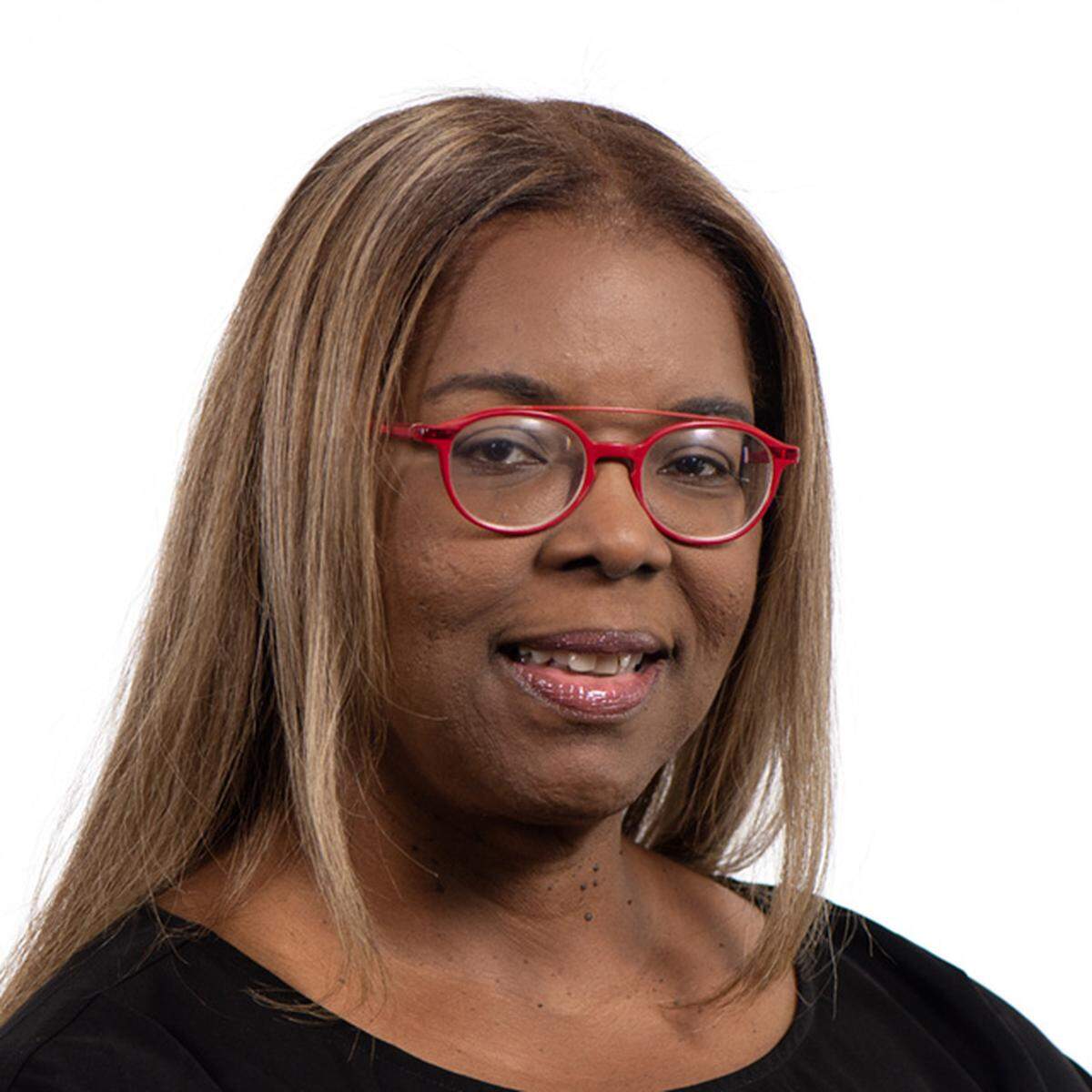
Tiffaney Whitt left criminal justice to foster change at Hope Leadership KC
This interview is part of the third season of Voices of Kansas City, a project created in collaboration with KKFI Community Radio to highlight the experiences of Kansas Citians making an impact on the community. All the episodes are available at the KKFI.org site https://kkfi.org/program/voices-of-kansas-city/ and listen to KKFI live on 90.1 FM, or at KKFI.org. Do you know someone who should be featured in a future season of Voices of Kansas City? Tell us about them using this form.
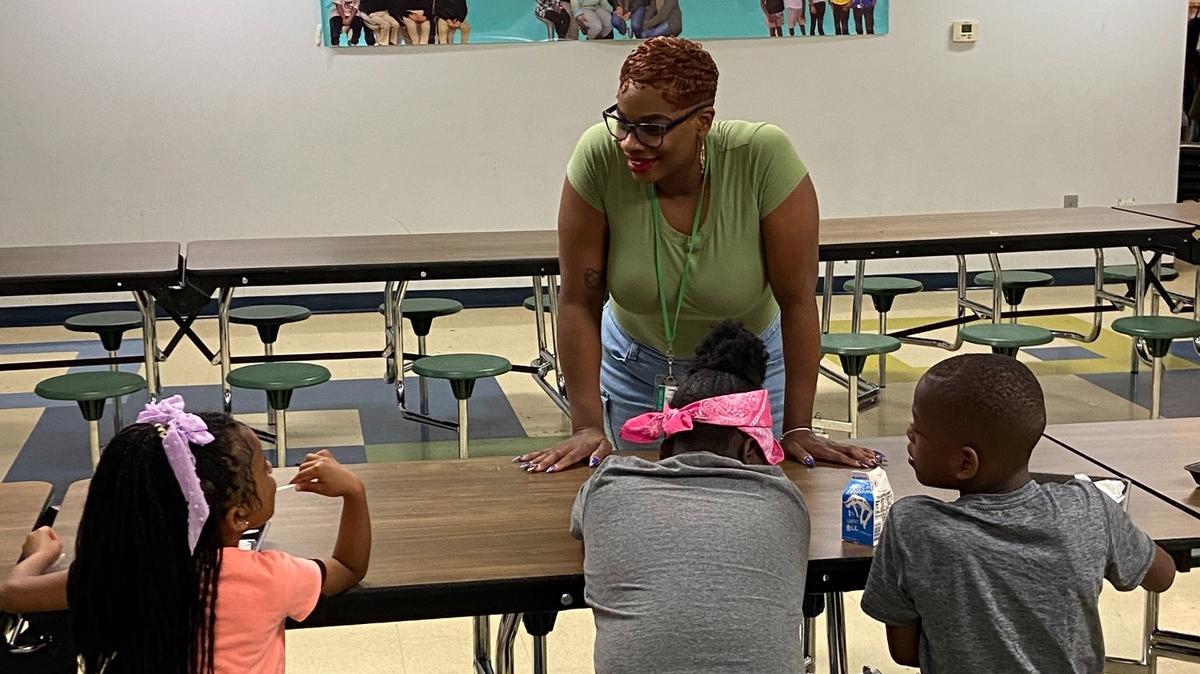
Yvette Walker, vice president and opinion editor at The Star was fortunate to catch Tiffaney Whitt, Hope Leadership Academy Executive Director, on the last day of school. Hope Leadership is a Kindergarten through 5th grade charter school on 28th and Linwood. Observing her interaction with the younger levels at lunch and on the playground, it’s evident that Whitt is a born leader and teacher. She’s like a magnet to the students, who are attracted to her brilliant smile and bubbly personality.
Whitt, who started in criminal justice but has worked in the Kansas City School district, wants to model the behaviors of love of learning, confidence and professionalism to her students.
The Star invited Whitt to join us in the studios of KKFI radio station where she spoke to Walker about her background, plans for the future of Hope Leadership, and what she wants for her students. That interview, with minor editing for space and clarity, is published here in a question and answer format to share Whitt’s authentic voice.
Meet Tiffaney Whitt:
Yvette Walker: It was so good to see you with the students and also with staff on the last day of school. And so there’s definitely a relationship that you’ve built with them. The kids were hugging you. They were so happy to see you. And I’m sure they’re happy for summer, but they also seemed like they were going to miss school just a little bit. Here’s an interesting fact: When you came to Hope Leadership Academy, you told me that the school didn’t look like a school.
Tiffaney Whitt: Right. Three years ago, I moved into the community and did not realize that it was a school. I worked in the Kansas City Public School district, and I worked right down the street at Central Middle School, so I would have to pass there every day. I did not know it was a school. It kind of, on the outside, looks like maybe a nursing home.
I received a call to interview, and when you walk in, it absolutely does look like a school. It sits on the Hope Center’s campus. And we’re talking with the executive director and other staff at the Hope Center to try do some different things with the aesthetics so that it does look more like a school.
In our conversation you talked about why it was important to know that that school was there. You like the idea of living in a neighborhood with a school. Can you tell us why?
Yes. It’s extremely important in the urban core (the school is in the 2800 block of Linwood). If you look around Kansas City, there are a lot of neighborhoods that are deteriorating. And when there are neighborhoods with schools, they thrive more, they bring families into the neighborhood because they want to be in a place where their kids can go and grow and feel a part of. It’s extremely important to have schools in neighborhoods.
In times past, there have been students who lived far away from their school and had to be bused all the way to a different community where people did not look like them. And so I think it’s extremely important for Hope Leadership to be a pillar in that community, because it is a neighborhood school, and we have students that walk right to the school because they are close enough.
I have been there and it does look like a school (laughing). Especially when you turn that corner. You see that beautiful playground.
Let’s talk about you now, because you have a real passion for education. And you’ve been doing this for a while.
I’ve always wanted to be a teacher, but I started off growing my family, really young. I have eight children.
When you told me that before, I said, OK, so you’re a mom and you know how to take care of kids, so this makes a lot of sense.
I took an alternative route to get into education. I got my bachelor’s in criminal justice, and I started working for the Missouri Department of Social Services , Division of Youth Services, with youth who had committed crimes. My primary job was to facilitate in this facility with 24 boys.
And we were basically their advisors, we would come in, sit with them, take them to school, take them on outings, eat lunch with them, coordinate counseling services. And so, in talking to those students — because I always want to acknowledge them as kids, although they may have done things in their lives — the commonality was that they did not have a rewarding educational experience.
And so one night I sat up and I said, OK, I need to do something. And so right there, I enrolled into my master’s program for teaching. I started teaching high school and I found out that my passion and love was actually for middle school.
I spent most of my career in middle school. And then I moved into leadership. I had, a mentor who was a family member — shout out to Dr. Howard Fields in St. Louis, Missouri, where I am from. I would have conversations with him about just certain things that were happening.
I think I was in my maybe third or fourth year of teaching. And one day he stopped me and said, “Hey, you know, you can do something.” And that something was moving into leadership. I asked him if he thought I was ready, and he said, absolutely. That gave me the encouragement to further my education.
I then went back to get my degree in school administration, moved here to Kansas City, taught one year at University Academy and saw an opportunity to move into leadership through the Kansas City Plus leadership program. I got my first opportunity at leadership at Central Middle School. I stayed there for two years and then moved around the district in middle school, elementary and high school.
And then an opportunity came about with Hope Leadership. At that time, I was, I think, in year five of KCPS and, was pursuing my Ed.D. in, instructional leadership — the doctoral degree for educators.
So, finishing up my Ed.D., I saw the opportunity to work specifically in instruction, curriculum and instruction, which is my strong suit. Once I got there, I was able to really work in that area and really improve some things in that area. Made a tremendous shift at Hope leadership.
Let’s go back to your background in criminal justice. Before, you worked with the kids after they had made some bad decisions. Now you have an opportunity to see children before they go down that road perhaps make an impact. Is that what you were going for?
We play a huge role in the lives of these students. We are in a very powerful position to make or break them. What we say to them, what we do in front of them, how we show up for them, makes a difference in how they respond and act. I do feel like this is my calling, and this is what I’m supposed to be doing.
And, I try to build a team of people that believes in that same vision and want to pour into kids and provide them with an opportunity. I can remember being in school, and my coaches and my teachers were the positive adults in my life, who helped me to make decisions. When I went home, I didn’t see those type of things.
I try to make sure that myself and my staff are pouring into our kids every day and making those impactful interactions with our students that could truly change the trajectory of their life.
Now in your role, you could play the disciplinarian, which I’m sure you have to do sometimes. But you have a passion for instruction. Why is that piece of it important?
There’s historical data that shows that students in the urban core have scored academically lower than their peers in affluent school districts. It was important for me to understand why that was happening and how we could make that same impact in the urban core that’s being made in affluent districts. That’s why curriculum and instruction is important to me because I want to make sure that our kids are connecting with what they see.
If it’s a subject matter that they don’t understand, how can we scaffold this information for the kids, for them to make a connection with it? Because I know for myself, if I don’t understand it, I’m not interested. And I want to make sure that everything about school: math, reading, science and social studies is extremely important to our kids. How do I break this down in a way, for the kids who look like me, who don’t have these same experiences as kids in the affluent district?
And how are you measuring this to see that this is indeed happening?
We have multiple ways to measure, we do several different assessments to diagnose our students to see exactly where they are. We do benchmark assessments and those are assessments that are done across the school.
Are these assessments similar to the testing that we see at the public schools?
Yes. We all kind of use the same type of systems, no matter if it’s public or (public) charter, because it is something that’s mandated by the state of Missouri.
We do use a lot of testing. We use testing within assessments within our curriculum, to test, to determine whether students are learning it or not. And, when I say test, I know people get scared, like, oh, my God, they’re testing kids a lot. We do. We absolutely do test kids a lot. However, some of the things that are done are just for us to progress, monitor.
We may say, OK, let’s give a 5-to-7 question assessment on this specific concept to see if kids have received this information. If they know it, the data will show us that data drives instruction. Data tells us where we’re going. Data tells us where we are and how far we have to go. And so when we receive that information, we’re able to now go back and collaborate as a staff.
I understand you have made some changes since you’ve been there. There are some rooms that you’re using differently and new staffing that you’re looking at.
Yes. So, this year was my first year serving as the executive director and principal, and, when I was there two years ago, myself and another staff member under the direction of the previous executive director, put a lot of things in place to ensure that it looked sounded and it felt like a school. When I first walked through the halls after I accepted the position, it kind of looked like teachers in a room babysitting students. I didn’t see any learning going on. There was a lot of behavior and things of that nature.
Acting out?
Yes. I spoke with the executive director and asked her if I could create some systems that will help the school to flow in a way that it was conducive to learning. We put a lot of things in place, such as a morning meeting where we all come together and we say an affirmation.
And that is still true to this day. We do the morning meeting and we affirm our students because we want them to start off with a good day. We want them to speak into themselves so that they are showing up and being their best selves no matter what their home life looks like. In addition to that, this year we created a social emotional space for our students.
What is that?
We noticed that there were a lot of students who struggle with coping with their emotions. We wanted to provide a space for them to, not only get what they need from us as adults, but also find a space where they can just relax — because everybody gets overstimulated and everybody has a moment where they just need a space to be quiet.
We want our students to advocate for themselves. And so with that model, when students are feeling overwhelmed, they have a right to raise their hand and ask their teacher if they could go into that space. We got a mural painted in that space to display our five character traits that we go by, which spells out the acronym of CARES.
CARES?
It is cooperation, assertiveness, responsibility, empathy and self-control. And those words are also stated daily in our affirmation to our students. And then we focus on one of those character traits for about a month or two. We also embed that into our curriculum with our students, where we have an activity every other Friday called Flex Friday.
My goal for Hope Leadership is to continue to expand. I do know when hope leadership first came about, it was a, I believe, pre-K through fourth grade building. Since I’ve been there, it is now a K through five.
And next year we are expanding and offering Pre-K. And so the vision, and this is not just my vision, this has been the vision of Hope Leadership from the founders, was to create a K through eight building. So, the goal is to have a pre-K through eight school.
Wow. That’s awesome. There’s a special mural in the hallway. Tell us about that.
Yes. So, I believe that mural was created when the school was first established, and it really depicts the neighborhood school. That is what the mission and vision is all about. It’s having that, that neighborhood school. When you walk in that main hallway, you look at that mural and you see the school, you see families and houses around, you see kids outside riding on bikes.
And it really speaks to the vision for Hope Leadership right in that picture.
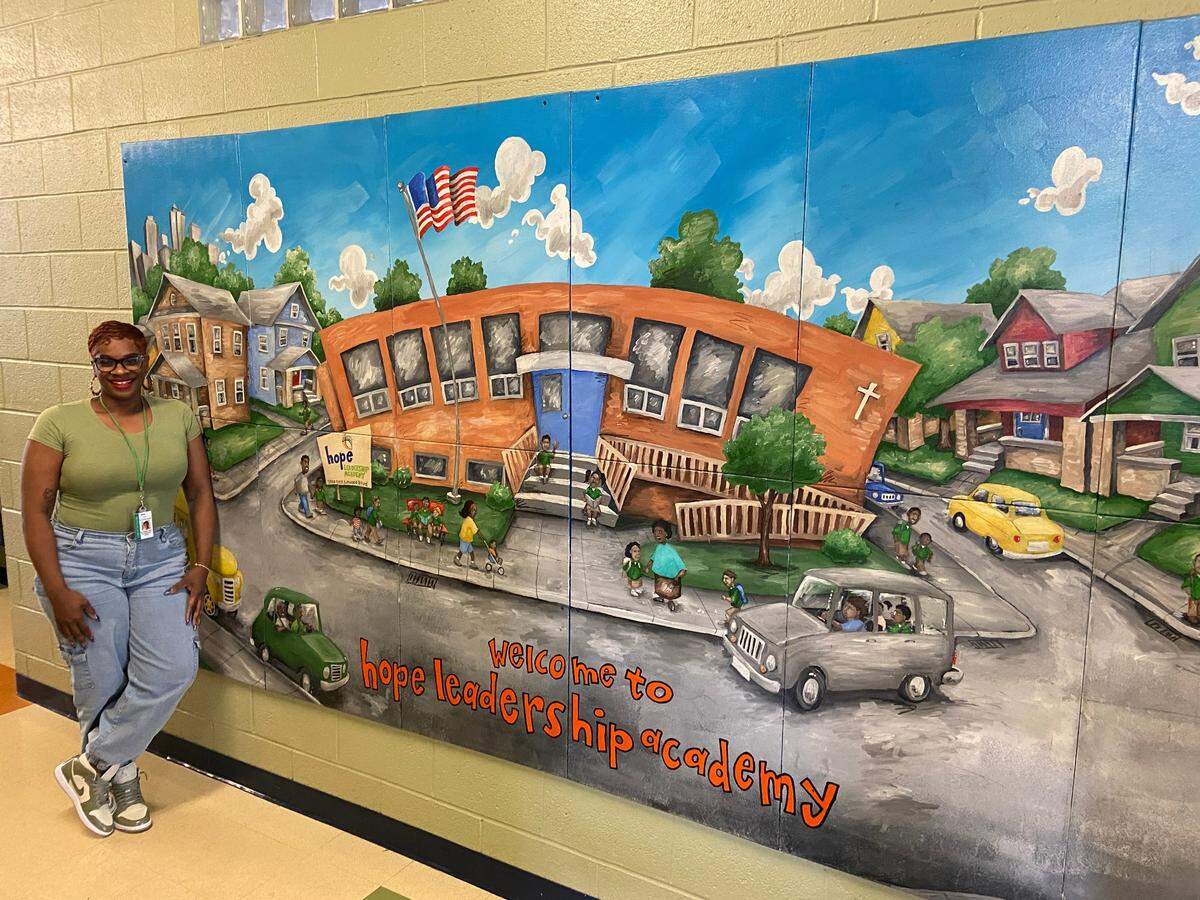
And that really kind of speaks to what we talked about from the very beginning, It looks like a school and it’s part of a neighborhood, and a neighborhood with a school is a good thing.
How many students attend Hope Leadership Academy?
We started off the school year with 112 students, and we ended with 99 students. And that was students whose families decided to pull out because they were moving and students we did not have the resources for. And we had conversations with the parents about what we could offer, because we’re such a small learning community and we allow the families to make that decision on removing their students from our school because we do not turn kids away. We welcome all students of all walks of life.
We want the families to feel safe in that community. And so if I can have a moment to just speak to the public officials as well as the police department, there are certain things that are happening within that community that is an eyesore, that will turn families away when they have small children.
If we could partner together and come together and sit at the table, have this discussion about how we can work together to make that corner of Prospect and Linwood a little bit more feasible for families. And that way families don’t feel like they have to move out of the community because they don’t feel safe.
OK, city leaders, police. You heard it. Dr. Tiffaney Whitt wants to sit down at the table with you.
Yes.
This is a reclaiming of this urban core. We’ve seen it happen around the 31st and Prospect area. We have longtime housing groups who live there and who care about their neighborhood and now we have a school and leadership that, again, cares about the school, and the community and wants to make a difference through education.
Tell us why education is the one thing that is so important, that will make a difference in changing perhaps even a whole community.
If we go back through history, and we read it in our history books about how, Blacks were denied an education and several opportunities that were afforded to other races. Now be in a position in leadership and be a Black woman, and to be in the urban core and to look like the kids that I serve, that’s extremely important to me.
Kids have dreams and aspirations, and how can they get to those dreams and aspirations if they’re not educated? College is not for everybody. There are different lines of opportunities that students can take. However, they do have to be educated in those areas in order for them to show up and be efficient and effective in those roles. And so education is important on all levels.
That’s a huge responsibility. That’s a big weight on the shoulders of your staff, of people who are interacting with the children. What resources are you trying to give them? What research do they need from our communities, our cities, our states to keep going? And always being on for your students. I mean, that’s a heavy lift.
For me, as a building leader, I set the tone. I try to make sure that I’m very supportive and understanding of my staff, because outside of them being professionals, they are human beings, they have families, they have issues and problems. And so I try to make sure that I am empathetic too, what they may be experiencing in their lives.
Also, you must set an expectation for professionalism. When you are here, these are the expectations, coming with that heart again of understanding and also providing staff with the resources they need so that they can be effective and efficient at their job.
How do I make this happen when I don’t have the resources? We need the funding to do it. This year. BLAQUE KC ( Black Leaders Advancing Quality Urban Education is local non-profit), has been a huge supporter of Hope Leadership Academy. I wrote a grant to them, and it was approved and I was able to get new smart boards for all of our classrooms.
Prior to that, we did have smart boards, but they were not functioning in the way that they needed to. So how can we expect our teachers and our kids to show up and perform at their best selves when we don’t have technology and equipment that will allow them to do so?
Some students had HP computers, some students had Chromebooks. Why? Why don’t we look uniform across the building? And so I spent a significant amount of our funding to get new technology through T-Mobile for our students. And now all of our K through first-grade students have tablets and then our second through fifth-grade students have the new laptops.
And so it’s, it’s things like that that make a difference. The funding is important. We held a partnership dinner at New Reflections Technical Institute. And we invited our current partners, and we invited a lot of potential partners.
While we did not get the attendance that we expected, the event still turned out great. The goal is $50,000. We have raised about $10,000. And so, for those of you who want to sew into the vision of Hope Leadership Academy, you can visit our website at www.HLAKC.org. You can click on Donate Now. And you can make a donation to go towards resources for our staff and students at Hope leadership.
Information: Hope Leadership Academy is located at 2800 Linwood Blvd, Kansas City, 64128. Their phone number is 816-921-1213. Hope Leadership currently is enrolling PreK-5 for 2025-2026.
How to help: You can donate here or from the homepage at hopeleadershipacademykc.org
This story was originally published July 16, 2025 at 5:00 AM.