Refugees who made KC home lose services after Trump cuts: ‘We are in hard times’
Kansas City, Kansas’s land has historically served as a place of refuge for people fleeing religious, racial and political persecution — dating at least as far back to the Underground Railroad.
And although local organizations are trying to preserve that legacy by providing services and support to refugees in KCK, federal crackdowns on admissions and diversity, equity and inclusion-related programming are making that harder to accomplish day-by-day.
“People are suffering, people are struggling to survive, we are in hard times,” said Mitima Burhungane, who has lived in KCK as a refugee for nine years. As a father of eight children, he’s particularly worried about local cuts at a time when basic living expenses are high.
Almost immediately into his second term, President Donald Trump issued executive orders that defunded programming, paused services and sent a clear message on how his administration plans to treat asylum seekers in the United States.
KCK residents are hearing that message loudly, clearly and daily.
As a city with nearly 20% of its residents coming from different countries (the county rate is slightly lower), federal policies’ effects on local immigrants and refugees — and the people that guide them during their time here — don’t go unnoticed.
Among the groups notably affected in the area has been Catholic Charities of Northeast Kansas, an Overland Park-based group that’s one of a few resettlement agencies operating in KCK.
The organization lost roughly $5 million in funding, began laying off employees earlier this year and is on track to shutter two of its programs by fall, according to public statements and emails obtained by The Star. Services will continue, although in a limited capacity.
Mission Adelante, another KCK-based program that did not respond to The Star, told The Beacon earlier this spring that it had to lay off about seven employees due to federal policies.
As they watch their jobs and stability for local asylum seekers evaporate, people who have worked with local refugee resettlement services, previously or currently, weighed in on local changes to services since Trump took office. Catholic Charities itself did not respond to interview requests as of publication time but has shared financial and operational updates in periodic emails to volunteers and staff and in public blog posts.
‘Pain and sadness and chaos’
Catholic Charities in an April email to staff said that funding cuts have impacted refugee reception, support services, training for farmers and programs that offer refugees access to employment, language classes and ways to navigate the local education and health care systems.
People don’t often understand how much support goes into helping a refugee get acclimated to life in the U.S., especially early on, one employee that asked not to be named told The Star. They need assistance applying for jobs, enrolling their children in schools, getting transportation to and from essential locations and acclimating to new cultures and languages.
The employee said reductions to services sends a direct message to refugees that the U.S. government doesn’t want them here.
“It’s just heartbreaking to hear something like that,” they said. “We try to remind everyone we work for that there are people in our community who do want them here, and just because a few people that are in power right now are saying they’re unwanted, that’s not how everyone in our community feels.”
They also said it’s important for people to see how refugees and the people that work with them are being affected. It’s the only way to show people that the way they vote directly impacts others’ qualities of life, they said.
“I want them to see how it’s affecting local people and their communities and their neighbors,” they said. “It’s causing pain and sadness and chaos and I feel like more should be happening as far as trying to stop it. I think a lot of people feel powerless.”
Burhungane, an interpreter who works in Kansas City, Kansas, Public Schools is originally from the Democratic Republic of Congo and moved to the United States nine years ago, meaning he no longer qualifies for all of the federal services that refugees receive during their first five years after arrival.
That said, he still occasionally goes to Catholic Charities of Northeast Kansas for assistance paying bills — the one issued by the Board of Public Utilities being his primary bane of existence, he said.
And although his wife also works, her job has cut back her working hours at times, which has also affected the couple’s ability to pay bills to keep their family of 10 afloat.
The services he can still receive, however limited they may be, still make a difference. And the extra work he does for Catholic Charities of Northeast Kansas helps pay bills so he can focus on feeding his family with his primary paycheck.
He said he hopes the government starts letting refugees back into the country and that the local government, particularly BPU, does more to reduce lofty cost of living expenses during difficult times.
Program cuts
The Trump Administration’s efforts to quell funding has affected U.S. refugee resettlement services across the country, leaving many agencies that are reliant on federal funding to pivot or fold.
Catholic Charities of Northeast Kansas is still trying to offer scaled back resettlement services, but the organization will have to pull out of its mentorship and small farm business programs. All programming will be reduced by Oct. 1.
“Although refugee programming is transitioning to a more condensed service model, they will continue supporting current refugee clients through access to our food pantries, intensive case management, mental health services, employment assistance and housing support,” according to a blog post.
Catholic Charities will no longer fund or staff its New Roots program, which helps refugee families start small farm businesses, beginning Oct. 15. Catholic Charities staff members working in those programs have the option to resign before then or stay on until their program ends, one former staff member told The Star.
The New Roots program helped more than 50 immigrant and refugee families and has been in operation for roughly 17 years. Cultivate KC, the group’s partner organization, will continue to operate the program and is in the process of working out how to do so without Catholic Charities’ involvement, according to their blog.
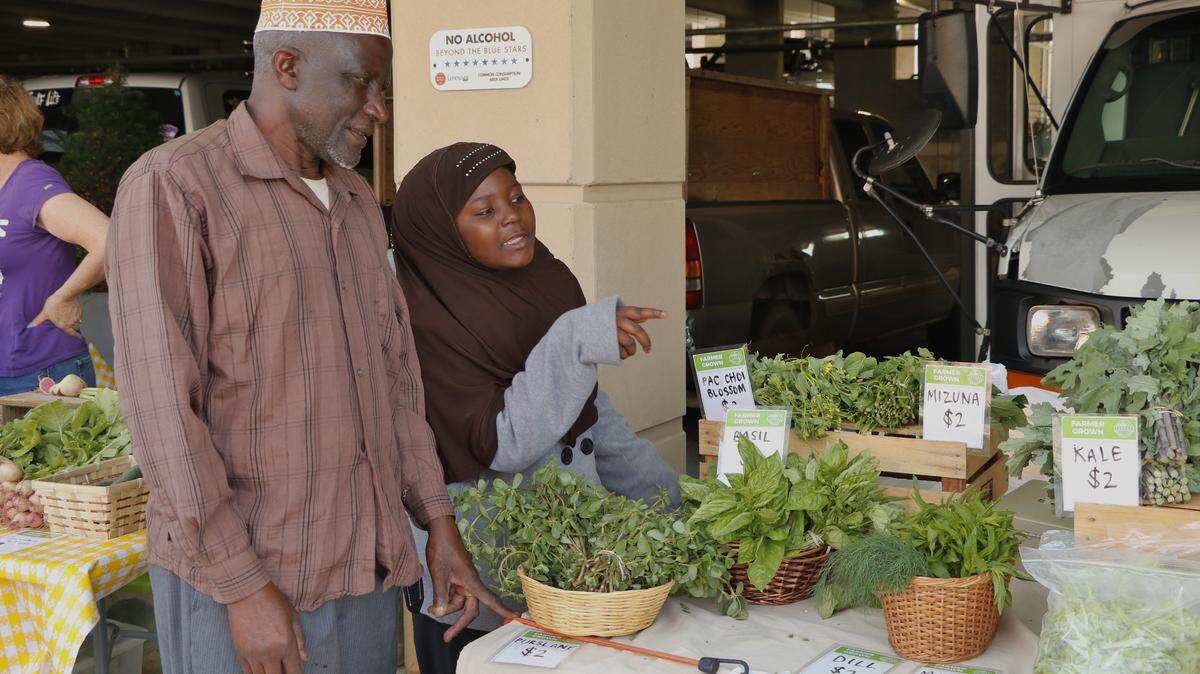
People who want to help out the New Roots program can do so by purchasing or donating farm shares and shopping at a nearby farmers market selling New Roots farmers’ crops, according to the group.
Members of the program sell produce at markets across the metro, including in Kansas City, Missouri; Lee’s Summit; Overland Park; Bonner Springs and more. The New Roots web page has a map detailing where its farmers sell.
Mentorship program
The ReConnect mentorship program, which partners volunteers with refugee youths, is scheduled to end in September.
Elena Hardy, the former ReConnect program coordinator, resigned earlier this spring and moved to the East Coast to be with family. The fact that she wouldn’t have a job by fall accelerated a move she had already been considering.
“The lack of certainty propelled me to make some decisions in my life,” she said. “I was not laid off but the way things were headed was a factor in the decision.”
Hardy joined Catholic Charities in 2023. The COVID-19 pandemic had derailed some programming previously in place, and she took on the chore of rebuilding it. The program, meant for people aged 15-24, helps refugee youths find community, set goals, utilize local resources and build friendships in the area.
It’s also entirely federally funded, Hardy said. The program in October 2024 had just received approval for funding through September 2025. Things took a turn right after the inauguration, Hardy said. She had been banking on having a fully-funded program for the year.
In the months to follow, Hardy watched as peers were called into human resources meetings; emails painting uncertainty for the funding year, detailing layoffs and staffing changes and the possibility that the program could end earlier than September periodically filtered into her inbox.
And although services will continue to support refugees locally, it was clear those services would be more limited than what they were before Trump took office, she said.
“It was really hard to leave when I did just because of everything that was going down because I just have amazing co-workers, many of them that I call friends,” Hardy said, adding that it’s particularly common for refugees themselves to work in refugee resettlement and administration.
Worldwide impact
Trump’s Jan. 20 order to immediately suspend refugee admissions stranded more than 10,000 people that completed the lengthy process to acquire refugee status and had scheduled flights to the U.S. A federal court in Washington ruled the government can’t deny admission to refugees approved before Jan. 20, but later clarified that cases would need to be reviewed individually.
A small fraction of those tens of thousands of refugees have since made it into the states and are receiving resettlement services, according to Church World Service, one of the plaintiffs in the case.
About 22,000 refugees had received approval to travel, and about 600,000 people around the world were under consideration for admission to the U.S. when the executive order fell, CBS and AP News reported, respectively.
Among those admitted in the states since the order were a few groups of white South Africans, who Trump permitted into the country on an expedited track due to being victims of “racial discrimination” during a time when non-white refugees living in war zones are being denied refugee status.
This story was originally published June 22, 2025 at 6:00 AM.