
Last Pony Express rider on 2,000-mile relay to arrive in MO town, with GPS tracker
The first rider, on horseback, left the historic riverfront neighborhood of Old Sacramento, California last week with 1,000 pieces of mail inside a leather satchel.
They rode a few miles, satchel draped over the horse, until meeting up with a second rider astride a fresh horse. They made the handoff of the mail and bid farewell.
By the time those letters reach St. Joseph, Missouri on Saturday night, if all goes well, more than 750 volunteer riders will have re-created the way mail was delivered for a brief, historic period of U.S. history — by the Pony Express.
Every summer, members of the National Pony Express Association stage a 10-day Pony Express Re-Ride. They journey nearly 2,000 miles across eight states — 24/7, day and night.
It’s a relay, like in days of old, following the Pony Express National Historic Trail managed by the National Park Service, which describes the trail as covering “some of the wildest and most desolate landscapes in the country.”
Unlike days of old, that mail pouch has a GPS tracker inside.
Riders hand off the mail at appointed destinations along the way, exchanges that sometimes occur in the dead of night. The transfers are quick and business-like because neither rain nor snow nor dark of night ... well, you get the idea.
Though this year’s ride began in California and ends about 55 miles north of Kansas City, next year it will reverse course and launch from St. Joseph, where the Pony Express began with great fanfare on April 3, 1860. The service closed after just 18 months in October 1861.
“St. Joseph was fortunate, with the arrival of the Hannibal and St. Joseph Railroad February 14, 1859,” says the city’s website. “This city was on the western edge of civilization.
“Settlers headed west from here faced a 2,000 mile trip by wagon train that often took three months of hardships. Those who had already reached California and its promise of gold found themselves cut off from the rest of the world.
“At a time when there were no telephones, radios, or telegraph, letters from New York to San Francisco took 30 days by steamship around South America. An overland mail route ... took 23 days for delivery.
“Most knew it was a matter of time before the telegraph and the railroad would span the nation, but with the Civil War looming on the horizon, something was needed now.”
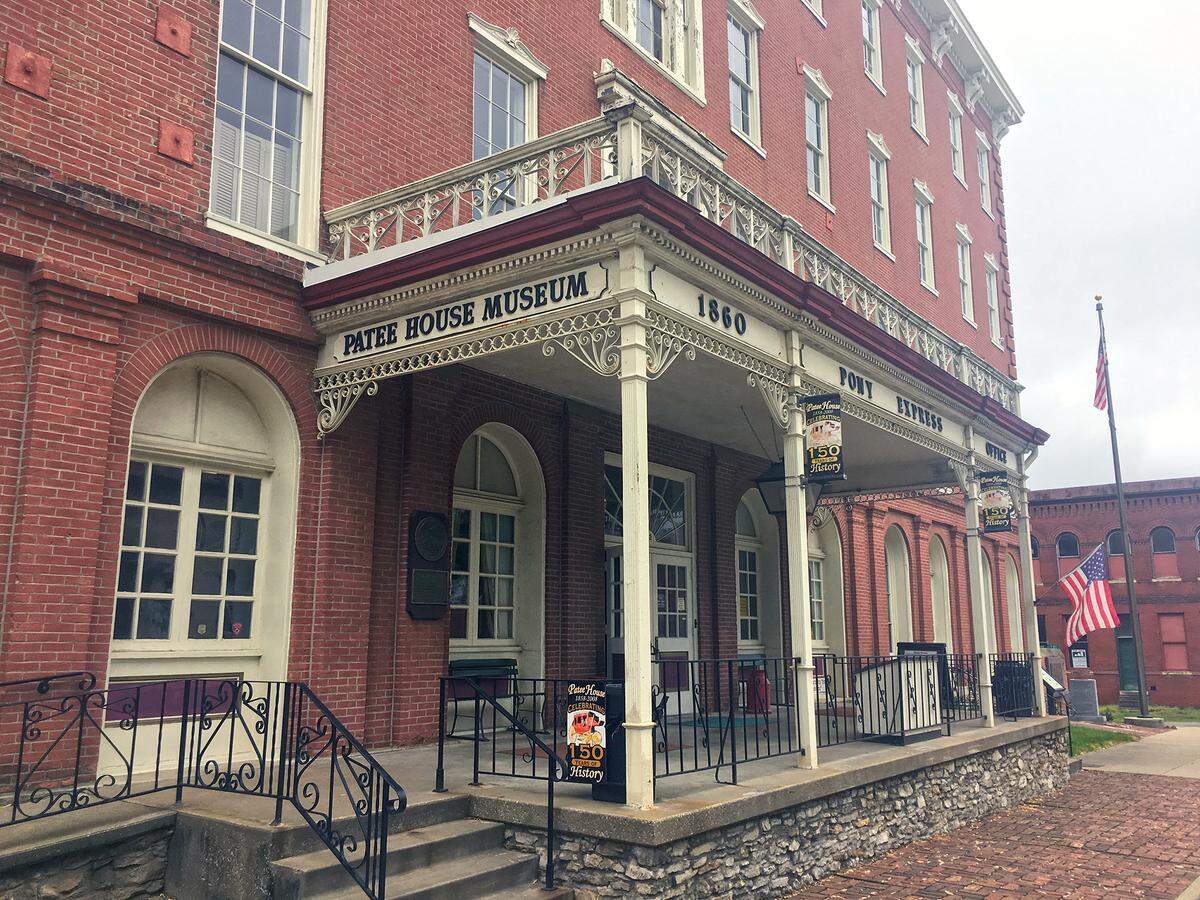
William H. Russell, Alexander Majors and William B. Waddell, three businessmen in the freight industry “with 4,000 men, 3,500 wagons, and 40,000 oxen,” conceived the Pony Express and set up headquarters in St. Joseph’s luxury hotel, Patee House.
The first rider set out from St. Joseph to the celebratory firing of a cannon — poor horse — with a mail pouch containing 49 letters, five telegrams and miscellaneous papers.
The Patee hotel remains today, housing the Patee House Museum. St. Joseph is also home to the National Pony Express Museum.
‘They travel 24 hours a day’
The last rider of this year’s relay is expected to reach St. Joseph around 7 or 7:30 p.m. Saturday. The public is invited to watch.
“Not a good time to arrive, but that’s the way it’s scheduled,” said Gary Chilcote, the 90-year-old director of the Patee House Museum who has worked there since 1963. “We’ll have a ceremony out front and will see the riders arrive.”
Chilcote said the riders got behind schedule a couple of days ago.
“Particularly, weather is a problem for them,” he said. “They travel 24 hours a day ... they have to travel the whole distance by horseback. Some of them will get daylight, some of them will get midnight, 4 a.m. in the morning.”
True to history, the mail they’re carrying is tucked inside a saddle bag called a mochilla — easy to sling over a horse when time is critical.
Before the ride began, patrons could pay $5 for a commemorative letter or $10 for a personal letter to be placed in the bag and carried to Missouri. A special stamp marks them as official Pony Express mail and the United States Postal Service will deliver them to their final destinations.
To make the ride interactive, there’s also a GPS device inside the mochilla. People can follow the trip and read updates of the progress on an interactive map at nationalponyexpress.org.
Bonus: No saddle sores.
Each volunteer, all members of the National Pony Express Association, rides five or six miles. “No one rider ever goes the whole distance,” Chilcote said. “They never did.”
They get to see parts of the historic Pony Express trail that the public can’t. The National Park Service says the trail is neither clearly marked nor a continuous hiking trail.
Instead, “it is a corridor that passes through different states and land ownership. Visitors can follow segments of the original trail on public lands and approximate other sections by following the trail’s Auto Tour Routes.
“However, many parts of the original trail are privately owned, have been lost to development, are under plow, or cross military or American Indian tribal reserves.”
The riders generally “travel on either the shoulder of the road or across fields or private land that people have given them permission to cross,” Chilcote said. “They still have to cross a lot of highways to get here.”
The riders will travel through Nebraska on Thursday and cross into Kansas late Friday night. The last handoff is scheduled for 7 p.m. Friday in Elwood, Kansas, southwest of St. Joseph.
“At the arrival, they have to cross the Missouri River,” Chilcote said. “They have to do that on the bridge because they can’t swim the river. They’ll have a police escort at night ... with semis honking their horns.”
To see where where and when the riders will stop before Saturday, go to nationalponyexpress.org.
.jpg)