
Popular TikToker, former Mizzou professor, attempts speed record on Ozark Trail
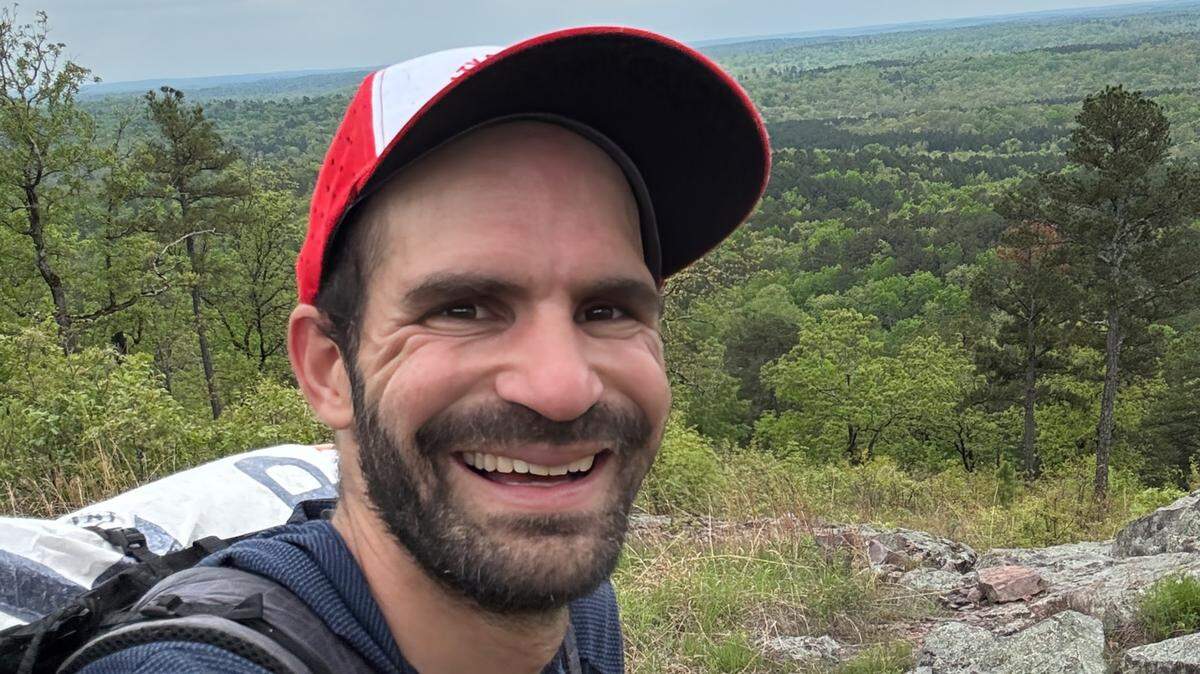
He had a good plan, a very good plan he thought, to prevent blisters on his feet as he set out alone to break a speed hiking record on Missouri’s Ozark Trail.
He packed five pairs of socks instead of the usual two.
But Missouri’s longest multi-use National Recreation Trail (NRT) spanning hills and crossing streams and glades in the Ozark Mountains played a trick on veteran hiker Tim Beissinger — and it was painfully worse than the dozens of blood-sucking ticks that attached themselves to his body.
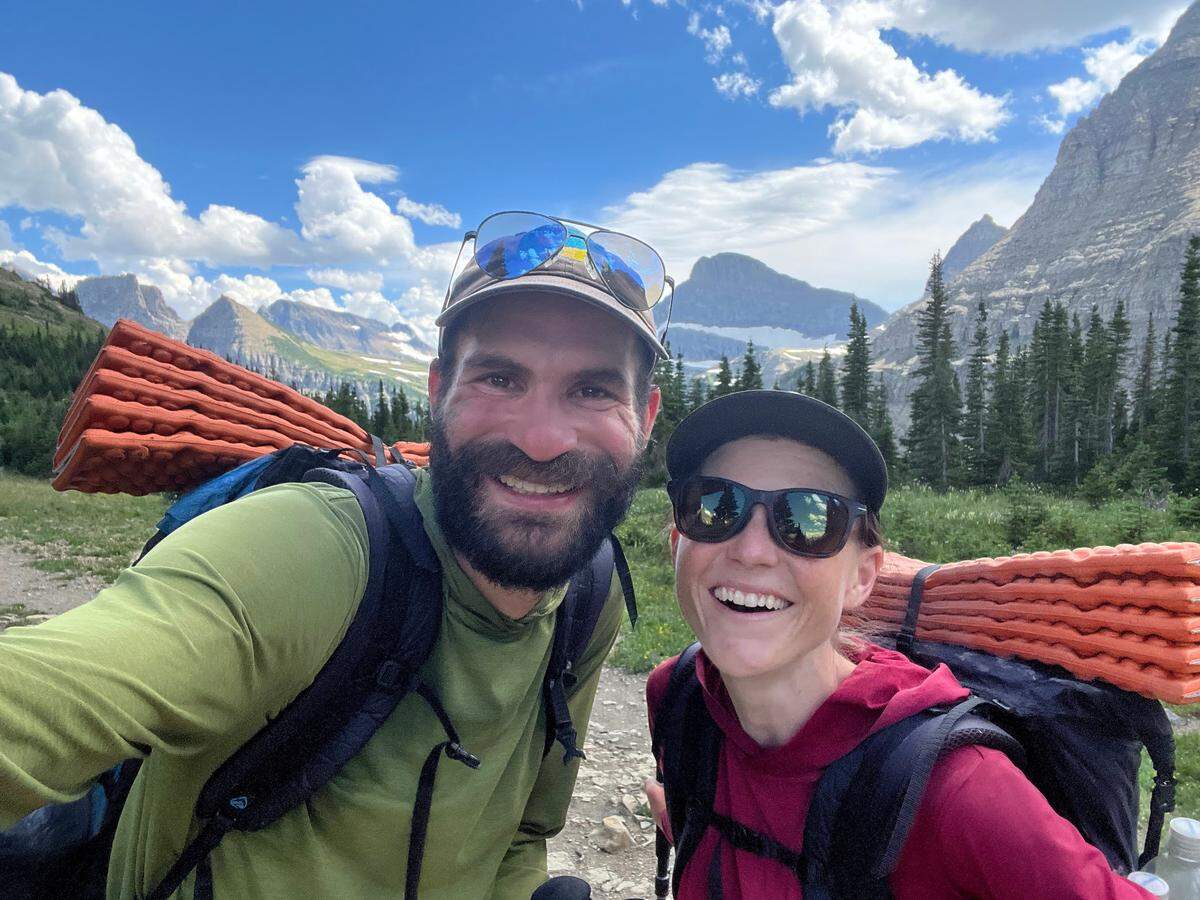
The former University of Missouri professor, who lives in the San Francisco Bay area, is one-half of the popular husband-and-wife team @ThruHikers on TikTok.
A thru hike is a backpacking trip on a long-distance trail essentially from Point A to Point B.
Beissinger and his wife Renee Miller, both 37, have more than 3.5 million social media followers — more than 2 million on TikTok alone — who follow them hiking, backpacking, canoeing and camping, mostly out West, though they have backpacked and biked through Europe and South America, too.
They hiked the Continental Divide Trail twice. They’ve traveled the full circuit of the Pacific Crest Trail, canoeing 1,200 miles and hiking 1,500 miles along the U.S.-Canada border.
They’ve hiked more than 10,000 miles. “We stopped counting a couple of years ago,” Beissinger said.
Last summer they released a hiking survival book, “Thruhikers: A Guide to Life on the Trail,” because they couldn’t fit all their expertise into brief TikTok videos.
On Friday, April 25, Beissinger set out to break the record for the unsupported “fastest known time” — or FKT — on the Ozark Trail.
The goal: Hike 230 miles in less than four days, 11 hours and 28.5 minutes — the record.
He would have to hike more than 51 miles a day for four straight days, day and night.
Unsupported meant his wife couldn’t drop off food or water for him along the way or even meet him along the trail and cheer him on. It was just him, his thoughts, turtles, armadillos and lots of ticks and pain out there.
Excruciating pain with every step.
He chronicled the trip for his followers and began posting videos last Thursday, more than a week after the hike.
He revealed today whether he beat the record.
Recounting the hike to The Star, he was still in pain a week after getting back to California and he was blunt: “It was harder than I thought.”
His first dispatch showed him flying to Missouri, the tent where he and his wife slept on the trail the night before he set out, then bidding her farewell at 6:24 a.m. on April 25, 30 pounds strapped to his back — including 18 pounds of food — and a walking stick in his hand.
“Goodbye. Good luck!” she told him.
“Thank you,” he told her with a grin.
The grin was gone the next day.
Water, water everywhere
The couple found TikTok fame during the pandemic when they shared videos of their first Continental Divide Trail hike, a 3,149-mile trip that took four months. The fame was accidental.
“We have a lot of things we do in life other than be influencers,” said Beissinger, a plant geneticist. His wife is a mechanical engineer.
His wife got a lot of attention last summer when she hiked 457 miles alone and set the women’s record for fastest known time on the Oregon section of the Pacific Crest Trail.
That kind of triggered Beissinger’s competitive juices. He started looking for a record of his own to break.
The Ozark Trail happens to be special to the couple. They lived in Columbia from 2015 to 2018 while he was teaching at Mizzou.
“Back when we lived in Columbia, I volunteered to build part of that trail, signed up for some trail-building weekends,” he said. “I just knew I liked that trail from when we lived there, and it’s beautiful. It was the right length and difficulty for me. I wanted to do something about this length for my first attempt at a record to see if I could.
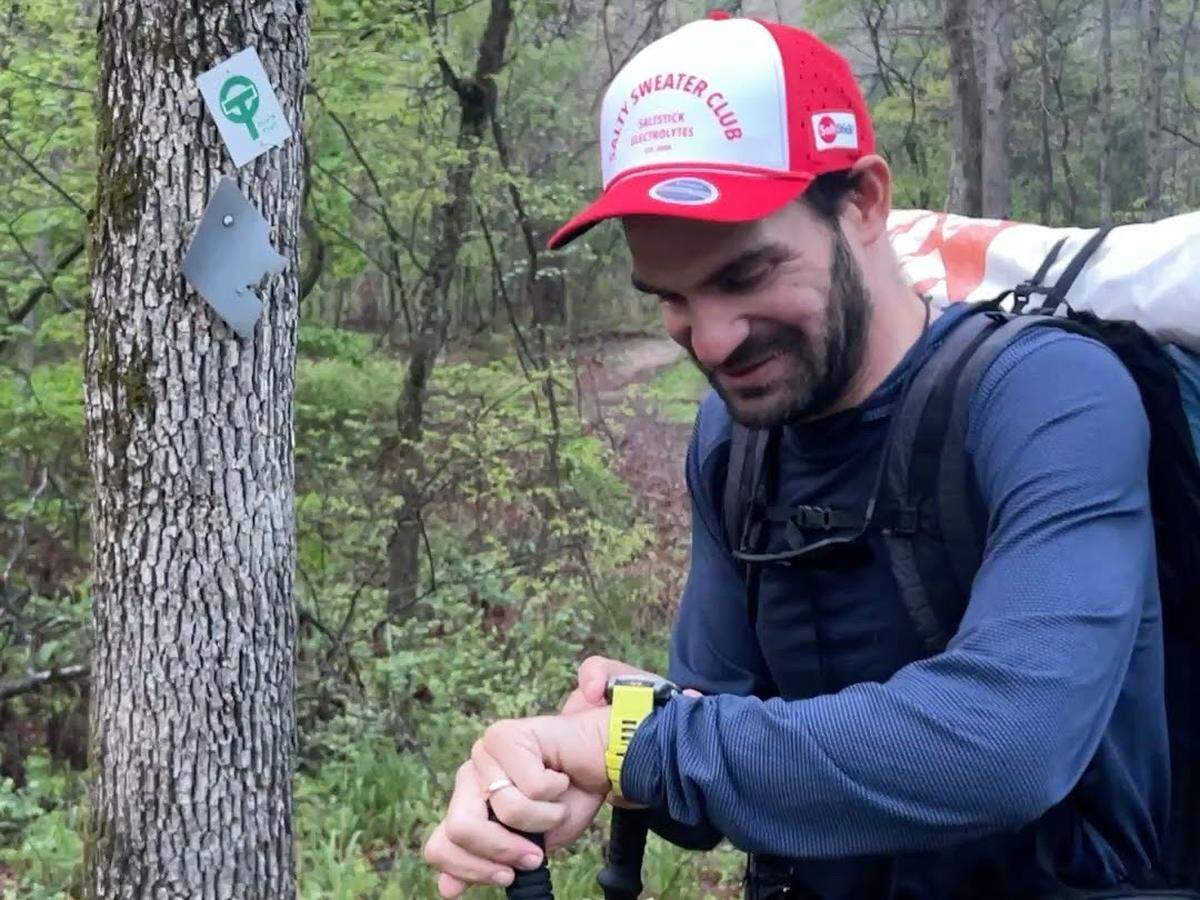
“And one thing that stood out, it is marked extremely well. The trail blazes (markers) along the trail were among the best I’ve experienced. ...
“It’s easy for people to forget about the beauty of the Midwest,” he added. “Even just these small, rolling hills of Missouri, they’re not as huge as the Rocky Mountains, but it is remote and it is gorgeous.”
He recommended that hikers visit the trail’s website, which has a trip planner.
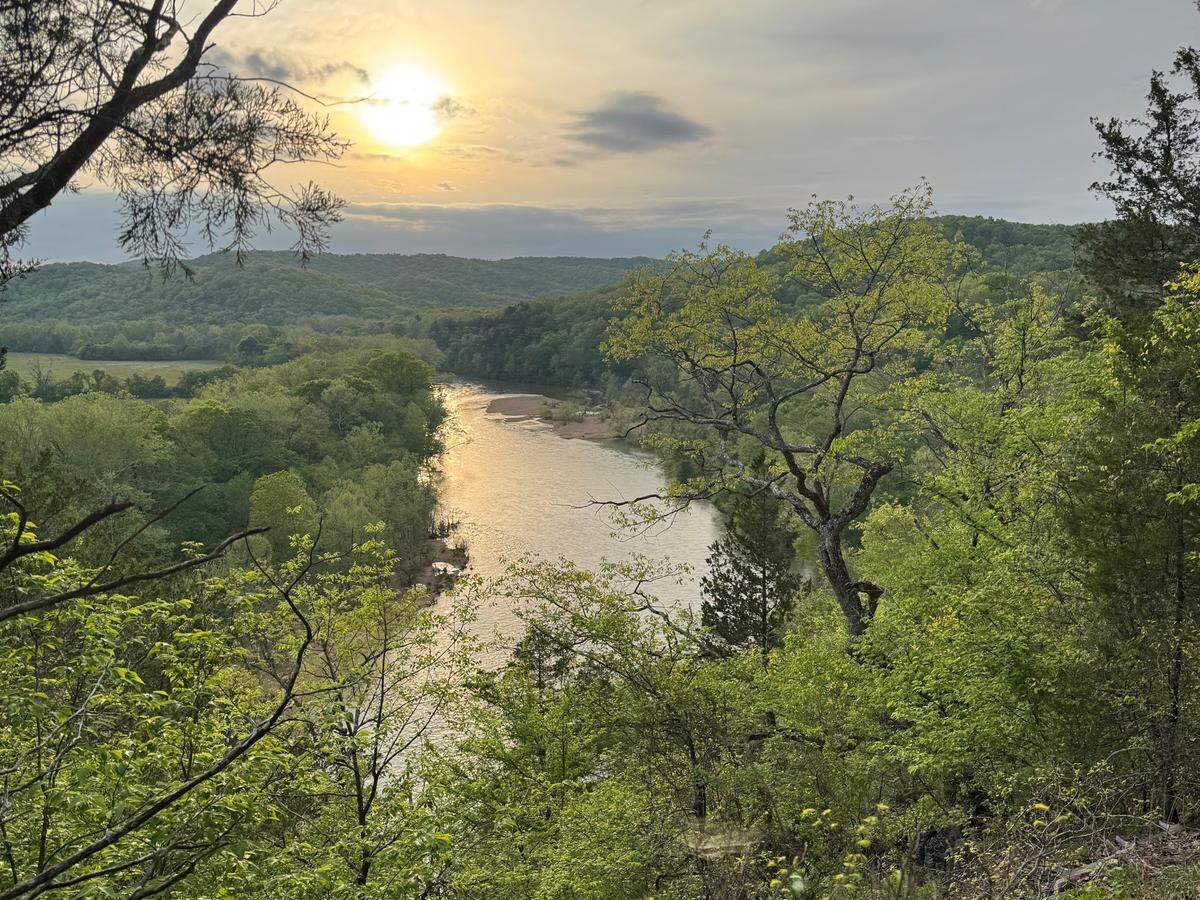
But “from more of a ‘what’s cool about it’ standpoint, it has a lot of water, which is not 100% good. That ended up being my challenge,” he said. “You’re constantly going to dry land up high, then have water at the bottom.
“The frequency of water crossings was unlike anything I’ve ever experienced.”
Top 10 backcountry trail
Anyone who steps foot on the Ozark Trail is experiencing “a trail that is not your typical long-distance trail,” said Kathie Brennan, past president and current vice president of the Ozark Trail Association and one of its most high-profile champions.
Beissinger took on the 230-mile “backbone” of the trail, but the 430-mile trail is more than that, she said.
“It is rugged, remote, with road crossings from three to five miles, with a natural beauty of what we call the Ozarks,” she said. “Because it does not go into any towns or cities, it is also one of the top 10 backcountry trails in the U.S.”
Backcountry, as in remote.
Beissinger, an experienced trail runner and finisher of the Ozark Trail 100-mile Endurance Run, faced a particular challenge, she said, because spring rain and storms, including tornadoes, had washed out creek crossings and uprooted trees that blocked the path.
Beissinger knew about the storms. It rained periodically as he hiked, but “I didn’t get poured on,” he said. “The weather was not ideal, but it was tolerable as long as you don’t mind walking in the rain.”
He posted videos of his preparations.
“My gear will be as bare-bones as possible so I can travel fast with a light pack. I’ll cowboy camp instead of pitching a tent, I’ll chemical-treat my water instead of spending time filtering, and I’ll cold soak instead of stopping to cook,” he said in one pre-hike video.
Normally having a tent is nice, he said, especially in Missouri “when you have bugs and rain. But that was something I was willing to sacrifice.”
As it turned out, there were few mosquitoes, nor did he have to contend with another hiking nemesis. “Poison ivy and I are not friends. We’re enemies and it always finds me,” he said.
The ticks were another story.
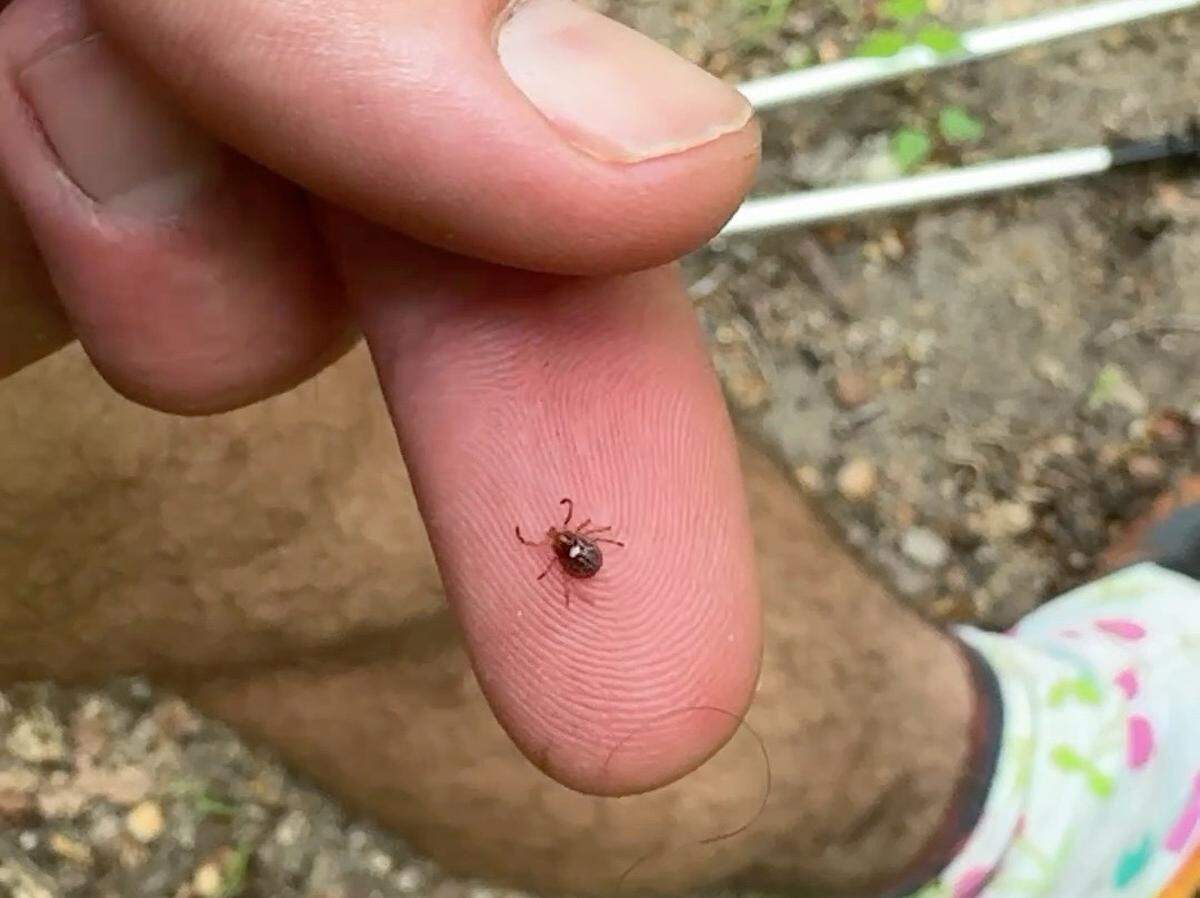
“It was crazy how many ticks there were,” he said. “I have a count of the total number of ticks I removed from my body ... well over 100, probably 150. There was one time I had 14 ticks on my leg all at once. I was pretty much able to remove them before they nestled in.
“When I finished and Renee met me, she found a couple on the backs of my knees.”
Planning the food challenged the couple, who decided he would have to eat 6,000 calories a day, “and that’s just a lot of food weight,” Beissinger said.
So they opted for a lot of energy bars — he ate 13 a day — Salt Stick electrolyte tablets and freeze-dried quiche.
One thing he didn’t carry: toilet paper.
Their social media followers always ask about pottying in the wild.
He and his wife prefer using natural materials instead of paper when they hike. She wipes with a rock. “I prefer a smooth stick,” he said.
“It sounds bad but is really not bad ... I’ve never gotten a splinter.”
Being on TikTok has shown them what resonates with people. “If I’m talking to someone who has not spent one night or 100 nights outdoors, they want to know: How do you sleep on the ground?” he said.
“People even want to know if we have sex.”
Painful trench foot
“My feet were soaking wet within the first hour of the hike,” Beissinger said. And they stayed soaked for four days. Eventually the skin on his feet ripped, damage too gross to show on social media.
He likened it to trench foot, the serious condition soldiers in World War I suffered from standing long periods of time in wet, cold trenches.
“That’s something that I didn’t expect,” he said. “I thought this was going to be a physical challenge: ‘That’s a lot of miles.’ That ended up being the easy part.”
He had five pairs of socks with him when he and Miller hiked the Continental Divide, a four-and-a-half month trip. But that wasn’t enough this time.
“The blisters — that’s where I failed to do well,” he said. “That was really bad. I had trench foot and my skin was ripping apart. It was extremely painful to walk. I had no idea that it would be so hard as my feet got wet.”
He didn’t have the luxury of time to take off his shoes at every stream crossing, and they came so frequently there was no time for his feet to dry out. “Within the first two hours the trail was a river,” he said. “Walking hundreds of meters in about 12 inches of water along the trail.
“Take a four-day bath and take a look at your feet at the end. Imagine doing 50-plus miles a day walking on those broken feet.”
Day Two “was sort of a mental day of: ‘Wow, this is going to suck.’”
Day Three, “I thought I would have to quit.”
At that point, he was in so much pain he couldn’t walk for more than a half hour without stopping. But he knew his brain would have to help him push through. “I went from, ‘Oh my God, I’m going to fail’ to ‘No, I can do this,’” he said
With more than 100 miles to go, “it really was just one foot after the other no matter how much it hurt, and over time it hurt less because I got used to it.
”But that was also a big part of why I did this hike. I wanted to learn what my body was capable of.”
The pain also kept him from sleeping well, which made the trek even harder. He averaged one and a half hours of sleep each night, lying down next to the trail, and relied on caffeine to push him on.
He had a cell phone but kept it off given that he wouldn’t have had service on much of the hike anyway. He had a satellite tracking device through which his wife could text him and send voicemails.
As he hiked she was enjoying a relaxing weekend in Columbia visiting friends, checking out the local breweries.
He wished he could be there instead.
The last, scariest crossing
Along the way he only met seven other people, a couple of fellow hikers heading in the opposite direction and a group from the Ozark Trail Association taking some kids on their first backpacking trip. But there was no one for the first 83 miles except turtles and armadillos.
Five miles from where he needed to finish, he came face-to-face with his scariest moment.
Raging between him and the record he chased was Courtois Creek, prone to flooding that makes it impassable, he said.
“I was worried about that and two hours away it stared raining really hard,” he said. “I was going to get the record and started thinking, ‘Well, I might get to the stream and be unable to finish.’”
He has crossed streams that he was lucky to escape alive, but this creek, thankfully, wasn’t like that.
He waded into the fast-moving water, which reached up this armpits, and managed to stay on his feet to reach the other side.
His wife met him at the finish where he kissed the trail marker on April 29.
His final time: 4 days, 9 hours and 24 minutes, two hours faster than the previous record sanctioned by Fastest Known Time, which governs hiking speed records.
He had averaged 53 miles of hiking a day.
“It ended up being closer in the end than I was hoping for,” he said.
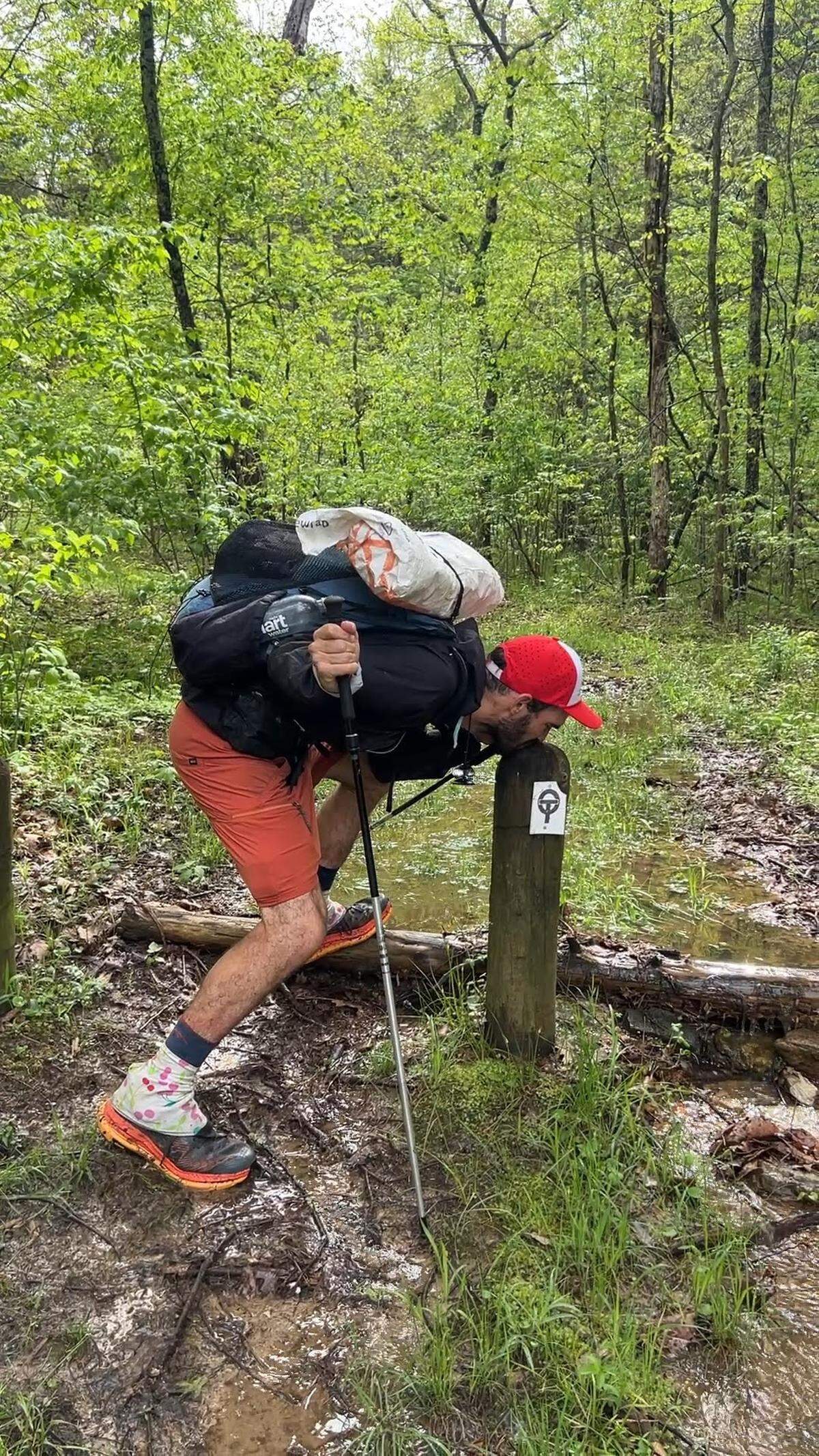
His wife had chips and Skittles for him at the end, where he lay down on the trail to rest for a half hour before getting into a car and immediately falling asleep.
Though Beissinger insists the experience was “fun,” the toll it took on his body was extraordinary. Within 24 hours of the hike his pale feet swelled like balloons and the bad smell they gave off indicated that some of the many cuts and blisters were infected.
His mom insisted he see a doctor.
He insisted on treating them himself with antibiotic ointment.
“I stopped walking, That was the main thing I needed to do,” he said.
He hobbled so badly through the airport in St. Louis to fly home “the airline people tried to get me into a wheelchair because I was so broken,” he said.
“I had the strange realization of, OK, it hurts so bad to walk through the airport. On the other hand, if I had 50 miles to walk today I would tell my feet to shut up ... and I would walk at full speed.”
He finished the hike on a Tuesday and by early the next morning, he was back at work in California taking a meeting.
.jpg)