Abandoned by LGBTQ supporters, sued by Kansas: How a trans nonprofit fell apart
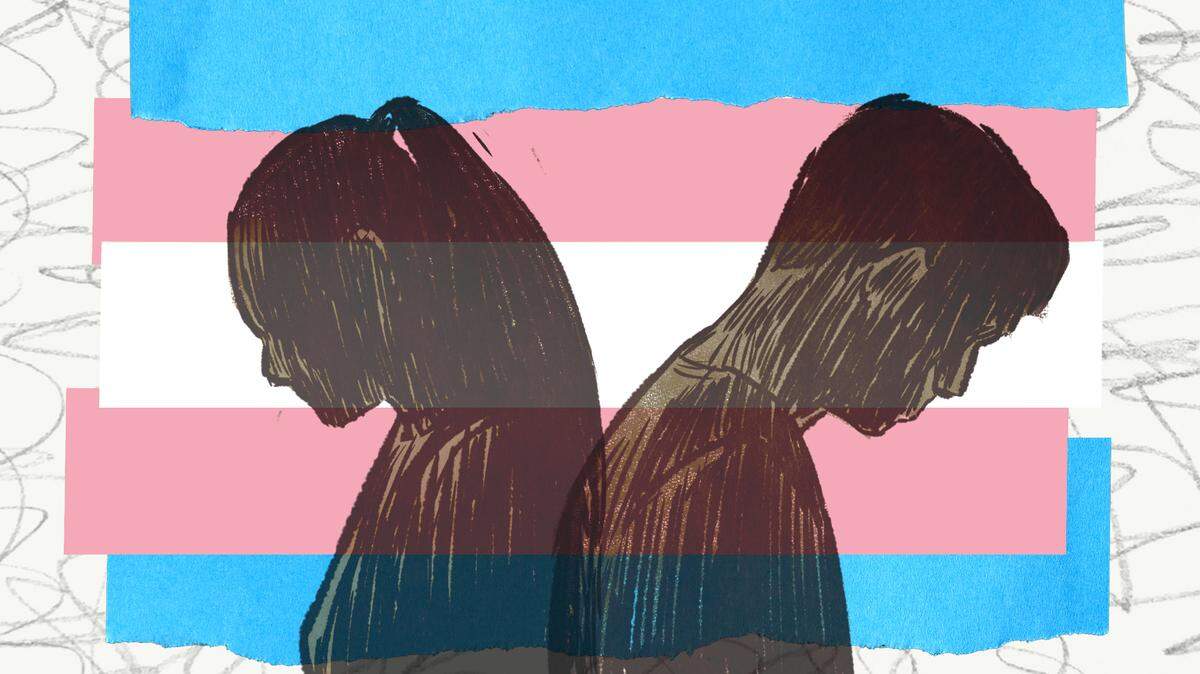
Elise Flatland hoped the Kansas nonprofit Trans Heartland would help her two transgender kids meet other young people like them.
And for her, she wanted the organization founded by Justin Brace, a Kansas trans man, to help her find support from other parents without driving from Olathe to Kansas City.
“It’s tricky finding pride organizations that do a lot, and that specifically were trying to uplift trans people,” said Flatland, whose four children are in middle and high school, and two of whom identify as trans. “I really hoped that (Brace) had the network of people that he said he did.”
But she got none of what she wanted. Instead she lost more than $1,300 and her hope for a ready-made Johnson County trans community.
Flatland is not the only one who has had trouble with the organization. In early April, Kansas Attorney General Kris Kobach filed a civil lawsuit against Brace and Trans Heartland, alleging Brace took at least $11,700 in donations.
The Star interviewed 10 people affected by the organization, received documents through multiple open records requests and reviewed court filings, text messages, emails, social media posts and Venmo transactions to understand Brace and Trans Heartland’s effect on the Kansas LGBTQ community.
The Star attempted multiple times to reach Brace through various platforms. After contacting two of Brace’s former lawyers and one former associate, The Star was unable to locate a current lawyer for him. The Star reached out to Brace through three phone numbers, three addresses and a fundraiser page, giving him more than a week to respond before publication.
Trans Heartland said on its now-archived website that it provided support for trans Kansans through an Overland Park drop-in center, scholarships and three peer support groups.
But instead, people familiar with Trans Heartland told The Star that the organization took money from well-meaning donors and left a pattern of hostile interactions in its wake.
Though Brace himself is transgender and ran an organization aimed at supporting other trans Kansans, those LGBTQ individuals interviewed did not rush to defend him. They say Brace launched barrages of hateful messages, ran unlicensed camp for trans teens and deceived supporters who gave money to fundraisers he set up.
“(Brace and Trans Heartland) intentionally obfuscated the intended beneficiary and falsified the context of the solicitations to mislead donors,” the Kansas Attorney General’s Office said in its lawsuit.
Court documents filed by the attorney general show that early on, some supporters of Trans Heartland — including Flatland — had faith in what Brace said he was trying to do. As they gave money, donors wrote messages of gratitude and support, ranging from “thank you for bringing pride to our hometown” to “Thank you for being awesome!”
The last one came from Flatland, a screenshot from an April 2024 Venmo transaction confirmed.
But things changed.
In March 2024, Flatland took her kids to a Trans Day of Visibility picnic in Olathe. On the outskirts of the event stood Justin Brace, Trans Heartland’s executive director.
While Flatland described Brace as “kind of an awkward guy,” she said she had a good conversation with another mom. If Brace attracted nice people to his picnic, Flatland said, she thought she could overlook “a weird thing.”
Wanting to support Brace’s work, Elise Flatland and her husband Jay gave money multiple times — $500 in April, $200 in May and $50 that same month for their child’s registration for youth camp, which The Star confirmed with screenshots. And when Brace said he needed money for medical expenses, the family gave $600 to his GoFundMe, receipts confirm.
Flatland said she was dubious of Brace’s management style — she said his events were disorganized and sparsely attended — but she said she continued to bring her kids to activities, like a pizza picnic and a movie screening, and help with the organization.
That was until Kansas City Pride that year, where Flatland helped Brace run a booth promoting the nonprofit. At the event, Brace saw Flatland talk with the leader of PFLAG, a decades-old organization with chapters across the country that supports families of LGBTQ people.
Brace reacted with a barrage of emails and messages to Elise and Jay Flatland saying the organization was transphobic. The Flatlands shared those interactions from June 9, 2024, the day after the event.
That day, the couple wrote in an email to Brace that they would stop attending Trans Heartland events, to which Brace responded:
“The only harm you’re doing is to your Transgender children by choosing to participate in PFLAG. … We will be here for your children when you allow them to speak for themselves and choose where they go instead of you choosing for them.”
Now Flatland tries to forget about the money her family gave to Brace.
“It sucked, because giving him money enabled him to keep going and to keep hurting people.”
Kansas files suit
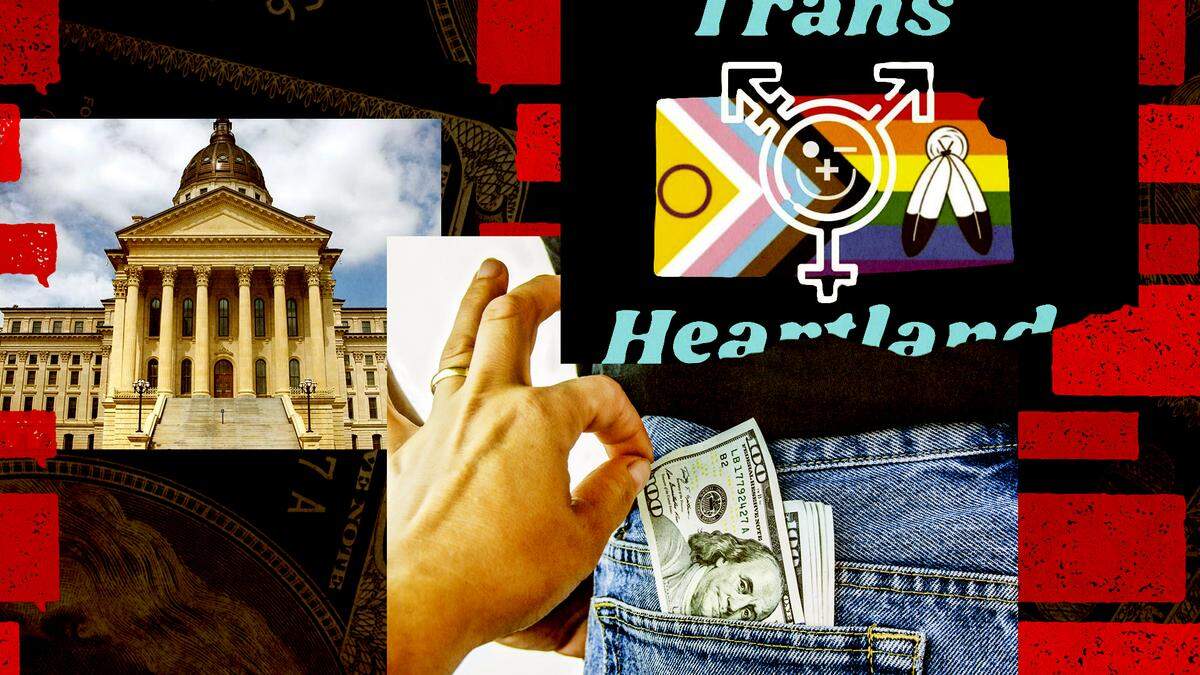
The Kansas Attorney General’s Office is seeking a default judgment after Brace and Trans Heartland did not respond to the lawsuit in Johnson County court. The hearing is scheduled for Monday, Aug. 4, in Olathe.
The Attorney General’s Office says it wants Brace to pay back the $11,700 in donations, along with court costs and tens of thousands of dollars in civil penalties and investigative fees. In addition, the office wants to stop Brace from being involved in Kansas charitable organizations moving forward.
The lawsuit said Brace worked alone: “BRACE should be considered indistinguishable from (Trans Heartland) and operates as one joint entity.”
In April, Brace filed documents with the state of Kansas to dissolve Trans Heartland, which has the official name of Transgender Kansas Foundation. The paperwork lists an Overland Park address.
In one instance highlighted in the lawsuit, almost $2,000 in donations collected at the 2024 Olathe Pride event were deposited into Brace’s personal bank account. Brace then used the money at Michaels, Barnes & Noble, and Amazon, and to pay AT&T bills.
In addition, Brace allegedly broke state law by failing to register with the Attorney General’s Office, according to Kobach’s lawsuit.
The suit lists a Lawrence address for Brace.
Brace describes himself on a recent GoFundMe page as “an intersex trans man who was forced female at birth and while growing up.” That page was started in May, after the Kansas lawsuit was filed, and asks for help with gender-affirming surgery.
While Brace incorporated the organization in Kansas in April 2023 as Transgender Kansas Foundation, though court records state that “Brace’s solicitations on behalf of Trans Heartland date back to June 15th, 2022.”
On that day, Brace posted a GoFundMe fundraiser where he identified himself as the executive director of the organization, according to the affidavit.
Kobach’s trans track record
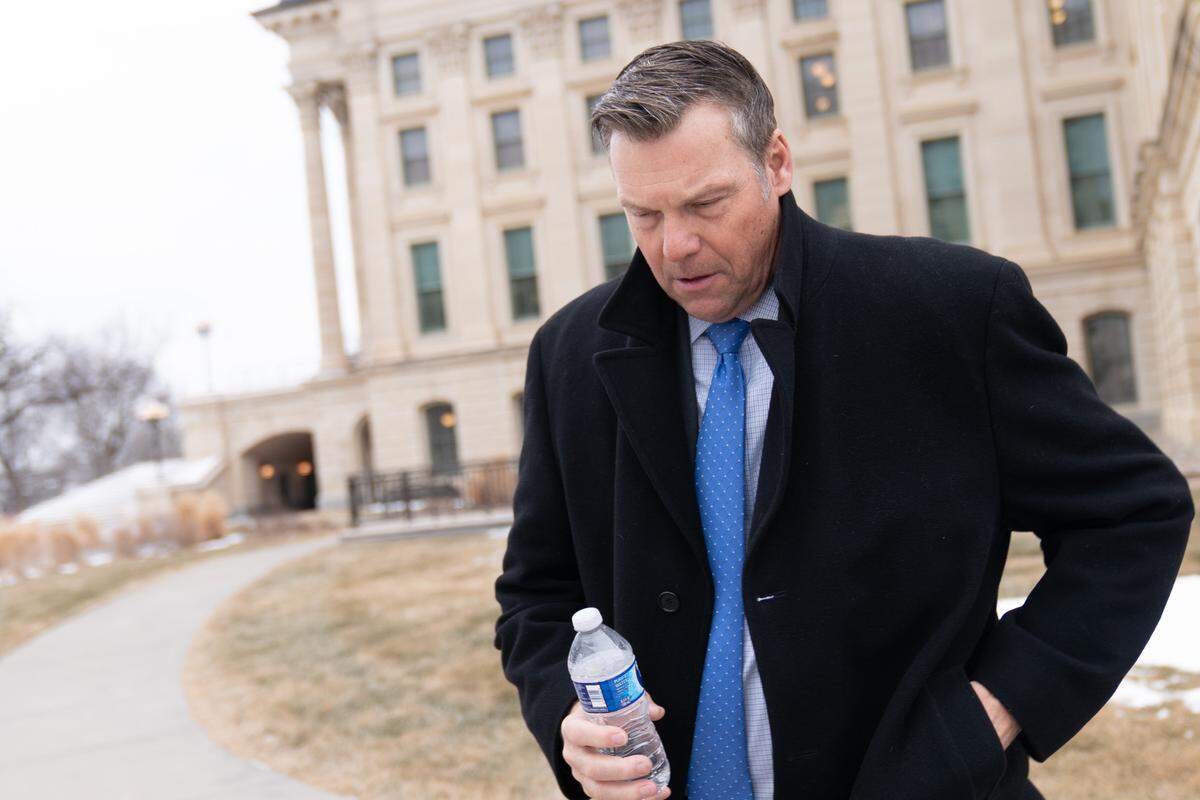
Kris Kobach, whose office filed the lawsuit against Brace, has shown to have an adversarial relationship with Kansas’ LGBTQ community.
In the past two and a half years, Kobach has sued to stop residents from changing their gender marker on driver’s licenses and worked to keep trans individuals from playing on sports teams.
This Pride month, Kobach called for a probe into four Kansas City area school districts for their policies related to including trans students.
Since he became attorney general in 2023, Kobach’s office has looked into 114 nonprofits and individuals because of alleged issues with the establishment and/or actions of the charities.
The department pursued legal action against one nonprofit and four individuals related to former Overland Park police officers accused of misusing police charity funds, according to documents obtained through the Kansas Open Records Act.
One Kansas City-based attorney with extensive experience in nonprofit law and charitable fundraising told The Star in May that Kobach’s legal challenge against Trans Heartland appears to fall within the office’s purview.
Errol Copilevitz said instances of nonprofits failing to register or misusing funds are more common than people might expect.
“As much as I’d like to criticize Kobach or his office, there’s nothing to criticize,” Copilevitz said.
“This is a proper function of that office.”
Camp Luna
Ellyott, a 17-year-old from Johnson County, said he felt uneasy from the moment he arrived at Trans Heartland’s outdoor weekend for trans teens, called Camp Luna, in August 2024.
Ellyott’s mother asked for the teen to be identified only by his first name to protect his online privacy.
The high schooler said he imagined his first summer camp experience to be full of teens in cabins doing well-planned activities. Instead, Ellyott described the unlicensed camp as “almost dystopian.”
“None of it seemed right, none of it seemed comfortable.”
Last summer, when he attended the three-day and two-night camp, Ellyott was a rising junior in high school. A handbook provided by Ellyott confirmed his attendance and the details of the event.
Kansas overnight camps are required to have a license from the Kansas Department of Health and Environment. The department confirmed through the Kansas Open Records Act that no license existed for Camp Luna at the location and dates of the camp.
According to the handbook emailed to Ellyott before the event, Camp Luna was “specifically designed for Transgender teens, in sixth through 12th grade, emphasizing gender exploration alongside getting to enjoy camp activities regardless of gender.”
Families paid up to $75 for their child to attend the camp held at Big Bull Creek Park in Edgerton, located southwest of Olathe, according to a screenshot of a Trans Heartland Facebook post.
While the camp was advertised for 11- to 18-year-olds, Ellyott said the approximately 25 campers included children as young as 7.
Ellyott wasn’t allowed to bring his car to camp, so his mom dropped him off.
When Ellyott arrived, he said that Brace led him and his fellow campers to the treeline. There, Brace drew a line on the ground with chalk. Ellyott remembers Brace warning campers that if they went past the line, Brace said he would immediately call the police.
At Camp Luna, Ellyott said, “It was no watches, no clocks, no phones, no cameras, just nothing that let you have any connection to the outside world.”
Without a car or phone, Ellyott couldn’t leave or call for help.
“It felt like a ticking time bomb.”
The camp did not have proper refrigeration, Ellyott said. This meant the meat substitute served on the last day tasted and smelled like cat food, according to Ellyott.
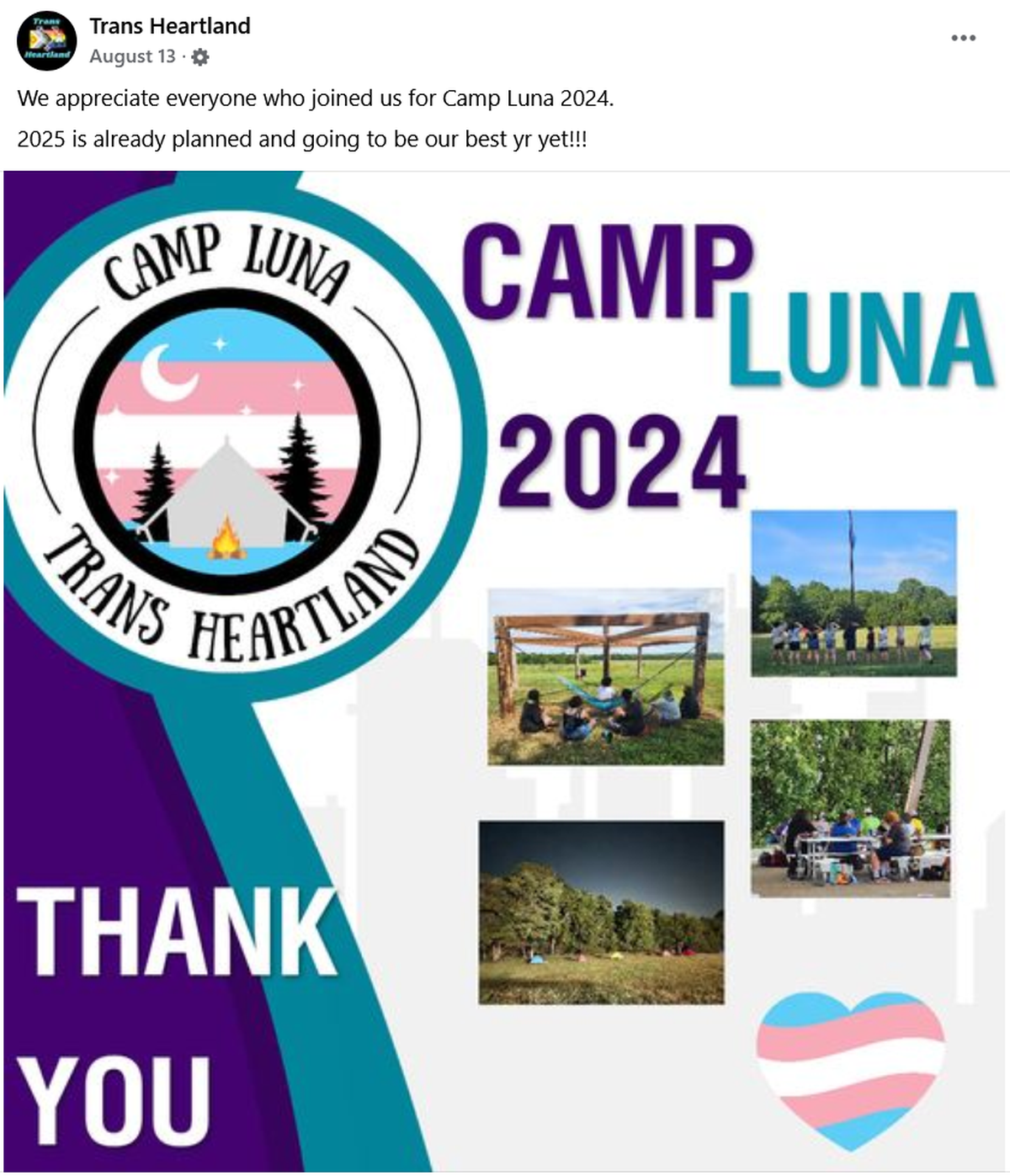
While there were six or seven camp counselors during the day, Ellyott said that only three adults, including Brace, stayed overnight. Each camper shared a tiny, two-person tent with another young person they barely knew.
Ellyott remembers waiting in his tent as Brace called each camper out one-by-one to take their medications.
“We had to, like, move our tongues out of the way so he would, like, be able to see if we took our meds,” Ellyott said.
Ellyott said the whole experience felt like a “breach” of his safety.
“It wasn’t due to, like, the queerness, the transness of the people. It was just the situation that we were put into,” he said.
Luckily, Ellyott said he was able to bond with his fellow older teens and their counselor, the only trans adult there outside of Brace.
He said the counselor “was definitely a safe space within what was supposed to be a safe space for everyone.”
Ellyott said of Brace, “I never felt safe being anywhere really near him.”
Kansas trans activists
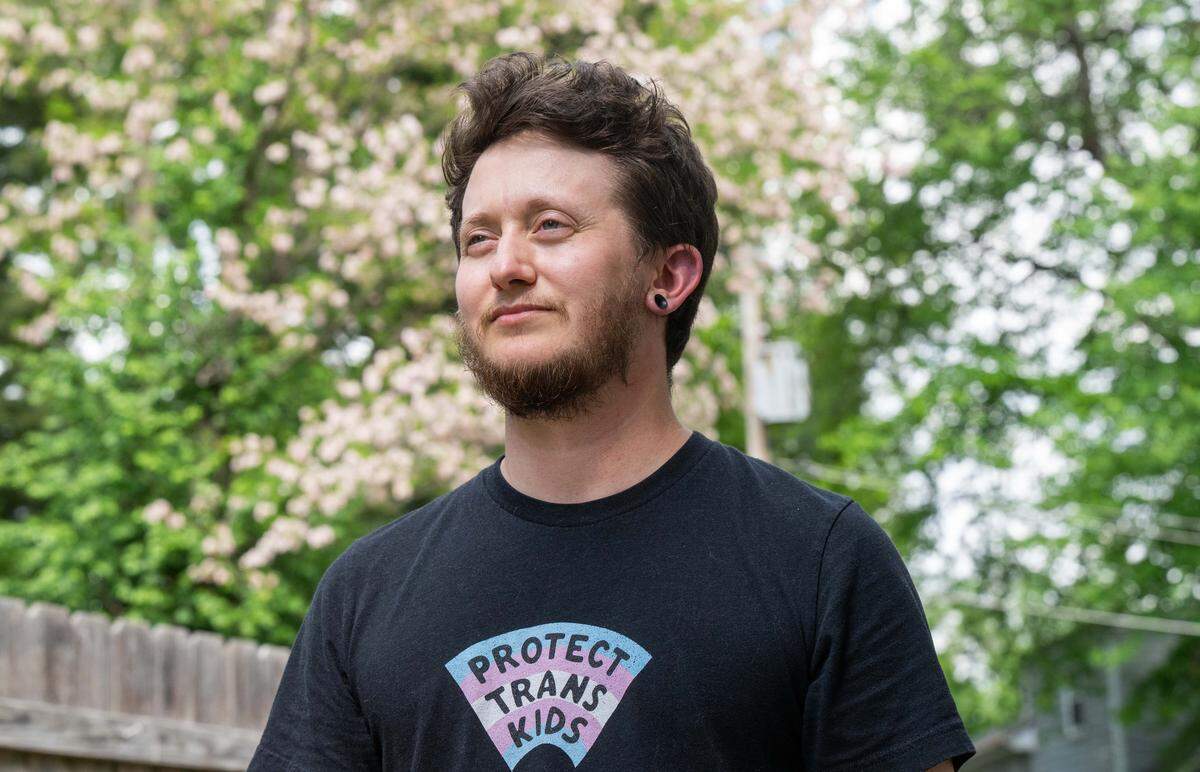
Riley Long hesitated before pressing “submit” on the Kansas attorney general’s website in early April 2025.
The Shawnee trans activist wanted to report Trans Heartland to Kobach’s office, but he knew sharing his experiences could open his community up to scrutiny.
Long said he worked on @stoptransheartlandfraud, an Instagram account started in late 2024. The page shared posts with alleged evidence of the nonprofit’s wrongdoings, under which commenters shared their experiences.
Through an open records request, The Star confirmed that Long was one of two people who submitted a complaint against the nonprofit.
Long wrote in his investigation request, “We have lots of suspicion of Trans Heartland profiting the money they are fundraising.”
“It’s scary, because I know people are going to use this as a way to say, ‘yeah, we told you so, these people are pedophiles or mentally ill,’” he told The Star in May.
Ultimately, Long pushed through his hesitation. “At the end of the day, there’s right and there’s wrong, and I’m not going to stay silent for what is wrong,” he said.
And Long wasn’t the only one who felt that way.
After two of his friends had bad experiences with Brace, Isaac Johnson started collecting information about Trans Heartland’s operations in 2023.
Johnson, an activist with the Trans Lawrence Coalition, compiled the information into a 60-page Google Doc recording Brace’s social media activity, with links to more than 600 screenshots. A select number of people, including The Star, viewed the document.
He said he documented the organization to protect his community.
“(Brace is) harming people, and he uses those stories to get into positions of authority to harm people,” Johnson said.
He said that in a time when governments are trying to take away rights of trans people in Kansas and across the country, “It’s hard, because you don’t want to accuse someone of lying about something traumatic, which I think is, like, why he holds so much power over people, because he finds those people who have good intentions, and he just knows how to exploit them.”
Johnson said he worries that Brace will repeat the scam elsewhere. In the bio of a 2024 self-published book, Brace wrote he lived in Colorado. He has also posted multiple times on social media since 2023 saying he lives there.
Johnson said that Brace’s actions hurt both trans and queer people themselves and the perception of LGBTQ activists in Kansas.
“He’s literally harming us, like he’s being abusive, he’s being exploitative, he’s being manipulative,” Johnson said.
“But also harming us, because how does it look to see Kris Kobach’s office suing a trans-led organization, and I have to be on Kris Kobach’s side?”
Online web of deception and hurt
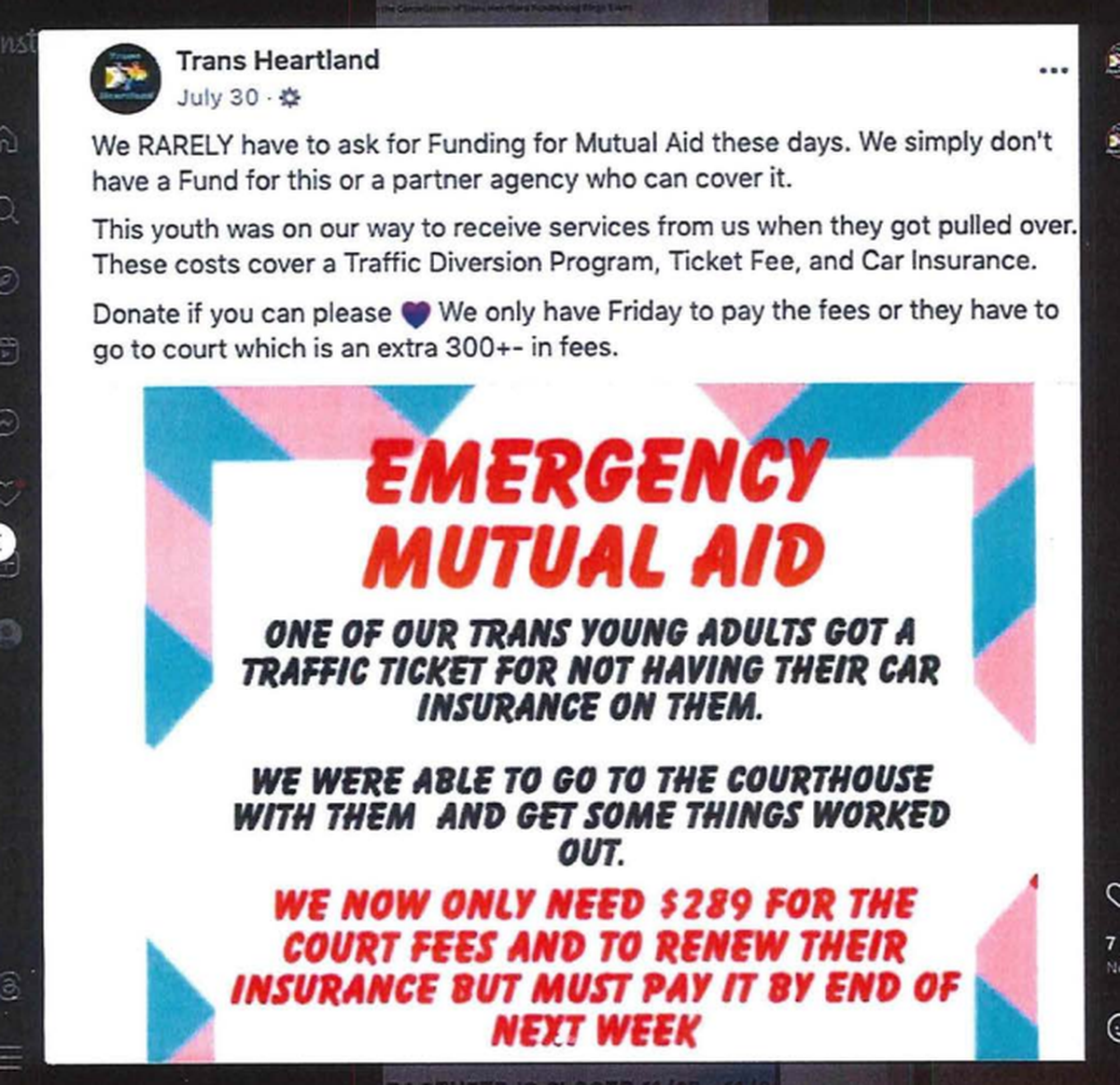
An urgent request appeared last July on Trans Heartland’s Facebook page.
After getting a traffic ticket for not having vehicle insurance, a trans young adult needed $289. “Donate if you can please,” the post said, followed by a heart emoji. Followers gave almost $300 in 10 separate transactions.
But according to the Kansas attorney general’s lawsuit, “There was no ‘trans youth’ separate and apart from Defendants. Instead, there was Brace … allegedly driving a motor vehicle without insurance in Johnson County.”
Brace received the traffic misdemeanor a week before posting on the nonprofit’s page, according to court documents included in the affidavit.
A litany of negative stories surround Brace, from people across Kansas and Missouri that The Star has spoken to.
In western Kansas, Kristi Khan reached out to Brace and Trans Heartland to volunteer. Khan wanted to help because her son Kai, who died by suicide in 2022, was trans.
But her Facebook friendship with Brace turned sour when the Colby resident agreed with another commenter that a link was broken on the nonprofit’s website.
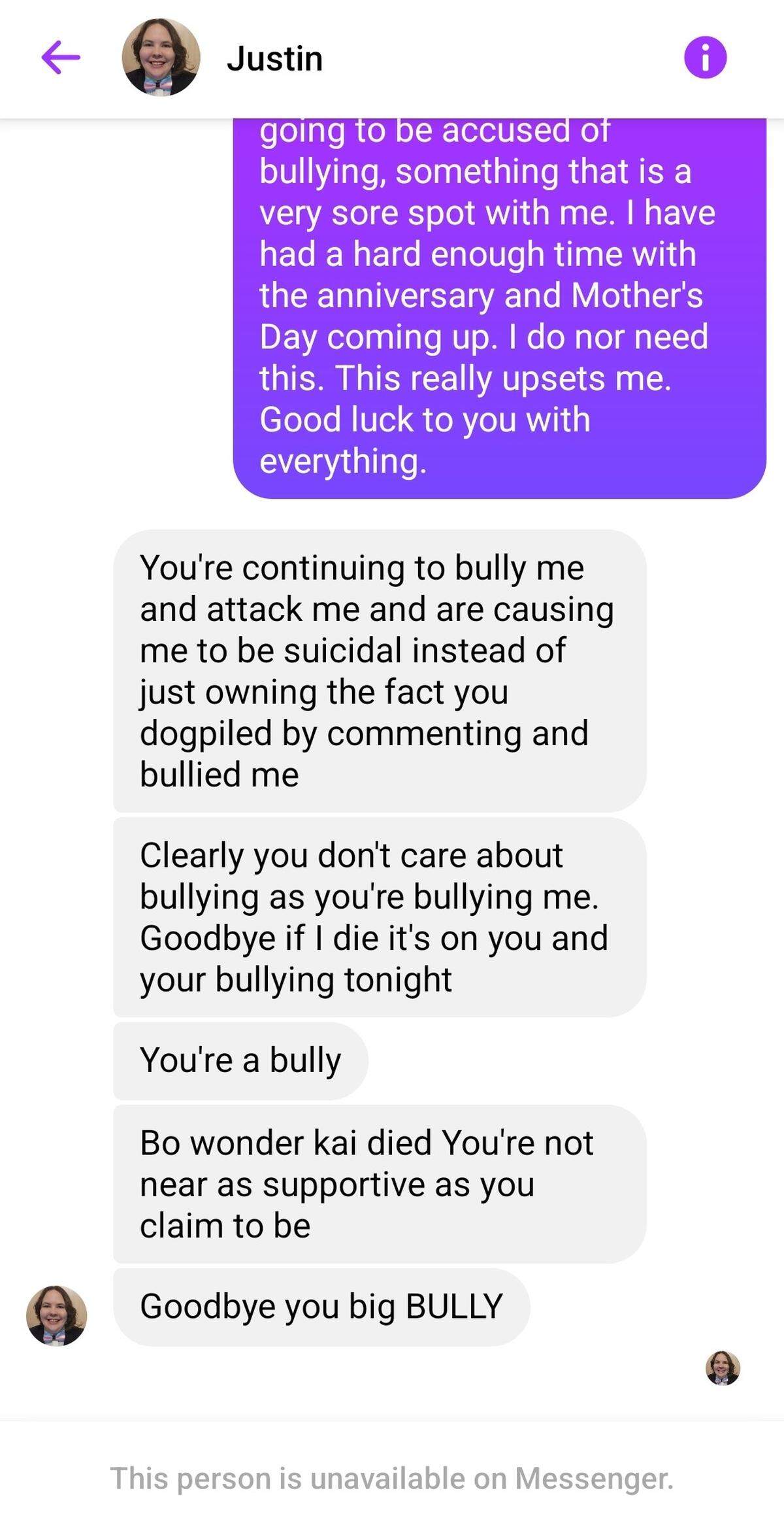
Brace launched a series of messages calling Khan a bully, saying, “(No) wonder kai died You’re not near as supportive as you claim to be,” according to screenshots provided to The Star.
“That was devastating,” Khan said. “I was both heartbroken and then angry.”
After a mutual friend died in 2019, Brace started texting with a southern Missouri woman. The woman asked not to be named because she wants to distance herself from Trans Heartland.
From 2021 to 2024, Brace mentioned the woman in Facebook and Instagram posts, saying he considered the woman a sister and part of his chosen family. She told The Star she didn’t think of Brace as a brother.
The two texted back and forth before growing apart by the time Brace posted a GoFundMe in 2023.
“Hi everyone, I’m raising money for my brother Justin to fix their car,” the description began. It was signed with the woman’s name and she was listed as a co-organizer along with Brace.
The Missouri woman learned of the fundraiser more than two years later while on the phone with The Star.
“I’m reading this, I’m like, I don’t know why he’s making it sound like I am organizing this,” she said.
“I never wrote this.”
Justice for trans Kansans?
When the Attorney General’s Office filed the lawsuit against Trans Heartland, Flatland said she felt “happy but nervous.” That’s because of Kobach’s adversarial views on many LGBTQ issues.
“Trashing a queer organization in the state of Kansas, that just sends a bad vibe,” Flatland said.
Most of the people interviewed by The Star said they hope Brace reforms himself and stays away from trans advocacy in Kansas and beyond.
Ellyott, the Camp Luna attendee, said that he doesn’t want Brace to be a public face of trans people.
“I have never met another person, cis or trans, that acted like this,” he said.
Thomas Alonzo is pessimistic about Kobach’s motives for the lawsuit. Alonzo, the executive director of the more-than-20-year-old Equality Kansas, said of Kobach: “Negative people can sometimes do something positive.”
Kipp Ellis, founder of grassroots community organization Trans Joy KC, said they believe the lawsuit filed by the Kansas attorney general will be used as a justification for transphobia.
“People are already heavily scrutinizing the behavior of trans people and trans people’s morality,” Ellis said.
Reporting Brace to Kobach’s office and exposing Trans Heartland’s alleged wrongdoing was “challenging,” Long said. But he said he believes it was the right thing to do.
“At the end of the day, trans people are human,” Long said.
“There’s people that are doing good things. There’s people that are doing not so good things.”
How can I support trans people in Kansas?
While Trans Heartland took advantage of donors, there are many credible trans and queer-focused organizations in Kansas and Missouri that can use money and other resources.
Here are some to check out:
Trans Joy KC hosts events to unite the trans community
Trans Lawrence Coalition pushes for trans inclusion and holds social events in Lawrence
Equality Kansas advocates for pro-LGBTQ policies around the state
PFLAG supports loved ones of LGBTQ people, with chapters in Kansas City and Lawrence and Topeka
Our Spot KC helps queer and trans people in the Kansas City area find stable housing
Loud Light organizes for progressive causes in the Kansas statehouse
Trans Women of Color Collective is raising money for a transitional shelter in Kansas City
This story was originally published August 3, 2025 at 1:46 PM.