Virtual teachers are on-screen in more KCK classrooms as shortage persists: ‘Just chaos’
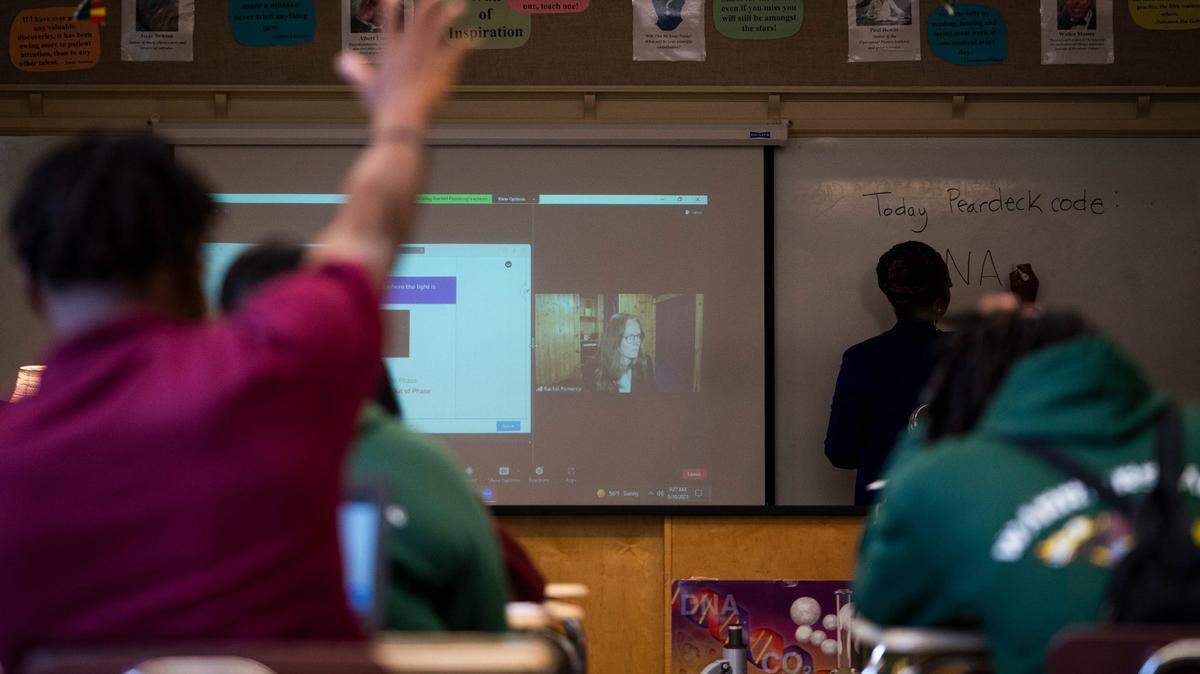
Moni Khadka is fed up with splitting his attention between two teachers. He said it doesn’t help that one of his instructors, who looms large on a screen over his college prep algebra class, breezes through core topics — like the notorious quadratic formula — from states away.
Although his classroom’s in-person aide tries to keep Khadka on pace as his questions pile on, the Wyandotte High School senior recently told The Star he has often felt overwhelmed and unmotivated throughout his final semester in the district.
“It makes me just not want to learn,” he said of the set-up with his lead teacher on a screen. “I don’t want to have to keep going back and forth. I look at the screen and wonder whether I should even keep going.”
Kansas City, Kansas, Public Schools is in its third contract year with Proximity Learning, a company that offers real-time, virtual instruction from certified teachers that remotely wire into classrooms across the map. The program is among school districts’ options to address the ongoing teacher shortage felt on campuses nationwide.
While KCKPS district officials know the classroom dynamic isn’t a particularly popular solution to its teacher vacancies, they told The Star they see Proximity as a stopgap in their efforts to build up the local teacher workforce without sacrificing the quality of learning.
But the district’s own data indicates it’s working as more than a stopgap. For now, the strategy is expanding dramatically, not going away.
In the last three years, the number of KCKPS students in classes taught by Proximity teachers has more than doubled: 1,813 in the 2022-23 school year, and 3,848 in the 2024-25 school year.
Proximity teachers taught 101 classes in KCK middle and high schools in their first year. The following year they taught 175 classes, and this school year they taught 181 classes.
Local critics of the program — including some students who have had virtual teachers and their parents — say the arrangement echoes many learning woes of the COVID-19 era. They are concerned about student engagement.
At least one parent who spoke to The Star said she’s pulling her son from KCKPS after this school year, in large part due to frustrations with virtual instructors. And at least one former teacher told The Star she quit her job over similar concerns and a lack of support.
The district says the program hasn’t marginally harmed, and has maybe even helped, learning outcomes across the board. Officials pointed to district data showing that similar numbers of students got As, Bs and Fs in classes taught by in-person teachers as they did in classes taught by Proximity teachers.
Not enough teachers
Post-pandemic exhaustion, low pay and high-stress work have exacerbated a U.S. teacher shortage that has been in the works for more than a decade, according to the National Education Association.
Research on the teacher shortage, led by Kansas and Missouri education researcher and associate professor Tuan D. Nguyen, indicates that Kansas had 671 teaching vacancies at the start of the 2024-25 year. More than 35,000 teachers work in Kansas.
KCKPS said it started the 2024-25 school year with 68 teaching vacancies and as of March had 53. It is closing the year with Proximity teachers leading classes in 22 core subjects among its middle and high school campuses. That’s down from about 35 at the start of the fall semester.
While the district’s vacancies are decreasing this school year, in part with help from Proximity teachers, state data show that the number of teachers the district is employing has declined significantly in recent years.
During the 2021-22 year, KCKPS had 694 teachers instructing its general education classes among its middle and high schools, according to state data. That dropped to about 486 by the 2024-25 year.
Jarius Jones, the district’s assistant superintendent of human resources, said although KCKPS is making gradual strides toward filling vacancies, it will likely continue to use the Proximity program in coming school years. He said the district wants to phase the program out but sees it as a better option than placing non-certified teachers in charge of classrooms across the district, he said.
“It was determined that this was a possible way to ensure that scholars had certified teachers that were leading their classrooms, and that’s the key part,” Jones said last week.
Teachers on screens
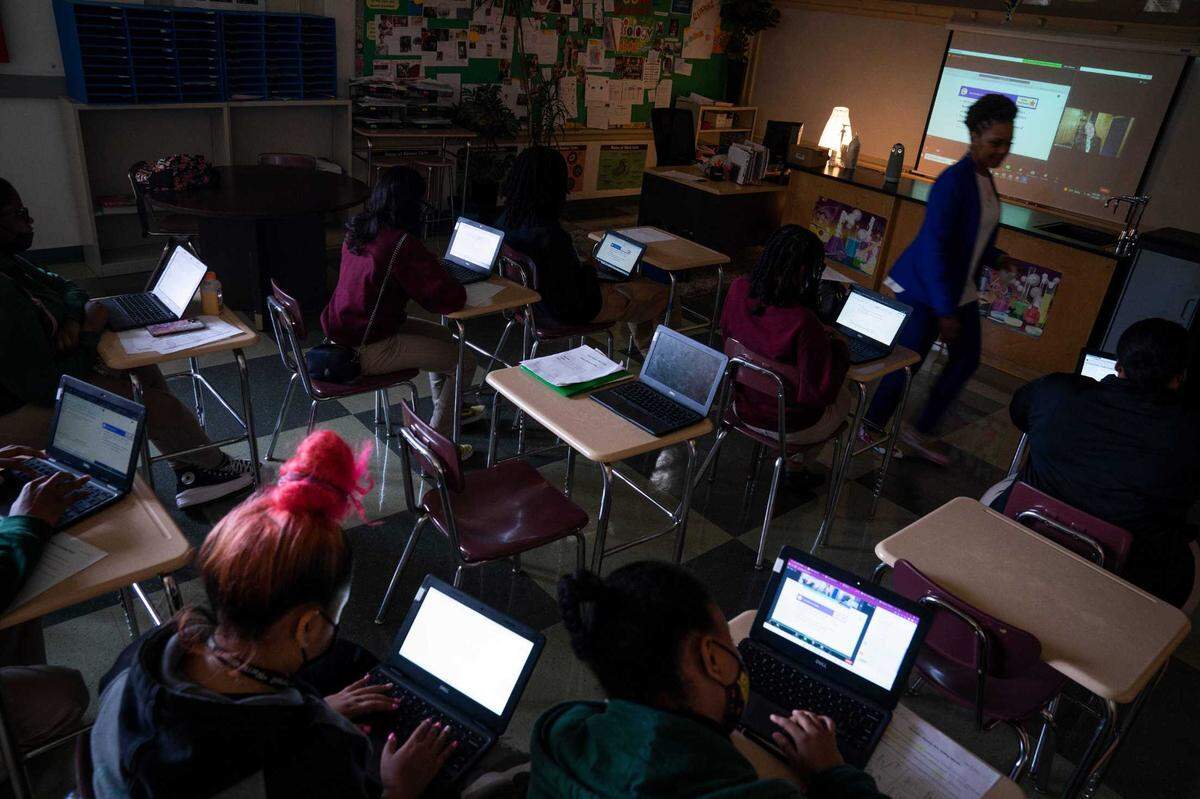
Proximity Learning classes are led by virtual teachers that must be certified to teach in the state of Kansas. Teachers deliver live, online lectures to classes of in-person students, and students have the opportunity to ask questions of teachers by most commonly typing into a messaging program.
A second instructor, who is typically an educational aide or someone working to acquire their certification, oversees the physical classroom and tries to support the primary, virtual teacher on the day-to-day. When a Proximity teacher misses five or more consecutive classes, the district has another virtual teacher swap in to teach the class, it said.
As it stands, KCKPS exclusively uses Proximity Learning to fill teaching vacancies in core subject classes – math, science, social studies, English language arts – for grades 6-12. Most of the time, these instructors are filling in for math or science classes. They appear on screens in classrooms of six middle schools and five high schools.
Of the 3,848 district students that had a Proximity class during the 2024-25 school year, 46% had Proximity teachers in science and 26% had a Proximity teacher for math, according to the district.
“Science and math classes, those are your toughest to try, and of course special education, those are the ones that are very difficult to fill, and that’s common across the country,” Jones said. KCKPS had not implemented the program in any of its special education classrooms as of this school year.
KCKPS offers a fellowship program through which non-certified teachers with bachelor’s degrees in other subject areas may teach full-time while earning a master’s in education. Jones said the Proximity Learning program has allowed the district’s teaching fellows to adjust to classroom life with the help of a certified teacher before taking the helm.
Of the in-person teachers the district hired going into the spring semester, nine were district fellows that served as in-class aides to Proximity classrooms during the fall semester, according to KCKPS.
The district, in tandem with its fellows, is keeping an eye out for other ways to fill classrooms with qualified staff.
“We are looking into alternative licensure pathways that can help staff who currently work for us become teachers and those looking to change careers,” said Edwin Birch, lead spokesperson for KCKPS.
He added that misinformation during Proximity’s introduction to the district caused a stir among parents, who thought that children were being left unsupervised in classrooms.
But now that parents know their children have teachers that are certified, he said the district rarely hears concerns from community members.
Proximity Learning initially agreed to interview with The Star but was not reachable by time of publication.
Classroom frustrations
After COVID-19 thrust Kansas City-area public schools and districts across the country into the world of virtual learning, Khadka said he’s hungry for a reason to pay attention. His Proximity class is lecture-only; classroom discussions and group projects are few and far between, he said.
“There’s way more they could be doing to broaden the style of learning,” he said. “I’ll say, students learn the best when there’s more than one style of learning.”
Simple things, like the volume on his teacher’s screen being too low, or having to use the web chat function on the live feed to ask questions during class, frustrate him daily.
Khadka doesn’t blame his teachers – he understands they’re trying their best. And it’s not all bad, he said. Not having an in-person teacher means no more getting randomly picked to answer a question in class, and no more humiliation when you answer incorrectly.
Khadka said that his parents, as of publication time, had no idea he was in a Proximity Learning classroom this semester. He said KCKPS didn’t notify them, and he didn’t want to field their questions.
He doesn’t want his parents to think it’s his fault he doesn’t have an in-person teacher.
The soon-to-be graduate wants to attend Kansas City, Kansas, Community College after high school. He hopes to study nursing.
Erica, a KCKPS parent with an eighth grader in the district, told The Star that she plans to enroll her son out of the county starting next school year. She asked to not use her last name or her son’s out of concerns of retaliation against him.
COVID learning wore on Erica’s son, and she’s concerned that missing out on the consistency of an in-person teacher may affect how he performs in high school.
“I’m afraid that he’s not getting what he should’ve gotten, so we plan on leaving the district and going to a school that basically has full-time teachers,” she said. “I feel like once we started that virtual thing with COVID, it’s like, they did not stop that.”
Erica’s concerned by turnover she said she’s seen among teachers within KCKPS; friends of hers that teach in the district tell her they want more support.
Educators weigh in
Dom De Rosa, president of the Kansas City, Kansas, National Education Association said the teachers’ union and school district agree that having a certified teacher in every classroom is the best thing for students.
And although he doesn’t want to dismiss concerns about Proximity Learning among teachers and students, he said the association views the program as a Band-Aid — not a permanent solution — to a crisis in the education system.
De Rosa said harmful politicization of the education system at the state and federal levels — such as through restricting what subject matter can be taught — has injured public schools systems across the nation. That rhetoric and traditionally low compensation weakens teacher morale and public trust in the education system.
A stronger way to fill vacancies and recruit more teachers, he said, is through community investment in public schools and uplifting the teacher workforce through respect and fair pay. It takes every member of a community to make that happen.
“Our students deserve nothing less, and frankly our educators deserve better,” De Rosa said.
Taylore Dionne Hood said she resigned from her English teaching job at Gloria Willis Middle School in 2024 for a lot of reasons, but a big one was feeling like she wasn’t being valued for her work.
“I wanted to be that person that I needed as a kid,” she said, recalling her childhood in Wyandotte County. “But I felt like I was contributing to a system that I didn’t believe in and didn’t see changing.”
She said supporting and respecting current teachers within the district would reduce turnover and address staffing shortages through retention.
During her time at KCKPS, Hood said she would on occasion substitute for the in-person instructors serving Proximity Learning classes.
“It’s usually just chaos, really, because I feel like people online, they can’t establish the control that you need and the interpersonal relationships you need,” she said during a recent phone call.
She added that it’s particularly important among younger adolescents to establish stronger rules and structures in the classroom.
Hood added that she thought the Proximity teachers were, for the most part, qualified teachers, “but kids need connection at that age.”
This story was originally published May 6, 2025 at 6:00 AM.