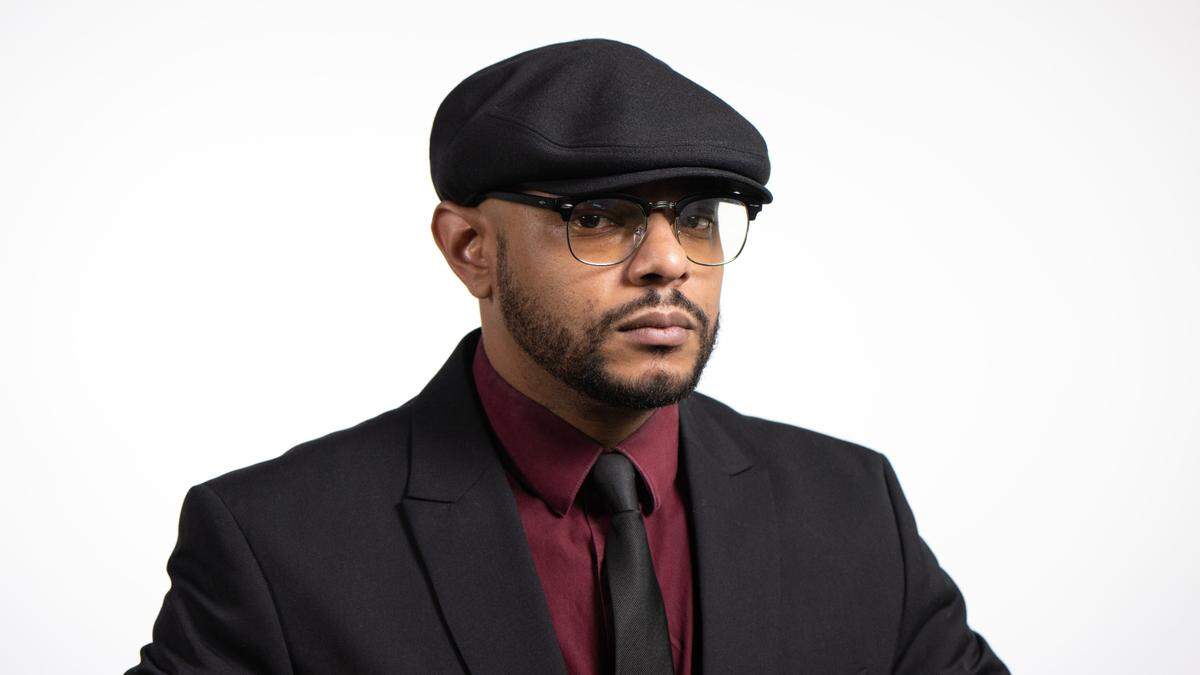
His students could recite lyrics, but struggled to read. Now, KC educator blends both

Early in his teaching career, Lamont Muhammad had an eye-opening experience that would reshape his approach to education.
While working with a first-grade class, he noticed that many of his students struggled with reading but excelled at memorizing song lyrics. Inspired by this, Muhammad began creating lyrical affirmations for the students to recite, helping boost their confidence and engagement with learning.
This insight became a cornerstone of Muhammad’s teaching philosophy, prompting him to constantly seek new ways for children to connect with education.
In 2016, he published his first children’s book, “I Am,” which is part of his “Little Monte Series,” The books feature the rhyming affirmations he developed to help children find their voices.
Raised by his two grandmothers, Muhammad, 45, drew from their wisdom and life lessons. He channeled the guidance he’d gotten from them into messages for children, reminding them that they have the potential to be anything they aspire to be.
Now, working as the dean of culture at the Academy for Integrated Arts in Kansas City, Muhammad has racked up two decades as an educator and hopes he can reach even more children through the book series.
Recently Muhammad sat down with The Kansas City Star’s culture and identity reporter, J.M. Banks to talk about growing up without his parents, finding new ways for kids to learn and the importance of students knowing they can be anything.
Banks: Can you begin by telling me about your early life and upbringing?
Muhammad: I grew up in California in the Bay Area, in a city called Pittsburg. When I was growing up my mother was young. She was 15 when she got pregnant with me and my father was 16. My parents did not stay together and she began to get addicted to drugs.
My grandmother told my mom to leave me with her and my mother ended up living a life of addiction and my father went off to prison at 17, so I grew up in the care of my grandmother.
She passed away when I was eight then I went into the care of my mother’s father. I did not really know at that time, but my grandfather was living the life of what they would call a hustler and his girlfriend ended up taking us on because of his life he lived. She ended up raising me.
I didn’t really have a lot of male figures that gave guidance. I think they had the desire but their lifestyles didn’t permit them to be the best role models. I ended up having my own experiences connected to street life and getting caught up in little crimes. I ended up getting a mentor when I was in high school who ended up helped me stay on the right track and graduate.
I moved to a place called Rock Island, when I got out of high school and ended up going to college in Iowa at Wartburg College (in Waverly, Iowa).
How did you get into the field of education?
I was working as a barber when I was 20 and I was trying to figure out what I wanted to do. I always wanted to work with kids. I had thought about my mentor, because that is what inspired me to do better. I wanted to be that for kids and teens so I went back to school and decided to go into education.
I got the opportunity to be in this program in Iowa that was aimed at getting more minority teachers into schools. So they paid for your education but you had to go back and teach in the underprivileged communities of the district. I started working as a teacher’s assistant in 2004 and have been teaching since 2006. I ended up moving here to Kansas City in 2023 after getting an offer for a job in an arts integrated school.
At what point did you begin to think about writing children’s books?
After I graduated I began to see education as a tool. I felt like education should be used to help kids find what gifts they have. Cultivate these gifts in our children and help them find how to put their gifts into service for their community.
I was very involved with hip-hop at the time so I wrote this lyrical affirmation that I had the students say everyday called I Am. It let them say out loud the possibilities of who they could be through education. I am a lawyer, I am a doctor, I am a teacher, and so on.
It made students think about not only what they wanted to be, but how they would help people. I found that a lot of kids in the first grade class couldn’t read but they could learn lyrics. So I started to think about how to create something that had these affirmations and wrote a song,. Then I made a video to go along with the song. By the time I finished I said this needs to be a book.
I started looking into how to get images for the book and put it all together. I was sitting on the idea for a while until I learned more about self-publishing and released it in 2016. It is filled with those lyrical affirmations that I found, that young children can learn easily. When they learn those words and keep saying them it makes a difference in how a kid sees themselves.
Can you tell me about the book series and the inspirations from your childhood that you put into them?
So I developed the Little Monte Series which is representative of myself as a kid and of my grannies. Because I was raised by my maternal grandmother and my foster grandmother, those women were the inspiration of the books. The grandmother figure was big in my community growing up because at the time there was the crack epidemic so a lot of children lost their parents to drugs and the grandparents stepped up. So the book is really a homage to them and the lessons I learned from them growing up about who I could be.
I wanted to tell stories that related to my growing up and it was a type of therapy for me. It was a way for me to process things in my past, to help the future, and impact kids who may need to hear these words.
I have published three books so far. The first ,which was titled “I Am,” the second called, “I Can,” and the third is “Things Granny Said.” I have another book that I am hoping to release in the summer.
Why do you feel that it is important that more Black men write children’s books?
The pen and the paper are very powerful. Words are powerful. I think it is important that kids are able to connect with a wide variety of stories because you never know what might connect.
A child may read my book and hear something in a different way that connects with them on a different level. I may be the first or only Black male author some kids will come in contact with so I have to make sure what I am creating is a meaningful narrative that awakens their curiosity and empowers them.
What are the challenges that you face in your career?
The illustration process can be a lot and artwork for all three books have all been done through different artists. The first was an art teacher I was working with at an elementary school. The next was a college student, and the last two books I have been working with this new artist I found through social media. A lot of it is networking and resourcing to try to find who can help.It is a collaborative work because they hear my vision and make sure we capture what I want it to look like.
There have been times I have worked with people who didn’t look like me so I would have to send them reference pictures to say this is an Afro, this is a loc, because they have never drawn Black hair. So there are certain cultural differences that can occur.
What is the most fulfilling part of your work?
I’m the first in my family to reach this level of education and get to work within academia. So to be able to stand in front of students with many of them coming from a similar background and get to show them a representation of the possibilities of who they can be. I have been teaching for 20 years now and to see the impact that I have on them and how powerful it is knowing that you played a role in helping them fulfill their education.
I have had students tell me that those words they used to say in class impacted them and they still remember them. It is affirming to know it connected and helped students to tap into their gifts.
What are some things that you would like to see happen within Kansas City’s children’s book community?
I would love to see more collaboration and more spaces where we can come together. I have met a few people who are trying to do that so we can meet, talk and share ideas surrounding things like cost, publishing and illustrations. Of course I want to know where everyone is at and how everybody is getting their work out and come up with ways to support each other.
What are your goals for the future?
My plan in the future is to continue to write and continue to work as an educator. I want to to keep working in spaces where I can impact change and develop the youth. I hope I can also help develop other educators to find new ways of reaching kids.
For more stories about culture and identity sign up for our free On The Vine newsletter at http://KansasCity.com/newsletters.