Months after Plaza sale, questions loom in KC over construction, rent, height restrictions
Nearly nine months have passed since July 1, when Dallas-based Highland Park Village Partners — owned by descendants of famed Texas oil tycoon, H.L. Hunt, father of Kansas City Chiefs founder Lamar Hunt — announced they had become the new owners of Kansas City’s Country Club Plaza.
After years of watching the 15-block Spanish-styled shopping district languish under previous owners, Kansas Citians greeted the announcement of what was later reported to be a $175.6 million purchase with great enthusiasm as principal partner Ray Washburne laid out the Plaza’s future, promising to return it to its past glory, and even better.
He spoke of improving security and outdated office space in the short-term and, in the long-term, making major architectural and infrastructure changes, possibly adding a boutique hotel, residential apartments, a bodega-like grocery, luxury retailers and an infusion of local retailers and eateries over mall-like chains.
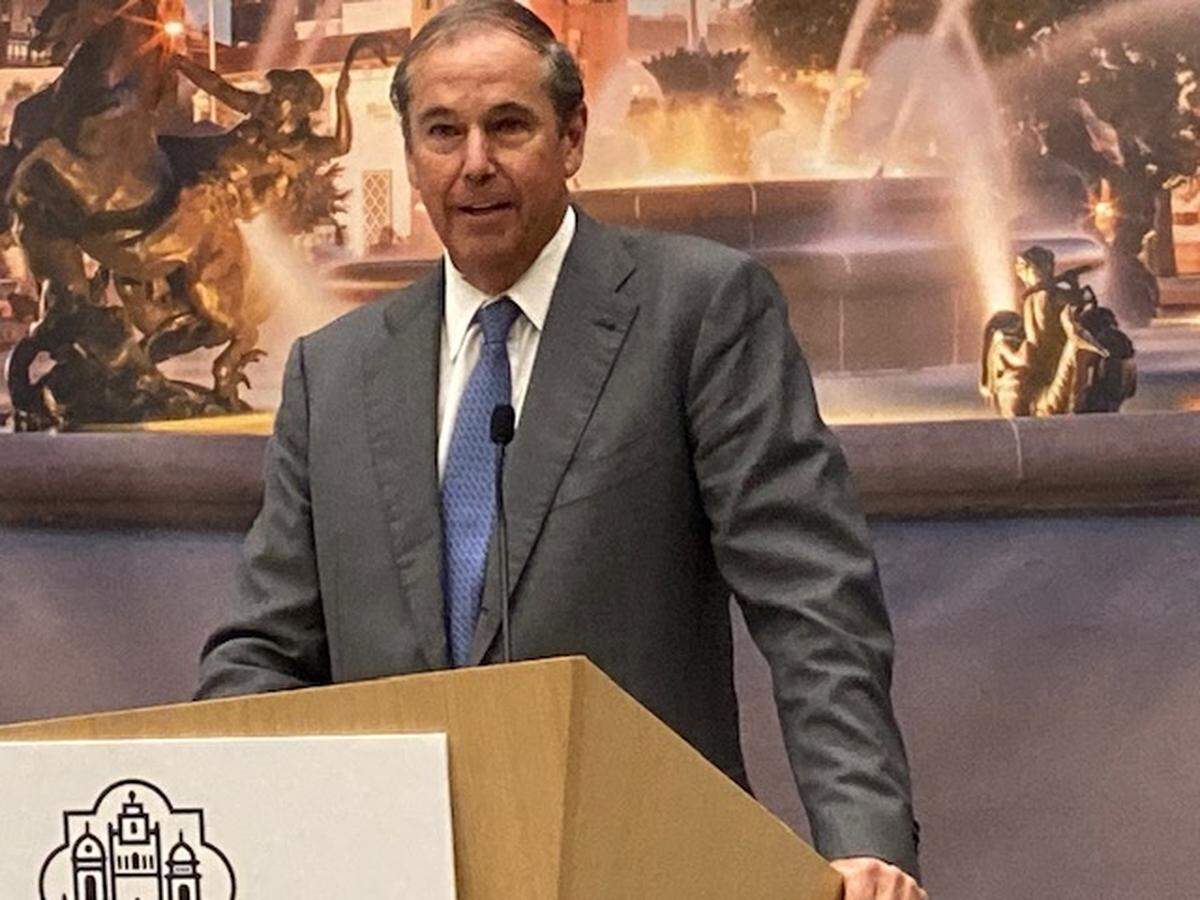
“In general,” Washburne told The Star prior to the press conference on the west edge of the Plaza, “we’re going to clean it up and reposition the center as something that Kansas City will be proud of again.”
“One of the things we pride ourselves in,” he said later, “is being place-makers.”
But nine months in, except for releasing broad, conceptual artists’ renderings to neighborhood groups, HP Village — rebranded last year at The Village Collection — has yet to submit even preliminary plans to City Hall or the City Plan Commission.
As such, they also have made no formal submissions to agencies that would provide possible tax relief or other incentives such as PortKC, the Land Clearance for Redevelopment Corp., the Planned Industrial Expansion Authority or the Tax Increment Financing (TIF) Commission.
“We have not received any presentation, plans, data or financing from then,” said Jon Stephens, PortKC’s president and chief executive officer. “Nor has there been any formal or informal application.”
While merchants and other stakeholders say they remain confident in, and excited about, what the new owners have promised, the prime question over solid plans and when construction might begin has presented attendant questions that have also yet to be answered, including:
How much might the city be asked to foot to remake the Plaza’s crumbling infrastructure? Some sources within City Hall suggest it could be as much as $200 million.
There are questions on future lease rates, whether any significant changes will come in time for the World Cup.
Also, whatever plans the Village Collection has, will they, as some suspect, require going beyond the height restriction established by what’s known as the Plaza bowl overlay?
Confidence and concerns
In announcing the sale, Washburne emphasized that his company’s dedication to the Plaza was long-term, with an overhaul taking many years.
“We’re generational owners,” he said. “We’re not putting lipstick on something and flipping it. To us, it’s very important that the community understands where we’re going and what we’re doing. And we look at the community as partners with everything we do — every project we’re part of. So we want the people there to know that there’s no curtain up and, you know, there’s total transparency.”
Kate Marshall, the president and founder of the Plaza District Council, a non-profit established to sustain and protect the area’s interest, said she trusts the company’s intentions and methods.
“I have been able to get to know the members of the new Plaza membership over the last six months,” she said. “They are smart people with integrity and I believe they care deeply about the revitalization of the Plaza. They want to get it right.”
City leaders, had hoped that, once the Plaza was purchased in July, that the City Plan Commission and others might have been looking at preliminary plans as early as last fall or, perhaps, six months later, by the end of December.
Other than engaging in numerous discussions, the city has yet to receive anything official.
World Cup and cupolas
The more time that passes, the prospect of the Plaza making significant changes by the time the city hosts multiple games for the World Cup in June 2026 seems less likely.
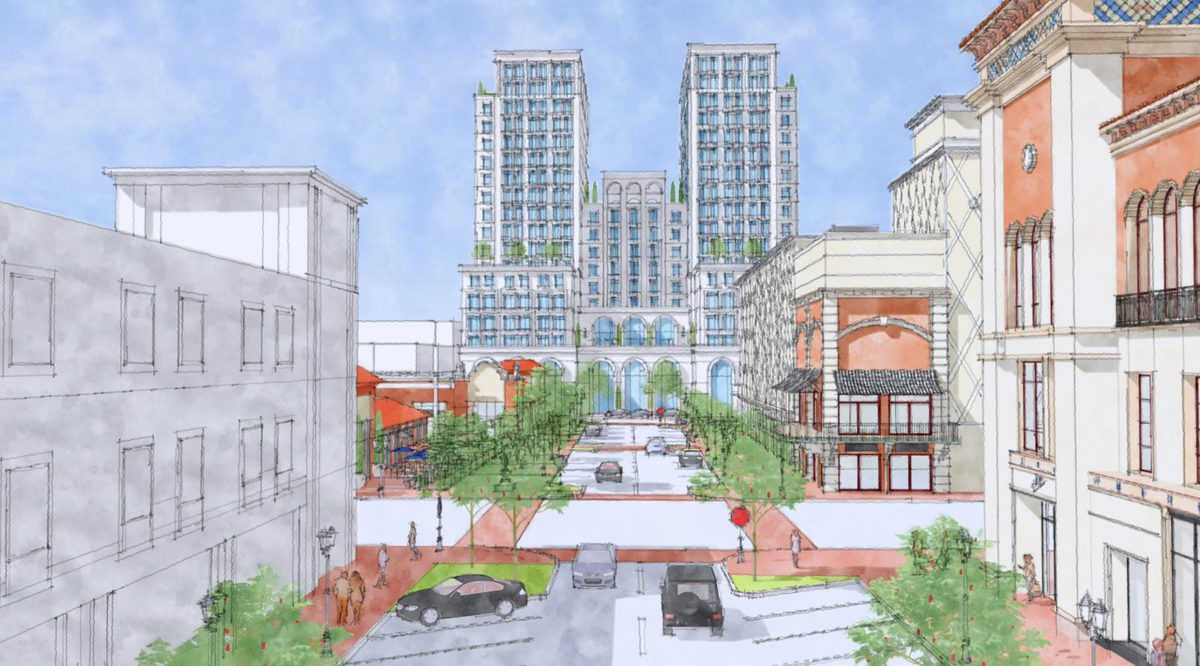
Renderings that have been previously released have shown new cupolas and new, narrow retail and restaurant pathways carved between existing buildings on the Plaza’s west side — where construction would purportedly first begin.
“I think when the purchase was made,” Kansas City Mayor Quinton Lucas told The Star, “our view was — and our hope was — that there would be, in many ways, if not a new Country Club Plaza, then many new developments and activities to welcome visitors from around the world, by June of 2026.”
Early World Cup ideas called for having one of the fan fest locations near the lawns of the Nelson-Atkins Museum of Art, providing a draw to a revitalized Plaza.
“I think a concern that many of us have right now,” Lucas said of the Plaza, “ is perhaps we won’t get there. We’ll continue to work as actively as possible with the Plaza ownership group in connection with accomplishing that. I would love for people to see that . . .welcoming people from around the world.”
But construction requires solid plans. As recently as February, Dustin Bullard, an architect and urban strategist with Charter Holdings, a Washburn-owned company working with The Village Collection, said the company was consulting with engineers, but had no timeline for construction. He said they were purposefully moving slowly.
“We believe that the Plaza is such a special place that we’ve really got one opportunity to get this right,” he said at the time. “We think there’s value in being deliberate at this stage. Because, again, we want to come out with the right first moves, and the right and correct impact, to set the project up for success in the long term. And that just takes time.”
Victoria Snee, a spokeswoman for The Village Collection, said the same last week.
“Our team is engaged in a master planning process with a team of consultants,” she said. “We know that ensuring we have a strong plan as a guiding foundation will ensure both short- and long-term success for Country Club Plaza.
“Once the master plan is complete, we will begin to work directly with the community, city and other stakeholders on implementation, timelines, etc. At this time, it would be premature to forecast when formal meetings or submittals would occur.”
Lag time and leadership
The Plaza has made noticeable progress.
The Dallas company has increased security significantly, installed new lighting in its parking garages, painted and stained exteriors, repaired broken concrete and tiles, and made other cosmetic improvements.
Work has reportedly begun on redoing outdated second-floor office spaces throughout the district. Vendors broadly say communication with the new ownership has been far superior than what they had under the Plaza’s previous co-owners, Taubman Co. and Macerich.
What has not improved, concerned tenants said, are the number of empty storefronts, making it hard to draw business for those that remain. The most recent to close, this week, was Hokibar, a poke and sushi restaurant that had been on the Plaza since 2022.
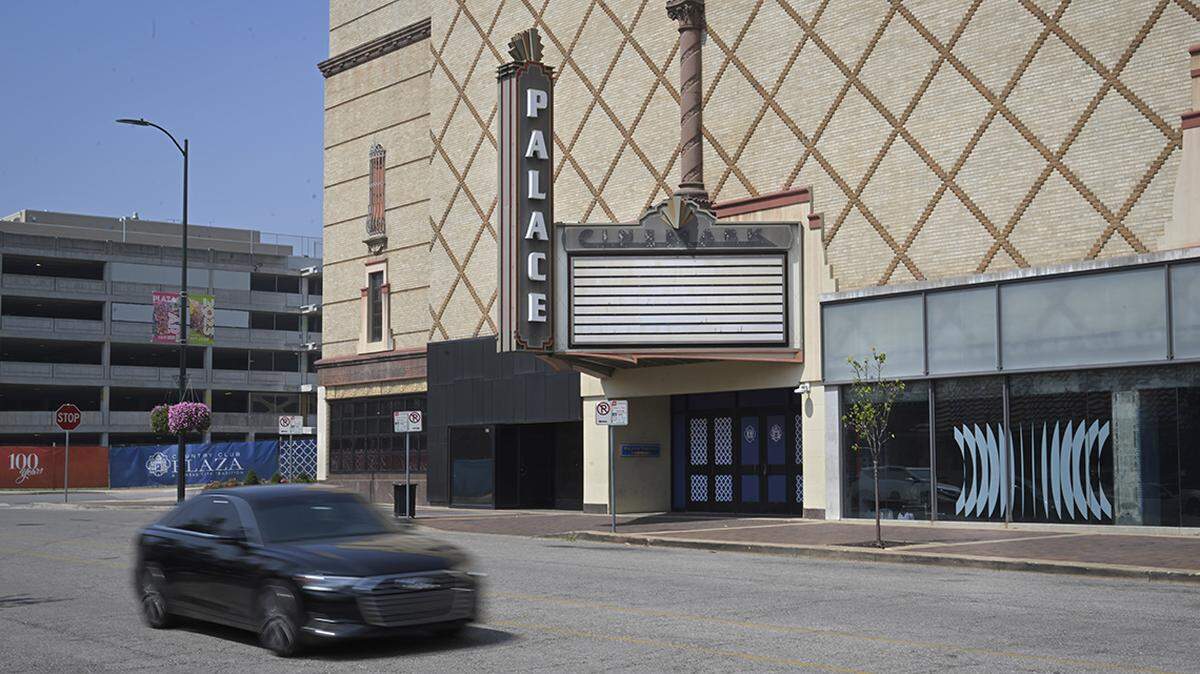
“It’s really hard for us to drive traffic, when we have no neighbors who are bringing in traffic,” said one Plaza retailer who requested anonymity out of concern that criticism might lead to their lease not being renewed.
Some Plaza advocates maintain that the slower-than-expected pace of change may, in part, be a result of some delays caused by changes in leadership at The Village Collection, formerly HP Village Partners.
Besides Washburne, the principal partners in the company — which owns, among other properties, the luxury Highland Park Village shopping center in Dallas — include Washburn’s wife, Heather Hill Washburne, his brother-in-law, Stephen Summers, and his wife, Elisa Summers. Elisa Summers and Heather Washburne are sisters and descendants of H.L. Hunt.
While Ray Washburne remains the head of the company, The Village Collection since September has added new leadership. It hired Drew Steffen, the former senior vice president at the Houston private equity firm McNair Interests, as the company’s chief executive officer and president.
Soon after the Plaza’s purchase , Ed de Avila — who 27 years ago had been a J.C. Nichols vice president in charge of the Country Club Plaza’s development — moved back to Kansas City when he was hired under contract to be the Plaza’s managing director.
He is no longer in that role.
In December, Scott Keller, a former associate director in Overland Park at CBRE, the real estate analytics firm, was brought on as the general manager of the Country Club Plaza.
That same month, Chris Harren, another senior vice president at McNair Interests, was hired as the Plaza’s senior vice president of development. Still living in Houston, he is expected to move to Kansas City soon.
Higher rents?
The question remains open as to what new tenants might pay to be part of the new Plaza.
The Star contacted AREA Real Estate Advisors, which is handling the Plaza’s retail space, and received no response. The company forwarded The Star’s request back to Dallas.
“We are happy to release news on leasing and development when the time is right,” Snee, the company spokeswoman, said in an email. “All deals are done separately and confidentially with tenants
“These negotiations are private and confidential. We would not release that information.”
In general, leasing deals with tenants can vary greatly depending on the duration of the lease, the square-footage being leased, whether the tenant is a small, local vendor or a national retailer.
In recent weeks, brokers and others who deal with the Plaza have been reluctant to speak on the record, but said they are already apprehensive, having received quotes that are upwards of double or more current rents.
The worry is that such lease arrangements could possibly and particularly price out local retailers or restaurant owners with less financial leeway than luxury or national brands.
The Plaza ‘bowl’
The most recent renderings of the Plaza — floated merely as broad ideas or “possibilities” — show, among other changes, a new retail/office tower on the Plaza’s west edge where a Nordstroms was planned, before the retailer backed out in 2022.
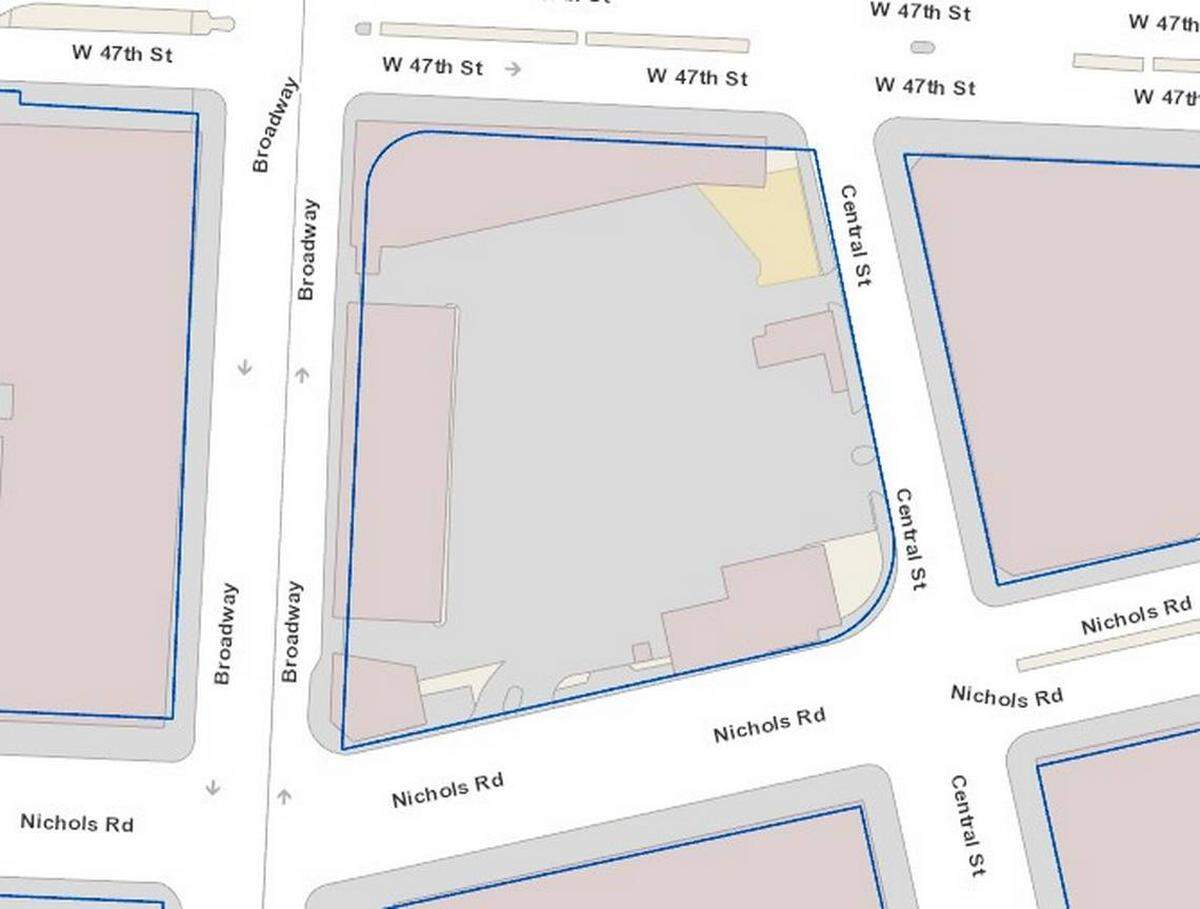
It also reveals a “plaza on the Plaza,” a green space and public area near the center of the Plaza, located behind where the Classic Cup restaurant and the former Starbucks stand. The area, between Broadway Boulevard and Central Street, W. 47th Street and Nichols Road, is currently the top of an outdated underground parking garage that needs replacing.
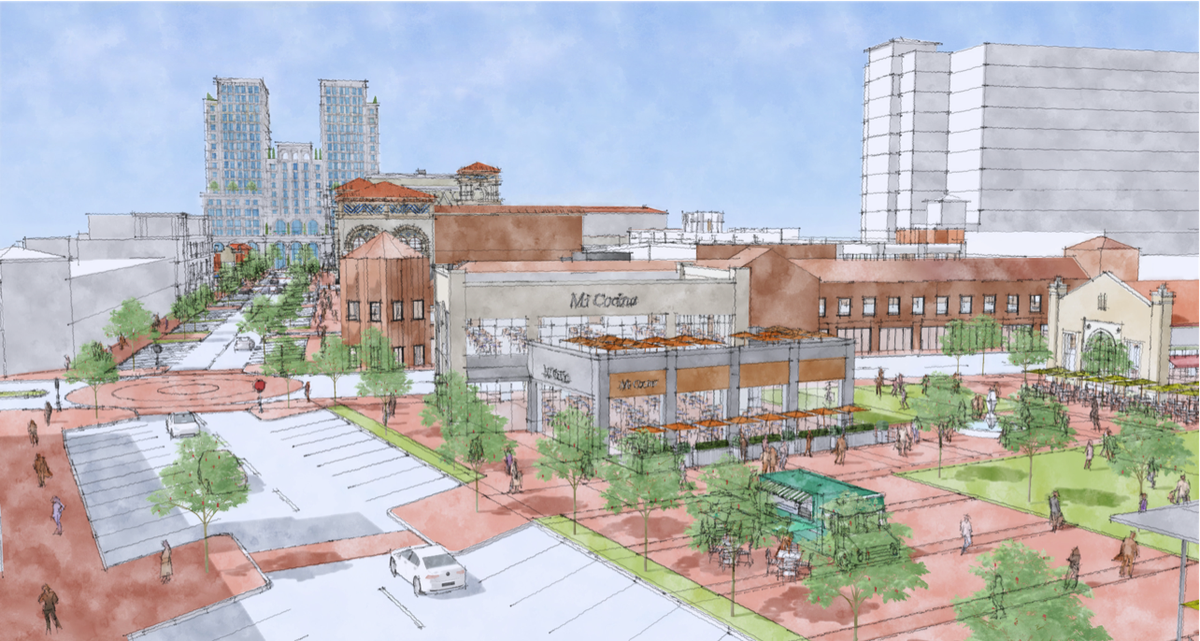
What is not seen in the rendering, but what city leaders say the Plaza’s new owners have raised consistently in meetings, is the possibility of placing a boutique hotel someplace in the interior of the Plaza. Since no preliminary plans have been submitted, it’s unclear if such a hotel is still envisioned, or if one might be placed on the outer edges of the Plaza.
But if a boutique hotel of more than three stories, possibly five or six, is in the Plaza’s plan, it would mean overriding the current “Plaza bowl overlay” that sets height restrictions on the Plaza — no more than 45 feet at the heart of the Plaza and rising like a bowl on its outskirts.
Should the Plaza’s new owners attempt that, stiff opposition would likely arise from opponents, with the preservationist group Historic Kansas City chief among them. The group has already said it would be against any such plan.
“Yes, and so would a whole bunch of other people. I mean that’s like going after the heart — testing the heart of the whole plan,” said architect Vicki Noteis, Historic Kansas City Foundation board president. Noteis is also a former member of the Kansas City Planning Commission and a former director of the city’s Planning & Development Department.
Extending beyond the Plaza bowl, she said, would set a bad precedent, opening up the Plaza in the future to other developers wanting to go beyond the limits set in place to preserve the Plaza’s character.
The Plaza bowl overlay was created by ordinance in 2019, but its history goes back to 1984, and a proposal to build what was then known as the Sailor’s Project — a private development of six office towers ranging from 11 stories to 53 stories to be located just east of Winstead’s where Grand Street Cafe was eventually located.
The project met major opposition and didn’t happen. But in 1989 it also spawned the Plaza Urban Design and Development Plan, a purely advisory plan that created the “bowl” concept.
For decades it had been clear to city leaders that the Plaza had been so broadly zoned that it allowed almost any development of any height. The J.C. Nichols Co. began the Plaza in 1923 and, it was believed, as long as they owned it, its character was safe.
In 1998, Nichols in a merger passed control of the Plaza to Highwood Properties of North Carolina. In 2010, outrage erupted again when Highwoods looked to raze the 1925 era “Balcony Building,” with its second-floor Spanish portico, on W. 47th Street, and replace it with an eight-story office tower for the Polsinelli Shughart law firm.
That, too, was not built. In 2013, Polsinelli moved into its own, new, 10-story building just beyond the Plaza’s west edge. Highwoods sold the Plaza to Taubman and Macerich in 2016 for $660 million.
By the time the company sold to HP Village Partners, the Plaza was so languishing, the sale price was 27% of what they had paid.
The Village Collection, as stated “generational owners,” insists they will bring the Plaza back.
The city awaits their plan.
This story was originally published March 21, 2025 at 5:00 AM.